Entretien et authenticité
Yurial Royal vs Serum vs Water Brown : Guide des teintes 12 mois
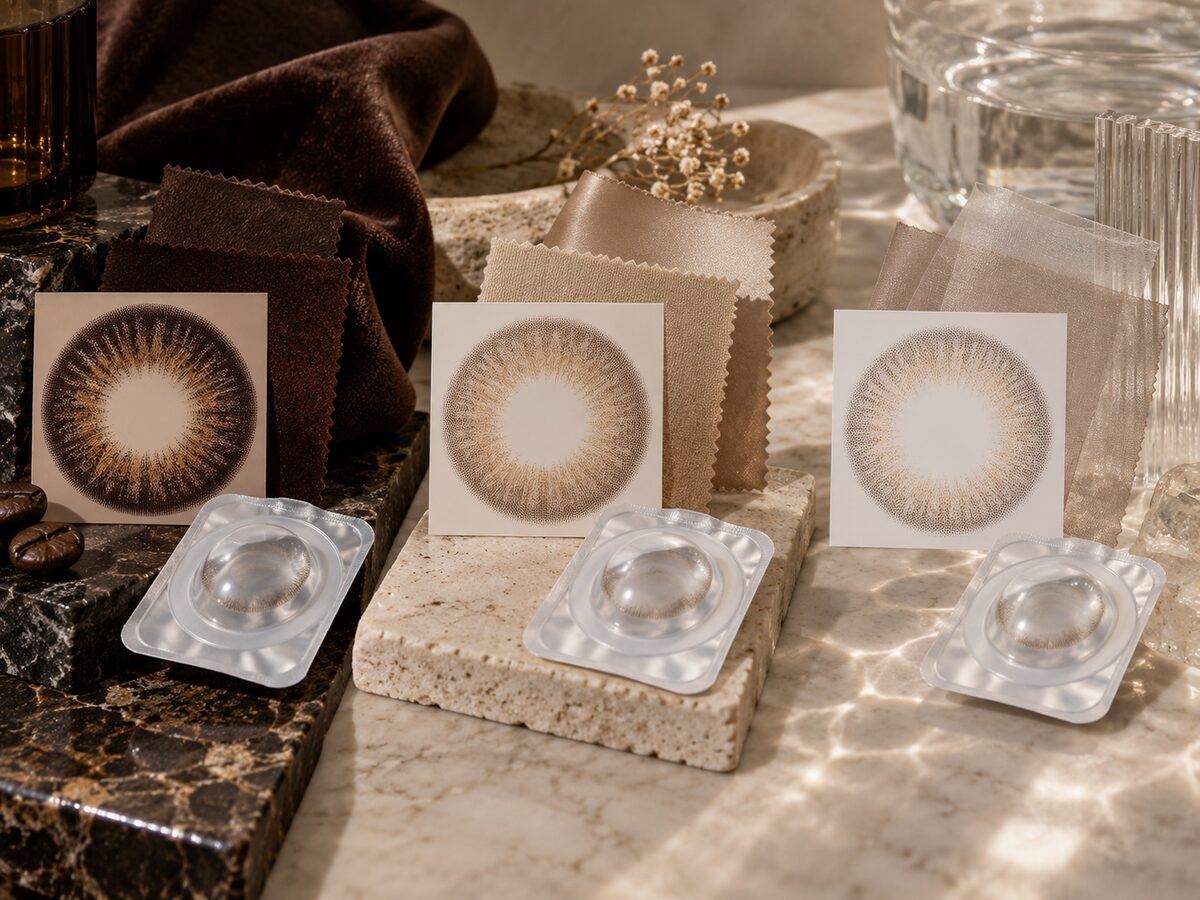
Yurial Royal Brown, Serum Brown et Water Brown partagent les mêmes spécifications techniques pour une durée de 12 mois : un diamètre de motif de 12,8 mm, un diamètre total de 14,0 mm, une courbe de base de 8,6 mm, un matériau HEMA, une teneur en eau de 38 % et une lentille par boîte. Leurs noms identifient des designs de couleur différents, et non des avantages spécifiques en matière d'hydratation ou de traitement. Pour choisir une teinte, comparez les versions exactes de 12 mois à partir des images correspondantes, puis confirmez votre correction optique et la quantité correcte pour vos deux yeux.
Dans ce guide
- Définissez votre objectif de lentilles marron
- Lisez les spécifications correspondantes
- Comparez les photos des teintes
- Adaptez les trois designs
- Comptez correctement les boîtes à une lentille
- Comprenez l'entretien sur 12 mois
- Choisissez selon un ordre logique
- Plus de questions d'achat
- Questions et réponses
Déterminez d'abord ce que le « marron » doit apporter à votre look
Royal Brown, Serum Brown et Water Brown sont trois noms différents au sein de la gamme Yurial. Un nom peut suggérer une ambiance, mais il ne mesure ni la luminosité, ni l'opacité, ni le confort. Avant de choisir à partir des images, définissez l'effet que vous recherchez. Souhaitez-vous un changement subtil qui laisse votre iris naturel prédominant, une impression de marron chaud et clair sur vos portraits, ou une définition plus visible autour du bord extérieur ? La réponse transforme une recherche de teinte large en une comparaison spécifique.
Notez cet objectif en une phrase et gardez-la près des trois onglets produits. Si vous voulez un résultat naturel pour tous les jours, regardez des portraits pris à distance normale sous un éclairage ordinaire. Si vous voulez accentuer la couleur de vos yeux pour une séance photo, vérifiez si le marron imprimé reste visible à la distance de l'appareil photo que vous prévoyez d'utiliser. Si vous voulez un anneau extérieur, zoomez sur le bord, puis dézoomez pour voir si cela reste significatif sur un visage complet.
Ne déduisez pas du nom « Water » que la lentille Water Brown contient plus d'eau ou qu'elle hydrate davantage. Les dossiers KPOP2 actuels indiquent une teneur en eau de 38 % pour les trois produits. « Serum » identifie également une teinte, et non un traitement. Un choix d'achat basé sur ces noms confondrait la marque avec une propriété technique mesurée de la lentille.
Ce que les spécifications correspondantes vous disent et ne vous disent pas
Les trois fiches actuelles indiquent un diamètre de motif de 12,8 mm, un diamètre total de 14,0 mm, une courbe de base de 8,6 mm, un matériau HEMA, une teneur en eau de 38 %, un calendrier de remplacement de 12 mois et une lentille par boîte. Ces valeurs partagées vous aident à éviter de confondre par erreur une Water Brown journalière avec un produit régulier de 12 mois. Elles indiquent aussi clairement que les noms ne sont pas des raccourcis pour des pourcentages d'eau ou des quantités de boîtes différents.
Cependant, le diamètre du motif ne représente que l'étendue listée du design imprimé. Deux designs peuvent partager 12,8 mm tout en utilisant des placements de couleur, des bordures plus ou moins sombres et des transitions vers la pupille différentes. Le diamètre total de 14,0 mm est le diamètre physique de la lentille, une mesure différente. Aucun de ces chiffres ne prédit à lui seul la taille des yeux sur une photographie, et aucun ne détermine si une lentille vous convient.
La courbe de base est une autre mesure descriptive, pas un code d'ajustement universel. Des valeurs identiques de 8,6 mm ne garantissent pas que les trois lentilles reposeront et bougeront de la même manière sur vos yeux. Un ajustement professionnel de lentilles de contact prend en compte le produit exact et son comportement sur l'œil. Si votre prescription concerne une teinte ou un modèle, confirmez tout changement auprès de votre opticien ou professionnel de santé plutôt que de vous fier à un chiffre commun.
La gamme de puissances listée, de 0,00 à -10,00, donne les limites de la famille de produits, et non la garantie que chaque valeur intermédiaire est actuellement sélectionnable. Vérifiez le menu de puissance exact pour chaque teinte et la prescription séparée pour chaque œil. Une teinte différente peut être visuellement attrayante, mais elle ne peut pas compenser une option de puissance manquante en utilisant une valeur approximative.
Réalisez une comparaison équitable des trois teintes
Commencez par les pages produits exactes pour 12 mois. Gardez une image étiquetée pour Royal, Serum et Water Brown. Si un résultat de recherche n'indique que « Yurial Water Brown », vérifiez son calendrier de remplacement et le contenu de la boîte avant de l'inclure. Un produit journalier ou « Max » peut avoir un nom similaire mais un design et des spécifications différents. Les mélanger rendrait toute conclusion sur la teinte peu fiable.
Rassemblez, si possible, une image en gros plan et une image de visage complet pour chaque version exacte. Le gros plan montre l'impression ; le portrait montre l'effet à une distance de vision plus réaliste. Notez la couleur d'origine de l'iris du porteur, car la lentille superpose un arrière-plan différent sur les yeux clairs et foncés. Un iris foncé peut changer la luminosité apparente et les sous-tons d'un marron imprimé. Ne traitez pas une photographie sur un iris de départ comme une promesse pour un autre.
Contrôlez les conditions de prise de vue autant que le permettent les images disponibles. La lumière du jour et une lumière intérieure chaude peuvent mettre en valeur différents tons. Les éclairages circulaires (ring lights) peuvent créer des reflets brillants, tandis que les filtres peuvent altérer le marron vers le doré, le rouge ou le gris. Un portrait en pied capturé avec l'exposition automatique d'un téléphone n'est pas directement comparable à une image macro de studio. Lorsque les conditions diffèrent, notez l'écart plutôt que de déclarer un gagnant.
Utilisez une fiche d'observation simple
- Bord extérieur : semble-t-il net, doux, sombre ou difficile à juger sur cette image ?
- Couleur intermédiaire : le marron est-il visuellement chaud, neutre ou mélangé à une autre tonalité apparente sous cette lumière ?
- Transition centrale : quelle partie de l'iris d'origine reste visible près de la pupille ?
- Effet sur portrait : le design est-il visible à une distance normale, ou principalement en gros plan ?
- Lacune d'information : quelle image ou condition d'éclairage auriez-vous besoin pour mieux juger ?
Il s'agit d'observations sur les images disponibles, non de mesures en laboratoire. Vous pourriez trouver qu'une teinte bénéficie d'une meilleure preuve photographique que les autres. C'est une raison pour être plus prudent, et non une preuve que le produit le mieux photographié est le meilleur choix. Si vous possédez déjà une paire correctement adaptée, prenez vos propres photos dans des conditions cohérentes et enregistrez-les avec l'étiquette exacte du produit pour une comparaison future.
Adaptez les teintes sans forcer un classement fixe
Pour un look sobre, essayez d'évaluer la lentille avec le maquillage que vous portez réellement la plupart du temps. Les lentilles marron peuvent paraître très différentes selon que vous avez un œil nu, un fin trait d'eye-liner marron ou un trait sombre marqué. Une photo promotionnelle très travaillée peut rendre la bordure de la lentille plus douce en contexte qu'elle ne le serait avec un maquillage minimal. Si le rendu naturel est votre priorité, comparez des exemples sur visage complet avec peu de retouches et un maquillage habituel.
Pour un événement ou un portrait, faites attention à l'harmonie des couleurs avec les cheveux, les sourcils et les vêtements. Les palettes de blush chaud, caramel, chocolat et taupe neutre peuvent chacune soutenir une impression de marron différente. Ce sont des idées de style pour les photographies, et non des règles sur qui peut porter quelle teinte. Le même design peut paraître discret dans un look maquillage contrasté et prédominant dans un look minimaliste.
Ne qualifiez pas Royal, Serum ou Water Brown comme universellement les plus clairs, les plus sombres ou les plus naturels d'après leurs noms. Si vous voulez un tel classement pour votre propre décision, définissez d'abord les conditions : votre iris, la lumière, le maquillage et la distance de l'appareil photo. Comparez ensuite les images rassemblées dans ces conditions. Si les preuves sont trop inégales, considérez que le classement est incertain et choisissez seulement après avoir obtenu les informations dont vous avez besoin.
Une lentille par boîte change le calcul de la quantité
Chaque fiche KPOP2 actuelle indique une lentille par boîte. Pour les deux yeux, vous avez généralement besoin de deux unités individuelles appropriées, choisies avec la puissance prescrite correcte pour chaque œil. Si les puissances sont identiques, cela signifie deux boîtes de la même sélection. Si elles diffèrent, cela signifie une boîte correcte pour l'œil droit et une boîte correcte pour l'œil gauche. Une quantité de deux à une seule puissance ne crée pas une paire à puissance mixte.
Vérifiez le panier comme un ensemble de lentilles individuelles plutôt que de supposer qu'une gamme de produits signifie une paire. La même logique s'applique si vous achetez deux teintes approuvées : chaque teinte nécessite un ensemble complet pour deux yeux si vous avez l'intention de la porter aux deux yeux. Comparez les prix des paquets en utilisant le nombre de lentilles physiques, et tenez compte des solutions d'entretien approuvées nécessaires pour les lentilles réutilisables. Les prix, les promotions et la disponibilité peuvent changer, alors fiez-vous au récapitulatif de commande pour les totaux actuels.
Si vous commandez pour la première fois, vérifiez le produit exact et la prescription avant de vous concentrer sur les économies en gros. Acheter plus de boîtes d'une teinte attrayante ne rend pas une lentille non confirmée appropriée. À la livraison, inspectez l'emballage scellé par rapport à la commande et à la prescription : produit, teinte, puissance, quantité et date de péremption. Résolvez toute anomalie avant ouverture.
Ce qu'exige une étiquette de remplacement de 12 mois
Une période de remplacement de 12 mois ne signifie pas une autorisation de port continu. Cela ne signifie pas que vous pouvez dormir avec les lentilles, ignorer la routine de nettoyage ou les utiliser après la date de remplacement indiquée. Suivez les instructions pour le produit exact et le calendrier donné par votre professionnel de santé. Si vous alternez entre plusieurs paires, suivez la date d'ouverture et la date de remplacement pour chaque paire séparément.
Les lentilles de couleur réutilisables nécessitent une manipulation et un stockage appropriés. Lavez et séchez vos mains avant de les toucher. Utilisez une solution fraîche recommandée pour vos lentilles et votre système d'entretien ; ne complétez pas un étui avec de l'ancienne solution et n'utilisez pas d'eau. Nettoyez l'étui et remplacez-le comme indiqué. Gardez chaque lentille assignée au bon œil si vos puissances diffèrent. Les directives du CDC sur les lentilles de contact et les directives de la FDA sur l'entretien expliquent ces principes fondamentaux.
Inspectez la lentille avant l'insertion. Ne portez pas une lentille déchirée ou visiblement endommagée. Si vous ressentez une douleur, une rougeur inhabituelle, des sécrétions, une sensibilité à la lumière ou un changement de vision, retirez-la et demandez rapidement conseil à un professionnel de la vue. Évitez de nager ou de vous doucher en portant vos lentilles. Une teinte attrayante ou un événement prochain ne sont pas des raisons d'ignorer un signe d'alerte pour la santé oculaire.
Ne tirez pas de promesse de confort d'une teneur en eau de 38 %, d'un matériau HEMA ou du nom de la teinte. Le confort dépend de l'ajustement, de la surface de la lentille, de votre film lacrymal, de l'environnement, de la routine d'entretien et d'autres facteurs individuels. Cet article est une comparaison de produits et de style, non un test de transmission d'oxygène, de rétention d'humidité ou de résultats cliniques.
Choisissez selon un ordre logique
- Confirmez la version exacte : Royal, Serum ou Water Brown dans la liste régulière de 12 mois.
- Confirmez l'adéquation professionnelle : Faites correspondre le produit exact et la prescription de chaque œil avec les conseils de votre professionnel de santé.
- Confirmez l'option actuelle : Vérifiez les deux puissances et la quantité de boîtes d'une lentille sur les pages produits en direct.
- Comparez le design : Utilisez des gros plans et des portraits étiquetés sur un iris de départ pertinent, avec les différences d'éclairage notées.
- Planifiez l'entretien et le renouvellement : Enregistrez les dates d'ouverture, les instructions, la teinte, les puissances et les détails de l'emballage.
Cette séquence sépare les préférences esthétiques des exigences de prescription et d'entretien. Si une teinte préférée n'est pas disponible dans la spécification correcte, suspendez la commande plutôt que de chercher une approximation. Si les trois options sont appropriées, la préférence de couleur finale peut rester personnelle. Vous n'avez pas besoin d'un classement technique inventé pour sélectionner un design marron qui vous plaît.
Plus de questions à résoudre avant le paiement
Le mot « Water » signifie-t-il un pourcentage d'eau plus élevé ?
Non. Les dossiers KPOP2 actuels listent une teneur en eau de 38 % pour Royal Brown, Serum Brown et Water Brown. Le nom de la teinte ne décrit pas un traitement d'hydratation différent et ne prouve pas un meilleur confort. Utilisez les spécifications et les conseils d'ajustement professionnel plutôt que le nom lors de l'évaluation de l'adéquation d'une lentille.
Puis-je mélanger différentes teintes Yurial entre mes deux yeux ?
Un look bicolore délibérément dépareillé est un choix de style, mais chaque lentille doit toujours être appropriée pour l'œil auquel elle est destinée et correspondre à sa prescription. Si vous l'envisagez, confirmez les produits exacts avec votre professionnel de santé et vérifiez le nombre de boîtes à une lentille ainsi que la puissance de chaque œil. Ne supposez pas qu'une photographie de couleurs dépareillées prédit votre propre résultat.
Les trois designs nécessitent-ils trois routines d'entretien différentes ?
Les listes actuelles partagent un format réutilisable de 12 mois, mais suivez toujours les instructions fournies avec la lentille et le système d'entretien exacts. Ne supposez pas qu'une étiquette de remplacement commune autorise à utiliser n'importe quelle solution ou à sauter le nettoyage. Si vous alternez les teintes, utilisez des étiquettes claires et des registres de date d'ouverture séparés afin que chaque paire soit remplacée à temps.
Puis-je utiliser une photo de Water Brown journalier pour juger ce produit ?
Elle peut offrir une inspiration générale sur la couleur, mais ce n'est pas une preuve fiable pour le design régulier de 12 mois. Vérifiez le nom complet du produit, la taille du graphique, le format de remplacement et la taille du paquet avant de faire une comparaison directe. Les différentes versions doivent être traitées comme des produits distincts.
Catégories associées
Pour la prochaine comparaison de lentilles marron, parcourez Lentilles marron, Lentilles journalières, Lentilles 12 mois. Traitez une collection comme un itinéraire de découverte, puis vérifiez le modèle exact, le calendrier de remplacement, le nombre de paquets, les mesures et les sélections de prescriptions disponibles sur la page du produit.
Questions et réponses
Laquelle de ces trois teintes est la plus naturelle ?
Il n'existe ici aucune comparaison contrôlée établissant un gagnant universel. Définissez si vous souhaitez une bordure plus discrète, un changement de couleur moins visible ou un effet photographique particulier, puis comparez les designs exacts de 12 mois sur des couleurs d'yeux similaires et sous une lumière similaire.
La Water Brown a-t-elle une teneur en eau plus élevée ?
Non. Les dossiers vérifiés pour 12 mois pour Water Brown, Royal Brown et Serum Brown indiquent tous 38 % d'eau. Le nom de la teinte n'est pas une revendication d'hydratation et ne prédit pas le confort individuel ou une durée de port autorisée plus longue.
La Serum Brown est-elle une lentille de traitement ?
Rien dans les champs produits vérifiés n'établit un avantage de traitement associé au nom « Serum ». Traitez-le comme le nom du design de couleur. Si vous souffrez de sécheresse, d'irritation ou si vous avez une préoccupation médicale, discutez du choix de la lentille avec votre professionnel de santé plutôt que de sélectionner selon ce mot.
Une boîte suffit-elle pour les deux yeux ?
Non. Ces trois listes vérifiées de 12 mois contiennent une lentille chacune. Un approvisionnement pour deux yeux nécessite deux lentilles individuelles, avec la sélection de puissance appropriée pour chaque œil. Lisez les options du panier ainsi que sa quantité avant de passer commande.
Puis-je remplacer la Water Brown de 12 mois par une version journalière ?
Ne supposez pas qu'un nom de teinte partagé rend les versions interchangeables. Leurs dimensions, matériaux et emballages peuvent différer. Confirmez le produit prescrit exact, puis utilisez la comparaison de version séparée pour identifier la bonne liste et la quantité de commande.
Pourquoi une teinte peut-elle paraître différente de sa photographie produit ?
La couleur d'origine des yeux du porteur, l'éclairage, le traitement de l'appareil photo et la distance de vision peuvent tous affecter la comparaison. Une photographie de catalogue est une référence pour l'image représentée, pas une garantie de votre résultat. Recherchez des images pertinentes et clairement identifiées avant de porter un jugement visuel.
Dossiers produits vérifiés le 17 septembre 2026. Conseils éditoriaux KPOP2 utilisant les champs produits KPOP2 et les sources liées. Les images du catalogue et les discussions sur le design ne sont pas des tests de port contrôlés.