
Keep used contact lenses out of sinks and toilets. Separate the lens, blister, foil, outer box and care packaging before checking the disposal route for each item. A dedicated collection program may accept items that your household recycling service does not. Daily-versus-monthly waste comparisons also need the whole care routine, not just a count of lenses.
In this guide
Start with the used lens
A lens can be small enough to disappear down a drain while still being plastic waste. A published study of contact-lens disposal and wastewater treatment found that biological treatment did not produce measurable plastic-mass loss in the tested lenses. Flushing is not a disposal method that makes the material disappear.
For ordinary used lenses, use an appropriate dedicated collection route when one is available, or follow local residual-waste instructions. Do not put loose lenses into household recycling simply because they are plastic. Keep them out of wastewater.
If a lens is involved in an eye problem, follow your practitioner's instructions about retaining it for assessment first. The discomfort guide explains that exception to routine disposal. A lens retained for examination must not be treated as a spare for another wearing session.
Separate the packaging into actual items
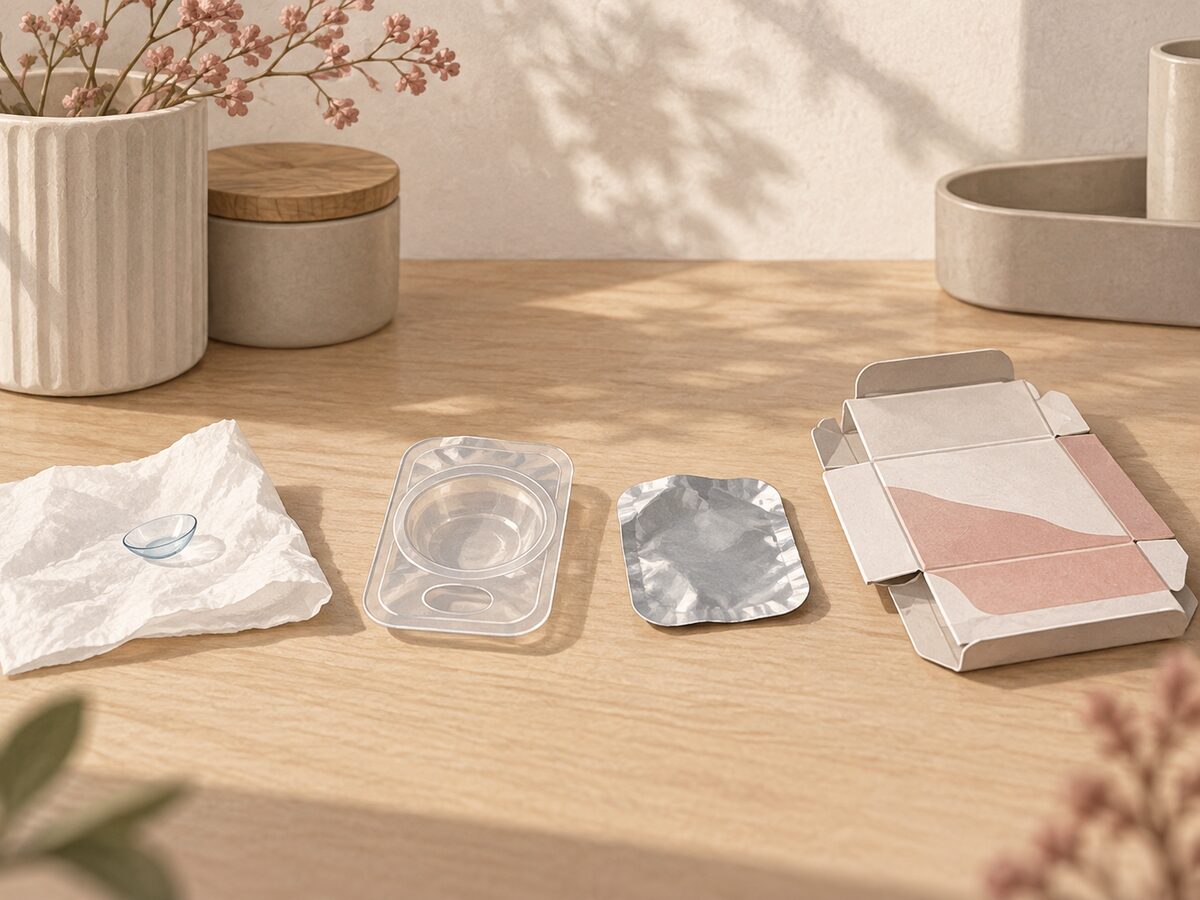
The outer carton, plastic blister and top foil do not necessarily share a disposal route. Identify them separately, along with any lens case and solution bottle from your care routine. An instruction saying “recycle the packaging” is too vague if it does not say which component and where.
The U.S. Environmental Protection Agency explains that a resin-identification symbol does not necessarily mean a plastic item is accepted by the local recycling program. Acceptance depends on the program, not just the number or triangle on the material.
A useful sorting note has one line for each item:
- Used lens: dedicated collection or the locally instructed residual-waste route.
- Blister and foil: check a named program's acceptance and preparation instructions.
- Outer carton: check the local paper/cardboard stream.
- Case: confirm whether the collection route accepts this item.
- Solution bottle and cap: check them separately, including any size restriction.
Do not assume that instructions for an ordinary drink bottle apply to a tiny blister, or that a bottle and its cap always travel together. Follow the directions of the service that will actually receive the items.
A U.S. collection example: ONE by ONE
The Bausch + Lomb ONE by ONE program is a U.S. example of a dedicated route. Its current page lists empty, dry used lenses, lens cases and used contact-lens packaging among accepted materials. It directs consumers to participating offices through its location finder.
The same page distinguishes bottle sizes and caps, and excludes unopened blister packs, outer paperboard packaging and full-size solution bottles from that program. Check its current item list before preparing a collection. Do not generalize one accepted item into approval for everything in a lens-care bag.
Use the official finder and confirm the location's collection arrangements before making a special trip. This article links to an external program; it does not establish KPOP2 as a collection location or offer a KPOP2 mail-back service.
If you live outside the United States, look for a local route rather than mailing materials internationally based on this example. A program name in an English-language article does not establish service in every country where KPOP2 customers live.
Make collection separate from active lens care
If you collect accepted waste for drop-off, label the collection container clearly and keep it separate from lenses and supplies still in use. Follow the receiving program's preparation instructions. The collection container is for discarded material, not for disinfecting or storing reusable lenses.
Choose a handover point that fits an existing trip when practical, such as a confirmed visit to a participating office. An elaborate storage system is less useful than knowing where the items will actually go.
Keep a short note with the program name, accepted items and the date you checked the rules. Recheck when changing location or product packaging. If an item is not listed, ask rather than adding it to the collection because it looks similar.
The case-care guide remains the reference for a case that is still in use. Preparing waste for collection must not interrupt the care routine for current lenses.
Compare daily and monthly waste on equal terms
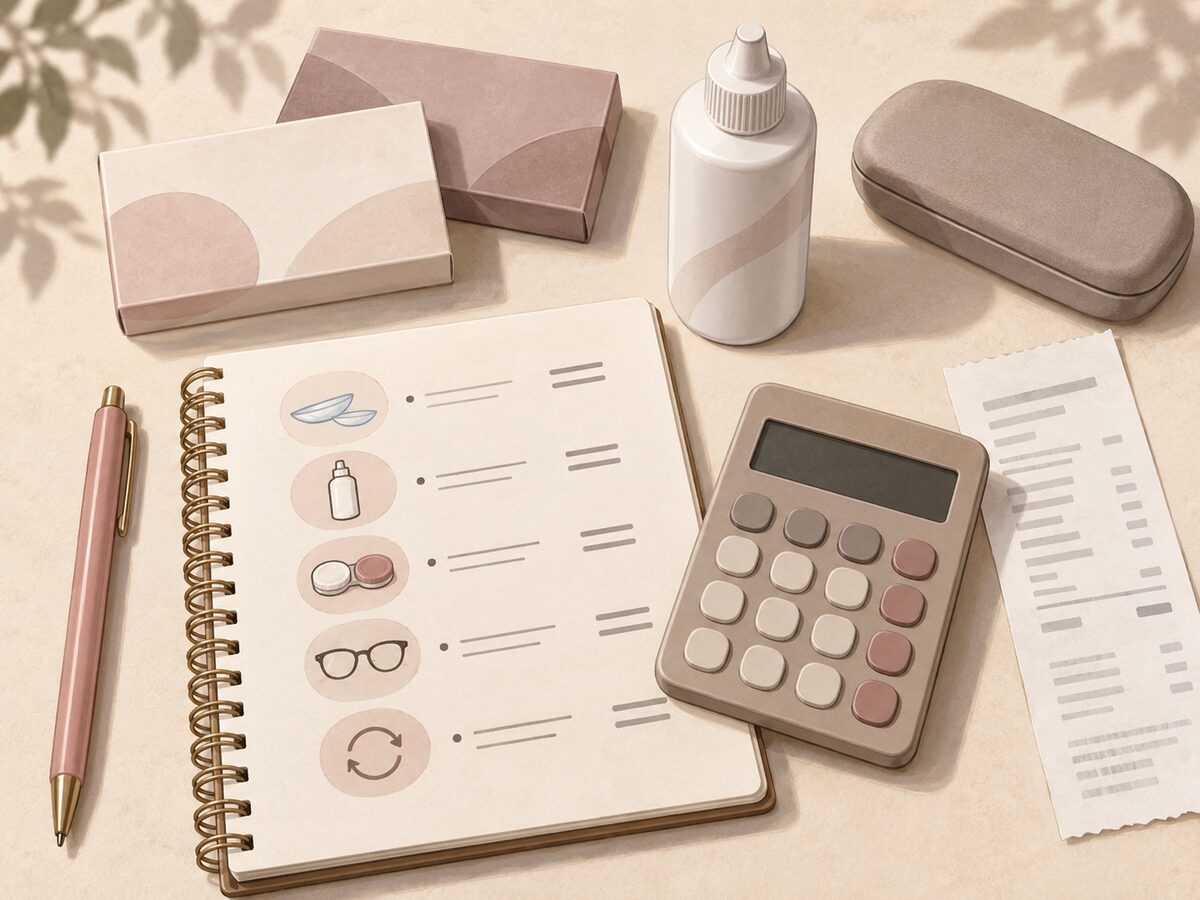
Counting one daily lens against one monthly lens is not a complete environmental comparison. First define the same period and intended use. Then list the lenses, primary packaging, outer cartons, required care bottles and replacement cases associated with each actual routine.
For example, four two-eye daily uses involve eight lenses before any reserve or additional use. A reusable option has a different replacement and care plan. That difference does not, by itself, establish which option has a lower full environmental impact.
A count of discarded items is also not a carbon calculation. It leaves out material mass, manufacturing, transport, treatment and other factors. This article does not supply a universal “greener lens” ranking or invented emissions number.
For your own comparison, write “items counted” beside the result. If some care packaging was omitted because you did not know the amount used, state that gap rather than treating it as zero. The total-cost guide uses a similar principle for purchasing: compare the complete routine over the same period.
Reduce avoidable waste without extending wear
Start with order accuracy. Confirm the exact prescribed version, each eye's selection and the required quantity before purchasing. The first-order checklist helps catch errors that could leave the wrong supply unused.
Keep an inventory of sealed boxes and their dates before placing another order. If your prescription changes, ask about the remaining stock instead of assuming it can still be used. A long package expiry does not answer that question.
Do not stretch a lens's replacement period, reuse daily disposables or shorten care steps to reduce waste. The replacement guide keeps those instructions separate from purchasing and disposal goals.
Also avoid opening an unused package solely to make it fit a collection program's accepted-item description. Resolve product suitability, any applicable returns question and the local disposal instructions before changing its condition.
Disposal and recycling questions
Can I flush a lens because it is soft?
No. Softness does not make the material suitable for wastewater disposal. Use the appropriate collection or local waste route described above.
Does a recycling triangle mean my blister is accepted?
No. Confirm the item with the actual receiving service. Material identification and local collection acceptance are different information.
Can I put everything from the box into one recycling bag?
Only if the named program explicitly accepts those items and instructs that preparation. Cartons, blisters, foil, bottles and caps may need different routes.
Does KPOP2 collect used lenses?
This guide does not offer a KPOP2 collection service. The external U.S. program linked above provides its own current locations and conditions.
Are monthly lenses automatically more sustainable?
A replacement label alone does not establish the full impact. Compare the actual use period and complete care system, and distinguish an item count from an environmental life-cycle assessment.
What if no dedicated program is available?
Follow your local waste authority's instructions for the material and keep lenses out of drains. Do not put unaccepted items in recycling in the hope they will be sorted later.
AI-assisted educational content using the linked primary sources, checked September 12, 2026. This guide does not report an individual clinical assessment or a KPOP2 product test. Explore related guidance in Lens 101.