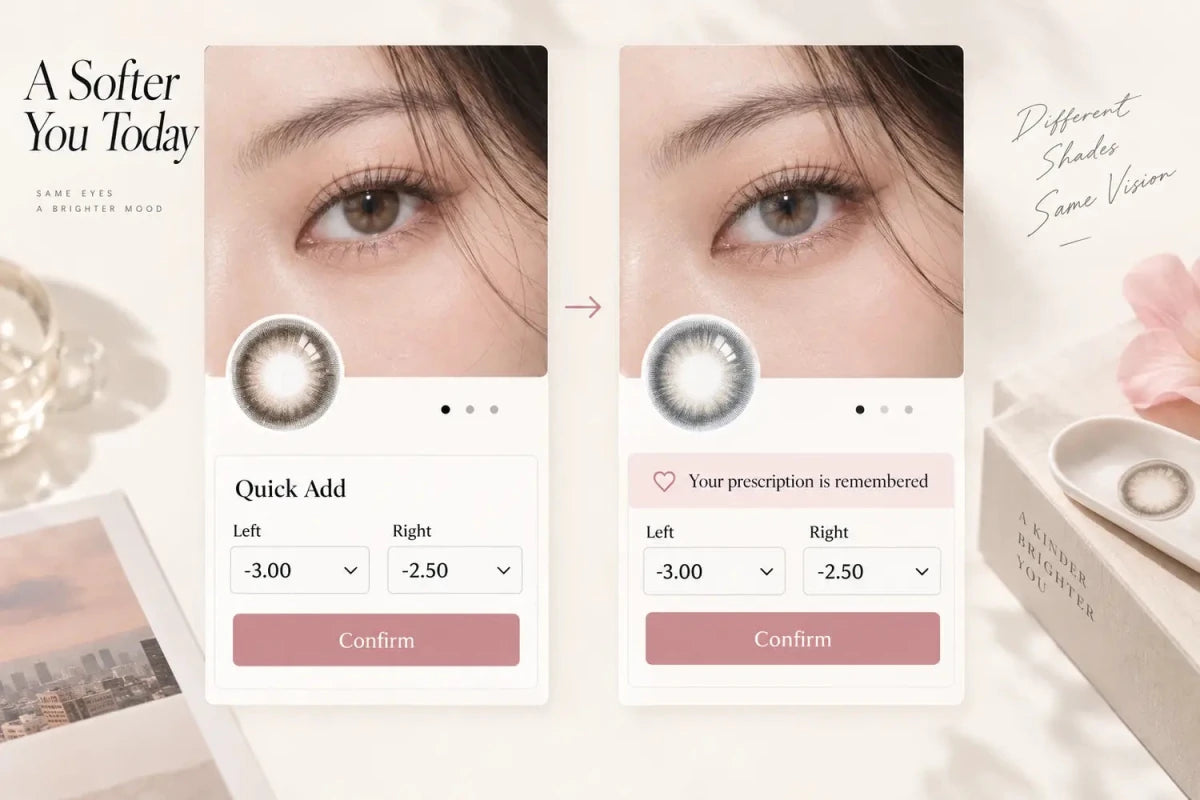

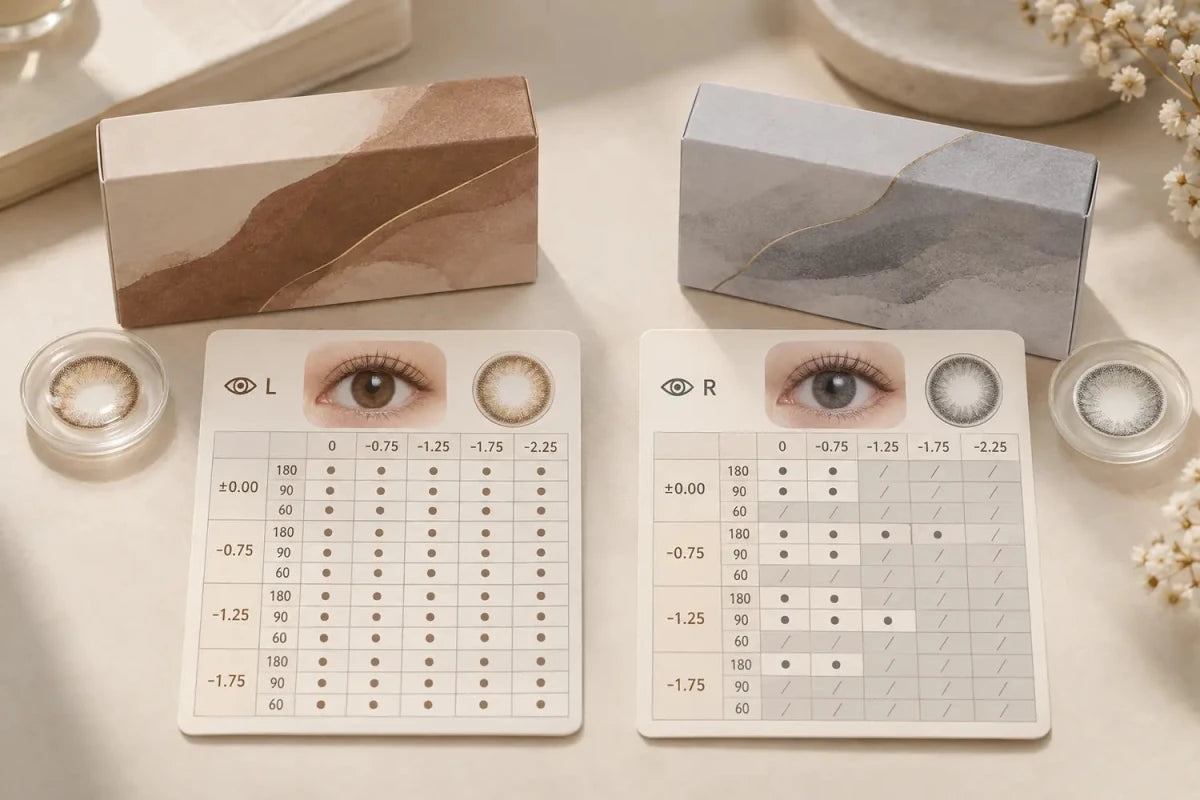
Yes—two colored toric shades can have different prescription availability, even when they look related or share a brand. Availability belongs to the exact product and version, not to the color family as a whole. Check the complete sphere, cylinder and axis combination for each eye on each shade before comparing appearance, price or replacement schedule.

Why Two Shades May Not Share the Same Option Grid
Color is only one part of a toric product. A brown and gray lens may use different designs, manufacturing runs, materials, replacement schedules or catalog configurations. Even two shade names inside one series can be separate variants with different combinations released or stocked.
A broad statement such as “power range 0.00 to −8.00” describes only the sphere span. It does not prove that every sphere is offered with every cylinder and every axis. One shade may include the required sphere but omit the needed cylinder; another may offer both but not their exact axis combination.
Check the Complete Combination, Not Three Independent Lists
Toric options are linked. The required order is not “sphere exists, cylinder exists, axis exists somewhere.” It is one valid sphere-cylinder-axis combination for the exact model. A storefront should narrow later fields based on earlier selections so unavailable combinations cannot appear orderable.
| Check | What it proves | What it does not prove |
|---|---|---|
| Sphere range | The broad SPH span for the product | That every CYL and AXIS works with every SPH |
| Cylinder list | Which CYL values appear somewhere | That your sphere-cylinder pair is available |
| Axis list | Which axis values appear somewhere | That the axis exists with your SPH and CYL |
| Validated combination | The selectable set for one exact eye and product | Suitability of a different model or shade |
Repeat the Check for the Left and Right Eye
Do not stop after finding one matching eye. Record the exact product name and version, then validate the full combination for the left eye and the right eye separately. If the two eyes differ, the order may need separate selections or boxes even when the shade is the same.
The cart summary should preserve those eye labels and show all required fields. If identical variants are combined into one line, verify quantities and option details before checkout. A shade is not a complete candidate until both required eye configurations are valid.
What to Do When the Preferred Shade Lacks One Option
Do not choose a nearby axis, round the sphere, change cylinder or switch to the regular non-toric version for color alone. A missing combination means that exact product does not match the order as entered. The next step is to check another properly prescribed model or discuss suitable alternatives with the eye-care professional—not to convert the prescription yourself.
If another shade in the same series offers the full combination, confirm that it is the same prescribed model/version and not merely a similar name. Appearance can be compared only after the prescription and product identity checks pass.
A Faster Shade-Comparison Workflow
- Write the exact prescribed model and every required field for each eye.
- Open the first shade and validate the complete left-eye combination.
- Validate the complete right-eye combination.
- Reject the shade if either required combination is unavailable.
- Repeat the same check on the next shade.
- Only then compare color, graphic diameter, replacement schedule, production time and price.
This sequence prevents shoppers from spending time choosing among attractive shades that cannot support the actual order. A good filter can narrow by one field, but the product page remains the place to confirm the full combination.
Product-Page Recommendation
Show availability at product level and update it as the shopper chooses SPH, CYL and AXIS. When a combination is unavailable, explain which exact value set failed instead of leaving an empty dropdown. If the customer moves to another shade, carry previous entries only as unconfirmed reference values and rerun validation against that shade’s option grid.
Frequently Asked Questions
Can two colors in the same toric series have different powers?
Yes. Treat each exact shade and version as its own catalog item and verify its complete option combinations.
Does a listed sphere range guarantee my cylinder and axis?
No. The range does not prove that your full SPH/CYL/AXIS combination exists.
Can I choose the closest available axis in another shade?
No. Do not approximate an unavailable prescribed value. Confirm the exact required combination.
Should I check both eyes before choosing a color?
Yes. A shade is a viable candidate only after the required combination for each eye is available.
Can a non-toric version replace the toric shade?
Not as a color-based substitution. A non-toric lens does not reproduce a prescribed toric configuration.
Why can an option appear in a filter but fail on the product page?
A filter may represent one available field, while the product page validates the full linked combination. The product-level combination is the decisive check.
Editorial note: Toric availability must be checked against the exact product and complete eye-specific option set. Similar shade names do not establish prescription equivalence.