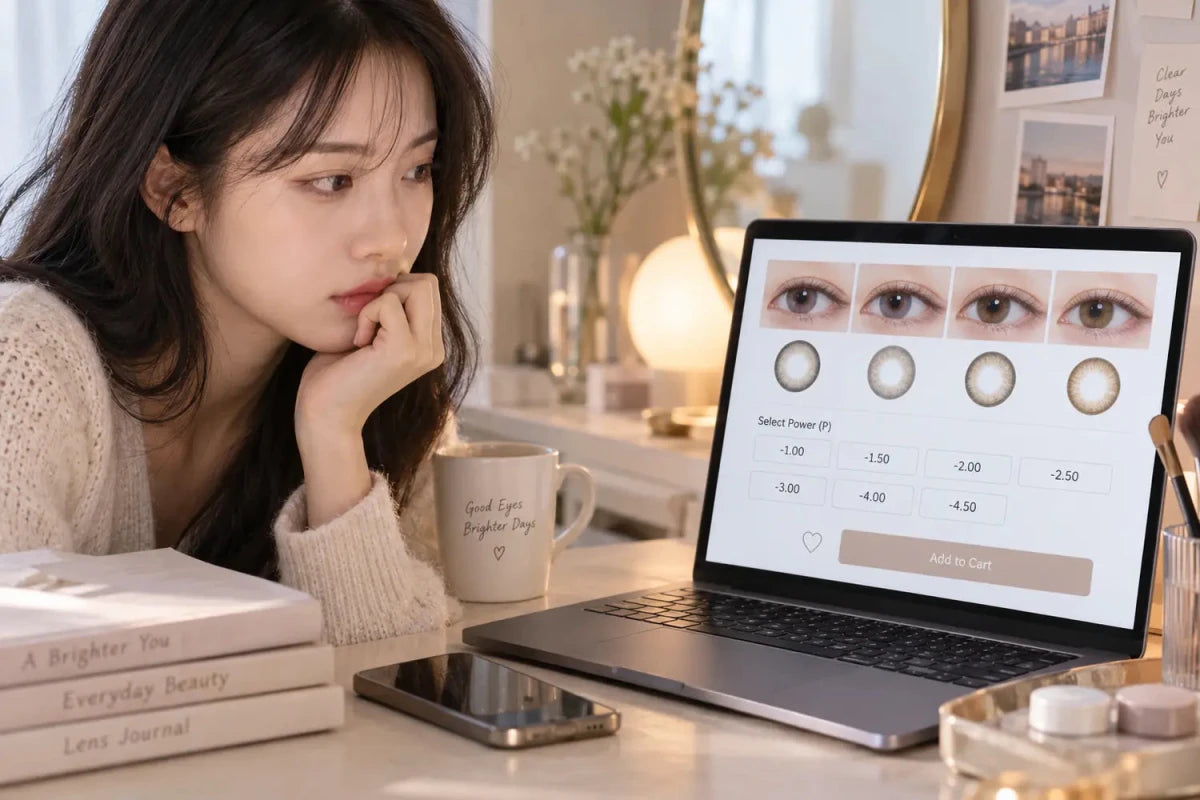


Brown contacts can look black when a dense dark print, strong limbal ring or low indoor light combines with a very dark iris. The result is usually an edge-and-contrast effect, not simply the word brown being inaccurate. This guide keeps the visual decision separate from the product, prescription and quantity checks that determine whether an order is appropriate.
In this guide
Direct answer
Brown contacts can look black when a dense dark print, strong limbal ring or low indoor light combines with a very dark iris. The result is usually an edge-and-contrast effect, not simply the word brown being inaccurate.
Evidence to compare
Look at the outer ring, print density and how much natural iris remains visible near the pupil. A cool espresso shade may also read darker than a warm honey brown, especially in shadow.
| Checkpoint | Useful evidence | Do not assume |
|---|---|---|
| Exact product | Brand, model, color and schedule | A related name is identical |
| Order eligibility | Complete live options for each eye | A headline range proves availability |
| Appearance | Comparable on-eye images | One edited photo predicts every result |
| Final order | Cart lines, quantities and timing | Remembered values are automatically correct |
A practical workflow
Compare a no-rim brown, a softly defined brown and a high-definition ring at similar graphic diameters. Use window light and a normal viewing distance as well as macro photos.
- Open the exact product page rather than relying on a collection card.
- Confirm product identity, schedule and pieces per box.
- Check every required option separately for the left and right eye.
- Compare only the candidates that remain valid.
- Read the completed cart before payment.
Mistakes to avoid
Do not solve an overly dark look by choosing only a larger or smaller diameter. Ring density and color placement may be the stronger variables.
Store content can explain what a product page, selector or package says. It should not diagnose symptoms, choose a lens for an eye or invent equivalence between products. If anything about the prescription or fitted model is unclear, pause and ask the eye-care professional.
Related categories
Continue with Brown Contacts, No Black Rim Contacts, Contacts for Dark Eyes. These links are grouped compactly so the next comparison is close at hand on desktop and wraps naturally on mobile.
Related categories
Browse Brown Contacts, Daily Contacts, Monthly Contacts as discovery routes. Verify the exact model, replacement schedule, package quantity, measurements and prescribed selections on the product page before ordering.
Questions and answers
What is the direct answer to “Why Brown Contacts Can Look Black on Dark Eyes”?
Brown contacts can look black when a dense dark print, strong limbal ring or low indoor light combines with a very dark iris. The result is usually an edge-and-contrast effect, not simply the word brown being inaccurate.
What should I check first?
Look at the outer ring, print density and how much natural iris remains visible near the pupil. A cool espresso shade may also read darker than a warm honey brown, especially in shadow.
What is the simplest comparison method?
Compare a no-rim brown, a softly defined brown and a high-definition ring at similar graphic diameters. Use window light and a normal viewing distance as well as macro photos.
What mistake should I avoid?
Do not solve an overly dark look by choosing only a larger or smaller diameter. Ring density and color placement may be the stronger variables.
Can a product photo or menu replace professional fitting advice?
No. Product information helps you compare and place an order, but it does not prescribe, fit, round, convert or substitute contact lens specifications.
Where should I continue the comparison?
Use Brown Contacts, No Black Rim Contacts, Contacts for Dark Eyes for a focused shortlist, then verify the exact product page before purchase.
Reviewed September 14, 2026 by the KPOP2 Editorial Team. This guide explains product comparison and ordering information; it does not provide a prescription or substitute one contact lens for another. The image is an editorial illustration, not a wear test.