
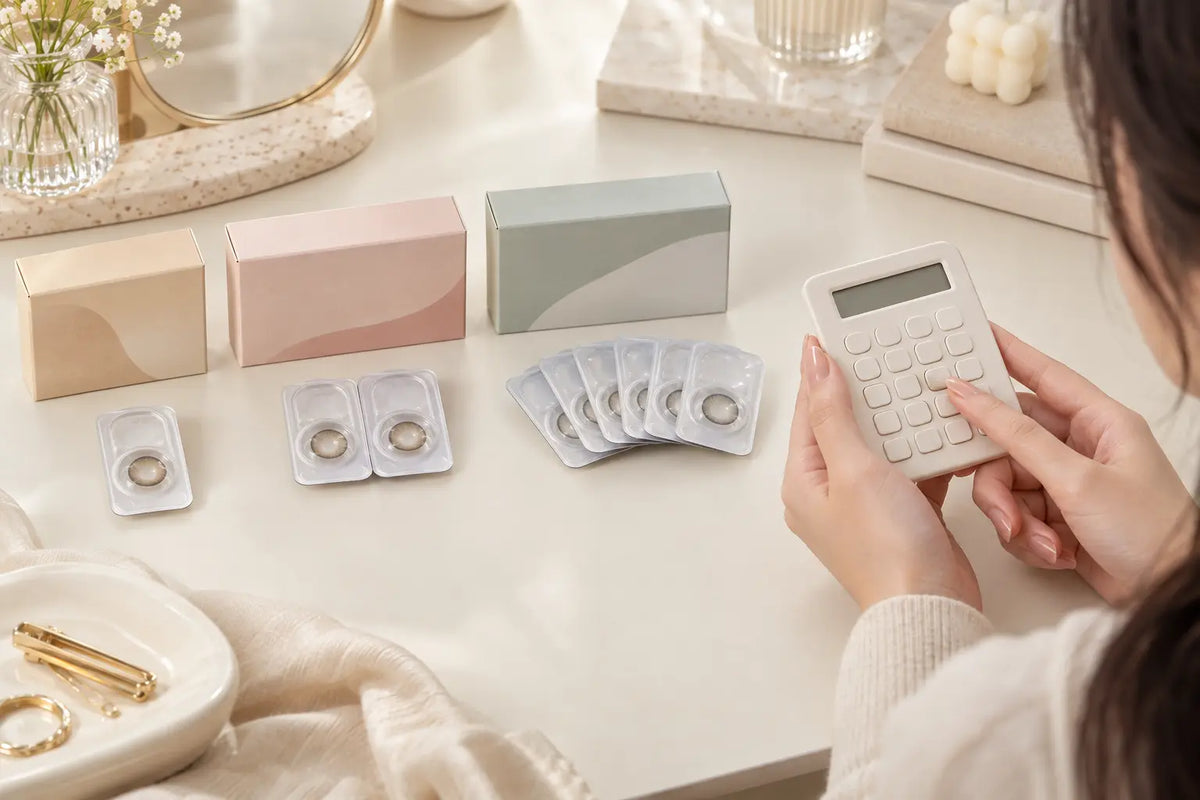
Compare colored contact prices by calculating the cost per lens first, then the cost per complete two-eye wear or replacement cycle. The box price alone is misleading because one product may contain one lens, another two lenses, and a daily box many individually packed lenses. Prescription differences between eyes can also change how many boxes you need.

Start With Cost per Lens, Not Cost per Box
The first calculation is simple:
Cost per lens = final product price ÷ number of lenses in the box.
Use the final price that actually applies to the product, including an automatic product discount or eligible promotion, but keep shipping and taxes separate until you compare the complete order. A low box price can be expensive per lens when the box contains only one piece.
Next calculate the quantity needed for both eyes. If both eyes use the same power, a multi-lens box may be shareable between them. If the powers differ, each eye normally needs lenses from its own prescribed power selection. That can require two boxes even when one box contains several pieces.
For reusable lenses, calculate the cost of one complete replacement cycle rather than pretending that every opening equals one wear. For daily lenses, each lens is discarded after one use, so a two-eye wearing day normally uses two lenses. Follow the exact replacement and care instructions for the prescribed product.
How Common Box Quantities Change the Comparison
| Package description | What it contains | First calculation |
|---|---|---|
| 1 piece / box | One physical lens | Box price equals cost per lens |
| 2 pieces / box | Two physical lenses | Divide box price by two |
| 10 pieces / box | Ten individual lenses | Divide box price by ten |
| 20 pieces / box | Twenty individual lenses | Divide box price by twenty |
| Buy 1 Get 1 boxes | Two eligible boxes under the offer | Divide final eligible price by total lenses across both boxes |
Package labels can say “piece,” “lens,” “pair,” “bottle,” “blister” or “box.” Do not infer quantity from the photo. Read the Package Contents field for the exact product. A pair means two lenses only when the listing explicitly confirms that interpretation.
Different Left- and Right-Eye Powers Change the Box Count
Suppose a daily box contains ten lenses. If both eyes use the same power, those ten lenses can represent five two-eye wearing days. If the left and right powers differ, one ten-lens box for the left eye and another ten-lens box for the right eye together provide ten two-eye wearing days. The second order costs more upfront but also contains twice as many lenses.
For a monthly product containing one lens per box, a wearer with different powers needs one box for each eye to begin a complete pair. A Buy 1 Get 1 offer may cover that pair when the exact product provides separate purchased-box and free-box power selectors. Verify both values in the cart.
Do not combine prescriptions merely to simplify the calculation. A nearby power, a spherical substitute for a toric lens, or one eye’s values used for both eyes can produce the wrong order. Price comparison begins only after the exact prescribed options are available.
Daily and Monthly Prices Need Different Denominators
A daily lens is priced around single-use pieces. A reusable monthly lens is priced around a replacement cycle and also requires the care routine specified for that product. Dividing both products by “number of wears” without accounting for these differences creates a false comparison.
For daily lenses, estimate the number of two-eye days you actually plan to wear them. Someone wearing color only on weekends may value a smaller daily supply because unused sealed lenses remain available for later dates within their labeled expiration. Someone wearing lenses regularly may compare a larger daily box or a prescribed reusable option.
For reusable lenses, calculate the number of complete left-right pairs supplied and the number of replacement cycles those pairs cover when used exactly as directed. Do not extend a replacement period to lower the apparent cost per wear. Replacement timing starts according to the manufacturer’s instructions, not from the number of occasions you remember wearing the lens.
A Worked Example Without Brand-Specific Prices
Product A costs 24 units and contains two reusable lenses. Its cost per lens is 12 units, and one same-power box can contain one complete two-eye pair. If the two eyes need different powers and the lenses cannot be mixed within a box, two boxes cost 48 units and provide two lenses for each power—enough for two complete replacement cycles.
Product B costs 30 units and contains ten daily lenses. Its cost per lens is 3 units. A same-power wearer gets five two-eye days from one box. A different-power wearer purchases two boxes for 60 units and gets ten two-eye days. Comparing 24 with 30 would suggest the reusable box is only slightly cheaper; comparing the usable supply reveals a completely different decision.
This example is arithmetic, not a recommendation. Product suitability, exact prescription, intended wearing pattern, replacement schedule and care requirements come before price.
A Fair Price Comparison Checklist
- Confirm the exact prescribed product and available values for each eye.
- Record the final eligible product price.
- Read the exact number of lenses in one box.
- Calculate cost per lens.
- Determine whether left and right powers require separate boxes.
- Calculate the cost of one complete two-eye day or replacement cycle.
- Add shipping and applicable taxes only when comparing complete carts.
- Check whether a promotion changes the total box count or only the displayed price.
Keep the unit visible beside every number. “Per box,” “per lens,” “per pair,” “per wearing day” and “per replacement cycle” are not interchangeable. Most price confusion disappears once those units are written down.
Price Never Overrides Prescription or Replacement Instructions
Choose contact lenses using the exact brand, measurements and prescription provided for you. Decorative lenses require a prescription in the United States, including zero-power designs. Do not stretch a replacement schedule, reuse a daily lens or change a power to reduce cost. Follow the product’s wear and care instructions.
Frequently Asked Questions
Is a cheaper box always the better value?
No. Divide the final price by the number of lenses, then calculate the amount needed for both eyes and the intended replacement period.
Does one lens per box mean I need two boxes?
For a complete two-eye pair, normally yes. Confirm package contents and select the prescribed power for each eye.
How many days does a ten-piece daily box cover?
For two eyes using the same power, it contains five two-eye days. Different powers normally require two boxes, providing ten two-eye days together.
Should solution cost be included for monthly lenses?
Include required care supplies when estimating your total routine cost, but do not assume supplies are included with the lens box.
How should I calculate a Buy 1 Get 1 offer?
Add the lenses contained in both eligible boxes and divide the final promotional product price by that total. Verify both box selections in the cart.
Can I wear a monthly lens longer to reduce cost?
No. Follow the exact replacement instructions. Cost calculations must not be used to extend the approved product schedule.