
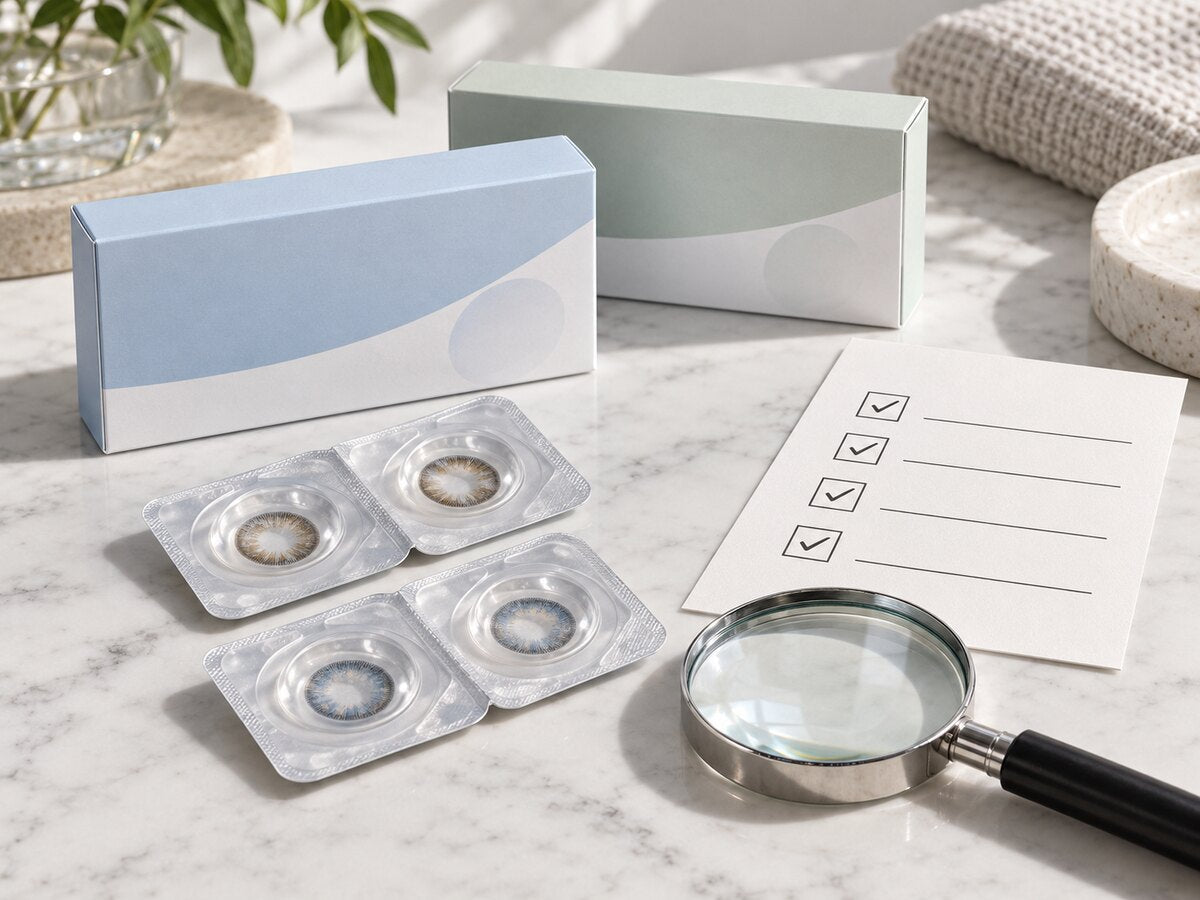
No single sticker, barcode or package photo can prove that colored contacts are authentic. Use several checks together: the seller, prescription process, manufacturer identity, exact product record, sealed packaging and traceable lot information.
Start with the seller, not the box design
In the United States, decorative contacts are prescription medical devices. A lawful seller should request the prescription and prescriber information needed for verification. A marketplace listing that promises “no prescription needed” is a stronger warning sign than a small printing difference on imported packaging.
Match the complete product identity
- Brand and manufacturer or responsible company
- Series, shade and replacement schedule
- Regular, toric or other optical version
- Base curve, diameter and available powers
- Box quantity and market-specific packaging
Do not authenticate a product only by comparing colors on two internet photos. Brands can update artwork, and legitimate packaging can differ by market or batch.
Inspect every sealed blister
Before opening, check that the blister is fully sealed, the solution is clear, the lens appears intact, and the printed product details match the outer box. Look for a readable lot or batch number and expiration date. Do not use a blister that is leaking, open, swollen, punctured, cloudy or mismatched.
Verification steps when something looks wrong
- Do not insert the lens.
- Photograph the outer box, blister, lot number, expiration date and shipping label.
- Compare the exact product with the manufacturer’s current catalog or contact the manufacturer through an official channel.
- Contact the seller with the order number and photos.
- If a serious adverse event or suspected counterfeit is involved, use the FDA reporting route described on its decorative-lens page.
Warning signs that deserve extra scrutiny
- The seller avoids prescription verification in the U.S.
- The price is implausibly low and the source is unknown.
- Product name, shade, power or quantity changes between box and blister.
- Lot or expiration information is missing or unreadable.
- The package arrives opened, leaking, damaged or without traceable order information.
Questions and answers
Does a QR code prove authenticity?
No. A code is one data point and can be copied. Confirm it through the brand’s official system when available and still check the seller and product record.
Does different packaging mean fake?
Not automatically. Brands can revise designs or use market-specific boxes. Ask the manufacturer or authorized distributor to confirm the lot and packaging.
Can I test authenticity by wearing the lens?
No. Never use your eye as a test. Keep a questionable product sealed.
What should I keep after ordering?
Keep the invoice, outer box and lot/expiration information until the order has been checked and used without a product issue.
Are 0.00 lenses exempt from prescription rules?
No. In the U.S., decorative lenses still require a prescription.
Reviewed September 12, 2026 by the KPOP2 Editorial Team. AI-assisted guidance checked against the official sources below. This article is general education and does not replace an eye exam, an individual fitting or product-specific instructions.
Sources
Explore the collections in this guide
Compare the exact lens version, available powers, replacement schedule and box contents on each product page.