Toric & prescription
LensTown Kiralet Gray Toric: Check Axis and Prescription Before Ordering
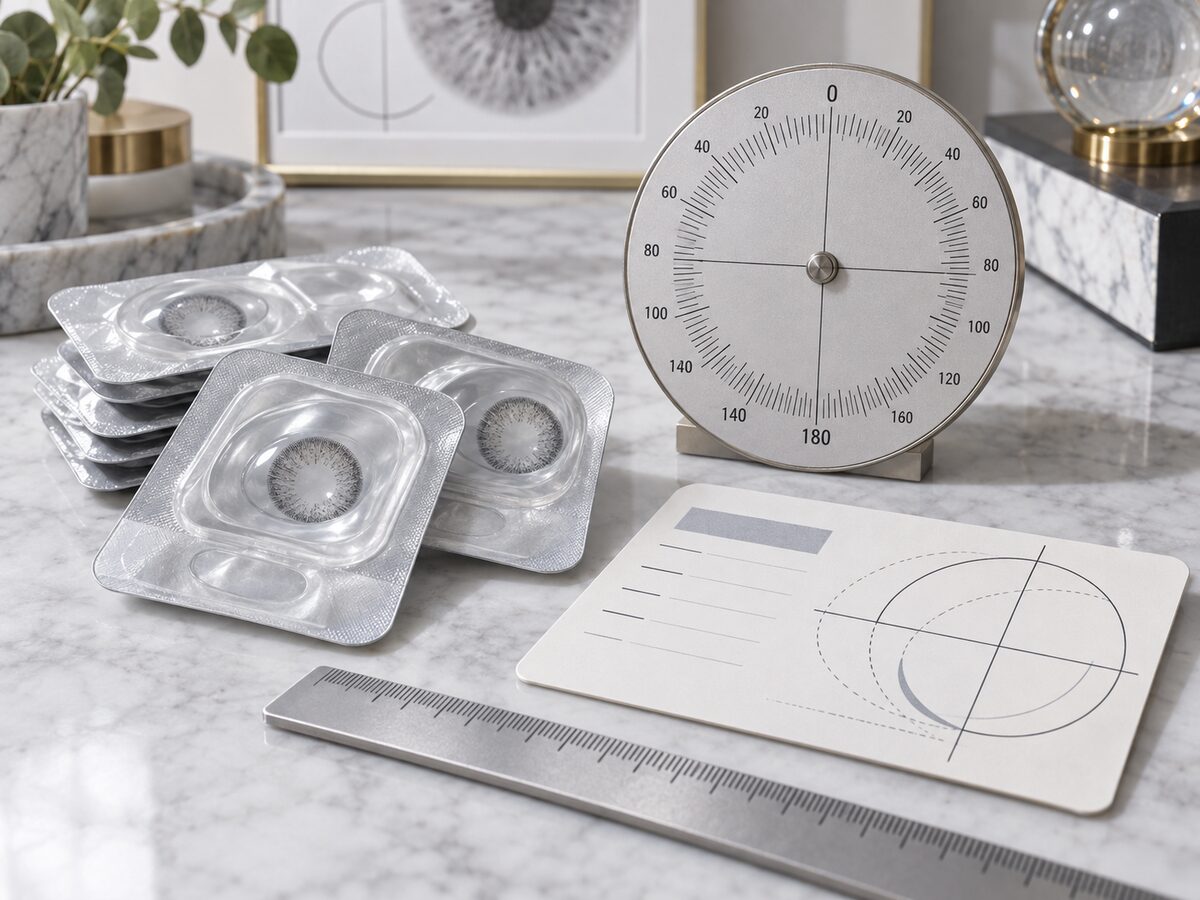
LensTown Kiralet Gray Toric is listed as a reusable colored toric lens with axis options from 10° through 180° in 10-degree steps. Seeing an axis number on the product page is only the beginning of an order check. The exact sphere, cylinder, and axis combination must match the current contact lens prescription for each intended eye and be confirmed as orderable. The public lists do not prove that every combination is available. Before checkout, preserve the full model name, eye assignment, one-lens bottle count, and replacement instructions; then compare the delivered label with the confirmed order.
In this guide
Identify the exact Kiralet product
The current KPOP2 product page names LensTown Kiralet Gray Toric. It is a reusable gray toric colored contact lens from LensTown, with one lens per bottle. The listing shows a 13.0 mm graphic diameter, 14.0 mm overall diameter, 8.7 mm base curve, silicone hydrogel material, and 38% water content. These published details help identify the product; they do not prove an individual fit.
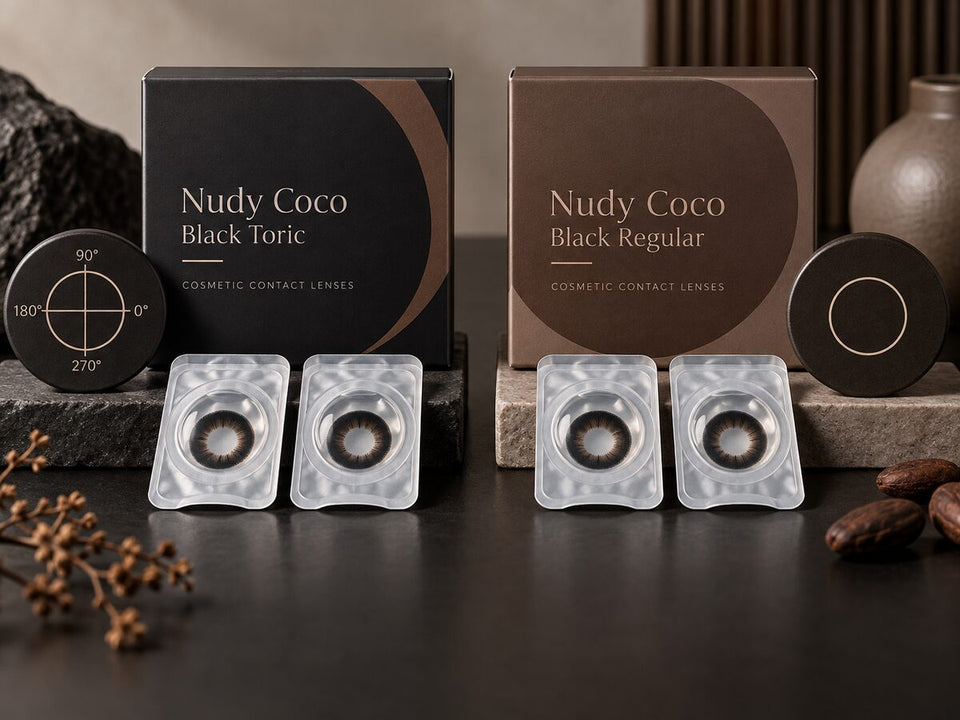
Keep “Toric” in the full name when you compare a prescription, previous order, and current cart. A similarly named Kiralet color or a regular spherical lens may not have the same optical design. Gray appearance and a matching printed size do not make two products interchangeable. An eye-care professional must determine the correct lens for your eyes.
The public page lists a general 0.00 to -12.00 sphere range, cylinder options of -1.25, -1.75, -2.25, and -2.75, and axis values at 10-degree steps from 10 to 180. These are category lists. The exact combination prescribed for an eye must be checked against the live selector or directly with the seller. Do not assume that every sphere can be paired with every cylinder and axis.
The listing also gives a 3–6 month replacement range. That range needs clarification from the supplied package and your eye-care professional for the exact fitted lens. Do not select the longest interval yourself. Product information can change, so recheck the live page before ordering and read the label that actually arrives.
Read the axis field correctly
Axis describes the orientation of the astigmatism correction in a toric prescription. It is not a cosmetic angle and should not be changed to make a color available. The current Kiralet Gray Toric page shows 10, 20, 30, and so on through 180. A clearly displayed list makes the catalog easier to read, but it does not establish that your full prescription is available.
Copy the axis from the contact lens prescription for the intended eye, including any formatting your clinician uses. Then check the corresponding sphere and cylinder on the same line. A number such as 90 is incomplete without the rest of the prescription and the product identity. If your written value is unclear, ask the prescriber to clarify it rather than guessing between nearby steps.
Do not round an axis to the nearest listed value on your own. If your prescription names a value not shown on the page, ask the seller whether the precise prescribed combination can be supplied and ask the eye-care professional about any alternative. A ten-degree catalog interval is not a customer instruction to modify a prescription.
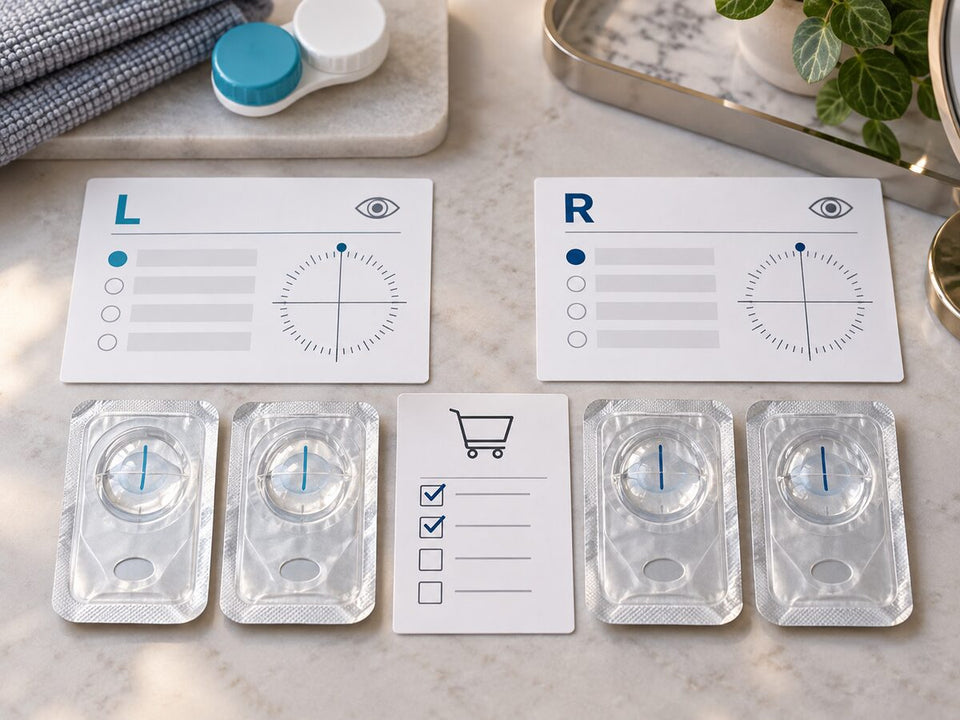
Keep right-eye and left-eye axes separate. A person can have different toric parameters for each eye, even when both lenses look the same color. An order summary that displays only “gray toric, quantity two” may not be enough to verify those two configurations. Ask how each eye’s values will appear on the order and delivered bottles.
Confirm sphere, cylinder, and axis together
A toric order is a complete combination, not three independent guesses. Sphere (SPH) relates to the main refractive power, cylinder (CYL) to astigmatism correction, and axis to orientation. The current public page lists values for each field. It does not prove that a specific SPH, CYL, and AXIS triple is manufactured, stocked, or selectable for the intended eye.
Put the prescription in a two-row worksheet with the full Kiralet model name. On each row, record the intended eye, SPH, CYL, AXIS, and any other professional instruction. Compare the selected cart variant with the complete row. If a dropdown shows one field but not another, ask the seller how the complete combination will be captured. Do not submit a partial toric order and expect a missing value to be inferred.
Be especially careful at the ends of displayed ranges. A general -12.00 to 0.00 sphere statement does not guarantee that -12.00 is offered with every listed cylinder or axis. Ask a precise availability question for your exact combination. If the seller cannot confirm it, return to the eye-care professional for suitable alternatives rather than selecting a nearby power.
The FDA contact lens prescription guidance explains that a prescription must contain enough information for a seller to fill the lens accurately. Use the contact lens prescription, not an eyeglass prescription or an old screenshot with missing fields. A current professional fitting identifies more than a color and three numbers.
If you previously wore Kiralet Gray Toric, the old package can help identify the exact model and values supplied then. Compare it against the current prescription. A prior successful order does not prove that the same combination remains the current plan. If any value changed, update the cart and record deliberately.
Keep right and left eyes separate
Write “right eye” and “left eye” in plain words beside OD and OS if those abbreviations appear on your prescription. The eye side matters even when both bottles are Kiralet Gray Toric. Different sphere, cylinder, or axis values mean the two physical lenses need separate identification. Do not rely on their gray appearance to tell them apart after opening.
If only one eye uses this product, state that explicitly. A one-bottle order may be correct for a single eye’s replacement. If both eyes use the product, count and select each prescribed configuration. Two bottles with the same color but different parameters are not interchangeable across eyes.
Keep packaging or a private photograph of each label until the lenses are used and the order is verified. A handwritten case marker can help, but it should not be the only identity record. If a label becomes unreadable or a lens is mixed with another, do not guess which eye it belongs to. Seek professional advice before wearing an unidentified lens.
When a clinician changes one eye’s plan, do not automatically change the other eye. Recheck each row of the current prescription. A customer service message that says “my axis is 180” is incomplete if the seller cannot tell which eye, model, sphere, and cylinder are intended. A full eye-specific line makes the question answerable.
Ask a precise availability question
A useful seller question identifies the exact product and one intended eye, then supplies the current prescribed SPH, CYL, and AXIS through the appropriate channel: “Can LensTown Kiralet Gray Toric be ordered in this exact combination for my right eye, and how will all three values appear on the confirmation?” Replace the placeholder with your real prescription, not a value copied from an example article.
If the live page offers an axis but not the prescribed cylinder, say which field is missing. If the selector shows all three values separately, ask whether the complete combination is actually available. A reply that confirms only “axis 180 is listed” does not resolve a question about a specific SPH and CYL combination.
If the seller proposes another model or parameter, send that proposal to the prescriber for approval before accepting it. Do not change axis, power, or product because a similar option is in stock. The FDA buying guidance recommends checking the exact lens identity and parameters and seeking professional approval for substitutions.
Keep the written reply with the order record. The reply should connect the specific product and eye-side combination to the final cart or order number. A generic availability statement may be too broad to verify a toric order later.
Count one-lens bottles against the plan
The current Kiralet Gray Toric listing says each bottle contains one lens. A two-eye plan may therefore require two bottles, each selected for the correct eye-specific parameters. A single bottle is not a pair. A quantity of two also does not automatically mean the two bottles have different settings; the cart must capture the right and left combinations correctly.
For a one-eye replacement, one bottle may be the intended order, but only if the professional confirms the exact model and parameters for that eye. If you are ordering a spare, ask whether an additional bottle is appropriate and check its unopened expiration date. Do not stock up using an old prescription that is no longer current.
Make a compact count sheet: right eye needed now, yes or no; left eye needed now, yes or no; product and complete parameter combination for each; number of bottles. This is especially useful if the eyes differ. A cart that has the correct total count but the wrong combination mix is not a correct order.
Check the final confirmation before leaving the checkout. If it omits axis or other toric fields, ask the seller how those values were captured. Keep the confirmation and prescription available when the package arrives. The purpose is to trace each physical bottle back to an eye-specific instruction.
Confirm replacement and care for this lens
The current page gives a 3–6 month replacement range. The exact interval for your lens must be confirmed from the supplied package and your eye-care professional. Record the opening date and instructed discard date for each physical bottle. Occasional wear does not automatically extend the schedule or pause it while the lens is stored.
Follow the cleaning, disinfecting, and storage routine recommended for this product and your eyes. The CDC contact lens prevention guidance advises hand hygiene, avoiding water, and using fresh solution rather than topping off old solution. Keep the case clean and replace it according to professional guidance.
Do not sleep, swim, or shower in the lens unless your eye-care professional gives an exact approved wearing plan; water exposure should be avoided. A toric lens that seems blurry, unstable, or uncomfortable needs professional assessment. Do not try a different axis from the online list as an at-home adjustment.
If pain, persistent redness, discharge, light sensitivity, or blurred vision occurs, remove the lens and contact an eye-care professional promptly. Do not continue wearing it because the gray style is important for an event. Eye health and correct vision take priority.
Verify the delivered lens before opening
Compare the bottle label with the current prescription and order confirmation. Check the full LensTown Kiralet Gray Toric name, intended eye, SPH, CYL, AXIS, quantity, seal, and expiration date. Do this before opening the bottle. A gray lens seen through the package cannot reveal its optical configuration.
If any value is missing or different, contact the seller and prescriber before use. Do not accept a substitution because the graphic diameter or overall diameter looks similar. Preserve the packaging and written confirmation while the discrepancy is resolved. An unopened item is easier to identify and correct.
When two bottles arrive, inspect each separately. Keep right-eye and left-eye labels with their respective lenses. If both have identical parameters, verify that they truly match the prescription. If they differ, make sure the differences are captured accurately. A complete delivery check closes the chain from prescription to cart to physical lens.
Three common order scenarios
Axis shown, combination unclear: Your axis appears on the page, but you cannot find your cylinder with the selected sphere. Ask whether the exact triple is orderable. Do not submit a partial selection or choose a nearby cylinder. If the combination is unavailable, your eye-care professional should guide the next step.
Different axes by eye: The right eye and left eye need distinct axis values. Put each on a separate order line or obtain explicit seller confirmation of how both combinations will be fulfilled. A generic quantity of two at one selected axis would not cover the two-eye plan.
Old bottle versus new prescription: The old package has a different axis from the current written prescription. Use it to identify the previous product, but do not let it override the updated instruction. Ask the prescriber if you need clarification, then order the current confirmed combination.
What the public parameter lists can and cannot tell you
The public SPH list tells you which sphere values are described for the product family. The CYL list tells you which cylinder values are described. The AXIS list tells you which orientations are described. None of those lists, viewed separately, is a complete catalog of every orderable triple. A seller may have stock or manufacturing constraints for a specific combination, and the live selector may be more limited than a general description.
Do not infer a missing value from a neighboring product. Another LensTown toric model may have a different cylinder range or base curve. A regular Kiralet lens may lack toric fields altogether. The exact product title and prescription belong together. When the catalog seems inconsistent, ask a question that includes the full model and all three prescribed values for one eye.
Likewise, a product photograph can answer a color question but not an axis question. It may show how gray appears on a model’s iris under a particular light. It cannot reveal the optical correction, lens rotation, or the parameter combination in a sealed bottle. Keep visual styling notes separate from prescription and order verification.
Finally, an axis being listed does not prove it is right for your eye. The correct axis comes from the current contact lens prescription after fitting. If you are uncertain whether a value was written for contacts or glasses, ask the prescriber. A copied number without the surrounding prescription and model identity is an incomplete order instruction.
How to make the seller’s reply actionable
A useful reply should say whether the exact SPH, CYL, and AXIS combination for the named Kiralet Gray Toric product can be supplied. It should also explain how those values will be represented on the final order. A reply that merely repeats “we have axes 10 to 180” does not answer the combination question. Follow up until the specific eye’s values are confirmed.
If the store requires a separate message after checkout, ask how the message will be connected to the order number and how you can verify it before fulfillment. Keep a copy of the complete instruction and the seller’s confirmation. Do not rely on an informal color comment or a generic note that leaves out the toric parameters.
If a value is unavailable, ask the seller for the precise limitation, then bring that information to your eye-care professional. The professional can determine whether another lens is appropriate. The seller’s availability answer and the clinician’s fitting decision are different steps. A customer should not bridge them by choosing a nearby axis or cylinder.
When the delivery arrives, the label should let you verify the final decision. If it does not show enough detail, pause and ask for clarification before opening. This final check protects the link between the current prescription, confirmed order, and physical lens. It matters even if the package came from a previously used retailer.
Keep the fitting, order, and wear plan aligned
The fitting step establishes whether this toric design is appropriate for your eye and what optical parameters should be ordered. The seller’s step establishes whether that exact configuration can be supplied. The package and wear-plan step establishes what was delivered and how to use it. Confusion happens when one step is assumed to answer another: a catalog value is treated as a prescription, a product photo as proof of fit, or an old bottle as proof of a current plan.
When you make a private reorder note, use three headings: “prescribed,” “confirmed available,” and “received.” Under “prescribed,” copy the full eye-specific line from the current contact lens prescription. Under “confirmed available,” record the seller’s answer and date. Under “received,” transcribe the sealed bottle label after delivery. A disagreement between the headings is a reason to pause before use, not to pick the most convenient value.
Do not overlook the product version while checking numbers. A similar gray lens with a matching base curve or graphic diameter is not necessarily the Kiralet Gray Toric design your clinician fitted. The printed 13.0 mm value concerns appearance, while the toric optical fields concern vision correction. These are different forms of information and should be verified in their proper places.
The replacement range requires the same careful thinking. The current page lists 3–6 months, but the applicable date for your lens comes from the package and professional instruction. Record the actual opening date, schedule, and discard date after the delivered product is confirmed. Do not count only the days it was worn, and do not extend it to match a future event.
Keep a backup vision plan if the lens is unavailable, damaged, or causes symptoms. The CDC recommends backup glasses. An unconfirmed toric lens is not a safe backup just because it has the desired gray appearance. Plan alternatives with your eye-care professional before a trip or important event, when there is time to resolve fit and availability.
Kiralet Gray Toric axis and reorder questions
Does axis 180 appear on the current product page?
Yes. The current Kiralet Gray Toric description lists axis values from 10 through 180 in ten-degree steps, including 180. That does not confirm availability with every sphere and cylinder. Check the exact full combination prescribed for the intended eye.
Can I round my prescribed axis to the nearest listed step?
No. Do not alter a contact lens prescription to match a dropdown. Ask the seller whether the prescribed combination can be supplied and ask your eye-care professional about appropriate alternatives if it cannot. Axis is an optical parameter, not a style preference.
What if only one eye needs a toric lens?
Follow the professional’s eye-specific plan. One Kiralet bottle may be needed for the toric eye, while the other eye may have a different prescribed product. Keep separate order lines and do not assume both eyes require the same gray lens.
Is one bottle a pair?
No. The current listing says one lens per bottle. A two-eye order may need two bottles with the correct parameters for each eye. Confirm the quantity and selected combinations before checkout.
Can the graphic diameter confirm fit?
No. The 13.0 mm graphic diameter describes the printed area. The 14.0 mm overall diameter and 8.7 mm base curve are physical specifications, but even those values alone cannot confirm an individual fit. An eye-care professional must evaluate the exact lens.
Can I choose six months from the listed 3–6 month range?
Do not choose the longer interval on your own. Follow the supplied packaging and your eye-care professional’s schedule for the fitted lens. Record the opening and discard dates for each physical bottle.
What if the lens is blurry or uncomfortable?
Remove it and contact an eye-care professional, especially with pain, redness, discharge, light sensitivity, or blurred vision. Do not experiment with a different online axis value. The correct response is a professional assessment of the lens and eye.
For official background, see the FDA contact lens prescription page, the FDA buying guide, and the CDC prevention guidance. Your current prescription and eye-care professional’s instructions govern the exact order.
A compact pre-checkout worksheet
- Write the full product name: LensTown Kiralet Gray Toric.
- Record the right-eye SPH, CYL, and AXIS from the current contact lens prescription.
- Record the left-eye SPH, CYL, and AXIS separately if this lens is prescribed for that eye.
- Confirm each complete combination is orderable, not merely that its components appear in lists.
- Count one-lens bottles for the intended eye or eyes.
- Confirm how every toric value will appear on the order and delivered label.
- Check the package’s replacement and care instructions before opening.
If a field remains unclear, ask the relevant professional or seller before payment. A complete, eye-specific order record is the safest way to prevent an appealing gray product photograph from distracting you from an unresolved optical parameter.
A last review should be simple enough to perform without interpreting medical notation from memory. Put the current prescription and sealed package side by side. Check the full name, intended eye, SPH, CYL, AXIS, and package date. If any field is missing or different, stop and ask the prescriber or seller for clarification. Once the identity is confirmed, follow the exact lens’s fitting, wearing, and care instructions.
Do not let an attractive product image or an apparently complete dropdown replace this check. The right gray style is the one that also matches a valid, eye-specific lens plan.