Toric & prescription
OLENS Real Ring Brown Toric vs Regular Monthly: Specs and Box Count

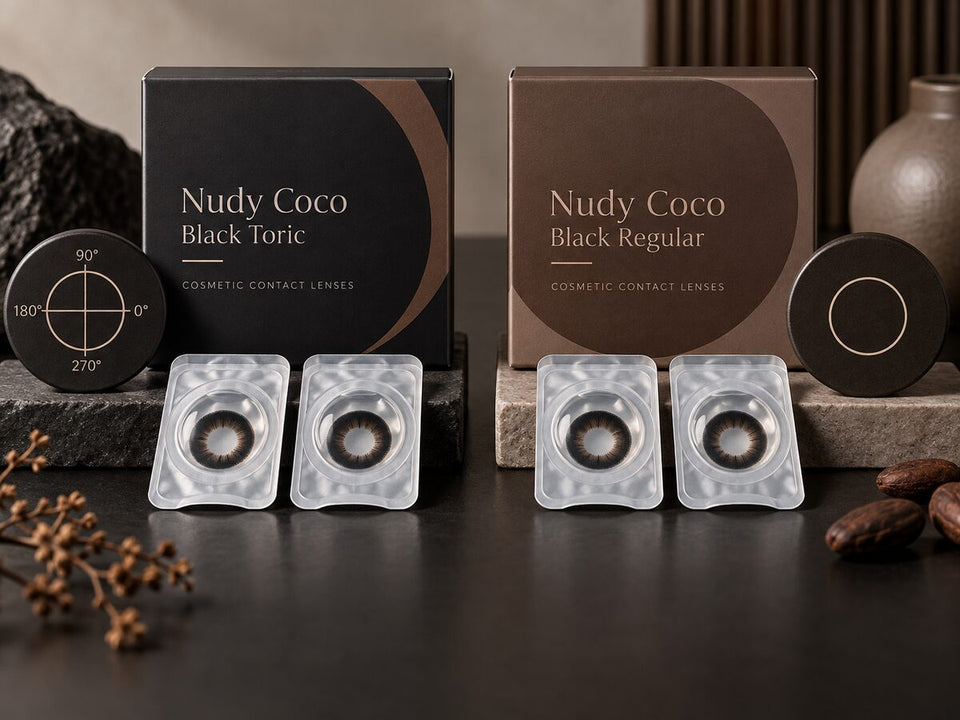
OLENS Real Ring Brown Toric and regular OLENS Real Ring Brown share a listed 12.5 mm graphic diameter, but they are different monthly contact lens products. The toric page identifies an astigmatism design, a 14.2 mm overall diameter, silicone hydrogel material, and one lens per box. The regular page lists a 14.0 mm overall diameter, HEMA material, and two lenses per box. The current toric description lists sphere and cylinder ranges but does not show an axis list, so a shopper should confirm the full eye-specific toric combination with the seller and prescriber before ordering. Similar brown appearance does not make the versions interchangeable.
In this guide
Keep Toric in the product identity
The current KPOP2 catalog has separate active listings for OLENS Real Ring Brown Toric (For astigmatism) and OLENS Real Ring Brown. The shared “Real Ring Brown” words identify a related visual direction, but “Toric” signals an optical design that must match a toric contact lens prescription. Do not shorten a reorder note to “Real Ring Brown” if the prescribed model is toric.
A photograph can show how a brown printed ring looks on one model. It cannot show sphere, cylinder, axis, lens material, or fit. A regular lens with similar artwork cannot be used as a toric substitute merely because the eye color seems the same. An eye-care professional must decide which exact design and parameters suit each eye.
Keep a copy of the current contact lens prescription beside the old package and new cart. The old package helps identify what was previously delivered; the current prescription determines what should be ordered now. If they differ, ask the prescriber to clarify the plan before choosing a product. A previous successful purchase does not automatically authorize a model change.
The title also matters at delivery. A bottle or box that says regular Real Ring Brown should not be accepted as the toric product simply because the graphic diameter matches. Check the full label before opening. Product identity is the first step of a correct order, not a detail to settle after the lens is worn.
Compare the current specifications without overreading them
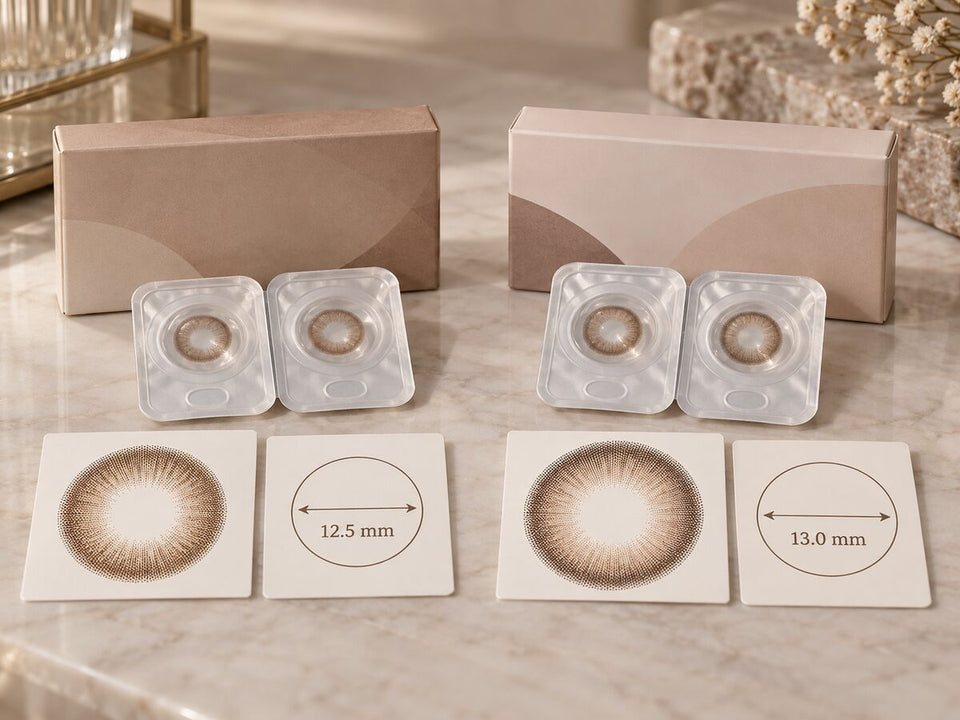
Both pages list a 12.5 mm graphic diameter and 8.6 mm base curve. The toric page lists a 14.2 mm overall diameter, silicone hydrogel material, and 40% water content. The regular page lists a 14.0 mm overall diameter, HEMA material, and 38% water content. These are current public product details. They help distinguish the listings, but no single measurement proves that a lens will fit your eye.
Graphic diameter describes the visible printed area; overall diameter describes the full physical lens. Sharing the first number does not erase the difference in the second or in optical design. A similar ring effect in photos cannot establish equal movement, vision, comfort, or substitution suitability. Your eye-care professional evaluates fit for the exact lens.
Both listings describe a monthly replacement format. That shared schedule category does not make the products interchangeable or eliminate cleaning and storage. The applicable replacement date should be calculated from the actual opening event under the exact package and professional instructions. Occasional wear does not automatically extend the month.
The toric page says one lens per box; the regular page says two. This is a significant purchase difference. A cart quantity of one toric unit is one physical lens, while a cart quantity of one regular unit is two physical lenses. Whether the two pieces in a regular box can serve both eyes depends on the prescribed powers and product instructions. Do not assume the same unit count across versions.
Check the complete toric prescription
A toric contact lens order requires the precise optical configuration for the intended eye. Sphere (SPH), cylinder (CYL), and axis may all be part of that line. The current Real Ring Brown Toric description lists SPH options from -8.00 to -1.00 and CYL values of -0.75, -1.25, and -1.75. Its general description also says 0.00 to -8.00, which differs at the upper end from the detailed SPH list. Do not infer that 0.00 is orderable in a toric combination without confirmation.
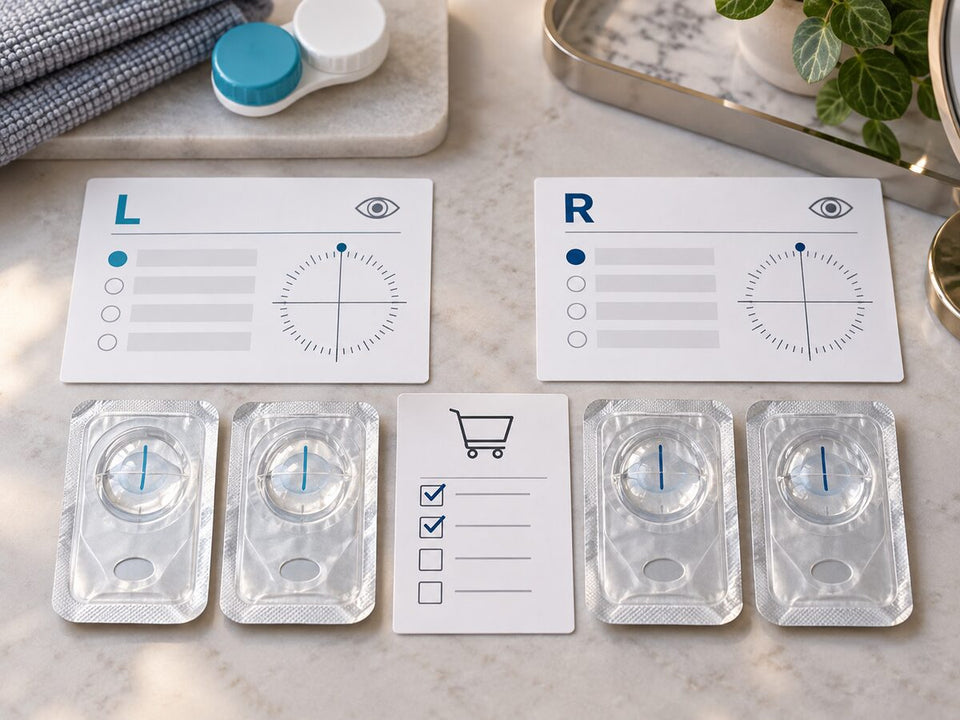
The current public toric description does not display a detailed axis option list. This is an unresolved order question, not a reason to omit axis or choose a default. If your prescription includes an axis, ask the seller how that exact value is selected and represented in the order. Ask the prescriber if any notation on the written prescription is unclear.
Do not treat the listed SPH and CYL fields as a complete combination catalog. A value appearing in each separate list does not prove that the two values are offered together or in your axis. Confirm the exact SPH, CYL, and AXIS triple for the right eye and the left eye separately. If a combination is unavailable, your eye-care professional should guide alternatives.
An eyeglass prescription is not automatically a contact lens prescription. The FDA contact lens prescription guidance describes the information needed for accurate fulfillment, including power, manufacturer or material, and fitting-related details. Use the current contact lens prescription for the exact product rather than transferring numbers from glasses or a different lens brand.
When the regular Real Ring Brown product is prescribed, its page gives a general 0.00 to -8.00 power range but no toric cylinder and axis fields. A regular lens at the same sphere value does not replace a toric prescription. The missing toric correction cannot be supplied by matching color or graphic size.
Resolve the missing axis detail before checkout
Write the axis from your current contact lens prescription beside the full toric model name and intended eye. Then inspect the live product options or ask the seller to confirm how that exact value can be ordered. The public description reviewed for this guide does not provide an axis list, so this extra step is necessary before claiming that a given prescription is available.
A useful question is: “Can OLENS Real Ring Brown Toric be supplied in my prescribed SPH, CYL, and AXIS for the right eye, and how will the axis appear on the order confirmation and package?” Send your actual values through the seller’s appropriate channel. If the left eye differs, ask a separate question for it or provide a clearly labeled second line.
A reply that confirms only the sphere or cylinder is incomplete. Ask for the whole eye-specific combination. If a seller proposes a nearby axis or another toric model, take that proposal to your eye-care professional for approval. A customer should not round axis or choose a substitute to make the brown style available.
Keep the written confirmation connected to the order number. If the checkout page lacks an axis field, ask how the detail will be transmitted and verified before fulfillment. Do not assume that a generic product title or a free-form color note carries an optical parameter correctly.
Keep the two eyes as separate order lines
Record the full product, SPH, CYL, and AXIS for each eye. Use “right” and “left” in plain words beside OD and OS if those abbreviations are used by the prescriber. The eyes may have different optical needs even if you prefer the same brown appearance. A quantity of two without eye-specific values can conceal an incorrect order.
If only one eye needs toric correction, the other may have a different prescribed lens. Do not assume two of the toric model or two of the regular model are correct. Follow the professional’s plan for each eye. The visual effect can be coordinated, but optical design cannot be inferred from styling preference.
Keep the old package labels until the new delivery is checked. If the previous order shows different values from the current prescription, ask the prescriber to reconcile them. Do not copy an old axis or power simply because the color and brand still look familiar.
Count individual lenses, not only boxes
The current toric page says one lens per box. For a two-eye toric plan, you may need two boxes, each selected for the correct eye-specific combination. A regular Real Ring Brown box contains two lenses, but that does not automatically mean one right-eye and one left-eye lens when their prescribed powers differ. Check the selected variant and package details.
Write a quantity worksheet: toric right eye needed now, yes or no; toric left eye needed now, yes or no; regular right eye needed now, yes or no; regular left eye needed now, yes or no. Then translate each line into physical lenses and boxes. Do not let a total of “two lenses” hide that both might be the wrong model or power for one eye.
If a two-eye regular plan uses the same exact prescribed configuration, a two-lens box may contain the needed pieces for one opening cycle. If the eyes differ, separate boxes or variant selections may be required. Ask the seller how the package is configured. Do not assume you can split one box into two powers just because it contains two pieces.
For toric reorders, a one-box quantity is a one-lens purchase. If a lens is lost in one eye, identify that eye and its complete prescription before ordering a replacement. Do not buy a generic brown pair and expect to select the correct toric lens later. Product identity and quantity have to be correct at the same time.
Maintain the prescribed monthly routine
Both product pages describe monthly replacement, which means the exact package and eye-care professional’s instructions should govern the period after opening. Keep a separate opening and discard date for each physical lens, especially if you replace one eye earlier than the other. Do not count only the days the lens was worn to extend a monthly schedule.
Reusable contacts require proper cleaning, disinfection, and storage. Follow the solution and case instructions given for the exact lens. The CDC prevention guidance advises hand hygiene, avoiding water, using fresh solution rather than topping off old solution, and caring for the case. A related regular product may share a monthly label but still be a different material and design.
Do not swim or shower while wearing the lens. Do not sleep in it unless the exact product and schedule have been prescribed for overnight wear. A toric lens that seems blurry, unstable, or uncomfortable needs professional assessment. Do not try to fix its vision by changing the online cylinder or axis values yourself.
Remove the lens and contact an eye-care professional promptly if you have pain, persistent redness, discharge, unusual light sensitivity, or blurred vision. Do not switch to the regular Real Ring Brown lens as an improvised workaround for a toric problem. The appropriate next step is to protect the eye and confirm the prescribed lens.
Check the delivered product before opening
Compare each sealed package with the current contact lens prescription and order confirmation. Read the full OLENS model name, “Toric” when required, prescribed power and toric parameters, box count, seal, and expiration date. A brown printed ring visible through packaging cannot tell you whether the optical design is correct.
If the toric package lacks a value you expected or differs from the seller’s confirmation, ask for clarification before opening. Preserve the order record and package. Do not accept the regular model as an equivalent replacement based on its shared 12.5 mm graphic diameter or similar photograph.
For a two-eye order, check right and left packages independently. One correct lens does not validate the other. Record the opening date only after identity is confirmed. This final comparison links the prescription, seller’s answer, order selection, and physical product.
Three purchase scenarios
Toric in both eyes: The complete SPH, CYL, and AXIS values may differ by eye. Two one-lens toric boxes may be needed, with separate selections and labels. A single generic quantity of two is not enough if the order cannot show each eye’s combination.
Toric in one eye, regular in the other: The cart may need one toric box and one regular product selection, depending on the clinician’s plan. The regular box contains two physical lenses, so the purchase quantity may exceed the immediate one-eye need. Confirm the exact powers and package structure before paying.
Same graphic size, different model: Both pages list 12.5 mm for the printed area, but overall diameter, material, water content, optical design, and box count differ. The shared graphic number cannot justify substitution. Ask your professional before changing the prescribed model.
What to compare on the live product pages
Begin with the exact title, not the photograph. Confirm that the toric page contains “For astigmatism” and that the regular page is the separate monthly brown product. Then note the published overall diameter and material. The shared 12.5 mm printed area is one visual point, but it is not a fitting conclusion. If a saved screenshot is old, check the live listing again before relying on it.
Next, compare optical fields. The toric page’s detailed SPH list currently starts at -1.00, while its general paragraph includes 0.00. It lists three CYL values but no axis list. The regular page gives a general power range without toric fields. These differences tell you what questions to ask; they do not authorize selecting a nearby parameter. The precise eye-specific combination must be confirmed before purchase.
Then compare package units. A one-lens toric box and a two-lens regular box make price-per-box comparisons misleading. Count physical lenses needed for the clinician’s plan. If right and left eyes need different powers, a two-piece regular box selected in one power might not supply both eyes. Ask how the product is packaged and selected if the current option display is unclear.
Finally, compare the replacement instructions on the exact package when it arrives. Both public pages say monthly, but the supplied label and professional guidance establish how to use the individual lens. Record opening and discard dates. A shared replacement category does not mean the lenses use identical fitting or cleaning decisions.
How to phrase a complete support question
If your prescription is toric, write: “My current contact lens prescription specifies OLENS Real Ring Brown Toric for the right eye with SPH [value], CYL [value], and AXIS [value]. Can this exact combination be supplied, and how will the axis appear on the order and package?” Replace the brackets with values from your prescription and use an appropriate private support channel.
For the left eye, write a separate line with its values. If the model differs by eye, name both models explicitly. A message that says only “I need brown toric lenses” may invite a partial answer about color or general availability. A complete question asks the seller to verify the exact order while leaving the clinical decision with the prescriber.
If the answer suggests a different product or parameter, ask your eye-care professional to approve or reject the proposal. Do not select the alternative yourself because it has the same graphic diameter or a more convenient box count. The seller can explain what can be supplied; the clinician decides what can be worn.
Save the response with the order number. At delivery, compare the sealed labels with the confirmed details. If the label lacks an expected axis or shows the regular model where toric was prescribed, pause and seek clarification before opening. This preserves a clear path from prescription to product.
Keep visual preference and prescription accuracy in their proper places
You may prefer the way Real Ring Brown looks in a model photograph, but the toric and regular pages do not establish that both versions will look identical on your eye. The printed area is listed at the same size, yet product construction and physical dimensions differ. Treat images as examples of styling, not evidence that the optical lenses can be swapped or that their color will reproduce exactly on you.
When choosing a brown-lens style, you can compare the outer ring, center blend, and wearer examples on a natural iris like yours. When choosing a lens to order, you must compare the exact product and prescription. Those two comparisons can inform one purchase without being confused. A visually attractive but unprescribed lens is not a valid alternative to the fitted model.
The one-lens versus two-lens box difference deserves the same separation. Quantity is a practical buying fact; it is not a clinical reason to prefer one optical design. Calculate the physical supply only after the product for each eye has been confirmed. If one eye needs toric correction and the other does not, the cart may contain different products and different package units.
Monthly replacement is also a use instruction, not a promise of comfort. A lens may be marked monthly but still be unsuitable for your eyes or require a specific cleaning solution. Follow the professional’s guidance for the exact product. If discomfort or vision changes occur, remove the lens and get advice rather than assuming the monthly format is the cause or swapping models.
Real Ring Brown Toric versus regular: common questions
Are the two versions interchangeable because they share a graphic diameter?
No. The 12.5 mm graphic diameter concerns the printed area. The current pages differ in overall diameter, material, water content, optical design, and package count. A toric prescription cannot be replaced by a regular lens simply because the color pattern looks similar. Consult the eye-care professional for any product change.
Why does the toric page not list an axis?
The current public product description reviewed here lists SPH and CYL values but no detailed AXIS list. The article cannot infer which axis options are orderable. Ask KPOP2 about the exact SPH, CYL, and AXIS prescribed for each eye and how those values will appear on the order confirmation.
Does the toric box contain a pair?
No. The current toric listing says one lens per box. A two-eye toric plan may need two separately selected boxes. The regular monthly listing says two lenses per box, but the correct power for each eye still must be checked.
Can I choose regular Real Ring Brown if the toric version is unavailable?
Do not make that substitution yourself. Ask your eye-care professional about a suitable alternative if the exact toric combination cannot be supplied. A similar brown appearance does not replace cylinder and axis correction.
Can I order plano toric from the general 0.00 range?
The toric page has a general 0.00 to -8.00 statement, while its detailed SPH list begins at -1.00. This is a discrepancy. Ask the seller whether the exact combination you need is available rather than assuming the general range guarantees it.
Do both products use the same monthly care routine?
Both are currently described as monthly reusable lenses, but follow the exact package and eye-care professional’s instructions for each model. Their materials and designs differ. Record opening and replacement dates and use the recommended cleaning and storage products.
What if the delivered toric package lacks my axis?
Do not open or wear it until the discrepancy is resolved. Compare the label with the current prescription and seller’s written confirmation, then contact KPOP2 and your eye-care professional. A sealed package can be checked more clearly than a lens already in use.
For official background, read the FDA contact lens prescription page, the FDA buying guide, and the CDC prevention guidance. Your current prescription and professional fitting govern the exact model.
A compact pre-checkout record
- Write the full OLENS product name for each intended eye, including Toric when prescribed.
- Copy each eye’s current contact lens prescription, including SPH, CYL, and AXIS for toric.
- Ask whether the exact toric combination is available; resolve the absent axis list and power-range discrepancy.
- Count one lens per toric box and two lenses per regular box according to the current listings.
- Confirm monthly replacement and care instructions for the exact delivered package.
- Check every sealed package against the order and prescription before opening.
If an order detail remains uncertain, ask a question that names the model and intended eye. A clear seller response and clinician-approved plan are more useful than guessing from a related product page or a brown-lens photograph.
Before submitting the order, read it once as if you were the person packing it: Can every line be matched to an eye, a full model name, a prescribed power, and the correct number of physical lenses? If not, clarify the missing field. A short review at checkout is easier than discovering uncertainty after the package is opened.