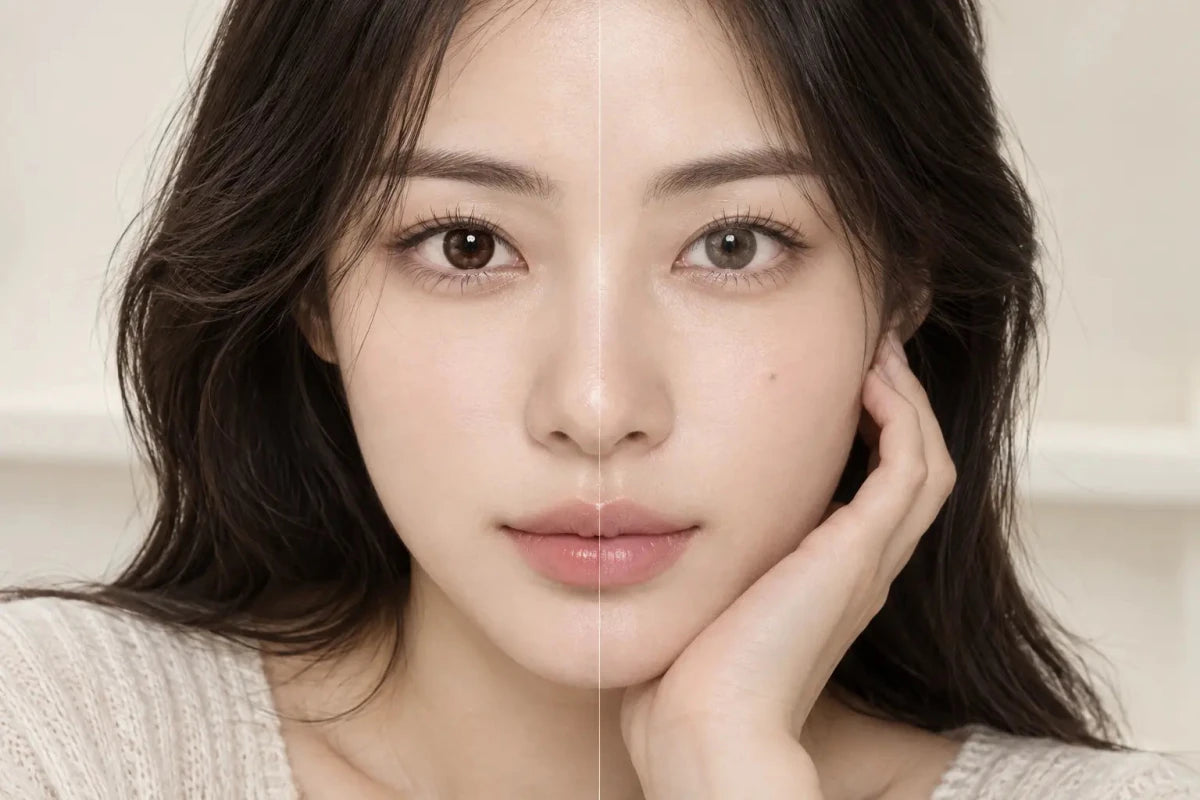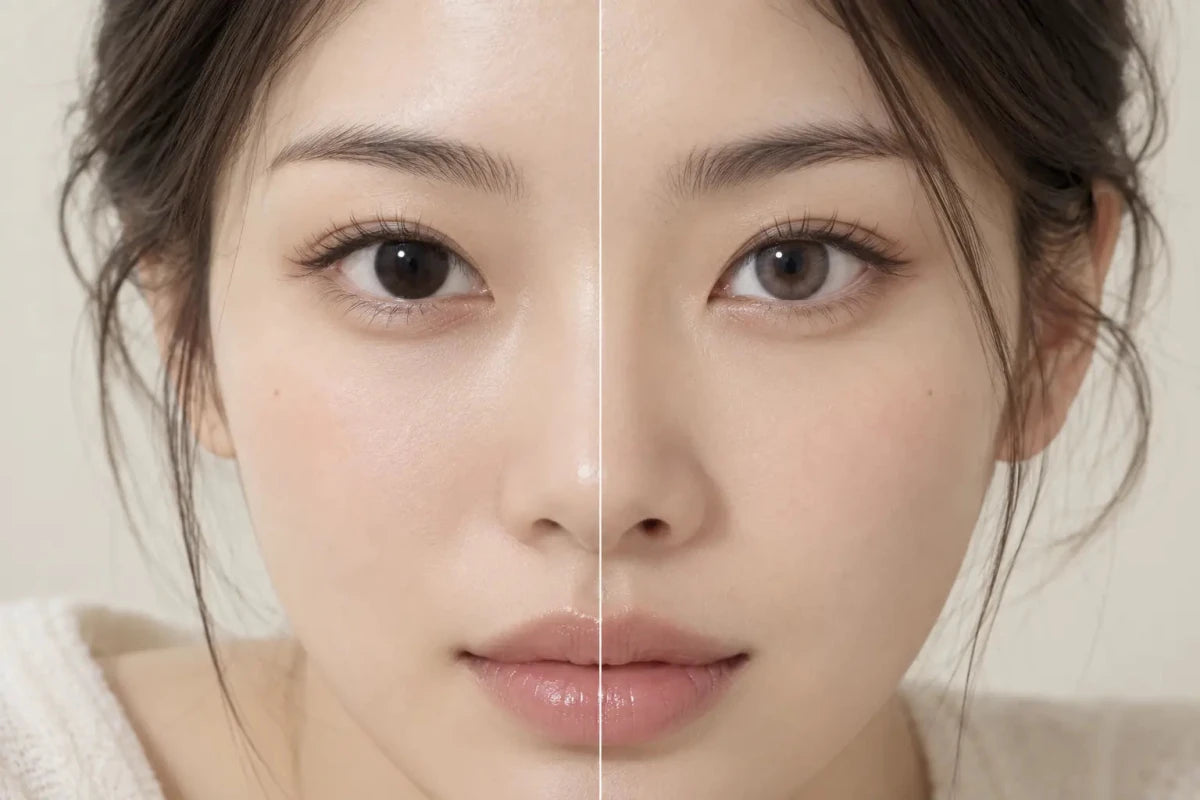


Olive contacts can look brown on dark eyes because olive is already a mixture of green, yellow and brown, and a translucent print allows the natural dark-brown iris to deepen that mixture. Warm indoor lighting, a golden center and low green-pigment density can push the final appearance further toward brown. For a result that stays visibly olive, evaluate the exact print—not the shade name alone.

Why Olive Often Becomes Brown-Olive
Olive is not a pure green. It lives between green, yellow and brown, so small changes in the wearer’s iris or surrounding light can change which component is most noticeable. On a near-black brown iris, a sheer olive print often retains the depth and warmth underneath. The result can look softly brown from normal viewing distance even when the printed lens looks green in its blister or product swatch.
This effect can be attractive when the goal is a natural, earthy change. It becomes a problem only when the shopper expects a clearly green result. The most useful question is therefore not “Is this shade called olive?” but “How much cool green survives on eyes like mine under ordinary light?”
A dark outer ring can make the lens look more defined without making the middle greener. A golden inner burst can create visible olive in daylight but brown or hazel indoors. A cool sage or khaki print may retain more green, but only if the printed density and coverage are sufficient. Each part needs separate inspection.
Five Variables That Change the Result
1. Natural iris color
The open and semi-transparent spaces in the lens reveal the wearer’s eye. Very dark brown adds depth and can reduce the apparent brightness of a translucent green. A result photographed on medium brown or hazel eyes is not a direct prediction for black-brown eyes.
2. Green-to-gold balance
An olive lens with a yellow or amber center will tend toward hazel and brown. One built from sage, moss or gray-green tones is more likely to stay recognizably green. Marketing names are inconsistent, so examine the actual print and on-eye images.
3. Pattern density
A dense print can mask more of the natural iris, while a fine translucent pattern blends with it. Density is not the same as graphic diameter: a large printed zone may still be very sheer, and a smaller zone may contain concentrated pigment.
4. Pupil opening and gradient
A wide transparent center can create a noticeable ring of natural brown around the pupil. A gradual transition can mix that brown into olive smoothly. A sharply separated golden center can emphasize warmth even when the outer area is green.
5. Lighting and camera processing
Warm bulbs strengthen yellow and brown. Neutral daylight reveals more green. Phone cameras may change white balance, exposure and saturation automatically, while ring lights can make a lens appear brighter than it will across a room.
Which Olive Designs Stay Greener?
| Design direction | Likely result on dark eyes | Primary check |
|---|---|---|
| Cool sage or gray-olive | Muted but recognizably green | Whether the print is dense enough indoors |
| Moss green with a soft edge | Earthy green-brown blend | Face-level visibility in neutral light |
| Golden olive or khaki | Warm hazel, brown-olive or amber | Color and width of the inner ring |
| Sheer olive gradient | Very natural; may disappear into dark brown | Photos on a similar starting iris |
| Dense olive with defined ring | Most obvious color and outline | Whether the contrast suits the intended look |
No row guarantees a result. It describes a visual direction useful for narrowing choices. The exact product version, prescription range and fit still need confirmation before color comparison becomes relevant.
How to Read Olive Contact Product Photos
Find a bare-eye reference. A before image or stated natural eye color lets you estimate how much of the result comes from the lens. Without it, use the image mainly to understand pattern placement.
Look at neutral areas. If white clothing, the sclera or a gray backdrop appears yellow, the entire image has a warm cast. The lens may look greener under neutral light. If those areas appear blue, a cool edit may exaggerate green.
Compare a close-up with a full face. The close-up shows dots, rings and pupil transition. The full-face image shows whether olive remains visible at conversational distance. An everyday-natural shopper should not rely on a macro photo alone.
Check more than one environment. Daylight and indoor views answer different questions. Daylight reveals the available green; indoor light shows whether the effect remains distinct during ordinary use.
Do not confuse model makeup with lens color. Green, bronze or brown eye shadow changes perceived contrast. If possible, compare images with neutral makeup or focus on the relationship between the lens and natural iris rather than the full palette.
How to Choose Olive Contacts That Stay Visibly Green
- Define the target: choose earthy brown-olive, muted sage or clearly green olive before opening product tabs.
- Confirm the prescribed product options: check the exact brand, measurements and power availability for both eyes first.
- Prefer cool olive evidence: look for sage, moss or gray-green print rather than a strong amber center when avoiding brown is the priority.
- Demand comparable photos: prioritize images on black-brown or very dark brown eyes under neutral and indoor light.
- Judge edge and center separately: decide how much limbal definition and pupil warmth you want instead of treating the pattern as one flat color.
- Use face-level visibility as the final test: select the lens whose green remains apparent at the distance that matters to you.
If an olive lens looks brown in most dark-eye images, it is better categorized mentally as a subtle earthy blend. Do not assume that a larger graphic diameter or a lighter product swatch will solve the issue. Search for stronger cool-green density and better evidence instead.
Prescription and Fit Are Not Color Variables
Do not change contact-lens measurements, brand, spherical power, cylinder or axis to obtain a preferred shade. Decorative lenses require professional fitting and a prescription in the United States, including zero-power designs. Follow the prescribed replacement and care routine, never share lenses, and remove them promptly if pain, persistent redness, discharge or reduced vision occurs.
Frequently Asked Questions
Does olive always look hazel on dark eyes?
No. Golden olive often leans hazel, while a cool sage or gray-olive print can remain greener. Pattern density and lighting matter as much as the name.
Why does olive look greener outdoors?
Neutral daylight can reveal cool green pigment that warm indoor light suppresses. It can also make the printed pattern and natural iris easier to distinguish.
Will a black limbal ring make olive greener?
Not directly. It increases outer-edge definition and contrast, but the middle and inner pigments determine whether the lens reads green, hazel or brown.
Does a larger graphic diameter improve olive coverage?
Not necessarily. Graphic diameter describes printed area, not opacity or green-pigment density. Inspect the exact pattern and on-eye result.
Should I choose green instead of olive?
Choose green if clearly green visibility is the priority. Choose olive when you want an earthy, muted blend and accept that dark eyes may make it browner.
Can I predict the exact color from a lens-in-case photo?
No. A product swatch removes the influence of your iris, pupil, lighting and distance. Use it for print structure, then confirm with comparable on-eye photos.