Buying guides
10p, 20p and 30p Contact Lenses: How Many Wearing Days?
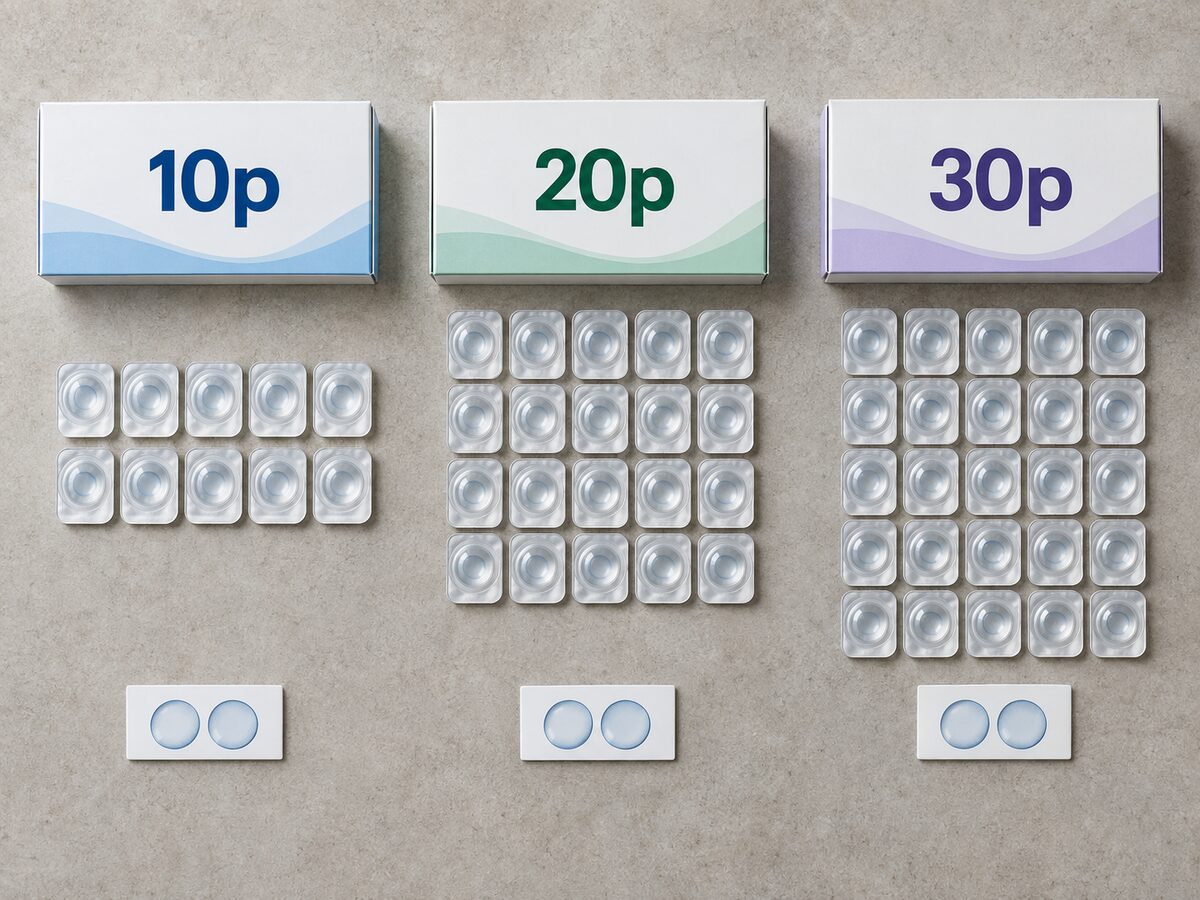
A “10p,” “20p,” or “30p” contact lens package often describes the number of individual lenses, but always confirm the unit on the exact product listing and package. If the unit is individual lenses, 10 pieces equal five pairs; 20 pieces equal ten pairs; 30 pieces equal fifteen pairs. For daily disposable lenses, that count can help estimate supply. For reusable lenses, piece count does not tell you how many days or months the lenses may be worn.
In this guide
Confirm what “p” means on the exact product
Online shorthand such as 10p, 20p, or 30p is not enough by itself to establish package contents. Check the product page and the supplied box for whether the count means individual lenses, pairs, or another package unit. Also confirm whether the box is configured at one prescription power or includes multiple powers. Do not infer those details from the product title alone.
When the listing confirms individual lenses, the basic conversion is:
- 10 lenses = 5 pairs
- 20 lenses = 10 pairs
- 30 lenses = 15 pairs
A pair here means one lens for each eye for one wearing occasion. This conversion is a piece count only. It does not establish a replacement schedule, suitability, or how long a reusable lens may be worn.
Convert individual lenses into pairs
For a daily disposable product where both eyes use the same prescribed power and one lens is worn in each eye per day, divide the number of lenses by two to estimate the number of complete two-eye days:
| Confirmed individual lenses | Complete pairs | Two-eye daily supply at one power |
|---|---|---|
| 10 | 5 | 5 days |
| 20 | 10 | 10 days |
| 30 | 15 | 15 days |
This simple table assumes that the box contains individual daily lenses at the needed power and that both eyes can use that same power. It is a quantity estimate, not a recommendation about how often to wear contacts. Follow the product’s labeling and your eye-care professional’s instructions.
Calculate daily supply for both eyes
Start with your expected wearing days, then calculate each eye separately. If you plan to wear daily lenses on 12 days, you need 12 lenses for the right eye and 12 for the left: 24 individual lenses total. If the product is sold in boxes of 10 individual lenses at one selected power, you may need three boxes to cover 24 lenses, leaving some lenses for later. Check whether the package count and power selection on the current product page match this assumption.
Use this formula when one box contains a single prescription selection:
Boxes per eye = the number of wearing days for that eye ÷ lenses per box, rounded up to a whole box.
Then calculate the right and left eyes independently if their prescriptions differ. For example, if each eye needs 12 daily lenses and each box contains 10 lenses at the selected power, the estimate is two boxes for the right eye and two for the left eye. That is four boxes total. If both eyes use the same power and the retailer permits a single box to supply both eyes, two 10-lens boxes provide 20 lenses, or 10 complete pairs; a third box is needed to reach 12 days.
Actual checkout options vary by product. Confirm the selected power, quantity, and number of lenses per box in the cart before payment. Do not assume that one box automatically includes two powers.
Account for different prescriptions
Many contact lens boxes contain one selected power. When the right and left eyes require different powers, a box selected for one eye may not provide the correct lenses for the other. Calculate the need for each eye, then check whether the listing supports separate right- and left-eye selections or requires separate boxes.
For example, a confirmed 10-lens box at one power supplies ten lenses for that selected power. It does not become five lenses for each eye when the eyes have different prescriptions. If each eye needs a different power, you may need one box configured for each eye’s power. The exact product page and cart determine what can actually be ordered.
Use your current contact lens prescription and the exact product identity. If the prescription or lens model is unclear, ask your eye-care professional. A similar shade name or a matching power value alone does not establish that a different lens is an approved substitute. The FDA describes contact lens prescription information, and its buying guidance explains why contact lenses should be purchased using the exact prescription.
Reusable lenses follow a different calculation
For reusable lenses, the number of individual lenses does not translate directly into wearing days. A pair may be worn according to the product’s prescribed replacement schedule and care instructions, but the schedule is not extended by having extra pieces in the box. A 10-piece package could contain several pairs, yet it does not mean ten days of wear or ten months of use.
Keep three questions separate: how many individual lenses are in the box, how many lenses make a pair for your prescription needs, and what replacement schedule applies to the exact product. Follow the package instructions and your eye-care professional’s advice for cleaning, storage, and replacement. Never reuse a daily disposable to stretch the quantity.
If the product page does not clearly say whether the count refers to pieces or pairs, or does not make the replacement schedule clear, pause and verify those details before ordering. Guessing can lead to a short shipment, the wrong powers, or a misunderstanding about replacement timing.
Order checklist
- Confirm that “p” means individual lenses on the exact listing and package.
- Confirm daily disposable or reusable format and read the replacement instructions.
- Check how many lenses are in one box and whether one box contains one power or more.
- Calculate the right and left eye separately when their prescribed powers differ.
- Check current selectable options, cart quantities, and total individual lenses before checkout.
- Ask the seller about package contents or listing details; ask an eye-care professional about prescription and fit.
Once the unit and prescription configuration are clear, box math is straightforward: count the individual lenses needed for each eye, divide by the package count for that power, and round up to whole boxes. Keep the replacement schedule as its own instruction. That gives you a reliable quantity estimate without mistaking pieces for pairs or package count for wear time.
Package abbreviations and configurations vary by product. Confirm current listing and package details before purchase. Quantity examples are arithmetic illustrations, not product availability statements.