Lens reviews & comparisons
Cocoview Arti Olive Brown vs OLENS Ending Olive: Color and Specs
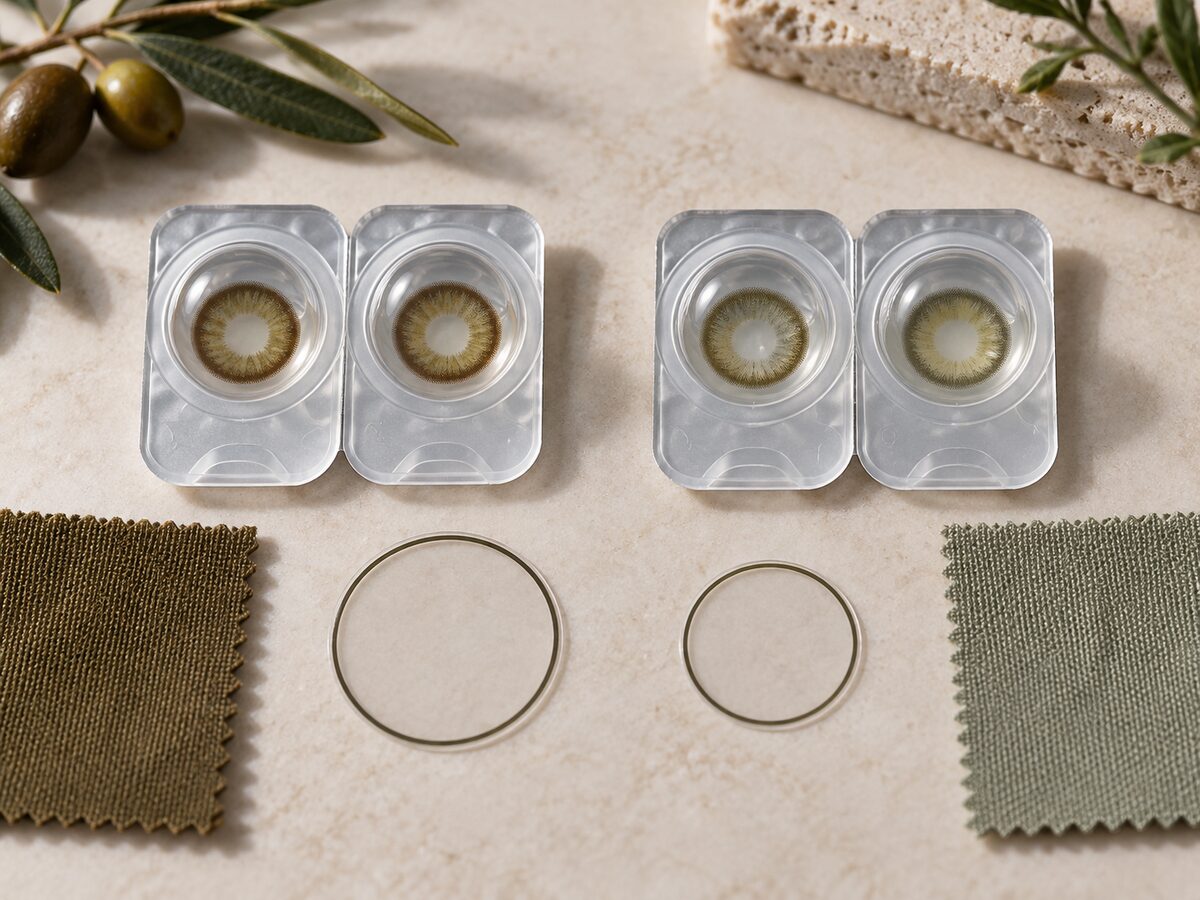
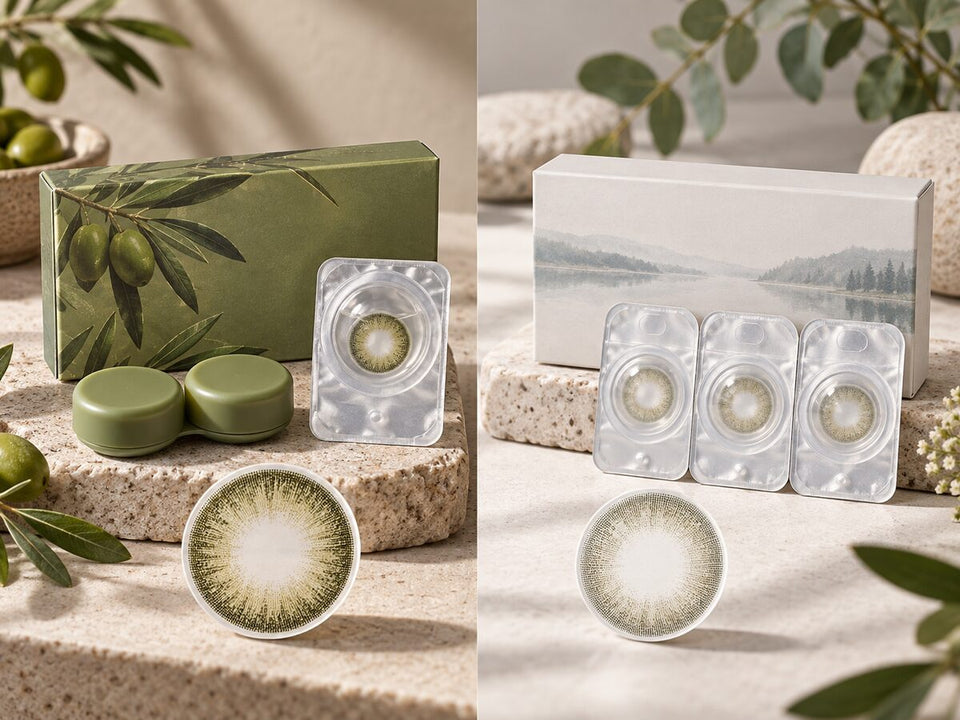
Cocoview Arti Olive Brown and OLENS Ending Olive share “Olive” in their names, but the current KPOP2 listings identify different daily lens designs and color categories. Both now list a 13.2 mm graphic and ten individual lenses per box. Arti is categorized as Brown, while Ending is categorized as Green. Use the full product names and verified specifications, then compare relevant photographs instead of expecting the shared word to produce the same color on your eyes.
In this guide
Use the current product identity before comparing shades
The current Cocoview listing is Arti Olive Brown (10p). An older spelling, “Arty,” can send a shopper through a redirect or to an outdated saved note. The live OLENS listing is Ending Olive (10p). Both are daily disposables with ten individual lenses per box. Record the full brand and model because the shared word “Olive” is not enough to identify either lens.
Current KPOP2 descriptions list a 13.2 mm graphic diameter for both. This corrects the older comparison that gave Arti a smaller number. A shared graphic value is useful for accuracy, but it does not turn the two prints into one design. The products still differ in brand, catalog color category, base curve, listed material, and water content. The visual question is therefore about color placement, pattern, and your iris rather than a 0.7 mm graphic gap.
“Olive” can point toward brown or green
Arti Olive Brown is categorized as Brown in the current KPOP2 listing. OLENS Ending Olive is categorized as Green. Those are shopping classifications; they are not standardized measurements of pigment or promises about the outcome on every eye. A brown-oriented olive effect might appeal to someone who wants a warmer look, while a green-category olive effect might appeal to someone exploring a cooler or greener direction. Actual appearance has to be judged from the exact design in relevant photographs.
Under warm indoor light, an olive lens may look more brown or muted. Under daylight, a green tint may be easier to notice. A camera's white balance and filters can strengthen or suppress those cues. If the product image was taken on light eyes and your iris is dark brown, the printed color may interact differently with your background. Avoid predicting a universal result from the category or a single image.
A useful personal brief is specific: “I want an olive association but mostly brown in a full-face portrait,” or “I want green to remain visible at conversation distance.” With that brief, compare close-up and full-face images for the exact products. If the evidence does not show the same starting iris and light conditions, keep the conclusion tentative.
The same 13.2 mm graphic can produce different impressions
Graphic diameter describes the stated extent of the printed design. It does not describe exactly how dark the outer border is, how much color sits near the pupil, or whether the print is dense or dispersed. Arti and Ending both currently list 13.2 mm, so the number cannot rank them by apparent size. Compare the pattern rather than inventing a size difference.
Look at the outer edge in a labeled lens illustration or close-up. Does the ring appear sharply defined or diffused? Then inspect the middle of the print. Is the apparent brown or green concentrated toward the edge, or blended through the iris? Finally, look near the pupil and note how the printed color transitions into the original iris. Each observation describes an image, not a measured opacity value or a guarantee for your eyes.
The full lens diameter is 14.2 mm for both products. That is a physical-lens measurement and should not be confused with the printed area. A shared overall diameter does not establish identical fit. Arti lists an 8.6 mm base curve and Ending an 8.7 mm base curve; they also have different material labels. A professional fitting is necessary to determine whether either exact lens is suitable for you.
Make the available images more comparable
First confirm image identity. A picture labeled only “olive contacts” could show a different brand, shade, or replacement format. Look for the complete product name, a link to the exact listing, or packaging that matches the product. If a photo seems inconsistent with the listing, treat it as an open question and do not use it as proof of this design's look.
Then compare like with like. Use a close-up and a full-face portrait for each product when available. Prefer similar starting iris colors, daylight versus daylight, and comparable camera distance. A cropped studio photo of Arti and a shadowed phone selfie of Ending do not form a fair brightness comparison. Note filters, ring lights, and colored makeup that may change the impression.
If you have an appropriately fitted lens already, make a repeatable personal reference: photograph it in indirect daylight and ordinary indoor light using the same device, distance, and makeup. Store the exact model name with the images. This record can sharpen your style preference, but it does not establish that the other product will fit your eyes or look identical to another person's photo.
Decide which difference matters most to your search
If your main question is color family, compare Arti's brown category with Ending's green category using verified photos. If your main question is a smaller listed graphic, these two current listings do not resolve it because both say 13.2 mm. Broaden the search to another professionally appropriate lens with a truly different listed graphic, then compare its complete specification sheet and images.
If your main question is comfort or fit, do not use the color category, water content, or graphic size as a shortcut. Arti's current listing gives HEMA and 45% water; Ending's gives phosphorylcholine and 48% water. Those differences identify the materials but do not rank personal comfort, oxygen performance, or allowable wear time. Bring the exact products and your experience with current lenses to an eye-care professional.
If your main question is value, start by counting the physical lenses. Both boxes contain ten individual daily lenses. At the same prescribed power in both eyes, one box can provide five complete two-eye occasions. With different powers, one box per eye's correct power can provide ten matched occasions. Current price and shipping must be checked at checkout; a catalog article should not state a total that may have changed.
Check the prescription before settling on a shade
Both current listings give a general power range of 0.00 to -8.00. That does not guarantee that every value within the range is currently selectable or in stock. Open each exact product's power menu and compare it with the contact lens prescription for each eye. Do not pick a nearby value if your option is missing, and do not assume a glasses prescription supplies every contact lens detail.
A switch from Arti to Ending, or the reverse, is a switch between different products. The shared 13.2 mm graphic and 14.2 mm overall diameter do not authorize substitution. The differing base curves and materials reinforce the need to confirm the exact lens with your eye-care professional. The FDA buying guidance explains the importance of obtaining the prescribed contact lens.
If a desired option is unavailable, ask about the exact power or consult your professional about an alternative. Keep suitable glasses available when a contact lens order cannot be completed. A planned event or preferred color does not justify a wrong power, a borrowed lens, or a product that has not been confirmed for your eyes.
Daily handling and ten-lens box count
Each daily lens is intended for one use. Wash and dry your hands before handling it, inspect the unopened blister and lens, and follow the package and professional instructions. Discard the lens after removal. Do not soak it for a later day or treat a 10p box as a reusable supply. The FDA lens-type guidance describes the daily disposable format.
For an event plan, count two lenses per occasion when both eyes wear contacts, plus spares for the powers needed. For example, four two-eye occasions use eight individual lenses, leaving two lenses from a ten-lens same-power box as one spare pair. If the eyes need different powers, check the supply in each power-specific box separately. A spare for only one eye is not a complete extra pair.
Avoid water exposure while wearing contacts. Do not swim or shower in them, and do not rinse them with tap water. If you develop pain, unusual redness, discharge, light sensitivity, or a vision change, remove the lens and seek professional advice promptly. The CDC contact lens guidance covers handling and water precautions.
Save a corrected record for a future reorder
Write down “Cocoview Arti Olive Brown (10p)” or “OLENS Ending Olive (10p),” the daily format, exact power for each eye, and the product URL. Do not save a note that says only “Arty” or “olive.” The current spelling and complete name help you reach the right listing and distinguish a redirect from an actual change in lens specifications.
At delivery, check the sealed box against the order: product, brand, shade, quantity, power, expiration date, and packaging condition. Resolve mismatches before opening. Recheck the live listing before a later reorder because specifications, options, images, and availability can change. A corrected record is useful precisely because it preserves the product identity that a vague shade name loses.
Questions about the current listings
Is Cocoview Arty Olive Brown a different product from Arti Olive Brown?
The older article and saved link used “Arty,” while the current KPOP2 product title and destination use “Arti.” The old URL redirects to the current Arti listing. Use the live product name, package, and specifications for a new order. Do not infer from a spelling change alone that a different physical lens was supplied in an earlier order; compare the actual packaging and ask the store if the history matters for your reorder.
Which product has the larger graphic?
Neither current listing has a larger stated graphic. Cocoview Arti Olive Brown and OLENS Ending Olive both list 13.2 mm. The printed patterns may still look different, and the shared measurement does not mean the lenses fit alike. If you need a truly smaller graphic, compare another exact product rather than relying on the outdated 12.5 mm figure.
Will Ending Olive always look greener than Arti?
KPOP2 categorizes Ending as Green and Arti as Brown, which is a useful search distinction. It is not a controlled outcome on every iris. Natural eye color, lighting, camera settings, and the printed pattern affect the visible result. Compare clearly labeled photographs of the two exact lenses on eyes similar to yours when possible.
Does Ending's 48% water make it healthier or more comfortable than Arti's 45%?
No such conclusion follows from the percentages alone. The products also use different listed materials, and individual fit and tear film matter. This article has no clinical comfort comparison. Ask an eye-care professional about the exact lens if comfort or eye health is the deciding concern.
Can one ten-lens box cover ten occasions?
Not for two eyes using the same power: ten individual lenses create five complete two-eye sets. If the eyes have different powers and you buy a ten-lens box at each correct power, that pair of boxes can create ten complete sets. These are packaging calculations, not advice to wear contacts on a particular schedule.
Related categories
For the next brown-lens comparison, browse Brown Contacts, Daily Contacts, Monthly Contacts. Treat a collection as a discovery route, then verify the exact model, replacement schedule, package count, measurements and available prescription selections on the product page.
Questions and answers
Are Arti Olive Brown and Ending Olive the same color?
They are different designs, and KPOP2 currently categorizes Arti as Brown and Ending as Green. Those categories help identify the products but do not establish the precise result on your eyes. Compare clearly identified images under relevant conditions before judging their appearance.
Which has the smaller listed graphic?
Neither current listing has a smaller stated graphic: both give 13.2 mm. That shared measurement does not imply identical prints, equivalent fit, or the same result on every iris.
Does the common 14.2 mm diameter make them interchangeable?
No. Their base curves, materials, water fields, and graphic designs differ, and a shared overall diameter does not establish an approved substitution. Confirm the exact prescribed lens with your eye care professional rather than choosing solely from the matching row.
Does ten pieces mean ten wearing days for both eyes?
At one shared power, ten individual lenses provide five complete two-eye occasions. With different powers, a ten-lens box for each eye can provide ten complete occasions. These calculations assume one appropriate daily lens per eye each time and do not authorize reuse.
Is 48% water necessarily more comfortable than 45%?
No. The percentages alone do not predict comfort for your eyes or establish a longer wearing allowance. This comparison does not include a clinical comfort test. Discuss fit and comfort concerns with your practitioner using the exact products involved.
What if a photograph seems to show another shade?
Treat that as an identity question and ask which exact product the photograph depicts. Do not use a potentially mismatched image as evidence for the selected shade. Check the full brand and design name rather than relying only on “Olive.”
Product records rechecked September 28, 2026. KPOP2 editorial guidance using KPOP2 product fields and the linked sources. Catalog images and design discussions are not controlled wear tests.