Care & authenticity
Buying Blue Contacts for Brown Eyes: In-Store Checklist

Buying blue colored contacts in a physical store starts with the exact prescribed lens, not the display shade. Confirm the product identity and parameters on a sealed box, check whether the available color photos show a similar brown starting iris, and leave with the right replacement and care instructions. A helpful sales conversation can clarify a product, but it does not replace a contact lens fitting or establish how blue will look on your eyes.
In this guide

Prepare your prescription and questions before the visit
Bring the current contact lens prescription or the precise fitted product details available from your eye-care professional. Glasses prescriptions and contact lens prescriptions serve different purposes, so do not fill in missing lens parameters from your glasses record. If you wear different powers in the right and left eye, write them separately. If you need an astigmatism or multifocal design, verify that the exact colored product offered can meet that prescribed need rather than assuming a standard spherical version will do.
Write down your preferred replacement format and your color goal before entering the store. For example: “I want blue that remains noticeable on dark brown eyes in ordinary indoor light, using the exact daily lens my professional has fitted.” The statement keeps the conversation tied to both appearance and suitability. If you are open to a softer result, say so; staff may otherwise interpret “blue” as the most intense display shade.
Ask whether the specific model, shade, power and other required parameters are actually available. A display lens or poster may represent a version the store does not have in your prescription. Ask to see the unopened sale unit before deciding. If the exact approved product is out of stock, take the proposed alternative's full details back to your eye-care professional rather than approving a substitution by color similarity alone.
Compare the exact sealed box with the fitted lens
Read the full brand and model name, shade, replacement schedule, eye-specific power, base curve and diameter where applicable. Match the packaging to the prescription and any instructions from your eye-care professional. Check the number of individual lenses in the pack, the expiration date and whether the seal is intact. A sealed package is a necessary product check, but it still cannot prove the lens is correctly fitted for you.
Do not confuse printed or graphic diameter with overall lens diameter if the product lists both. The printed area describes artwork, while overall diameter describes the physical lens. Neither measurement alone determines fit, and a larger printed area does not guarantee a brighter blue on brown eyes. Keep the distinction in mind when staff compare two products with different labels.
A practical question at the counter is: “Can we confirm the exact blue model and parameters on this box against my fitted prescription, and can I see its replacement and care directions?” It is more precise than asking only whether the shop sells blue contacts. If a label is unclear, ask for the manufacturer's product information rather than guessing from a shelf card or a similarly named line.
Preserve the box details or receipt after purchase so you can identify the exact lens if you need professional advice. Make a note of which eye receives which prescribed power. Those records also make a future reorder less dependent on remembering a display name that may be shared by several versions.
Why blue can vary so much over brown eyes
Blue contacts are printed designs placed over a naturally colored iris. A sparse or translucent blue pattern may let much of the brown show through. That can produce a cool tint, a mixed gray-blue impression, or very little visible change in dim light. A denser colored mid-zone can make blue more identifiable, yet the transition near the pupil and the outer edge still shape the finished appearance.
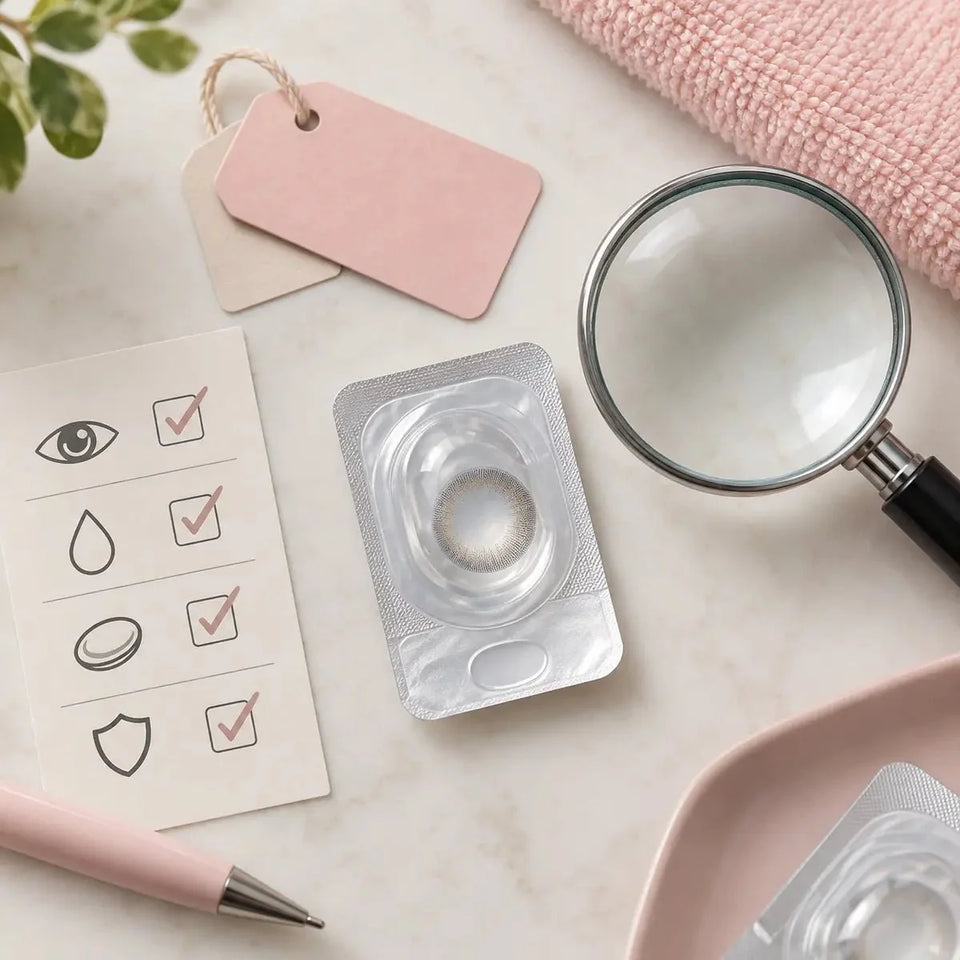
Inspect three areas in a labeled image. Near the center, notice how much brown remains visible through the clear opening. Across the middle, look for densely colored strokes or wider transparent gaps. Around the outside, decide whether a dark limbal ring defines the iris. A dark ring can add contrast even when the blue itself is subtle, so ask whether you like the ring and the color separately.
Light brown and very dark brown are different starting points. A photo on a light iris may show a bright blue that does not translate to a much darker eye. Conversely, a dramatic studio image can exaggerate the effect of a print with a ring light or intense exposure. No seller can guarantee that a shade will match an image on your individual iris.
Look at the result at normal conversation distance as well as close up. A dotted print may be obvious in a macro shot yet blend into a softer overall color from a few feet away. Decide which distance matters for your intended look. This is an editorial way to evaluate appearance, not a measurement of product performance.
Ask what each reference photo actually shows
An image is stronger evidence when it names the exact lens and version, shows the starting eye, and identifies the lighting. A close-up helps you inspect print boundaries; a full-face photo helps you understand everyday impact. Diffuse daylight and ordinary indoor light are more useful for a daily-life choice than a single high-contrast campaign frame.
If a store has a sample display, use it to inspect the print's artwork and color family. Do not treat a dry sample, a flat swatch, or a photograph on a different iris as proof of the final result on you. Never put in a shared display lens. Any on-eye fitting or trial must follow an appropriate professional process with a lens intended for that purpose.
Ask whether an online image belongs to the exact daily or reusable version for sale. Similar product names can cover different prints, materials or parameters. A blue shade photo attached only to the series name leaves an important question unanswered. Mark that uncertainty instead of borrowing evidence from another version.
Use caution with edited reviews. A reviewer who identifies a dark brown starting iris and photographs the exact lens in ordinary light may offer a helpful comparison, but individual results still vary. Filters, makeup, exposure and camera white balance can change how blue reads. Treat a review as one observation, not a clinical or color guarantee.
Separate daily disposable and reusable routines
A daily disposable lens is intended for one use and discarded after removal. It is not cleaned and stored for a second event. A reusable lens follows the manufacturer's replacement schedule and the care system recommended for the fitted product. Replacement frequency is not a measure of how strong the blue print is, and a similar shade name does not mean the two formats are interchangeable.
Before paying, ask staff to show where the replacement schedule is stated on the box or insert. For a reusable product, clarify when its schedule starts and what storage is required between wears. Do not calculate the interval by counting only the days you wore it unless the manufacturer's instructions specifically say to do so. Unopened-package expiry and replacement timing after opening or use are separate checks.
Pack quantity also deserves attention. Ten individual lenses are not ten pairs, and different powers for the two eyes may require separate boxes. Confirm the number of wear days the purchase actually provides under your prescription and format. This affects cost comparisons more than a shelf price alone.
Color is never a reason to extend wear or override an instructed replacement date. If the schedule does not suit how often you plan to wear blue contacts, ask about another appropriately fitted option before buying rather than planning to improvise later.
Leave with the correct care plan
For reusable lenses, confirm which solution and case are appropriate for the exact product and learn the cleaning and disinfection steps. The FDA describes different purposes for lens solutions; a rinse is not automatically a disinfectant. Do not use a homemade mixture or choose a product just because its package says it is gentle.
Wash and thoroughly dry your hands before handling lenses. Avoid tap water and saliva. Use fresh solution as directed rather than topping off old liquid in a case. Follow instructions for replacing and caring for the case. If you use a hydrogen peroxide system, its dedicated neutralizing case and complete neutralization process are essential; never apply unneutralized peroxide directly to your eye.
Ask for written manufacturer instructions and keep them accessible for the first evening. A quick verbal explanation is easy to forget, especially when the store is busy. If the spoken advice seems different from the package or your professional's directions, stop and resolve the difference before wear. Do not guess that blue pigment requires a special cleaning recipe.
For a daily disposable, the after-removal plan is simpler: discard it and use a new one next time, according to its instructions. Simpler does not mean no hygiene. Clean, dry hands and careful handling remain important, and the lens must still be the exact one selected for your eyes.
Your before-checkout and before-leaving checklist
- Identity: The full brand, model, shade and replacement version match the fitted product.
- Parameters: Each eye's prescribed power and any other required values match the box; the seal and expiry are acceptable.
- Appearance: You have identified brown-eye evidence for the exact blue version, or you have recorded that the result remains uncertain.
- Quantity: You know whether the label counts individual lenses or pairs and how much wear the purchase supplies.
- Care: You have written replacement, cleaning or disposal instructions and any required compatible supplies.
- Support: You know where to find the manufacturer's instructions and whom to contact about a product mismatch or eye symptoms.
Keep these checks in your phone notes or on the receipt. If the seller cannot answer a question about product identity, a photo's version or a care system, taking time to verify it is a reasonable next step. A store visit is useful precisely because you can inspect a physical package and ask for documentation before payment.
First wear, follow-up and when to stop
Follow the wearing schedule and insertion instructions provided for your fitted lens. Do not exceed a schedule to finish an event or because the color looks good in photographs. If the lens feels wrong, avoid repeatedly trying to “make it work” through discomfort. Remove it and contact an eye-care professional for guidance.
The CDC's prevention guidance emphasizes proper hand hygiene, avoiding water and following care instructions. Pain, persistent redness, light sensitivity, discharge or blurred vision call for prompt professional advice after lens removal. Keep the box or product identity available so the professional can identify what you wore.
Different questions have different owners. The store can address a packaging, order or return question. An eye-care professional should address fit and symptoms. Do not delay a symptom assessment while waiting for a return-policy answer, and do not assume a refund discussion establishes that a lens is safe to keep wearing.
For general discovery, browse Colored Contacts, then inspect the exact listing and prescribed options. For routine reminders, see KPOP2's wear and care guide. Online categories do not confirm what a physical retailer has in stock today.
KPOP2 Editorial Team · Reviewed September 27, 2026. Color comparisons are editorial guidance, not controlled wear tests or guaranteed results. Prescription and care statements are based on the linked FDA and CDC resources. Current stock and product details must be confirmed with the seller.