Care & authenticity
Can You Store Contact Lenses in the Fridge? Storage Guide
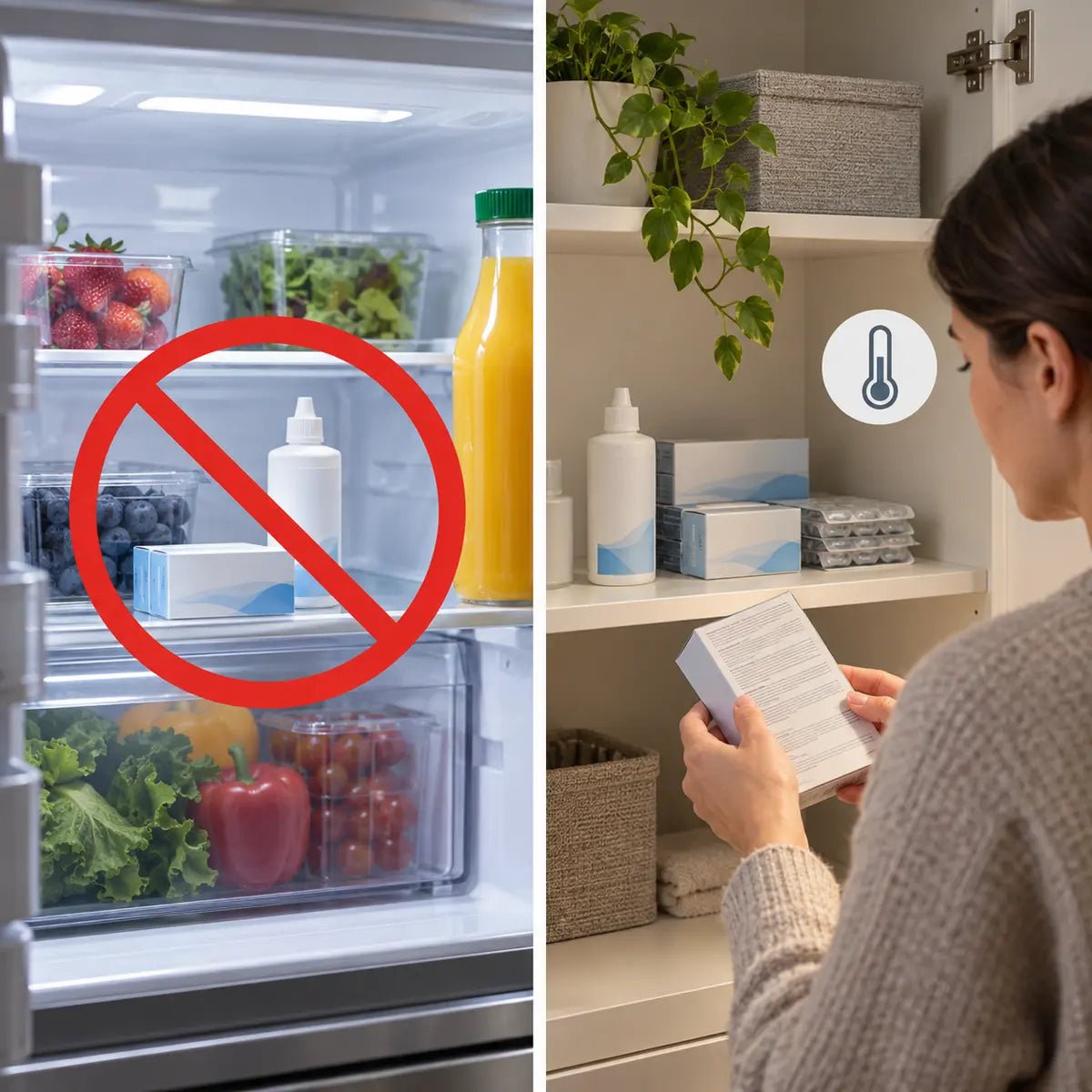
Can you store contact lenses in the fridge? For routine storage, use the conditions printed for your exact lenses and care products; a household refrigerator is not a replacement for those instructions or for disinfection. The right answer also depends on what you mean by “lenses”: an unopened sterile blister, a reusable lens in a case, and a bottle of solution are three different products with different labels. This guide shows how to check each one and what information to gather if a pack was chilled accidentally.

The short answer: follow the product label, not a fridge rule
Do not make refrigeration the default way to store contact lenses. Look for storage conditions on the carton, the package insert, and the instructions for any care system you use. Follow the instructions for the exact model and market version in your hands. If the wording is unclear, ask the manufacturer or your eye-care professional before changing where the product is kept. A temperature recommendation for one brand cannot safely be copied onto another brand's packaging.
Cooling does not sterilize a lens, disinfect an opened case, extend an expiry date, or reset a replacement schedule. If a reusable lens has already been worn, it still needs its prescribed cleaning and disinfection process. If a daily disposable lens has been used, the answer is disposal after that single use, not storing it in a fridge for another day. The KPOP2 wear-and-care guide can help you keep those routines separate.
There is also no reliable visual test for whether a chilled lens is suitable to wear. A sealed blister can look ordinary even when the storage history is outside the information you have. Treat uncertain exposure as a product-specific question. Keep the package intact while you identify its model, lot, and instructions.
First identify which item you are storing
Unopened sterile lens packs
An unopened blister or vial should remain in its original sealed packaging until you are ready to use it. The outer carton often carries the product name, power or other parameters, lot number, expiry, and storage wording. Keeping the carton with the lenses makes it much easier to check those facts if you later have a question. A lens that arrived in a package is not the same as a loose lens moved into another container.
Check the manufacturer’s instructions for unopened stock. Some people assume colder storage must be better for everything sterile; that assumption skips the actual package requirements. Do not move sealed packs between a freezer compartment, a refrigerator shelf, direct sun, and a warm room in an attempt to “preserve” them. If a pack has been exposed to conditions outside its label, gather the facts and request guidance for that specific product.
Opened reusable lenses in a case
A reusable lens in its case is no longer an unopened sterile retail pack. Its safety depends on compatible care products, clean handling, fresh solution, and the full process stated on the care-system label. Refrigerating the case does not stand in for any of those steps. It also does not turn saline into disinfecting solution or make yesterday’s used solution fresh again.
The lens replacement schedule still applies. A monthly, two-week, or other reusable schedule is determined by the prescription and product instructions, not by whether the case felt cool. Do not improvise a new replacement interval from a storage trick. If you are unsure when an opened pair should be discarded, check the instructions and ask the prescribing eye-care professional.
Contact lens solution
Solution bottles have their own storage, opening, and discard instructions. Read the bottle and carton rather than assuming the lens-pack label covers the solution. Keep the cap and nozzle as directed, record when you opened a bottle if the instructions require an after-opening period, and avoid transferring solution into unmarked travel containers unless the manufacturer specifically permits it. A cold bottle does not add cleaning or disinfecting power.
How to read the storage instructions without guessing
Begin with the exact name on the pack. Note whether it is a daily disposable lens or a reusable model, and whether you are reading a lens label or a solution label. Then find the storage statement, expiry, seal condition, and any “do not freeze” or exposure wording. Instructions may appear on the carton, an insert, a manufacturer page for that model, or more than one of these. When sources seem inconsistent, ask the manufacturer to identify the current instructions for your lot and market.
For a colored lens, the shade name and photograph are not enough to identify the medical device. Two colors in one line may share care instructions, but similarly named designs from different models may not. Keep the product name, replacement type, and prescription parameters with your storage note. A recommendation copied from a review or social post lacks this identity check.
Read “store at room temperature” in the context of the manufacturer’s actual wording. Do not invent one universal number for all lenses or solutions. Household fridges vary by shelf and door position; a food thermometer reading from one spot may not describe what happened to a pack beside a freezer wall. If the product has a stated range, compare the actual conditions with that range. If the range is missing or the exposure is uncertain, record the uncertainty instead of rounding it into an answer.
Keep the package sealed when asking for clarification. Opening it to inspect the lens can remove useful evidence about the original package and creates a new handling question. Check whether the foil is lifted, the blister leaks, the vial cap is damaged, or the contents look unusual. Do not use a damaged or leaking pack. Photograph the label and any visible defect so you can give the manufacturer an exact description.
If your contact lenses were already put in the fridge
First, separate the affected items from your ready-to-wear stock. Leave sealed packs sealed. Write down what was chilled: unopened lenses, an opened lens case, a solution bottle, or several of these. The next step differs for each. “My contacts were in the fridge” is too broad for a reliable answer.
Record how long the items were there and where they sat. Was the pack on a refrigerator door, a shelf near a freezer compartment, or beside an ice pack? Did you see ice, frozen contents, leaking solution, a lifted seal, or condensation inside a package? Do you know an approximate temperature, or only that it felt cold? An honest “unknown” is useful; it tells the manufacturer what cannot be confirmed.
Then contact the manufacturer or seller with the exact product name, lot number, expiry, market version, and storage history. A clear question is: “This unopened model and lot were in a household refrigerator for approximately this long. I did or did not observe freezing or package damage. Is that within your labeled storage conditions, and what should I do with this pack?” Ask separately about a solution bottle or opened case because its instructions may differ.
Do not microwave a pack, boil it, put it in hot water, or open it to warm the lens in your hand. These actions do not establish that the original storage conditions were acceptable. Do not wear a questionable lens as an experiment. If you need lenses immediately, use a known suitable pair that has been stored and handled according to its instructions, or ask your eye-care professional about your options.
One night in a fridge does not automatically prove a sealed pack is unusable, and a normal-looking pack does not automatically prove it is usable. The decision turns on the specific label, the exposure, and the condition of the package. Keep that distinction in mind when you see categorical answers online. If no one can confirm the conditions, leave the affected product on hold rather than converting uncertainty into a wear decision.
Refrigeration, freezing, and heat are different questions
“Cold” is not a precise storage history. A refrigerator shelf, a freezer, an ice pack in a small bag, and a delivery parcel left outdoors can expose products to different conditions. A pack touching an ice pack may experience more concentrated chilling than another item in the same bag. Ask about the actual event, not just the name of the appliance.
If you suspect freezing, visible ice, a cracked container, leakage, or a compromised seal, set the product aside and request product-specific guidance before considering use. Do not assume thawing reverses the exposure. The same caution applies to excessive heat or prolonged direct sunlight: do not try to “correct” one extreme with another. Packaging and solution conditions matter alongside the lens itself.
For unopened stock that has never been chilled, the practical approach is simple: choose a storage place consistent with the product label, protect the carton from damage, and avoid avoidable temperature extremes. For a product that has already been exposed, document the event. These are different decisions; the ordinary storage advice does not certify a particular exposed pack.
Why an opened lens case still needs proper care
CDC guidance says reusable contacts require the recommended cleaning and disinfecting process, including fresh solution and the steps specified for that solution. Do not top off old solution with new solution. Saline can rinse in situations described by a care system, but saline alone does not disinfect contact lenses. Water, including tap water, is not a substitute for lens solution. A fridge does not change these rules.
Before handling lenses, wash and dry your hands as your eye-care professional has instructed. Use the care system compatible with your lens and follow its stated rubbing, rinsing, soaking, and case instructions. Different systems work differently. Hydrogen peroxide systems, for example, require their supplied special case and complete neutralization time; peroxide must never be put directly into an eye. Do not shorten a labeled process because a case has been kept cool.
Care for the case itself as directed. The case is a reusable accessory that can become contaminated; it is not a sealed sterile lens pack. Follow current instructions for emptying, rinsing with the specified solution, drying, and replacing the case. Do not rinse it with household water or store used solution for later. If your own care product gives a different case procedure, follow that product’s label and ask a professional if the directions conflict.
Do not leave lenses soaking indefinitely because they are in a refrigerator. Care systems can have limits on how long lenses may remain in solution and when a fresh disinfection cycle is needed. Read the particular solution label. If you cannot identify the solution, the opening date, or how the case was handled, a cold temperature cannot fill those gaps. Pause and get an appropriate care plan before wear.
Set up a routine you can follow at home and away
At home, keep unopened lenses in their labeled cartons so you can find the model, lot, expiry, and storage text. Put opened care products where their labels remain readable, and note the opening date when relevant. Mark any pack on hold with a reason so no one else treats it as a spare. Keep daily disposable stock separate from reusable lenses and cases; the two routines should never be confused.
For travel, check both the destination conditions and the journey. A car in sun, checked baggage, an ice pack, or a cold outdoor delivery point may raise a different storage question. Choose a location that fits the labels for the lenses and solution rather than automatically chilling everything. Retain the original packaging where possible, especially for a trip long enough that you might need to identify a lot or expiry.
Plan the care routine before leaving. If you use reusable lenses, bring the compatible solution and case and allow the full required disinfection time. If that is difficult for a particular trip, ask your fitter whether an appropriate daily disposable option exists for you. The convenience of travel does not authorize changing your prescribed lens model, prescription, or wear schedule on your own.
When an online order arrives, inspect the outer packaging and each blister or vial before using it. Keep any suspect item separate, photograph it, and contact the seller with the order details. A delivery delay or seasonal weather alone does not establish the product’s temperature history; ask for information rather than assuming all parcels were exposed in the same way.
Frequently asked questions
Does refrigeration make contact lenses last longer?
No. Do not extend the printed expiry of a sealed pack, the after-opening period of a solution, or the replacement schedule of a reusable lens because it was refrigerated. Follow each product’s own dates and instructions.
Can I refrigerate daily disposable lenses?
Store unopened packs according to their label. A daily disposable lens is for its stated single-use schedule; refrigeration does not turn a used daily lens into a reusable one. Discard it after use as directed.
Is a sealed pack safe if it spent one night in the fridge?
The time alone does not answer the question. Check the exact storage instructions, approximate exposure, whether freezing occurred, and the package condition. Ask the manufacturer when those facts are uncertain. Do not open or wear the pack to test it.
What if a blister or vial appears frozen?
Keep it out of use and retain its packaging. Note the model and lot, photograph visible ice or damage, and ask the manufacturer for guidance. Do not heat it rapidly or assume a thawed pack has returned to its original condition.
Can I store my reusable lens case in the fridge overnight?
Use your lens and solution exactly as their care instructions specify. Cold storage does not replace fresh solution, cleaning, disinfection, or case care. Ask your eye-care professional or the product manufacturer if the required conditions are unclear.
Does saline work if I keep the case cold?
No. Saline alone does not disinfect lenses, regardless of temperature. Use a compatible disinfecting care system according to its label. Never substitute water for lens solution.
Can I cool hydrogen peroxide solution or its case?
Follow the exact peroxide system’s storage and operating instructions. Its special case and full neutralization period are essential; do not change the process to create a cooler feel. Ask the manufacturer about any accidental exposure outside its instructions.
What if a lens feels uncomfortable after storage?
Remove the lens and contact your eye-care professional promptly, particularly if you have pain, redness, light sensitivity, or a change in vision. Keep the package and describe the storage and care history. Do not diagnose the cause from temperature alone or keep wearing the lens to see whether it improves.
Sources and limits: Follow the exact lens and solution labels for product-specific storage. General care guidance: CDC: Cleaning, Disinfecting, and Storing Contact Lenses and FDA: Contact Lens Care. The advice to hold a temperature-exposed pack pending manufacturer guidance is a precaution, not a claim that every chilled pack is damaged.