
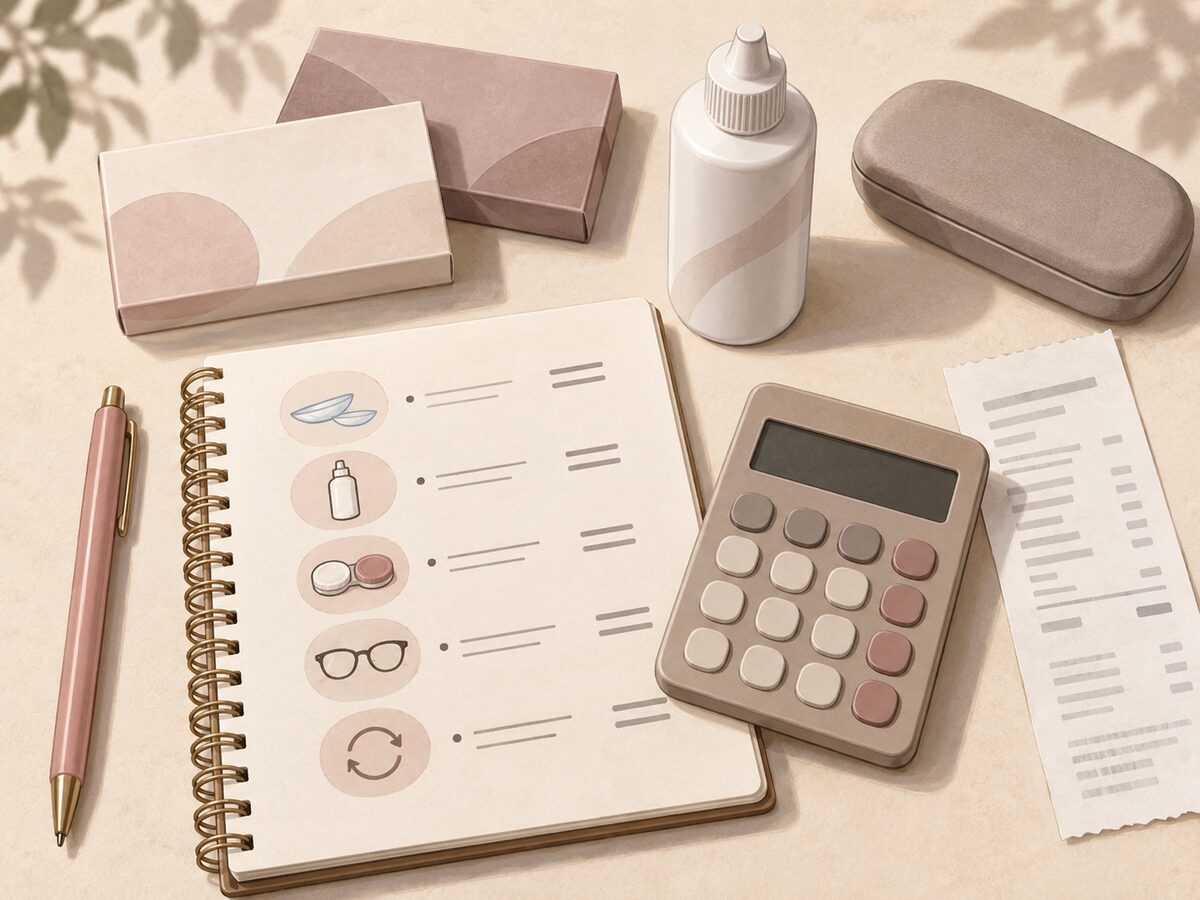
The price of one box is not the full cost of wearing colored contacts. Build your budget from the exact prescribed product, the boxes needed for both eyes, fitting and follow-up costs, any required care supplies, and the final delivered order total. Compare the same planned period and keep unused supply visible rather than treating every lens bought as a lens worn.
In this guide
Choose the comparison period before comparing prices
Start with an ordinary month, a trip or a set of planned occasions. Write down what you are budgeting for. A person hoping to wear lenses on four occasions has a different purchasing question from someone following a regular wearing routine throughout the month.
Do not turn the budget period into a wearing instruction. Your practitioner and the product directions establish the permitted routine. The budget records the cost of that routine after it is confirmed.
If you are comparing daily and reusable options, confirm that each exact product is professionally appropriate before comparing their totals. A cheaper format is not automatically an interchangeable lens. The FDA buying guide advises against accepting a substitute without professional approval.
Keep two totals: what you must pay now and what supply remains afterward. This avoids a common comparison error in which one option is priced by the checkout amount while another is priced only by the lenses expected to be used.
Count individual lenses for each eye
Read Package as individual lenses per selling unit, then check the selected configuration. One box is not necessarily one pair. If your eyes need different values and each box has a single selected configuration, allocate the boxes separately.
Here is a quantity example, not a product recommendation or a current price quote. Suppose a prescribed daily product comes in ten-lens boxes and you plan four complete two-eye uses. Those uses require eight individual lenses, before any reserve.
- If both eyes use the same confirmed configuration, one ten-lens box supplies those eight lenses and leaves two.
- If the eyes require different configurations, one ten-lens box for each eye means buying twenty lenses. After four uses, six remain for each eye.
- If a later occasion follows removal of the first daily pair, account for a fresh pair when further wear is appropriate under your instructions.
That is why a theoretical cost per lens and the cash needed at checkout can differ. The package-count guide provides more quantity examples.
A promotion can also change the number of units supplied. Read the exact offer, selectable options and final cart. Do not assume that the large price beside the title is already the total for both eyes or all the boxes you intend to receive.
Ask about fitting and follow-up charges
Before booking, ask the practice what services the quoted fee includes. Is the appointment an eye examination, a contact-lens fitting, or both? Are follow-up visits part of the quoted arrangement? Record the answer for that practice rather than borrowing an average fee from another country.
The exam and fitting guide explains the service distinctions. If you use insurance or another benefit, ask the provider what is actually covered and what you would pay. Do not subtract a benefit from your budget until it is confirmed.
Keep these service costs separate from the retailer's lens price. That makes the comparison clearer if you purchase lenses from a different supplier after fitting. A low product price should not conceal a missing appointment cost.
Add the care routine that the lens requires
For an appropriate reusable lens, include the recommended care system and replacement case requirements. Use the actual products and instructions. Do not invent a universal monthly solution quantity or assume that a complimentary accessory completes the care routine.
Ask how much the required system costs where you buy it and how its opening or discard instructions affect the supply you need. A bottle can have liquid remaining when its permitted use period ends. The cheapest price per milliliter is not necessarily the lowest practical cost for your pattern.
Our care-solution guide separates product functions. A saline rinse should not be priced as though it were the complete disinfection system.
For daily disposables, follow the single-use format described in FDA lens-type guidance. Do not make the budget work by planning to clean and reuse a daily lens. Keeping replacement instructions intact is a condition of the comparison.
Use the delivered order total
Record the product subtotal after applicable discounts, shipping, and any tax or import charges shown or applicable to the order. Check KPOP2's Shopping Guide and the information presented for your destination at checkout. Do not assume a delivery price from another shopper's country applies to you.
If you add products to reach a shipping offer, compare the complete totals before and after adding them. A shipping discount may reduce the shipping line while increasing the amount you spend overall. Buy extra supply because it fits the confirmed plan, not because one line becomes zero.
Also distinguish money already spent from a new purchase decision. An unopened box at home is not a reason to disregard a changed prescription. Ask your practitioner about remaining supply and check any relevant store policy separately.
Keep a budget record with clear units
Use the following lines in your own notes. Enter actual quotes and checkout amounts; leave unconfirmed items open instead of recording them as free.
- Planned period: dates or number of intended occasions.
- Exact lens: full model, version and each eye's configuration.
- Supply: individual lenses per box and boxes required.
- Lens purchase: subtotal after the applicable offer.
- Professional services: confirmed out-of-pocket amount.
- Care: required products and cases for the period.
- Delivery and charges: amounts relevant to this destination.
- Total and remainder: cash needed now and unused supply afterward.
For a product-specific comparison, see the Canna Roze occasional-wear cost guide. Its role is narrower than this checklist: it compares identified product units. Recheck current prices before purchasing.
A useful final question is, “Would I still choose this quantity if the promotion disappeared?” The answer can reveal whether the cart reflects your planned use or simply a discount target. It does not replace prescription and expiry checks.
Common cost questions
Is monthly always cheaper than daily?
Not for every purchasing pattern. Compare the exact required supply, care and services over the same period. A box-price comparison alone leaves out important costs.
Why do different eye powers change the checkout amount?
Single-configuration boxes may require a box for each eye even when you only plan a few uses. Record the remaining lenses separately instead of calling the extra supply already used.
Should I include free gifts as a saving?
Only count a saving if the item is suitable for your instructions and replaces something you genuinely needed to buy. Its advertised value does not automatically reduce your necessary costs.
Can I extend replacement to lower cost per wear?
No. Build the calculation around the instructed replacement routine. Changing that routine to achieve a lower number makes the comparison inappropriate.
Do I need a fixed annual estimate?
Start with the period you can describe accurately. Update it when your prescription, routine, prices or supply needs change instead of presenting an uncertain annual projection as a firm total.
What if an item has no confirmed price yet?
Mark it as unconfirmed and request the quote. A blank appointment or delivery cost should not silently become zero in the final comparison.
AI-assisted educational content using the linked primary sources, checked September 12, 2026. This guide does not report an individual clinical assessment or a KPOP2 product test. Explore related guidance in Lens 101.