Care & authenticity
Contact Lens Solutions for Colored Contacts: Saline vs. Multipurpose vs. Hydrogen Peroxide
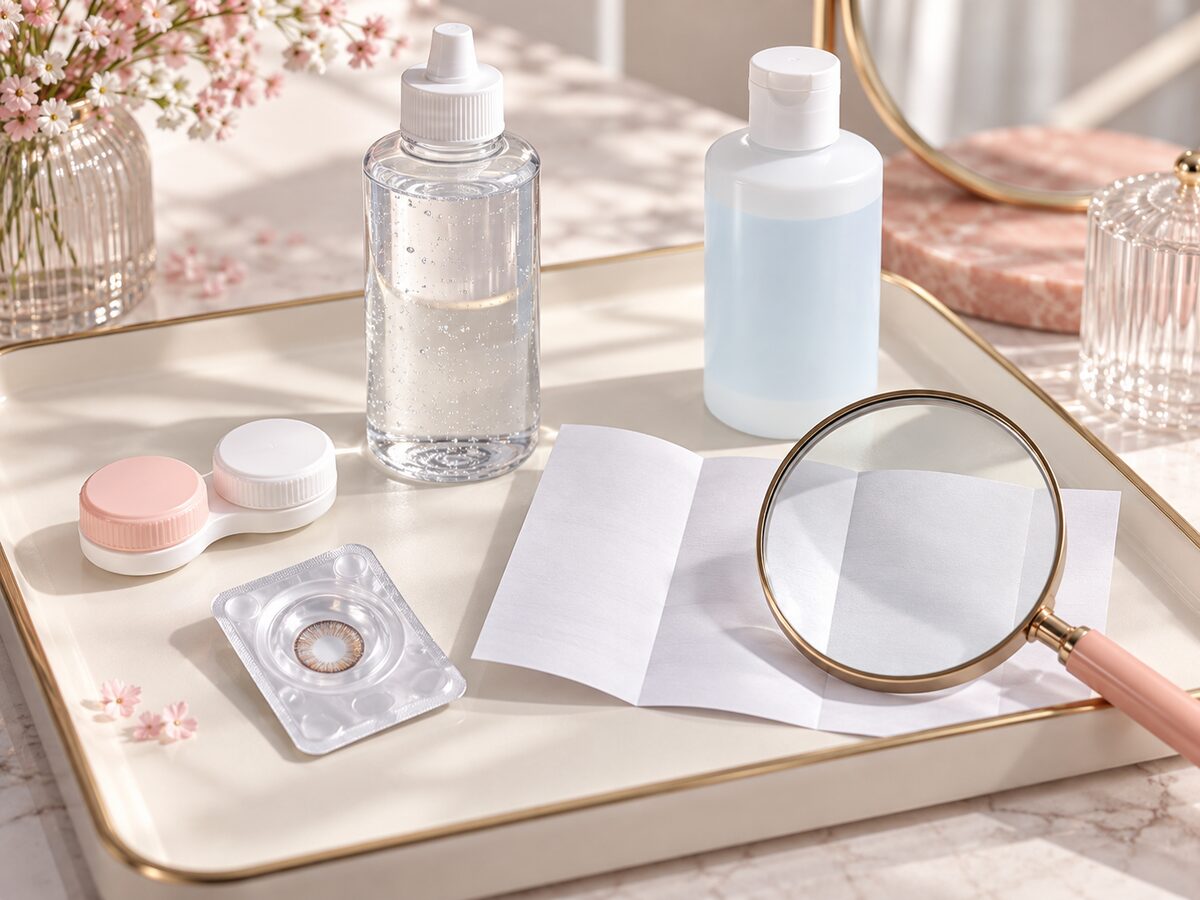
For reusable colored contact lenses, use the care system specified for the exact lens and follow its label and your eye care professional’s directions. Multipurpose solution, hydrogen peroxide and sterile saline have different roles: saline may rinse when instructed, but it does not disinfect; peroxide must be fully neutralized with its matching system before insertion. First confirm whether the lens is reusable, then compare the steps and required components. This guide focuses on solution choice and use. For a separate walkthrough of standard case cleaning, drying and replacement, see our contact lens case care guide.
In this guide
- Choose the care system after identifying the lens
- Understand what each liquid is supposed to do
- What to check on a multipurpose-solution label
- Hydrogen peroxide: the case is part of the system
- Why saline, water and homemade mixtures are not substitutes
- Track solution dates and storage instructions
- How to discuss a care-system change
- Three situations that call for a pause
- Questions to ask at a care review
- A care-solution choice in one checklist
- Care-solution questions answered in context
- Related categories
- Sources and scope

Choose the care system after identifying the lens
Before comparing bottles, identify the lens you actually wear. Write down its full brand, model, replacement format and any lens-specific instructions from its packaging and your eye care professional. A colored design can have daily disposable and reusable versions with similar names. Those versions do not share a care plan simply because the shade looks similar. A true daily disposable is used once and discarded; buying cleaning solution does not turn it into a reusable lens. A reusable lens needs the cleaning, disinfection and storage process appropriate to that product.
Ask your eye care professional which system is recommended for that exact lens and your circumstances. The FDA’s solution guidance tells wearers to follow the professional’s directions and product labeling and to use recommended solutions. This is more specific than choosing a bottle because it is on sale, comes in a travel size or says “gentle.” The right question is whether the complete routine fits the prescribed lens and whether you can perform every step correctly.
If the lens identity is uncertain, stop at identification. Look at the carton and manufacturer patient information, then ask the prescribing practice or seller about the precise version. A color name or product photograph is not enough. If you are considering switching lenses, resolve the fitting question first, then update the care system as directed. A new solution is not a workaround for a lens that was never prescribed or that does not suit your eyes.
Understand what each liquid is supposed to do
Words such as “rinse,” “clean,” “disinfect” and “store” refer to different functions. Sterile saline can be used for rinsing where the instructed routine calls for it, but the FDA says saline does not clean or disinfect lenses. Multipurpose solutions can combine functions according to their labeling, yet they still have exact rubbing, rinsing, soaking and case directions. Hydrogen peroxide systems clean and disinfect but require complete neutralization using the system’s specified components before a lens is inserted. The categories are not interchangeable.
| Product type | Main question | Critical limit |
|---|---|---|
| Multipurpose solution | What are the exact cleaning, rinsing, disinfection, storage and case steps? | Follow the label and professional instructions; never top off used liquid. |
| Hydrogen peroxide system | What special case or tablet neutralizes this particular product, and when is the process complete? | Non-neutralized peroxide must not be placed in the eye or used as a final insertion rinse. |
| Sterile saline | Where, if anywhere, does the prescribed routine call for rinsing? | It does not replace a cleaning and disinfection system. |
Read the full bottle label and accompanying instructions, not just the front name. A solution may have a specific lens compatibility statement, expiration date, after-opening discard instruction and case requirement. Keep the bottle’s original label visible. If you cannot tell whether a product performs the needed disinfection step, do not assume another liquid in the cabinet fills the gap. Ask the clinician or manufacturer to walk through the full sequence.
What to check on a multipurpose-solution label
Multipurpose products can combine cleaning, rinsing, disinfection and storage functions, but their instructions are product-specific. Confirm that the label supports your exact lens and note the required rub, rinse and soak steps and minimum disinfection time. The FDA advises following the professional’s directions and the solution’s labeling, including rubbing and rinsing as directed. A “no-rub” phrase on the front does not replace the full instructions or settle whether the product suits your lens.
Use fresh solution for each cycle as directed. Do not top off old liquid, reuse solution from a previous soak or pour used solution back into the bottle. If you miss a step or cannot remember whether the full soak time elapsed, do not guess from how clear the lens looks. Keep it out of the eye and check the exact product instructions or ask the eye care professional how to restart safely.
The case is part of the routine, but detailed case cleaning and replacement are covered in the separate case care guide. A peroxide system uses its own specified case and process; ordinary multipurpose case steps should not be transferred to it.
Hydrogen peroxide: the case is part of the system
Hydrogen peroxide products require more careful identification because the liquid must be neutralized before lenses go into the eye. The FDA’s peroxide guide describes systems using a neutralizing disc built into a special case and systems using a neutralizing tablet after disinfection. The correct method depends on the exact product. An ordinary flat contact lens case is not automatically suitable, and a special case from a different system should not be assumed compatible.
Do not put non-neutralized peroxide directly in an eye or use it as a quick rinse immediately before insertion. The FDA warns that this can cause stinging, burning, irritation or eye damage. Follow the full labeled time and steps. Do not judge completion from a remembered schedule for another brand, from how the liquid looks, or from the fact that you are late for an event. If the cycle is uncertain, keep the lenses out and obtain advice specific to your product.
Use the special case supplied with the product as directed and replace it when the instructions require. Some systems may look similar on a bathroom shelf, so store and label supplies in a way that prevents mix-ups. The FDA notes that a red tip or cap is common on peroxide products, but color alone is not a reliable substitute for reading the label. Avoid transferring any solution to an unmarked travel bottle. Misidentifying a peroxide product as a multipurpose solution is a consequential error.
If you accidentally expose the eye to non-neutralized peroxide or experience persistent pain, redness or vision changes, remove lenses if possible and seek prompt professional guidance. Do not keep trying the lens to see whether the burning will pass. Tell the clinician exactly what product was used and how, and keep the packaging available. This article cannot assess eye damage or provide an individual treatment plan.
Why saline, water and homemade mixtures are not substitutes
Sterile saline has a limited role: rinsing where the instructed care routine permits it. The FDA says it does not clean or disinfect contacts. A saline-only soak can leave the required disinfection step undone. Ask what product provides disinfection for your reusable lens and follow that product’s full directions. “Sterile” on a saline label does not turn it into a complete care system.
Tap, bottled and distilled water are also not lens-care substitutes. The FDA warns against exposing lenses to any water and against using saliva. Water exposure can introduce organisms and is associated with serious infections. Do not use a drinking-water bottle as an emergency rinse or improvise a homemade saline recipe. If you do not have the correct supplies, wear glasses and ask your eye care professional how to handle the lens and any interrupted routine.
A short trip, photo session or overnight stay can create a tempting exception. Plan the care supplies before leaving. A correctly labeled travel-sized product, if appropriate for your system, is different from pouring solution into a smaller unmarked bottle. The FDA advises against transferring solution into travel containers because sterility and product identification may be compromised. If the correct special case or complete system cannot be carried, discuss a practical alternative with the professional before the trip.
Track solution dates and storage instructions
Check the solution’s printed expiration date and any after-opening discard period. These are separate limits: follow whichever applicable instruction arrives first. Write the opening date on the bottle only if the label permits marking it, and keep the original container so the product, lot details and directions remain identifiable. Do not use an expired bottle or extend its use because liquid remains.
Store the product exactly as its label directs. Keep the cap and tip clean, close the bottle after use, and do not transfer solution to an unmarked cosmetic container. The FDA cautions against moving contact lens solution into travel bottles because sterility may be affected and products can be confused. Choose a properly labeled travel size of the same system when available, and pack every required component.
Lens replacement dates and case replacement instructions are separate from solution dates. A new bottle does not extend a lens’s wearing schedule. For the case-specific cleaning and replacement routine, use the contact lens case guide and the instructions supplied with your system.
How to discuss a care-system change
Start with the reason for the proposed change. Is the current bottle unavailable? Is the routine difficult to perform? Is there a product-specific compatibility question? Are you experiencing symptoms? Bring the exact lens and solution names to the discussion. A switch to a different multipurpose bottle or from multipurpose to peroxide can change the steps, required case and timing. A product marketed as “sensitive” or “preservative-free” is not automatically the answer for an individual wearer.
If the concern is discomfort, redness, pain, unusual light sensitivity or a change in vision, remove the lenses and seek professional advice promptly. Do not run a series of solution trials on a symptomatic eye. The FDA’s risk guidance advises leaving lenses out and contacting an eye care professional. A symptom can have causes that a bottle comparison cannot reveal.
If the change is simply practical, ask the clinician to review the new system and have them confirm lens compatibility and exact steps. Repeat the steps back in your own words. Verify that you have the correct case, full directions and any required neutralizer before opening the new product. Keep old and new bottles separate to reduce confusion. Retire outdated personal notes once the new instructions are established, but retain the manufacturer’s labeling for reference.
Three situations that call for a pause
“I only have saline.” Saline is not a substitute for cleaning and disinfection. Do not store a reusable lens in saline and treat the care cycle as complete. Wear glasses and ask the professional what to do if the recommended solution is unavailable.
“The solution is old or I cannot identify the bottle.” Do not estimate the opening date, mix liquids or use an unmarked container. Check the original label and discard limits. If product identity or a required step is uncertain, keep the lens out and confirm the instructions before use.
“I have peroxide but not its matching case, or I am unsure neutralization finished.” Do not substitute an ordinary case, rinse the lens with peroxide or shorten the cycle. Keep the lens out and contact the product manufacturer or eye care professional for directions tied to that exact system. If unneutralized peroxide contacts the eye, or pain, redness or vision changes occur, seek prompt professional advice.
Questions to ask at a care review
- What is the complete name and replacement format of the lens I am using?
- Which care system is recommended for this exact lens and why?
- Which actions are required before storage and before insertion?
- What is the full disinfection or neutralization time for the product?
- Which case and components must be used, and when should they be replaced?
- What should I do if I miss a step, run out of solution or cannot identify the bottle?
- What symptoms should prompt removal and immediate contact with the practice?
- If I switch lens version or brand, do I need a new fitting or care plan?
Write down the answers as a sequence, not as isolated product names. A safe routine requires the lens, liquid, case, timing and response to problems to fit together. When any component changes, review the sequence again. This is especially important if several people share a bathroom shelf or if the packaging of two bottles looks similar. The aim is a routine you can follow consistently, not a collection of supplies purchased “just in case.”
A care-solution choice in one checklist
Confirm the exact prescribed lens and whether it is reusable. Check the eye care professional’s recommendation and the manufacturer’s lens instructions. Identify what the candidate solution does, which steps it requires and whether its labeling supports the lens. Gather the correct case and any neutralization component. Note expiration and after-opening discard rules. Before each use, follow the complete directions, use fresh solution, keep water away, and leave lenses out if a step or product identity is uncertain.
Care planning is separate from style. A vivid color, soft pattern or convenient pack size can help select among professionally suitable lens options, but it does not determine the cleaning system. The best purchasing decision is the one that includes the correct lens and a care routine you can actually perform. If you cannot explain the routine back to your clinician, ask for another demonstration before relying on it at home.
Care-solution questions answered in context
Can a “no-rub” label replace every cleaning action?
Read the exact product label and follow your eye care professional’s instructions. The FDA advises rubbing and rinsing as directed by the professional, while individual products can have specific directions. A phrase on the front of a bottle is not a complete account of cleaning, disinfection, storage and case care. Ask the practice to demonstrate the sequence if the label and the instruction you remember seem different. Do not choose whichever version takes less time merely because the lens appears clear.
Does a preservative-free claim make peroxide the best choice for everyone?
No universal choice follows from that claim. The FDA explains that peroxide systems are generally preservative-free and may be useful for some people sensitive to preservatives, but also stresses the risk of incorrect use and the need for neutralization. The actual decision should account for your lens, ability to complete the process, the system’s case and your eye care professional’s guidance. If symptoms are the reason for considering a change, get the eye assessed rather than treating a label claim as a diagnosis.
Can I combine two solutions if each bottle is nearly empty?
Do not combine systems or leftover liquids as a shortcut. Each product’s directions assume its own ingredients, case and timing. A mixed bottle or case contents may be difficult to identify and may not follow either manufacturer’s instructions. Use the complete recommended product as directed. If you run short while away from home, keep lenses out and use glasses while asking the professional how to proceed. Avoid extending wear just to reach the next store.
Can I carry a small amount in a reusable cosmetic bottle?
The FDA advises against transferring contact lens solution into smaller travel containers because the transfer can affect sterility and create product confusion. Use an original, properly labeled size appropriate to the system after confirming that it is the exact recommended product. Pack the matching case and other required parts. A convenient bottle without the correct case or neutralizer cannot complete a peroxide process, and an unmarked liquid is hard to use safely.
What if a lens looks clean after rinsing with saline?
Visible clarity is not the same as completing cleaning and disinfection. FDA guidance says sterile saline is for rinsing, not for cleaning or disinfecting. Follow the lens’s instructed care system. If you do not have the required products, do not reinsert or store a reusable lens in an improvised liquid and assume it will be safe later. Ask your eye care professional for the appropriate next step for that lens.
Can I use the same case when switching to peroxide?
Do not assume so. The FDA describes peroxide systems that rely on a special neutralizing disc or a tablet process, and the case is part of that system. An ordinary flat case is not automatically compatible. Read the exact product’s directions, use the specified case and replacement schedule, and ask the professional to review the process. The absence of burning during one use would not prove that the system was followed correctly.
Does buying a monthly colored lens automatically mean I need a particular solution?
No. “Monthly” describes replacement, while the care system must be selected for the exact lens and wearer under professional and manufacturer instructions. Two monthly lenses can differ in material or product requirements. A retailer may show a related solution as a shopping convenience, but that association does not establish compatibility. Confirm the full lens name and its care directions before buying a bottle or case.
What if I am unsure whether the peroxide cycle finished?
Keep the lens out and seek product-specific guidance. Do not test it on your eye, assume completion because bubbles stopped, or shorten the labeled time to meet a schedule. Check the exact bottle, case and required neutralization method with the professional or manufacturer. If there is eye exposure or symptoms, contact an eye care professional promptly and describe the product and steps used.
Related categories
Use Daily Contacts and Monthly Contacts to locate product categories, then confirm which care steps apply to the exact lens you use. A schedule category does not determine whether a particular cleaning solution is compatible.
Sources and scope
This consumer guide summarizes the linked FDA contact lens solutions guidance, the FDA hydrogen peroxide instructions, and CDC cleaning, disinfection and storage guidance. These sources explain general care practices; they do not establish compatibility for every colored lens or give an individual treatment plan. Confirm compatibility and the full routine with the exact lens and solution labels and your eye care professional. If symptoms occur, stop wearing the lens and seek professional guidance.