Toric & prescription
Zero-Power Colored Contacts for Brown Eyes: Buying Checklist
A 0.00 colored contact can change the look of brown eyes without adding distance-vision correction, but “non-prescription” on a product page should not be read as “no fitting needed.” Build a shortlist from exact plano models that your eye care professional has fitted or approved. Then compare each lens's print on a brown starting iris, check the package and replacement schedule, and confirm the seller's current prescription process. A shade name or price cannot complete those checks.
In this guide

What to confirm before choosing a color
For brown eyes, “plano” or 0.00 means no spherical optical correction. It does not tell you whether a lens fits or how visible its print will be. The practical order is: establish the exact suitable contact lens, confirm that 0.00 is the appropriate power for the relevant eye, and only then choose the visual effect among those exact options. If you need prescription correction, a 0.00 lens will not provide it.
In the United States, decorative contacts remain medical devices. The CDC explains that they require a prescription and proper fitting, including lenses used only to change appearance. Other destinations may have different rules; check the applicable process. The clinical and hygiene concerns do not disappear because a retail page says “non-prescription.”
A lens can look subtle and still be unsuitable for an individual eye. A lens can fit appropriately yet provide a color effect you do not like. Keep the two judgments separate so neither a pretty photo nor an easy 0.00 selector stands in for the other.
A fitted plano lens is more than a power selection
Contact lenses sit directly on the eye. Fitting considers the exact lens design and its on-eye behavior, along with the eye's condition and the wearer's response. A glasses prescription is not a contact lens prescription. If you normally do not need vision correction, ask an eye care professional about an appropriate zero-power colored lens. If you already wear corrective contacts, do not place a plano colored lens over your clear lens as a workaround for limited color choices.
The FDA advises shoppers to use a current valid contact lens prescription and verify the exact brand, lens name, power, and other relevant specifications when buying. Matching a base curve and diameter number to a different model does not prove an equivalent fit. Ask before switching brands, replacement versions, or designs.
Check each eye's instructions. 0.00 may be appropriate for both eyes for one wearer, but it is not a default value to enter when an order form is confusing. Do not choose zero power simply because the desired shade is unavailable at a prescribed corrective power. Ask about an appropriate alternative instead.
Describe the change you want on your brown iris
Brown eyes vary in warmth and depth. A medium warm iris may show honey detail in daylight, while a very dark brown iris may read close to black indoors. That starting color influences a translucent print. Before searching, decide whether you want natural polish, warm lightening, cool contrast, or a more defined outer edge. Those are more useful targets than the word “brown” alone.
| Goal | Visual cue to inspect | Possible disappointment to check |
|---|---|---|
| Natural polish | Shade near your iris, soft center and edge | The effect may be almost invisible indoors. |
| Warm lightening | Honey or hazel layers and enough coverage | Bright photos may overstate the everyday change. |
| Cool contrast | Layered olive or gray over a similar starting brown | White balance may shift the apparent undertone. |
| Defined iris | Outer-ring density at normal viewing distance | A strong ring may look more obvious close up. |
A more opaque print may produce a clearer color change on a deep iris, while a sheer design may enrich the existing color. Yet opacity is not the whole design. A hard center boundary can make a muted shade look dramatic; a feathered transition can soften a brighter shade. Compare the actual print and representative images for the exact version.
Read center, middle, and edge separately
The center transition determines how the new color meets the pupil opening and visible natural iris. A soft gradient may allow the brown base to contribute to the final look. A sharp boundary can be intentional for a more graphic result, but it may be more noticeable in a close-up. The middle field carries much of the color impression, while the outer edge affects how defined or enlarged the iris seems.
Do not confuse graphic diameter with the physical lens diameter. Graphic diameter, sometimes listed as G.DIA, is about printed coverage. DIA is a physical dimension relevant to fitting. Neither number alone predicts how natural the lens will look or whether it is suitable for your eye. A smaller dark ring can appear more defining than a wider, soft print.
Use verified specifications from the live exact product listing. A shade family may include daily and reusable versions with different details. Avoid copying print measurements, material, or care directions from a similar name. If a detail matters to your choice and is not listed, ask the seller rather than guessing from a selfie.
What a useful before-and-after set shows
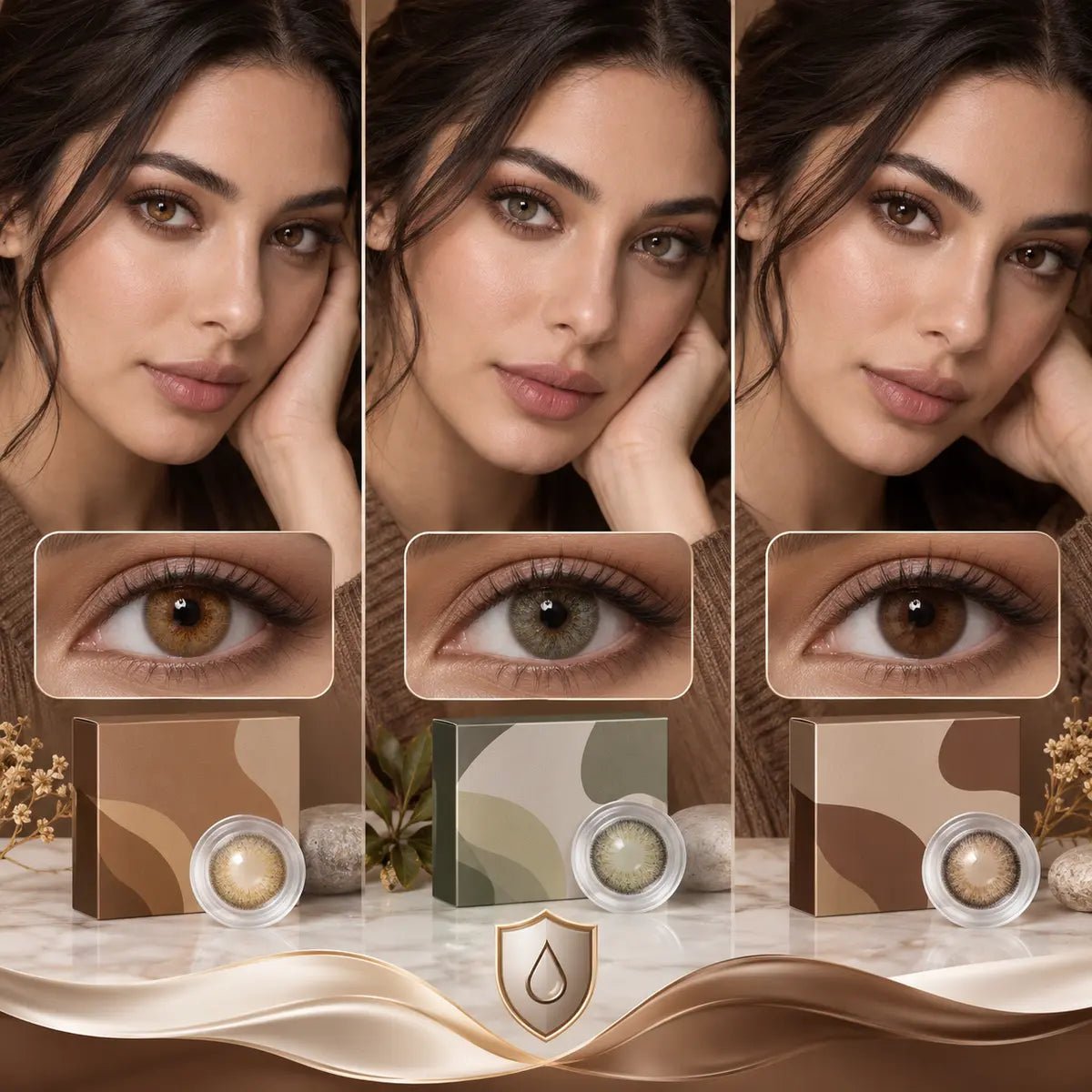
Look for the same wearer's bare brown eye and the exact named lens. The strongest comparison keeps light, camera distance, exposure, and editing similar between before and after. Add a daylight view and an ordinary indoor view. A close-up shows pattern detail; a normal-distance portrait shows whether the effect is subtle or obvious in daily life.
A ring light can reveal color but also make it seem brighter than it does in a room. White balance can shift gray toward blue or hazel toward gold. Makeup and lashes can increase apparent contrast. A photo that hides these conditions can still inspire a look, but it should carry less weight when predicting your own result.
Save a short evidence note rather than many unlabeled screenshots. For example: “Medium warm-brown starting iris; exact daily brown version identified; subtle center, dark edge; visible in daylight; indoor view missing.” The missing view tells you what to seek next. If the model version is unknown, keep the image as inspiration rather than transferring its result to a different product.
Audit the product page before choosing 0.00
Confirm full brand, exact model, shade, 0.00 variant, daily or reusable replacement schedule, package count, and any listed material and fitting specifications. Check current seller information and the prescription-verification process for your shipping destination. A low price and a dramatic image do not establish that the lens is appropriate or that the package contains enough lenses for both eyes.
If the title, variant selector, and lifestyle photograph appear to refer to different versions, ask for clarification before paying. A “zero-power” badge might describe one available option while the cart still holds another power. Review the final cart line by line. Read the return and shipping terms on the current site, particularly for sealed medical products; policies can change.
The package you receive is the final identity check. Before opening, verify the brand, model, shade, power, replacement schedule, quantity, labeled expiration and lot information, and seal condition. If the package differs from the order or looks compromised, contact the seller before use. Do not try the lens first and resolve the mismatch later.
Translate piece count into real use
“Ten pieces” means ten individual lenses, not ten pairs. If both eyes use the same exact daily lens and one lens is worn in each eye, ten pieces could cover five two-eye wear days. If the eyes require different powers, colors, or prescribed models, separate selections may be necessary. Always use the actual package count and eye-specific instructions rather than assuming a box covers a fixed number of days.
Reusable lenses follow a different replacement schedule and care routine. The opening date, manufacturer instructions, and your prescribed wear plan matter. A daily lens cannot be cleaned and stored for a second day to lower cost. A reusable lens cannot be kept beyond its intended schedule because it still looks clear. Compare value only after identifying the correct lens, quantity, and required supplies.
A photo session or occasional event can make a daily format convenient for some wearers, but that is not a reason to skip fitting. A reusable format can offer a different pattern or cost structure, but its cleaning requirements must fit your actual routine. Ask your eye care professional which exact models are suitable, then compare formats and visual designs within that set.
Build a decision record you can check later
For each option, note four facts together: exact model and version, whether your eye care professional approved it, package count and care format, and what the photos actually show on a similar brown iris. Mark missing details as “unknown” and resolve them before ordering. This keeps an attractive image or low price from standing in for product identity, fit, or usable quantity.
Care rules and stop signals stay the same at 0.00
The CDC advises against sharing decorative lenses, storing them in water, or using water or saliva to clean them. For reusable lenses, use the recommended disinfecting solution and follow the exact replacement instructions. Wash and dry your hands before handling lenses. Do not extend wearing time to match another person's review or finish an event.
Remove a lens and contact an eye care professional if discomfort occurs. Pain, unusual redness, light sensitivity, discharge, swelling, or a change in vision call for prompt advice. A lens that produces attractive color is not worth continuing to wear through symptoms. Do not reinsert it simply to see whether the problem has disappeared.
Keep backup glasses when you need corrected vision and might remove your contacts. If you are traveling or wearing lenses at an event, plan how to remove them and store or discard them according to their format. Good planning is part of the purchase decision, not an afterthought.
Three buyer scenarios
You have naturally clear vision and want subtle brown definition
Ask about a fitted plano model first. Within suitable choices, inspect a soft or moderately defined outer edge on a starting iris close to yours. A normal-distance indoor image will tell you whether the effect is pleasantly subtle or effectively invisible for your goal.
You wear prescription contacts but want a gray party look
Do not stack a gray plano lens over your clear corrective contact. Discuss a suitable colored corrective lens or another professionally approved vision plan. Complete the fitting and order checks before the event rather than testing an unknown lens on the day.
A discount listing says “no prescription needed”
Clarify what the seller means. In the United States, 0.00 decorative contacts still require a valid contact lens prescription and fitting. Confirm product identity, seller process, and sealed packaging before considering the discount. If the exact model cannot be verified, keep browsing.
For visual ideas, browse KPOP2's colored contacts for dark eyes and compare current brown, hazel, and gray listings. Read the current prescription verification and wear and care pages before ordering.
Sources: CDC decorative contact lens guidance and FDA buying guidance. Verify destination-specific rules and the live exact product listing before buying.