Toric & prescription
Colored Contacts for Brown Eyes: What Your Prescription Says
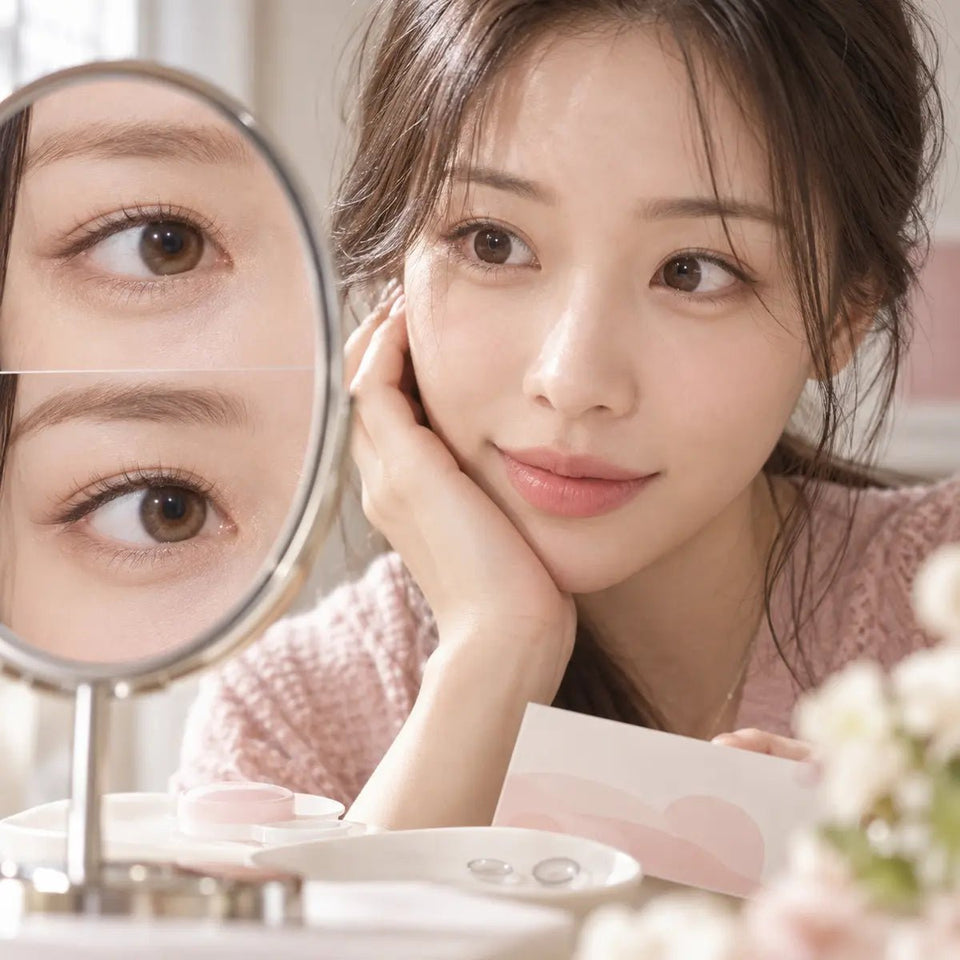
A contact lens prescription identifies the lens and correction selected for your eyes; it does not predict how a colored print will look over brown. Read the exact brand and model, right- and left-eye values, and replacement format first. Then assess shade, opacity, center transition and outer edge using images of the same lens on a similar brown iris. Keep clinical suitability and cosmetic appearance as separate checks.
In this guide

The short answer: two records, two purposes
Use your current contact lens prescription to identify the exact lens selected with your eye-care professional and the values needed for each eye. Use current product information to confirm that the identical model and complete values can be ordered. Then use exact-version photos on brown eyes to understand the possible color result. None of those sources alone supplies the whole answer.
In the United States, FDA buying guidance emphasizes a current, valid contact lens prescription. The FTC explains prescription release and seller verification. These are U.S. rules; requirements in other markets may vary. Wherever you are, ask your eye-care professional about the exact fitted lens rather than treating a shade page as an examination.
A prescription does not rank colors. A minus power does not mean a darker print, a zero power does not make a lens exempt from fitting, and a base curve number does not predict whether hazel will look natural on brown eyes. Those are different types of information that should stay in separate columns of your decision.
Why the brand and model belong in the check
Contact lenses are physical devices, not interchangeable pairs of numbers. Two products with the same spherical power can differ in material, geometry, replacement schedule and on-eye behavior. A colored version may also differ from a clear product in the same brand family. Matching only the power can therefore create an incomplete or incorrect order.
Read the full brand and model on the prescription or fitting record. If the document is unclear, ask the prescriber which exact product was evaluated and whether a colored alternative has been approved. Do not infer permission for a different lens because its product page has the same power, base curve or diameter.
Keep daily disposable and reusable versions distinct. A similar shade name does not prove they use identical prints or care instructions. The replacement schedule affects how the lens is used after opening; the artwork affects color. Check both in the current exact listing.
If the requested shade is unavailable in the fitted model, discuss a suitable alternative with your eye-care professional. A retailer can explain stock and product options, but the professional determines whether another lens is appropriate for your eyes.
What common prescription fields mean
OD and OS: These abbreviations identify the right and left eyes. Keep the two lines separate, even if one value matches. The package for one eye may not be the package for the other.
SPH or PWR: This is the spherical corrective power when applicable. Minus and plus signs matter. The value describes optical correction, not color opacity. A 0.00 or plano option provides no spherical correction, but it is still a contact lens requiring appropriate fitting and care.
CYL and AXIS: When prescribed, these describe astigmatism correction. Do not substitute a spherical colored lens just because its SPH field matches. The exact toric product and both values must be considered together with professional fitting. If a menu lacks the required value, leave the selection unresolved rather than choosing the nearest option yourself.
BC and DIA: Base curve and overall diameter identify physical lens characteristics. They can help confirm that the package matches the prescribed product. Matching those two numbers alone does not establish that another brand is equivalent, and overall DIA is not the same as graphic diameter.
Brand, model and expiration: These identify the lens and the period for which the prescription may be used under the applicable rules. If the record has expired or you are unsure which version it names, ask for professional clarification before ordering. Do not rely on an old product box as your only current authority.
Additional values or designations may appear for multifocal or other specialized lenses. Ask your eye-care professional to interpret every field relevant to your order. A blog can explain common abbreviations but cannot determine which values are correct for your eyes.
Make a two-eye ordering card
Create one line labeled right eye and one labeled left eye. Put the full product identity, power and every additional prescribed value on each line. Add the exact color and replacement version only after confirming they belong to the fitted product. This card helps you navigate selectors that otherwise make it easy to copy the same setting to both eyes.
For example, both eyes might share a sphere power but differ in cylinder or axis. Buying two boxes based on the shared sphere would not fulfill the complete prescription. The opposite can also happen: all values may match, but the seller's packaging still counts individual lenses rather than pairs. Read the product's actual unit count.
Before paying, compare each cart line with the card. Some stores show only the color and sphere in the summary until an option is expanded. If you cannot see the full required combination, request an itemized confirmation. Do not assume a hidden default is correct.
Keep the card for delivery. Similar-looking boxes can be mixed up, especially when the right and left powers differ only by a small decimal. Check the printed label before opening a blister, not only the memory of where you placed each box.
What the prescription cannot tell you about brown-eye color
The prescription does not measure the printed pattern's pigment density, color undertone or border design. It cannot say whether a lens will read as subtle cocoa, warm hazel, olive or cool gray on your natural iris. Those outcomes involve the exact print and the eye beneath it, plus the lighting and viewing distance.
Opacity words on product pages are not a universal scale across brands. A relatively translucent print may blend beautifully on medium brown eyes while nearly disappearing on a very dark iris indoors. A denser print may create more visible change yet look more graphic. Use the exact on-eye evidence instead of predicting from a label alone.
Graphic diameter describes the printed area when a listing provides it. Overall diameter describes the physical lens. A larger graphic area can affect apparent size, but ring contrast, center gradient and dot pattern also shape the visual impression. Do not use graphic diameter as a medical fitting value.
Nor can the prescription guarantee comfort or stable vision merely because a retailer lists all its values. The eye-care professional assesses the actual lens on your eye. A product photo and a matching selector are useful for shopping, not for completing a fitting remotely.
How to evaluate a shade on brown eyes
Look for identified photos of the exact product and replacement version on a starting iris close to your own. A before-and-after pair under similar light shows how much change the print produced for that wearer. A flat swatch shows artwork but not the finished appearance over brown.
Read the print in three parts. Near the pupil, natural brown may show through the central opening. In the middle, pigment density and transparent gaps determine how clearly the new shade reads. At the outside, a dark ring may add definition even when the center color is faint. A product can have a strong border and a subtle middle, or the reverse.
Compare a close-up with a full-face view. The macro image helps you inspect the center and pattern; the face image shows whether the color change is noticeable at normal conversation distance. Choose the view that best matches where you intend to wear the lens, rather than assuming the brightest studio close-up represents everyday life.
Lighting deserves a separate note. Direct sunlight, flash and ring lights can emphasize small colored details; warm indoor bulbs can change the apparent hue. Camera white balance and filters add uncertainty. Seek diffuse daylight and ordinary indoor examples when possible, and keep expectations open if those images are unavailable.
Do not let a shade choice change the clinical product
One common shopping error is selecting a beloved color from a different series and transferring the known power into its menu. That action does not confirm the new lens has the same fit or correction. Ask whether the exact colored version has been fitted or approved before ordering.
Another error is choosing the closest available toric axis, cylinder or power because a product appears almost compatible. The complete combination matters. If any required value is unavailable, pause and discuss alternatives with the prescriber; do not round the parameter to finish checkout.
A zero-power lens is not a universal workaround for a missing corrective shade. If you need vision correction, discuss how that need will be met. Do not stack a cosmetic contact over a clear corrective lens without specific professional instruction. The goal is one appropriate plan, not a cosmetic shortcut that bypasses the fitted product.
Finally, do not read a seller's “prescription colored contacts” category as proof that every product in it supports your own prescription. Categories help discovery. The exact product and options determine what can be ordered, while the professional determines what is appropriate.
Questions worth asking your eye-care professional
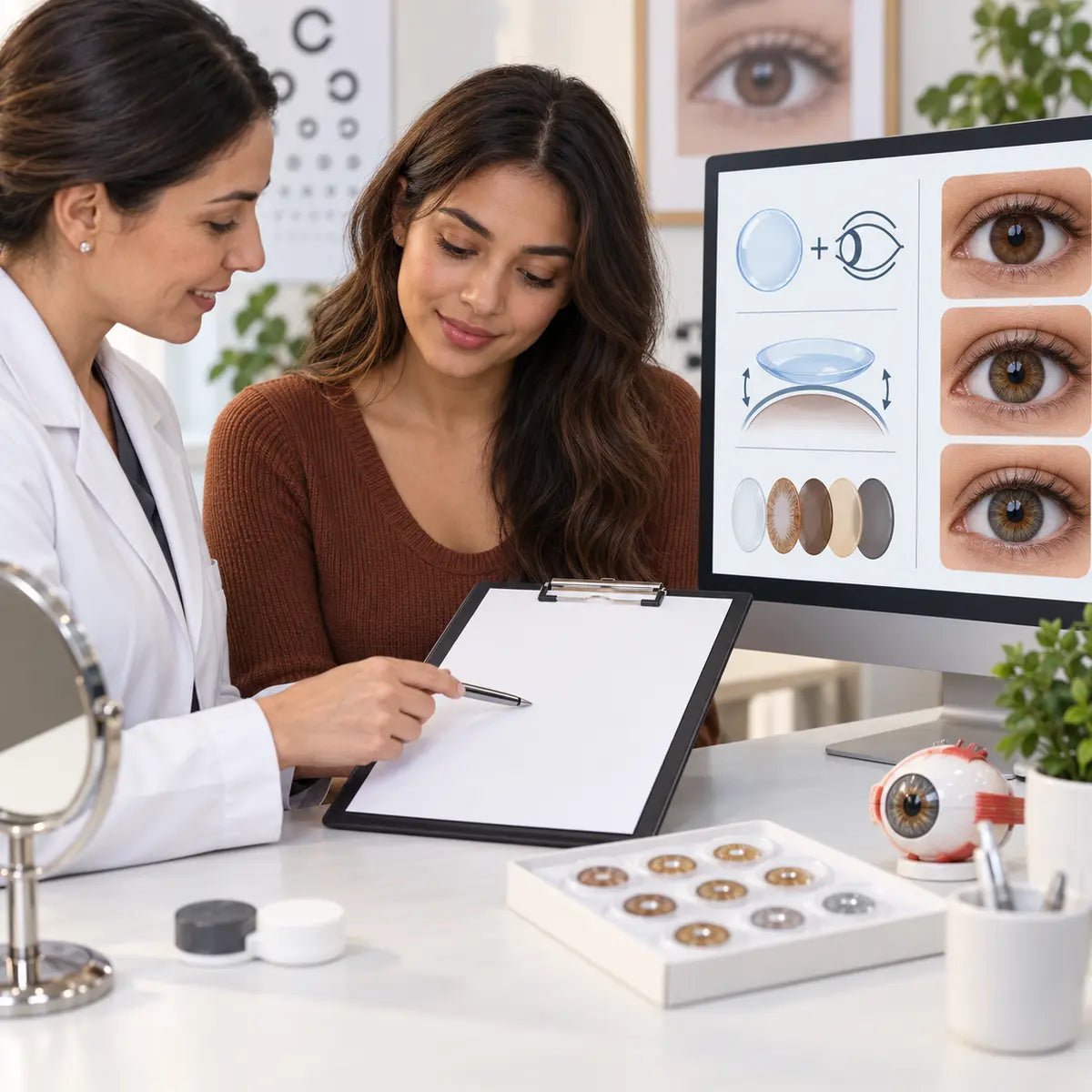
If your prescription names a clear lens but you want a colored option, ask whether the exact colored product needs a new fitting. Bring the full product name, replacement format and shade, not only a swatch. The professional can discuss whether it is an appropriate candidate and what needs to be assessed on the eye. This is more useful than asking a seller to convert your clear-contact power into a new brand.
Ask what to do if the preferred shade is missing in one eye's full prescription. A product may offer many sphere values while omitting the cylinder, axis or other parameter you require. The clinician can explain whether another product is worth evaluating. Do not use a different number in the order menu to make a favorite color available.
Ask how you should distinguish an appearance disappointment from a clinical problem. “The brown print looks too warm” is a styling observation; “my vision blurs after blinking” or “my eye feels painful” needs assessment. Keeping those issues separate lets you discuss a new aesthetic without overlooking symptoms.
Finally, ask which written instructions apply to the exact lens: wearing schedule, replacement timing, handling and follow-up. A product's color does not identify its care routine. Keep a copy of the information so a later order can be checked against the actual fitted model instead of relying on a remembered shade name.
Verify the delivered product and follow its care plan
Compare the unopened package labels with the confirmed order and prescription. Check the full brand and model, color, each eye's power and any other prescribed values, replacement format, quantity, expiry and package condition. If something differs, keep it unopened while contacting the seller or eye-care professional as appropriate.
Follow the product's prescribed wear and care instructions. The CDC's prevention guidance covers clean hands, avoiding water and proper care. A daily disposable is not stored for another wear; a reusable product requires its specified cleaning and storage routine. The shade does not change these rules.
If you have pain, persistent redness, light sensitivity, discharge or blurred vision, remove the lens and seek prompt eye-care advice. A color that looks attractive cannot establish that a symptomatic lens is safe to wear. Keep the exact product identity available for the professional.
Use the Colored Contacts for Dark Eyes collection to inspect visual directions, then verify the exact fitted listing. KPOP2's Wear & Care page has routine reminders. Neither a collection nor an editorial photo replaces your prescription.
KPOP2 Editorial Team · Reviewed September 27, 2026. This guide separates prescription and fitting from appearance observations; it is not an individual eye examination or wear test. U.S. prescription information uses the linked FDA and FTC sources, and care guidance uses the CDC resource.