Toric & prescription
Colored Contacts for Dark Eyes With Astigmatism: Fit Questions
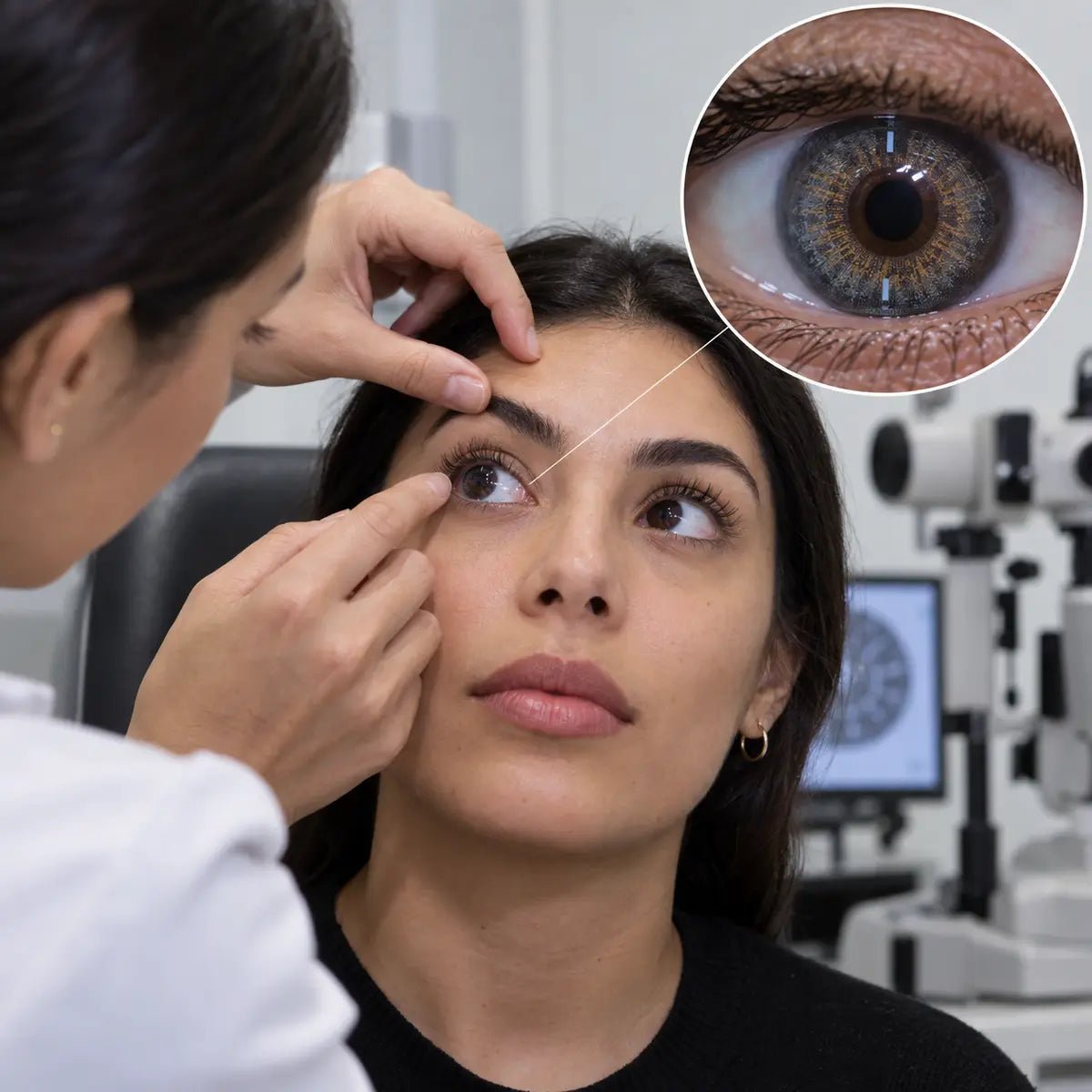
If you have astigmatism and want colored contacts for dark eyes, use the fitting appointment to separate correction, fit and appearance. Ask which exact contact lens can meet your visual needs, how its on-eye performance will be assessed, and which colored versions are genuinely available in your complete prescription. Then judge the print on a similar dark iris. A promising shade photo cannot answer whether a toric lens is suitable for you.
In this guide

Prepare a brief that separates needs from preferences
Write down what you need to see clearly: perhaps small text at a screen, distance signs, night driving or a full day of work. Describe any intermittent blur, dryness or discomfort with your current lens without diagnosing the cause. Note which eye is affected, when it occurs and whether it changes after blinking or later in the day. Those observations help the professional ask better follow-up questions.
Next, rank cosmetic preferences. Is a warm hazel effect enough, or is a clearly visible gray or green important? Would a soft edge matter more to you than a dramatic shade? How much visible brown around the pupil are you comfortable with? This ranking makes it easier to discuss compromise if the suitable toric options do not offer every shade in your inspiration gallery.
Bring the full name of any candidate product, its shade and replacement version, not just a screenshot of an eye. A single marketing image may belong to a spherical product while the fitting option is toric. Keeping the product identity attached to the image helps the professional and seller identify what is actually under discussion.
Also bring your existing contact lens prescription or box if you have one. An eyeglass prescription is useful medical context but should not be copied directly into an online contact lens order. Ask the clinician which record is current and which exact model it covers.
Ask whether the proposed lens meets your correction needs
Astigmatism does not tell a shopper which contact lens to choose from a cylinder number alone. Ask your eye-care professional whether the exact proposed lens should be toric and what correction each eye requires. Some clinical plans may differ from what a shopper expects from a glasses prescription. That judgment depends on the examination and on-eye assessment, not a general article.
A toric lens has different focusing powers in different orientations and uses design features to maintain the intended position. CooperVision explains the orientation issue. This is why a matching sphere power does not prove a colored product is a suitable replacement for a fitted toric lens.
Ask the professional to identify the complete product and prescription for each eye. If the recommendation includes SPH or PWR, CYL and AXIS, keep those values together with the named model. The right and left eyes may differ. Do not round to the closest available axis, borrow a value from another eye or assume a spherical product is adequate because it comes in the desired color.
A useful question is: “Does this exact colored model provide the correction and fit you recommend for my right and left eyes, and what limitations should I expect?” If the answer is no, ask what other product could be evaluated. That keeps the conversation constructive without asking the clinician to endorse a shade that does not meet the visual need.
Ask how the trial lens will be judged
Fit is more than whether the lens feels noticeable at first. Ask what the clinician will examine on the eye, how the lens should move, and whether its toric orientation supports stable vision. Ask how long an adaptation or observation period is appropriate for the specific product and when a follow-up should occur. The professional can explain what findings matter for your eyes.
Describe daily visual tasks while the fit is being assessed. A lens might feel acceptable in a brief mirror look yet leave you with unstable clarity during screen work or at distance. The point is not to self-test a product beyond the advised plan, but to tell the professional what your routine demands so the assessment addresses it.
If vision changes after blinking, report which eye, how often it happens and whether the change is brief or persistent. Do not conclude from a phone photo that the toric lens rotated or that the prescription axis should be changed. Other factors can affect clarity, and the eye-care professional must interpret the whole fitting.
Ask what would count as a reason to stop a trial and call. Pain, persistent redness, light sensitivity, discharge or blurred vision need prompt professional advice. The FDA's risk guidance explains why contact lens symptoms deserve attention. An attractive printed color does not make those signs acceptable.
Discuss what the exact product can actually offer
Colored toric options may be narrower than the full range of spherical colored lenses. Ask whether the model being fitted is available in the needed right- and left-eye combinations, including cylinder and axis. A headline sphere range or a “toric” collection label does not prove that every shade is selectable with every value.
Ask about the replacement format and package quantity. A product offered in a reusable version may require a different care routine from the daily format you hoped for. A shade available at one power may not be offered at another. If the product page is unclear, bring it to the appointment and ask the seller or clinician to identify what is a real, orderable configuration.
Do not treat a similar name as proof of an equivalent lens. Spherical and toric versions in one family can differ in construction; daily and monthly versions can have different materials or prints. Even when a series shares photographs, each exact product requires its own fit and parameter check. A model switch should be discussed with the professional.
Ask what happens if only one eye's complete combination is available. Ordering the available eye and improvising the other is not a complete plan. The fallback may involve another suitable product or a different cosmetic goal; the eye-care professional can help assess options that a retailer's menu cannot.
Talk about the print after suitable options are identified
Explain your starting iris color. “Dark eyes” can mean warm medium brown with visible amber detail or a very dark iris that appears almost black indoors. A translucent print may borrow more warmth from one starting eye than another. Seek exact-version references on a similar iris, not just a light-eyed campaign model.
Inspect the print in three zones. Around the pupil, the clear opening may leave natural brown visible. Across the middle, pigment density affects whether the new color reads at normal distance. At the outer edge, a limbal ring can add definition even when the middle shade is subtle. These are styling observations, not evidence of medical fit.
Ask whether the visual reference shows the toric version. A spherical shade in the same series may have a different design, or the image may not identify the exact format. Use a flat product swatch to inspect artwork, then look for a real-eye photo under ordinary light to judge interaction with dark brown. Keep your expectation uncertain if no comparable photo exists.
Compare a close-up and a full-face view. The macro image reveals center and edge detail; the ordinary-distance image tells you whether the color change supports your goal. A lens can look intricately patterned close up but remain mostly dark brown in everyday conversation. There is no universal “best shade” for everyone with dark eyes.
Agree on what to observe after the visit
Ask the clinician what to note if you are given a fitting trial. You might be asked to track when clarity changes, whether one eye behaves differently, and whether comfort or redness changes over time. Record observations in ordinary language rather than trying to infer a prescription adjustment. “Left eye becomes blurry after several blinks” is more useful than “axis should be ten degrees different.”
Separate visual performance from cosmetic assessment in your notes. One line can describe clarity and comfort; another can describe whether the shade looks too subtle, too warm or too sharply ringed in your normal lighting. This makes it easier to discuss whether the problem requires a clinical change, a styling change or both.
Do not extend wearing time for more photographs or to see whether discomfort resolves. Follow the plan your professional gives you. If a symptom warrants stopping, remove the lenses and seek guidance, even if you have not yet settled the color preference.
Confirm when and how to contact the clinic for follow-up, and whether any product change requires another fitting. A seller can explain stock and orders, but the clinician decides whether a new lens is suitable for your eyes.
Agree on a fallback before you order
Ask what to do if the only clinically suitable color is less dramatic than you hoped. You might decide that a subtle change is worthwhile, or that maintaining the correction you already trust matters more. That is a legitimate preference decision. Do not accept unstable vision or an unfitted lens just to reproduce a campaign photograph.
If the desired color does not exist in your complete prescription, ask which alternatives could be evaluated. A different toric design may be possible, but it requires professional assessment. Avoid stacking a decorative contact over a clear corrective lens or combining two lenses on one eye without explicit professional instruction. Such workarounds are not ordinary shopping substitutions.
Consider the care burden of any alternative. A reusable product requires cleaning and storage; a daily disposable is discarded after one use. The CDC's prevention guidance covers hygiene and water avoidance. A product that looks right but does not fit your routine may be a poor long-term choice, even if its prescription is available.
Leave the conversation with three concrete answers: the exact lens being evaluated, the criteria for continuing or stopping it, and the next suitable option if it does not work. Then use an order checklist to ensure the eventual purchase matches those answers.
Order the fitted lens, then verify delivery
Once your eye-care professional confirms the exact product and prescription, compare the complete right- and left-eye lines with the selectable options on the current product page. Check sphere, cylinder, axis, full model, color and replacement schedule. If a needed combination is missing, return to the professional or seller with that fact instead of changing a value to make the menu accept it.
At checkout, inspect both eye lines again. Some carts display only part of a toric selection until expanded. Request a clear itemized confirmation if necessary. Confirm the number of individual lenses or boxes required for your two-eye plan. Product availability and packaging can change, so the current exact listing matters.
When the order arrives, read the unopened package labels against the confirmed prescription and order. If the model, value, color or replacement format differs, do not open or wear the lenses while resolving it. Keep a record of the box details for any later follow-up.
Browse KPOP2's toric colored contacts collection for candidates to discuss. Once the fitting is complete, use the eye-by-eye toric order guide and prescription verification information. A collection page does not confirm fit or a specific available combination.
KPOP2 Editorial Team · Reviewed September 27, 2026. This is appointment-preparation and shopping guidance, not a diagnosis, prescription or independent wear test. The linked CDC, FDA and manufacturer resources support the fitting and care boundaries; individual lens selection requires professional assessment.