Style & occasions
Colored Contacts for a No-Makeup Look: How to Choose a Subtle Effect

For a no-makeup look, compare how a lens changes your usual eye color, apparent outline and overall facial contrast. A brown shade, a small graphic diameter or a product named “natural” is not an automatic answer. Choose the amount of change you enjoy with your everyday appearance, then check the exact lens specifications and professional suitability before ordering.
In this guide

Define the no-makeup look you actually want
“No-makeup look” can mean no cosmetics at all, a minimal routine that appears almost bare, or an everyday face without eye makeup. Decide which one describes your day before evaluating a contact lens. A lens that looks quiet beside liner and mascara may become the most visible detail when those products are absent. Conversely, a well-defined iris may be the feature you deliberately enjoy on an otherwise bare face. There is no requirement that colored contacts become invisible to qualify for the look.
Write a one-sentence brief: “My eyes should look a little warmer but still familiar,” “I want definition without eyeliner,” or “I want a visible gray accent with no other color cosmetics.” This gives you a way to evaluate photographs and product patterns. If the result does not meet the sentence, identify what changed too much: color, brightness, printed border, or the overall size of the colored area.
Three ways a lens can change a bare face
Color shift
A lens can add warmth, coolness, or a more noticeable new hue. On a bare face, that color may be clearer because eye shadow and eyeliner are not competing. But a product's shade name is only a starting point. The printed design interacts with your natural iris and can appear different in daylight and indoor light. Compare the color as worn in a full-face image, not only in a product-only close-up.
Outer definition
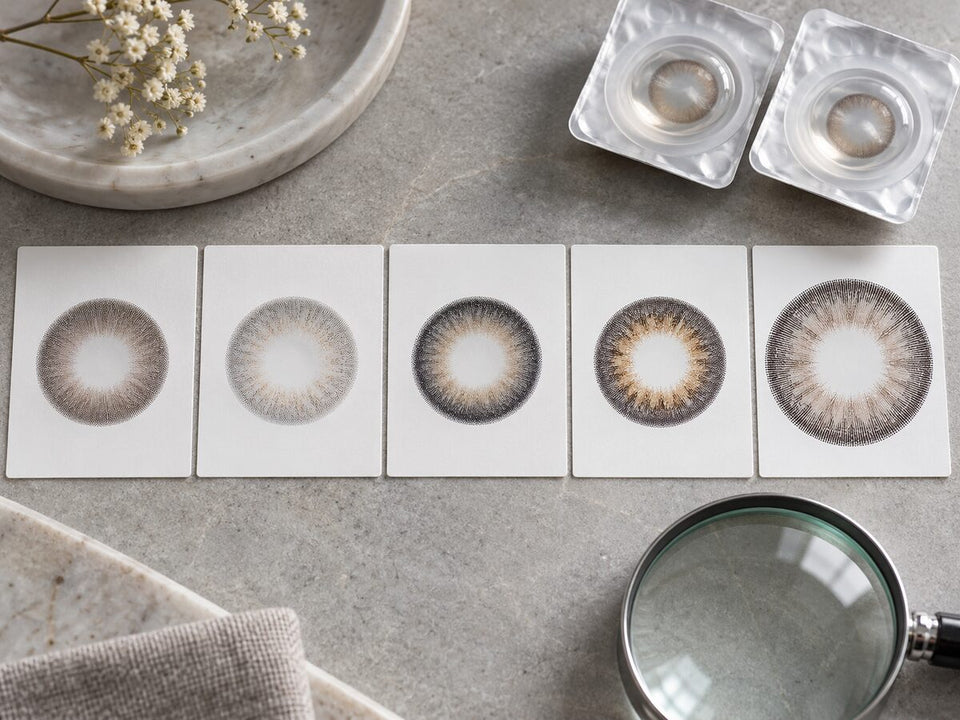
A dark or crisp printed boundary can define the eye even when the lens's main color resembles your natural iris. Some people want that circle-lens effect; others prefer a softer boundary. If a brown lens feels bolder than expected, the cause may be the ring rather than the shade. Look at the edge separately from the color field in your notes. Avoid rejecting an entire color family because one pattern had more definition than you wanted.
Center transition
Your natural eye color may remain visible near the center of the lens design. A soft transition can make that combination feel blended, while a sharp boundary can be a deliberate feature. The effect is individual and can be hard to judge from a model photograph taken on a different iris. Seek a clearly identified close-up for the exact product, then evaluate the full-face result at a normal distance.
Brown, choco, and gray are directions, not rules
Brown-family lenses can create a familiar-looking warmth, but they are not automatically subtle. A choco design may read deeper and produce an outlined effect; a brown print may be lighter or sharper depending on its details. A gray lens may be a quiet cool shift if the pattern is diffuse, or a visible statement if the contrast is strong. Decide what change you want, then compare designs inside and outside the color family you first expected.
Do not use skin tone, ethnicity, age, or gender as a rigid rule for this choice. The result you like depends on your own aesthetic brief and the actual lens pattern. A bare face is not a deficient canvas that requires “correction.” Colored contacts are an optional styling choice; your natural eye color is already a complete look.
What three KPOP2 catalog examples can tell you
KPOP2 currently lists OLENS Real Ring Brown with a 12.5 mm graphic diameter, monthly replacement, and two lenses per box. OLENS ViVi Ring Brown lists a 13.0 mm graphic, monthly replacement, and two lenses per box. OLENS Misty Natural Choco 20p lists a 13.1 mm graphic, daily replacement, and twenty individual lenses per box. These facts help identify the exact products and plan an order. They do not rank which will look most natural without makeup.
A smaller graphic area may be relevant to your visual brief, but it does not erase the effect of a strong printed border. A larger graphic may be softly printed. The daily versus monthly distinction also changes care and supply, not simply the appearance. If the two eyes need different powers, count the physical lenses and boxes for each eye. Save the full product URL and selected power rather than a shorthand such as “brown natural lens.”
A fair photograph test for a bare-face look
Take one head-and-shoulders portrait with your usual bare-face routine, then an eye-area detail. Use ordinary daylight and one common indoor setting. Keep the camera distance, angle, hair arrangement, and filters as consistent as possible. If you normally use a small amount of concealer or brow product, keep it in both comparisons; the goal is your real routine, not a staged definition of “bare.”
Use the portrait to judge the overall impression. Use the crop to understand a ring or center detail you noticed. A magnified iris can make nearly any printed design look more pronounced than it will in conversation. If the lens seems too bold in the portrait, change one variable in your next suitable comparison: the edge, apparent hue, or styling around the eye. Avoid changing the lens and adding several makeup products at once, because that hides which adjustment mattered.
When looking at customer images, verify the exact version. A photograph labeled only “Real Ring” or “Misty” may not identify the specific color and format. Note the starting iris color if stated, and leave it unknown if not. An image can still inspire your style while being too weak to predict a particular product's result on your eye.
Two practical no-makeup scenarios
Everyday errands and work
Your lens may be seen mainly in indoor light and at conversational distance. Prioritize the full face and the routine you can repeat on an ordinary morning. A quiet change may be successful even if it is difficult to see in a phone selfie. If you prefer visible definition without eyeliner, inspect the printed outer ring. If you want the eye color itself to lead, inspect the hue and the center transition rather than choosing only by graphic diameter.
Keep the approved lens routine independent of a busy schedule. Have current glasses available. A replacement period is not a personal daily wear-time allowance. If you prefer no cosmetics because it simplifies mornings, a reusable lens still requires the care and storage specified for that exact product; a daily disposable still must be used and discarded as directed.
Photos and special occasions
A no-makeup portrait can be intentional and polished. The contact may provide a color accent while hair and clothing remain simple. Take a normal portrait with the outfit you plan to wear, not just an eye crop. If the lens looks understated in daylight but conspicuous under flash or bright indoor light, decide which photograph matters most. A product image on a model is inspiration, not a guarantee of your own result.
Do not feel obliged to add mascara or liner solely to make the lens “work.” If the bare-face version already meets your brief, stop. If you want a little balance, test one familiar product and keep the lens fixed. This preserves the ability to identify what the lens itself contributes.
Keep the style question separate from suitability
A no-makeup aesthetic cannot establish contact-lens prescription, fit, or comfort. The FDA's buying guidance advises exact brand and lens identification and professional approval before substitutions. A lens with a pleasing color or small graphic is still a medical device that must be appropriate for your eyes. Do not use a style comparison to switch independently from a fitted model.
Daily and reusable formats have different handling requirements. The FDA's lens-type guidance distinguishes them, while the instructions for the exact lens govern use. A “natural” shade name, a water-content number, or a favorable review cannot guarantee individual comfort. If you have pain, persistent redness, unusual light sensitivity, discharge, or blurred vision, remove the lens and seek professional guidance.
Lens care matters even when you wear no makeup
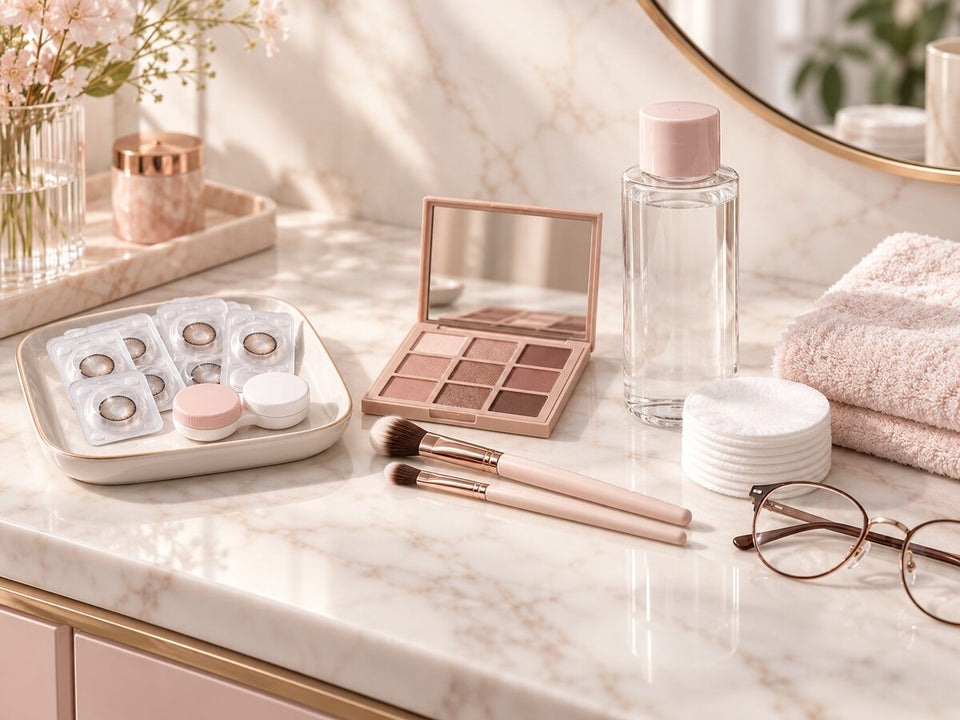
A bare-face routine may reduce cosmetic steps, but it does not eliminate hand hygiene, prescribed insertion and removal technique, or appropriate cleaning and storage for reusable lenses. Follow your eye care professional's directions and the product instructions. If you do use any cosmetics, the FDA recommends inserting lenses before applying them and removing lenses before taking makeup off.
Prepare an alternative that is easy to use. Glasses are part of a complete no-makeup look, not a failure of it. Keeping them accessible prevents a styling preference from pressuring you to continue wearing a lens when you want or need to remove it. The choice to wear no colored contacts on a given day is also valid.
Make a shortlist that describes features, not labels
Choose two or three exact, professionally appropriate products that answer your visual brief. For each, write the intended color shift, outer-edge strength, center transition, replacement format, and box count. Link one identified full-face reference and one close-up if available. Mark missing information rather than filling it in from the name.
If Real Ring Brown and ViVi Ring Brown are both candidates, ask whether you are comparing graphic area, print edge, or on-eye color. They differ in listed graphic diameter, but that fact alone cannot answer all three. If Misty Natural Choco is a candidate, the daily format and twenty-lens package create a different supply calculation. Keep the format decision beside, but separate from, the appearance comparison.
After the comparison, write one sentence: “I like this exact lens because it adds a little warmth without a strong border in the portraits I reviewed,” or “I prefer a defined eye even on days I wear no makeup.” That sentence makes the personal goal explicit. If the only reason is “the name says natural,” gather better evidence.
Final no-makeup lens checklist
- Define your routine. Decide whether you mean no cosmetics or a minimal everyday face.
- Name the desired change. Choose color shift, definition, both, or neither.
- Inspect the print. Separate outer ring, main color, center transition, and graphic area.
- Judge a full face. Use a normal portrait before magnifying the iris detail.
- Test relevant light. Compare daylight and ordinary indoor conditions.
- Verify exact product details. Confirm fitted model, power, replacement schedule, and individual lens count.
- Keep glasses available. A lens-free option is part of the plan.
- Stop when the brief is met. Do not add makeup or another lens just because a marketing image suggests you should.
The most useful no-makeup contact choice is one that supports your normal face and your chosen level of change, while fitting the exact lens instructions and professional guidance that apply to you.
Pattern questions that are more useful than “natural”
When a product is described as natural, ask what that word refers to in the specific design. Does the print have a diffuse outer edge? Is its main color close to the natural iris in the reference? Is the graphic area relatively restrained? Does the model wear little makeup in the image? These are different observations, and a product can meet some while missing others. A generic natural label does not tell you which feature created the impression you liked.
Try a two-column note: “Feature I can see” and “Result I still need to test.” The product close-up may show a soft ring; your own portrait remains unknown. A customer portrait may show a gentle full-face effect; the exact starting iris color may be unstated. Keeping those gaps visible helps you avoid an overly confident purchase based on a beautiful but incomplete image.
When the edge is the deciding feature
Compare the outer boundary in two identified product images at similar scale. If one ring appears more defined, record that observation without assuming it will have the same strength on your eye. A lens with a deeper main color may still feel quieter when its boundary is soft. A familiar brown hue may feel bolder when its border is crisp. The edge can matter more to a bare-face brief than the shade family itself.
When the color shift is the deciding feature
Look at portraits as well as close-ups. The apparent color may change with light and with the natural iris showing through. If the look is for ordinary indoor life, a bright window selfie should not carry the entire decision. Search for a relevant indoor view or make one with an approved lens. Decide whether you want an eye color that others notice immediately or a change that is mainly visible to you in the mirror.
When the full-face balance is the deciding feature
Keep hair and clothing near the face in the comparison. A dark fringe, white shirt, or strong lip can alter the visual hierarchy. If you rarely wear makeup, an image with elaborate lashes may be less useful than a plain portrait. The goal is not to duplicate the model's face; it is to decide whether the contact supports your own everyday styling.
A worked decision using two brown options
Suppose your brief is “slightly warmer eyes, minimal outer definition, no eyeliner.” Real Ring Brown and ViVi Ring Brown are two catalog candidates if their exact models are professionally appropriate for you. Their listed graphic diameters differ, but that is only the first sorting field. Gather clearly identified close-ups to compare the edge and center, then full-face images with modest makeup. Keep lighting context and starting iris information in your notes. You may prefer the larger listed graphic if its printed border appears softer in the relevant reference. You may prefer the smaller one for an entirely different reason. The result is a documented personal preference, not a universal size rule.
Now add Misty Natural Choco 20p as a third candidate. Its daily format and twenty-lens count belong in the practical column. Its “Natural” name does not award it the aesthetic comparison. If the imagery is insufficient or the model is not within your fitted options, do not invent a ranking. Ask for better product evidence or narrow the shortlist to appropriate choices you can assess honestly.
Questions and answers
Are brown contacts always the best option without makeup?
No. Brown is a broad color label, and patterns can create different levels of definition and contrast. Compare the exact design against the amount of change you want with your usual appearance.
Does Natural in a product name guarantee a subtle effect?
No. It is part of the product's identity, not a standardized measurement of realism. Use exact specifications and relevant photographs to investigate the lens instead of relying on the name as a prediction.
Should I choose the smallest graphic diameter available?
Not automatically. Graphic diameter helps describe the design, but it does not establish the full visual result or professional suitability. Compare the pattern and preferred contrast while keeping physical lens requirements separate.
Can I wear colored contacts without eyeliner or mascara?
Makeup is an optional styling choice. Whether you can wear a particular contact lens depends on appropriate fitting, prescription requirements and professional guidance, not on whether you also use cosmetics.
Is a daily lens easier to compare for occasional styling?
A daily format has a different use and disposal routine from a reusable lens. Discuss the appropriate product with your practitioner, then compare practical quantity and care requirements. Do not assume a format guarantees comfort or suitability.
What if the lens looks too defined for my usual face?
Identify whether the outer boundary, color change or overall contrast feels stronger than you prefer. Use that observation to compare another approved option. You do not need to add makeup or keep wearing a style you dislike.
The three named product records were checked in Shopify for this guide. KPOP2 editorial guidance using KPOP2 product fields and the linked sources. Catalog images and design discussions are not controlled wear tests.