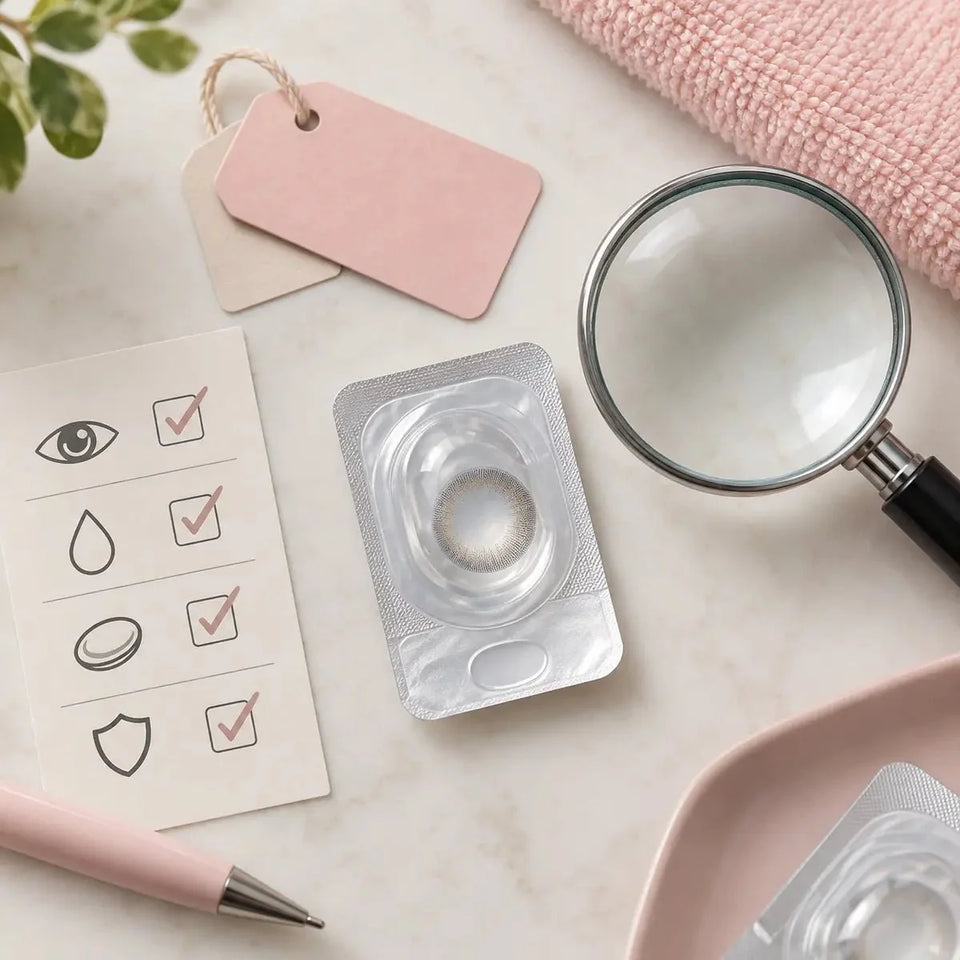
Care & authenticity
Contact Lens Size for Big Eyes: How to Choose a Design

If you have large eyes or want a more enlarged-looking lens effect, compare graphic diameter (G.DIA), print pattern, edge contrast, and how much natural iris remains visible in the exact product images. Overall lens diameter (DIA) is a separate physical measurement used in fitting. Neither number alone predicts appearance or fit.
In this guide
- Separate eye appearance from lens fit
- DIA and graphic diameter
- What changes the apparent eye size
- Choose a design for your style goal
- Three design comparisons in practice
- Compare product photos carefully
- A step-by-step comparison process
- Think about proportion
- Confirm fit and prescription
- Frequently asked questions

Separate the appearance of your eyes from contact lens fit
“Big eyes” can mean different things in a style conversation: a wide visible eye opening, a prominent iris, a rounder appearance, or an enlargement effect created by a printed lens. These descriptions are not a way to measure your cornea or determine which contact lens fits. A selfie, mirror, or visible amount of white around the iris cannot substitute for an eye examination and fitting.
For appearance, you can compare the printed area, color coverage, ring, and edge shown in product information. For fit, an eye-care professional evaluates the exact lens on your eyes and checks its suitability. Keep these decisions separate: a larger printed pattern may change the visual impression, but it does not mean you need a larger physical lens.
DIA and graphic diameter are different measurements
Overall diameter (DIA) describes the physical diameter of the contact lens. Graphic diameter (G.DIA) describes the width of the colored printed area on a colored or circle lens. A product can list both because the clear lens material may extend beyond the graphic.
G.DIA can be useful when comparing how much area a design intends to color. It is not a direct measure of how large your eye will look. Overall DIA is a physical product specification and must be considered in the lens-fitting process. Do not use one number as a substitute for the other or choose either measurement just to change an aesthetic effect.
Product listings may show the measurements differently or omit one value. Check the exact model’s specifications, and ask the seller or manufacturer if the label is unclear. Do not estimate graphic diameter from a resized photo or assume that two brands use identical visual design just because their G.DIA is the same.
For a closer explanation of these measurements and how print pattern changes the look, see our DIA vs. G.DIA size and pattern guide.
What changes the apparent eye-size effect?
A circle lens creates an impression through several design features working together. The result may vary with natural iris color, pupil size, visible sclera, print density, lighting, camera distance, and the proportions of the face. A numerical measurement alone cannot predict the final look.
- Graphic diameter: A wider printed area may cover more of the iris in the product design, but its effect depends on edge, color, and the wearer’s natural iris.
- Outer ring: A crisp dark ring can make the iris boundary look more defined. A softer or broken edge may create a gentler transition in the product image.
- Opacity and color: A high-contrast print can attract attention even if its graphic area is not the largest. A blended pattern may read more softly.
- Visible sclera: The amount of white around the iris affects the sense of proportion in a photo. A wider printed area may reduce the visible contrast with the surrounding white, but it does not guarantee a particular balance.
- Center opening and texture: The transition near the pupil and the presence of dots, spokes, or layered tones can change how prominent the design appears.
- Viewing distance and light: Macro photos reveal print details; face-distance views show overall styling. Flash, warm bulbs, and daylight can shift apparent color and contrast.
A smaller design with a dense dark rim may look more defined than a larger design with a pale, feathered edge. That is why comparing “millimeters” alone can lead to a misleading conclusion.
Choose a design for your style goal
Rather than starting with the largest available number, decide what kind of effect you want. These are visual directions, not guaranteed outcomes or fitting advice:
- Preserve a balanced, subtle look: Compare prints that sit close to the natural iris area, with softer color transitions and a less pronounced edge.
- Add definition without a dramatic enlargement effect: Look at a moderate printed area with a clearer ring or radial detail. Check whether the edge draws more attention than the color.
- Create a more noticeable circle-lens look: Compare broader printed areas and stronger rings, then inspect face-distance images to see how the design reads with the whole face.
- Change color more than apparent size: Compare color coverage and opacity while paying attention to whether the outer edge stays close to the natural iris boundary.
If your natural eye already appears prominent in photos, you may prefer a softer edge or a design that preserves more visible sclera. If you want a clearly stylized effect, a stronger ring may be intentional. Choose from actual product designs and your own taste, not from a rule that says one eye shape requires one lens size.
Three design comparisons in practice
Two lenses with the same graphic diameter: Compare the pattern before deciding they will look alike. One may have a dark ring and dense print; the other may have a pale edge and blended tones. The listed number is the same, but the design cues differ.
Two lenses with different graphic diameters: Compare them at face distance as well as in macro images. The broader print might seem more prominent, but a softer edge or lower contrast could change the impression. A product image cannot predict exactly how either will appear on your eyes.
A product page with only overall DIA: You can confirm the physical lens measurement from the listing, but you cannot derive its graphic diameter from that number. Ask the seller or manufacturer for the printed-area measurement if it matters to your style comparison.
These examples show why a size comparison works best when you record each measurement and print feature separately. They are shopping observations, not a substitute for fitting.
Compare product photos carefully
Photos are useful for comparing design, but they can exaggerate or soften the enlargement effect. Wide-angle phone cameras, close distance, portrait filters, retouching, angle, lighting, and image crop can distort proportion. The model’s natural iris and eye opening may also differ from yours.
- Match the exact product: Verify brand, model, color, and version before comparing images.
- Use two views: Inspect a close-up for ring and print, then a normal portrait for balance and proportion.
- Keep conditions similar: Compare similar camera distance, angle, and light rather than a studio image against a selfie.
- Check the original iris context: If visible, note the natural eye color but do not treat it as a guaranteed preview of your own result.
- Read measurements from the listing: Product photography is not a measurement tool.
If only a tightly cropped, edited image is available, record that the face-distance effect is unknown. Ask the seller for additional views of the exact lens if you need them. Never infer fit or a personalized result from a promotional photo.
If your comparison is specifically about brown circle lenses on blue eyes, see the separate brown circle lens shade and pattern guide.
A step-by-step contact lens size comparison
- Write down your goal: subtle color, clearer iris definition, or a more pronounced circle-lens effect.
- Compare G.DIA: Use the listed graphic measurement as one clue about the printed area, not a ranking or fit recommendation.
- Check the pattern: Note edge, ring density, opacity, layers, and center transition.
- Review more than one image: Compare macro and face-distance examples under similar conditions.
- Confirm the exact item: Record brand, product name, shade, overall DIA, base curve or other specified parameters, power options, and replacement schedule.
- Ask a professional about fit: Have your eye-care provider evaluate the exact lens rather than changing geometry based on appearance.
For example, if two candidate lenses list a similar G.DIA but one has a stronger dark ring, compare their edge definition separately. If one product lists DIA but not G.DIA, do not use its overall diameter to guess the size of its colored print. A precise product question is more useful than asking which number will make eyes look biggest.
Think about proportion, not just coverage
An enlargement effect is only one part of visual balance. Consider whether you want the colored edge to follow the natural iris closely, whether you prefer more visible white around the iris, and whether the ring should be subtle or distinct. These details can change how round, soft, or graphic a design seems without implying anything about the size of the physical eye.
Compare images of the same lens with your eyes open naturally and at a similar viewing distance. Avoid comparing a wide-eyed pose against a relaxed one; expression alone can change the visible opening. If you take your own reference photo, use neutral light, face the camera straight on, and avoid filters. This gives you a more consistent visual reference, though it still cannot predict the exact result after wearing a contact lens.
For someone who prefers a restrained look, a bold dark ring may be more noticeable than the difference between two nearby G.DIA values. If a more dramatic style is the goal, a clearly defined print may be deliberate. Let the design meet the personal goal rather than assuming “big eyes” calls for the largest number.
Confirm contact lens fit and prescription
The physical size and suitability of a contact lens must be assessed by an eye-care professional. The FDA says decorative lenses are not one-size-fits-all and require a prescription and professional fitting in the United States, even if they do not correct vision. Requirements can differ in other countries.
The CDC explains that contact lenses require a prescription and proper fitting. Ask your provider to confirm the exact brand or model, prescription for each eye, relevant measurements, and wear and replacement schedule. A lens with a larger or smaller printed area is not automatically a better physical fit.
Follow the instructions for the exact model. If you experience pain, unusual redness, light sensitivity, discharge, or blurry vision, remove the lens and contact an eye-care professional promptly. Do not keep wearing a lens to test whether discomfort settles.
Before deciding, write down what you can verify and what you cannot: the exact G.DIA and DIA, the print style shown, which photos are available, and any product details missing from the listing. Use that note to ask the retailer a focused question. Ask your eye-care professional a separate question about fit, prescription, and wear. This two-part check keeps appearance choices from turning into an unsupervised change in lens size.
Use the product’s full name when saving those notes so you can revisit the same color and version later. If a listing changes, verify the details again before ordering; catalog photographs and available measurements can be updated.
Frequently asked questions
Do people with big eyes need larger contact lenses?
Visible eye size does not determine lens fit. An eye-care professional must assess the exact contact lens for your eyes.
What makes eyes look larger with circle lenses?
Graphic diameter, edge contrast, print opacity, natural iris, and photo conditions can all affect the perceived effect. No single number guarantees enlargement.
Is overall DIA the same as graphic diameter?
No. DIA is the physical lens diameter; G.DIA is the colored printed area. Check the exact product specifications.
Can a smaller G.DIA look more dramatic than a larger one?
It can appear more defined in a photo if it has a darker ring or higher contrast. Compare the exact patterns at both close-up and face distance.
Can I pick fit by matching a number from another lens?
No. Similar dimensions do not establish that a different brand or model fits. Ask your eye-care professional to evaluate the exact lens.
Can camera angle make eyes look larger?
Yes. Close distance, wide-angle lenses, angle, lighting, and filters can alter facial proportions in a photo.
How should I choose a circle lens safely?
Confirm the exact lens and fit with an eye-care professional first, then compare printed design features for the style you prefer.
Editorial note: Styling comparisons are general and do not guarantee a particular result. U.S. prescription and fitting information is based on FDA guidance and CDC guidance. This article does not replace an eye examination, professional fitting, or current prescription.