Care & authenticity
How to Replace a Discontinued Contact Lens: What to Check First
If your contact lens is discontinued, first confirm what changed and identify the exact old lens. Then ask an eye-care professional whether a currently available lens is appropriate for your eyes and prescription. Compare color and design only among options that are suitable for you; a similar shade or matching number does not prove that two lenses are interchangeable.
In this guide
Confirm whether the exact lens is discontinued
A missing product page does not by itself show that a lens has been discontinued. The product may be temporarily out of stock, unavailable in one prescription, removed from a retailer’s catalog, renamed, repackaged or discontinued by its manufacturer. These situations call for different next steps.
Check the manufacturer’s current catalog or ask the manufacturer or seller to confirm the status of the exact series, shade and replacement format. Include the full name from your box or old order. A similar shade name, a new package design or a retailer’s search result is not enough to establish that the lens is the same product.
Keep the answer in writing when possible. Note whether the manufacturer confirmed the same lens under a new name, a packaging change, limited availability or a discontinued product. If only one seller stopped carrying it, you may still be able to locate the exact model through an authorized seller, subject to your current prescription and local requirements.
Recover the old lens record
Before comparing alternatives, write down the full identity of the lens you used. Gather any unopened carton or blister label, your contact-lens prescription, an order confirmation and the old product page if you saved it. Each record may answer a different question, and a past order receipt should not replace a current prescription.
- Full manufacturer or brand, series and shade
- Replacement format, such as daily disposable or reusable
- Prescription details for each eye; include cylinder and axis when prescribed for a toric lens
- Base curve, diameter and other labeled specifications, when available
- Individual lenses per selling unit and the number of boxes previously ordered
Separate facts printed on the package from details you remember. If a field is missing, label it unknown. Do not fill a gap by assuming that the right and left eyes used the same power, that a similar design had the same specifications or that a saved web page is current.
Check professional suitability first
A replacement changes the identity of the contact lens, even when the color name or prescription power looks familiar. The FDA’s contact-lens prescription guidance describes the product information that may appear on a prescription. Bring your current prescription and the exact product details for any proposed alternative to your eye-care professional, and ask whether that specific lens is appropriate or requires a new fitting.
Do not treat a matching power, base curve or overall diameter as proof that two lenses fit alike. Those numbers help identify a lens; they do not establish identical material, geometry, movement or suitability. Do not change a prescribed brand, model or power yourself to recreate the old look.
For shoppers in the United States, the FTC Contact Lens Rule guide explains prescription verification and seller responsibilities. Requirements differ by country, so check the rules that apply where you live and where the lens will be dispensed. This article cannot determine clinical fit; a product comparison should begin only after a professional has identified suitable options.
Compare the appearance you want
Once you have professionally suitable candidates, describe the feature you miss about the old lens. It may be a warm or cool color direction, a soft or defined outer edge, a visible center transition, a particular printed area or the overall contrast at normal viewing distance. “The same brown” is less useful than a specific feature you can compare.
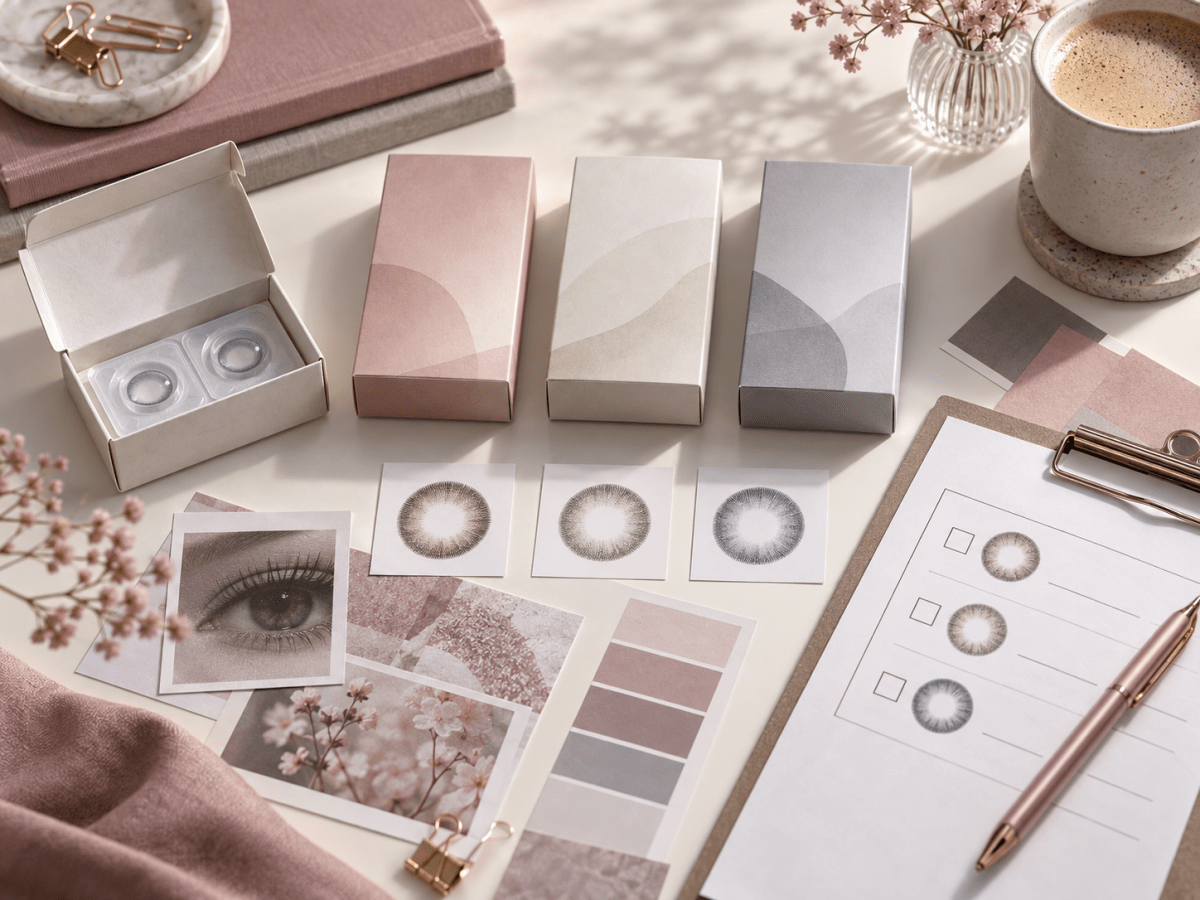
Use exact-product images where possible. A close-up may show print placement and edge detail; a face portrait can show how noticeable the design appears at a more natural scale. Check that each image is labeled with the exact series, shade and version. Record the starting eye color, distance and lighting only when the source states them. If a detail is not shown, leave it unknown rather than predicting your own result from an edited photo.
Graphic diameter can help describe the printed area when the manufacturer provides it, but it is not a complete appearance score. A smaller printed zone can still look defined if its edge is dark or opaque; a broader gradient may appear softer. Compare the design and relevant images alongside the measurement. Do not use graphic diameter as a fitting measurement or a guarantee of a particular effect.
A simple comparison table can keep style questions separate from professional approval:
| What to compare | Useful evidence | What it cannot confirm |
|---|---|---|
| Color and pattern | Exact shade images and labeled wear photos | Your personal color result in every light |
| Edge and printed area | Close-up and normal-distance views; listed graphic diameter | Fit or a guaranteed enlargement effect |
| Product identity | Manufacturer, series, shade and version | Whether another model is a clinically suitable substitute |
Compare replacement format and supply
A visually similar lens may come in a different replacement format or box quantity. Check the current listing for daily versus reusable use, the number of individual lenses per box and the available prescription options. A package count usually describes individual lenses, not pairs. If your eyes have different prescriptions, calculate the quantity for each eye separately and confirm the exact selections in the cart.
Compare the amount you can use before its labeled discard date, not only the number of boxes or the product-card price. Confirm the replacement schedule, package expiry date and any storage directions with the exact product labeling. Do not buy a large supply as a hedge against a possible discontinuation if your prescription may expire or the product may not be suitable.
Read the live product page when you are ready to order. Saved screenshots and old receipts can help recover the past model, but availability, pack sizes and prescription menus may change. If a needed power or parameter is missing, ask the seller about the exact listing and discuss any alternative with your eye-care professional instead of selecting a nearby value.
If there is no close match
Some discontinued designs have no like-for-like replacement. Ask your eye-care professional which alternatives are appropriate, then rank the visual features that matter most to you. You might prioritize a similar color temperature over the exact edge, or prefer a familiar replacement schedule over a closer-looking pattern. That is a styling trade-off, not proof of equivalence.
If the alternatives differ in several ways, compare them one at a time: product identity and fit first, replacement instructions and pack format next, then appearance. Remove any candidate that is not approved for you before deciding which remaining look you prefer. If no available lens meets your needs, ask about other options rather than forcing a match.
Inspect the order and follow its instructions
Before opening a delivered package, compare the confirmation, prescription and carton or blister labels. Check the exact product and shade, each eye’s prescribed values, replacement format, individual lens quantity and expiration date. If something differs, contact the seller before opening or wearing the lenses. See the package-check guide for a step-by-step receiving check.
Follow the exact lens’s replacement, cleaning and storage instructions and your eye-care professional’s advice. The CDC contact-lens prevention guidance covers safer handling and avoiding water exposure. Never extend a replacement schedule or share lenses because the old version is no longer available.
If a lens causes pain, persistent redness, discharge, light sensitivity or blurred vision, remove it and contact an eye-care professional promptly. The FDA’s contact-lens risk guidance explains symptoms that need attention. Do not keep wearing a lens to compare its color or test whether discomfort will pass.
For browsing, see Natural Color Contacts, Daily Contacts and Monthly Contacts. These are discovery routes; verify the exact product and prescription before ordering. KPOP2’s prescription verification and wear and care pages provide store-specific next steps.
KPOP2 Editorial Team · Reviewed September 2026. Product availability and specifications can change. Confirm the current lens record and follow professional fitting advice and the exact product instructions.