Size & design
G.DIA vs DIA: What Contact Lens Size Numbers Really Mean
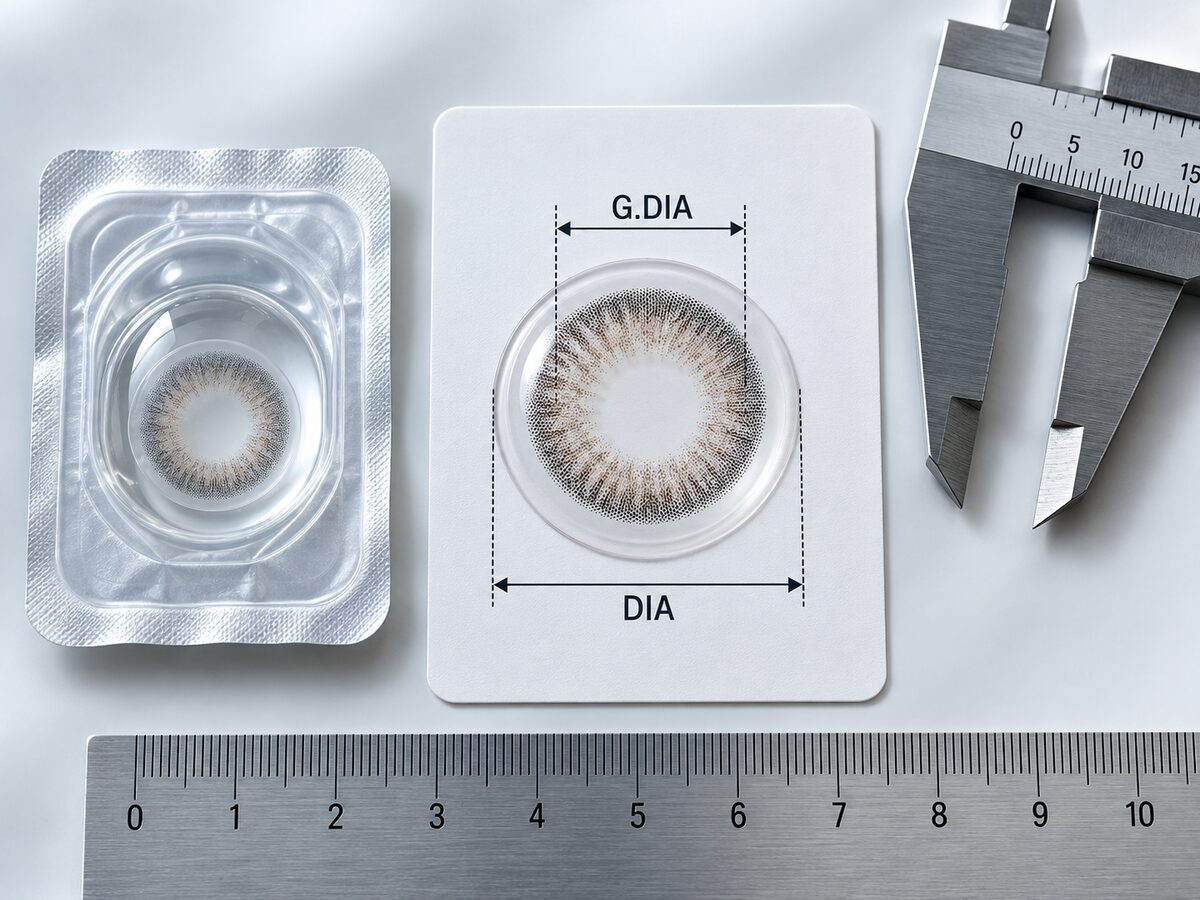
G.DIA describes the diameter of a contact lens’s printed graphic; DIA describes the diameter of the complete lens. They answer different questions. In current KPOP2 listings, OLENS Scandi Olive has an 11.9 mm graphic inside a 14.2 mm lens, while Real Ring Brown and ViVi Ring Brown monthly list 14.0 mm overall diameters with different graphic sizes. These measurements help identify and compare designs. They do not predict a wearer’s exact appearance or determine whether a lens fits.
In this guide
What the measurements describe
G.DIA (graphic diameter) is the stated width of the printed colored design. You may also see it written as graphic size. DIA (diameter) is the width of the full contact lens, including the clear material beyond the printed area. A product’s G.DIA can therefore be smaller than its DIA.
Neither value is the diameter of your natural iris or pupil. Neither is prescription power. Base curve (BC) is a separate product measurement. Keep each label beside its value in notes; “13 mm lens” is ambiguous unless you know which field the number refers to.
The FDA explains the information in a contact lens prescription, including the prescribed lens identity and relevant fitting parameters. A cosmetic graphic measurement cannot replace the exact prescribed product.
Current monthly product examples
The following comparison is limited to the exact monthly listings checked in KPOP2’s current product records. Do not transfer these values to a daily, toric, or other version with a similar name.
| Monthly listing | G.DIA | DIA | BC | Lenses per box |
|---|---|---|---|---|
| OLENS Scandi Olive | 11.9 mm | 14.2 mm | 8.6 mm | 2 |
| OLENS Real Ring Brown | 12.5 mm | 14.0 mm | 8.6 mm | 2 |
| OLENS ViVi Ring Brown | 13.0 mm | 14.0 mm | 8.6 mm | 2 |
This small sample shows why the two columns should stay separate. Scandi Olive has the smallest listed graphic but the largest overall lens of these three. Real Ring and ViVi Ring share a 14.0 mm DIA while their G.DIA values differ by 0.5 mm. A larger printed measurement does not mean the complete lens is larger.
Product records and options can change. Confirm the current product page and the exact package before ordering. These examples are catalog comparisons, not a controlled on-eye test. The Scandi Olive design guide and Real Ring and ViVi Ring comparison discuss those models in their own contexts.
What the numbers cannot tell you
G.DIA is one specification, not a personal enlargement score. The number does not describe the entire print pattern, color opacity, edge contrast, or how the printed area will align with an individual iris. A 0.5 mm difference is a difference between two listed measurements; it is not a guaranteed visible difference of a particular size on your eye.
Likewise, DIA does not tell you how large the colored area will look. Subtracting G.DIA from DIA does not reveal the exact shape or width of every clear region in a design. A circle diagram can illustrate that the printed and full-lens boundaries differ, but it is not a manufacturing drawing or a simulation of how a lens will look when worn.
Color and pattern also matter. A defined dark rim may attract attention even when the graphic is relatively small. A softer transition can read differently in photographs, but images vary with the wearer’s starting eye color, lighting, makeup, camera exposure, and editing. Avoid choosing a lens from a millimeter ranking alone.
Compare appearance with useful photo context
First identify the exact product and version shown in each reference. Then compare photos that answer the same question. Close-ups can help you inspect the outer ring and color transitions; wider portraits show how noticeable the overall effect appears with the rest of the face. One type of image cannot stand in for the other.
Look for the starting iris color and similar lighting. A bright studio image of one product and a dim phone photo of another do not show a controlled comparison. Treat customer and catalog images as visual references, not fitting evidence or guaranteed outcomes. If the product identity or photo conditions are unknown, keep that uncertainty in your notes.
Make the question specific: are you comparing the border, the color shift, or how prominent the lens looks in a full-face image? This keeps the shortlist useful. Our guides to evaluating customer photos and comparing a design that feels too dramatic offer additional reference checks.

Keep design comparison separate from fit
DIA and BC are part of product identification, but matching those two numbers to a different lens does not prove that it is an equivalent or suitable substitute. Brands and models can differ in shape, material, and other design details. The FDA advises consumers to use the exact prescribed lenses and consult an eye-care professional before accepting a substitution.
Do not change overall diameter or prescription power as a styling adjustment. If you are considering a different model, ask your eye-care professional about that exact product. For a purchase, separately confirm the product version, prescription options actually selectable on the current page, replacement schedule, and lenses per box. A description of a power range does not by itself confirm which selections are currently available.
Keep replacement and care instructions attached to the exact lens. A monthly lens does not become a daily lens because its graphic is smaller, and a daily disposable should not be reused. Follow the supplied product directions and the advice from your eye-care professional.
A practical comparison checklist
Use these fields to make a note you can verify later:
- Exact identity: brand, model, shade, and daily, monthly, or toric version.
- Design measurements: labeled G.DIA and its source; mark a missing value “not confirmed.”
- Lens measurements: labeled DIA and BC from the same exact product record.
- Visual references: image link, product version, starting eye color if known, and lighting context.
- Order details: prescribed selections for each eye, replacement schedule, and individual lenses per box.
- Fitting question: bring the exact product information to an eye-care professional rather than relying on a similar color or matching number.
If a product title, older note, search snippet, or social post conflicts with the current product page or package, do not guess which measurement is correct. Verify the exact version with the seller before ordering. For fit, prescription, or symptoms, contact an eye-care professional.
In short, use G.DIA to compare the stated extent of a printed design and DIA to identify the full lens diameter. Then evaluate identified photos for style and use the exact prescribed product for fitting and ordering decisions. Each number is useful when it answers its own question.
Product fields checked September 29, 2026. KPOP2 editorial guidance; measurements are tied to the named monthly listings above and may change. Catalog images are not controlled wear tests.