
Buying guides
How to Compare Customer Photos Before Buying Colored Contacts
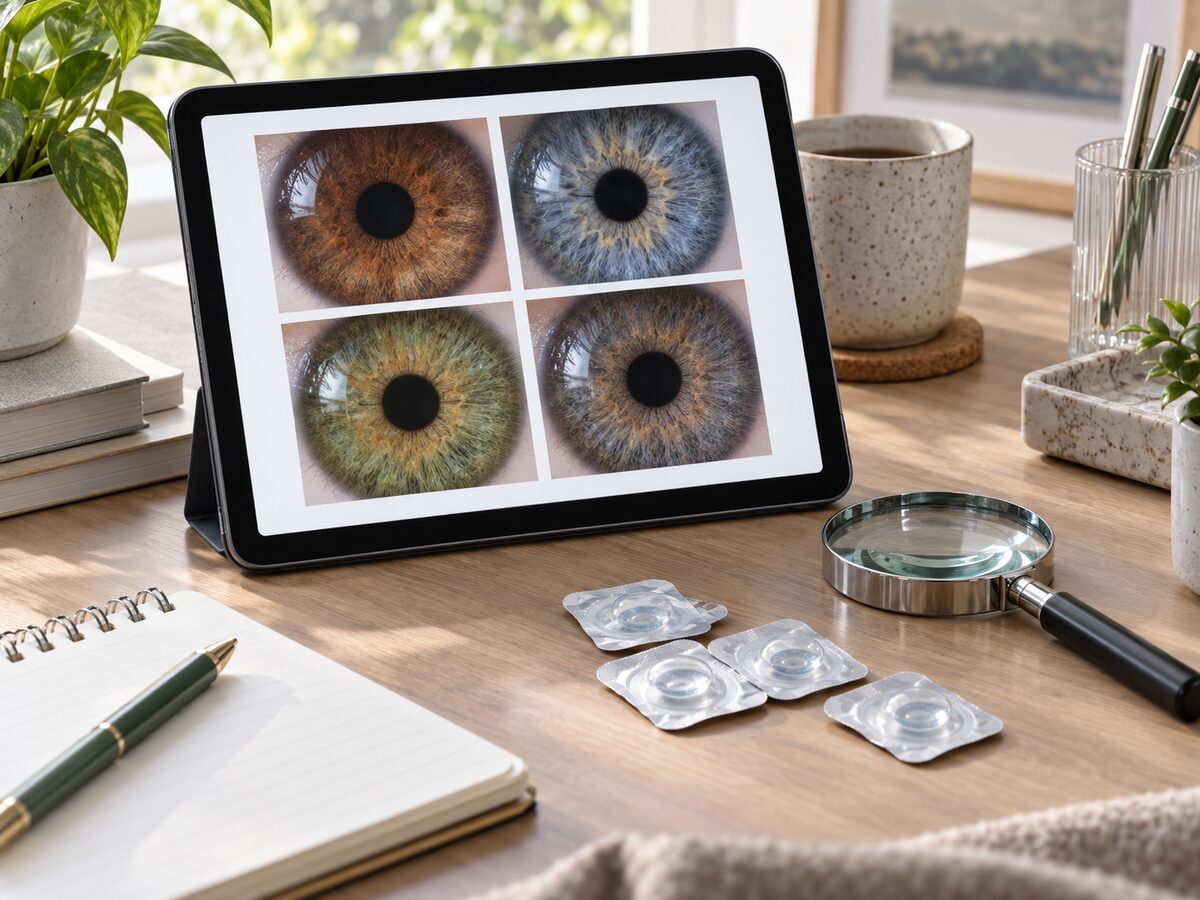
Customer photos are most useful when they identify the exact lens and help answer a specific visual question. Compare product version, stated starting eye color, viewing distance and visible pattern features before relying on the overall image. Count distinct wear experiences carefully, keep missing information visible, and use photographs for aesthetic comparison rather than proof that a lens will fit or feel comfortable on your eyes.
In this guide
- Start with the decision you need to make
- Verify the exact lens behind the image
- Record what the photo can and cannot show
- Read photographic differences cautiously
- Count independent experiences rather than repeated images
- Turn the evidence into a small comparison sheet
- Keep the final order decision broader than the gallery
- Questions and answers
Start with the decision you need to make
A customer gallery can answer several different questions, but not equally well in every image. You may want to compare outer definition, see whether a color is conspicuous in a portrait, or inspect the transition near the center. Decide which question matters before collecting references. Otherwise, a large number of attractive images can hide the fact that none addresses your actual concern.
Write the question in plain language. “How defined does this exact lens look without strong eyeliner?” is specific enough to guide a search. “Is it good?” mixes appearance, comfort, suitability, value and service into a question no single photograph can answer.
Separate a product reference from a styling reference
An image with no exact lens identification may still inspire a color palette or makeup idea. Keep it in a styling folder, not in the evidence set for a particular product. This distinction lets you enjoy the image without giving it more authority than its context supports.
Begin with the relevant product record or KPOP2 reviews page, then keep the image attached to the identifying information available there. For help defining an everyday brief, use no-makeup comparisons or subtle everyday styling.
Verify the exact lens behind the image
Check the full series name, shade, replacement category and package or version information. Similar words in product names can conceal different records. “Brown monthly lenses” is a category description, not enough identification to assign a photograph to one product.
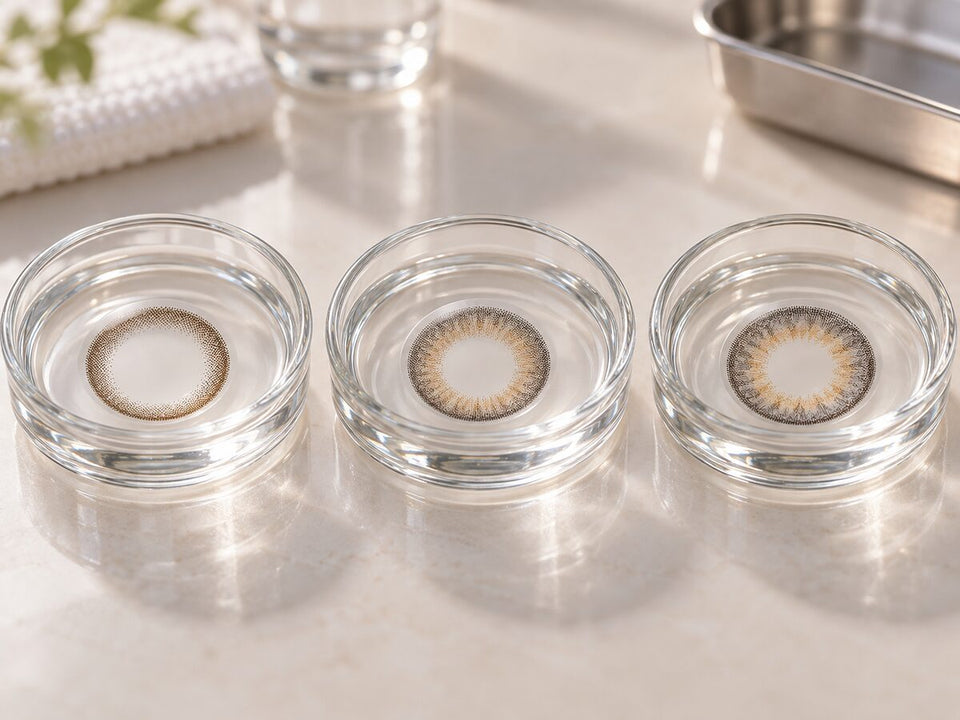
For example, the three records below all describe brown monthly options, but their names, graphic diameters and package quantities differ. A review photograph from one should not silently become evidence for another. These figures are current catalog fields, not visual measurements extracted from the images.
| Identifying field | OLENS Real Ring Brown | OLENS ViVi Ring Brown | i-DOL Yurial Royal Brown |
|---|---|---|---|
| Graphic diameter | 12.5 mm | 13.0 mm | 12.8 mm |
| Overall diameter | 14.0 mm | 14.0 mm | 14.0 mm |
| Base curve | 8.6 mm | 8.6 mm | 8.6 mm |
| Replacement category | Monthly | Monthly | Monthly |
| Listed lenses per box | 2 | 2 | 1 |
The exact records are Real Ring Brown, ViVi Ring Brown and Yurial Royal Brown. Shared physical measurements do not make their designs identical or establish professional interchangeability.
Label uncertain product identity explicitly
If a review says only “Yurial Brown,” leave the specific version unconfirmed until the source clarifies it. Do not select Royal, Serum, Water or another family member because one seems visually similar. A clear uncertainty label is more useful than a confident but unverified match.
The Yurial brown comparison and ViVi Ring version guide illustrate why this step matters. Exact identification should come before conclusions about what the product does.
Record what the photo can and cannot show
For each image, note whether it is an eye close-up, a full-face portrait or another view. Then record three visible features: apparent color impression, outer boundary and center transition. Use wording such as “in this photograph” to keep an observation tied to its evidence.
Starting eye color is useful context when the reviewer states it or provides a clearly identified reference. Do not infer a precise natural shade, medical characteristic or ethnicity from a photograph. If the starting color is not documented, simply write “not stated.” That reference can still help with some styling questions while being less informative for others.
Use close-ups and portraits for different questions
A close-up is useful for inspecting visible pattern detail. A portrait helps you consider the overall look with surrounding styling. Neither is automatically the more truthful image; each answers a different question. If possible, find both for the same identified lens rather than comparing unrelated photographs as if only the viewing distance changed.
See close-ups, portraits and video calls for a fuller comparison. The natural center color guide is more relevant when that specific transition is what you want to inspect.
Read photographic differences cautiously
Adobe's white balance guide explains that lighting and white balance can shift an image's color cast. This supports caution when comparing apparent hues across photographs; it does not reveal which settings were used in a particular customer image.
Adobe's exposure explanation describes how exposure influences brightness and retained detail. If two images look different, that context belongs on the uncertainty list alongside product identity and viewing distance. Do not automatically attribute every difference to lens coverage.
Avoid accusations based on appearance alone
A polished image is not proof of dishonest editing, and an informal image is not proof of accurate color. Unless the source provides the relevant information, you do not know the complete capture or editing process. Describe visible differences and missing context without inventing a story about the reviewer.
If faithful documentation is your goal, read photographing colored contacts. For a purchase comparison, prioritize clearly identified, relevant references rather than trying to reverse-engineer camera settings from a thumbnail.
Count independent experiences rather than repeated images
Several photographs can belong to one customer's experience. A review may also appear in more than one place, or an image may be reposted. When you are judging how much independent evidence you have, group clearly repeated material together instead of counting each appearance as a separate wearer.
This is a method for your comparison notes, not a finding that any particular review is duplicated or false. The source label alone does not establish that. An imported review can contain a legitimate experience; a repeated image needs its own context before you decide what it represents.
Keep source and experience separate
Imagine you find six gallery entries. Three show the same photograph and text, two are different angles supplied by one identifiable reviewer, and one has a separate clear product identification. Your notes should preserve those relationships. Six displayed entries would not automatically mean six independent accounts of the lens.
Record the source page and whatever identifying review context is actually available. Do not collect unnecessary personal information. You are trying to understand the lens reference, not investigate the customer. If the relationships remain uncertain, avoid assigning a precise independent-review count.
This approach also prevents repeated enthusiastic wording from outweighing a small amount of more relevant visual evidence. The most useful reference for your question may be the one that clearly identifies the version and viewing context, even if it is less dramatic than the most frequently reposted image.
Turn the evidence into a small comparison sheet
Use one row per distinct, identifiable reference. Record the exact product, view type, stated starting eye color, visible feature relevant to your question, and remaining uncertainty. This is a practical shopping worksheet we suggest, not a laboratory scoring system or a clinical assessment.
For example, one row might say: “Exact monthly version confirmed; full-face view; starting color not stated; outline appears defined; close-up unavailable.” Another might say: “Series name only; close-up; reviewer states brown eyes; center transition visible; exact version unresolved.” The second image may be more detailed, but the first has stronger product identification.
Do not collapse those differences into a numerical naturalness score. Instead, decide what additional information would actually change your choice. You may need a version confirmation, an ordinary-distance view or a better explanation of the package. Ask that question directly rather than searching indefinitely for more pictures.
A useful clarification request includes the exact listing and the unresolved detail: “Does this review show the monthly version named on this page, or a daily version from the same series?” That question can be answered more directly than “Will this look natural on me?” Keep the reply with the reference so you do not repeat the same uncertain comparison when returning to your shortlist later.
The model comparison guide addresses expectations across different people. The graphic diameter guide helps when your worksheet has started treating a catalog measurement as a guaranteed visual effect.
Keep the final order decision broader than the gallery
A convincing photo reference can help you choose an aesthetic direction. It cannot establish that the lens is appropriate for your eyes, that a different brand is interchangeable, or that you will have the reviewer's comfort experience. The FDA's buying guidance emphasizes exact lens identification and professional approval before substitutions.
Check the actual use category as well. The FDA's lens type overview distinguishes daily disposable lenses from other formats. A photograph does not change replacement instructions, and a reviewer describing occasional use does not establish an appropriate schedule for you.
Before ordering, review prescription verification, individual lens quantities and the first-order checklist. These checks answer practical questions that the gallery cannot settle.
Finish with a short, honest conclusion: which visible feature you like, which exact lens the evidence concerns, and what remains uncertain. If that conclusion is clear enough to guide the next step, the photo comparison has done its job. It does not need to promise that your eyes will duplicate someone else's photograph.
Questions and answers
Are customer photos more reliable than model photos?
Neither label guarantees useful evidence. Exact product identification, relevant views and available context matter more for a specific comparison. Customer images can add perspectives, but they still cannot guarantee your result or professional suitability.
Should I ignore a review marked Imported?
No. That label alone does not establish that the experience is false or duplicated. Evaluate the available product identification and source context. Group clearly repeated material in your own comparison without making unsupported accusations about reviewers.
Can a photo tell me whether a lens will be comfortable?
No. A photograph cannot assess fit or predict your comfort. A reviewer's personal experience is not a substitute for professional guidance on the exact lens, its prescription requirements and appropriate use.
How many photos do I need before choosing?
There is no magic number. A few clearly identified references that answer your actual question can be more useful than many unrelated or repeated images. Stop adding pictures when the remaining uncertainty requires a different kind of answer.
What if the review does not name the exact version?
Keep the version unconfirmed and seek clarification where possible. You can retain the image as general styling inspiration, but do not assign its result to a specific daily, monthly or similarly named product without evidence.
Should I expect the same shade as a reviewer with brown eyes?
No. A shared broad eye-color description does not make two people or photographs identical. Use the reference to explore a direction and visible pattern features, while keeping your own appearance and experience uncertain.
Product records checked September 11, 2026. AI-assisted guidance using KPOP2 product fields and the linked sources. Catalog images and design discussions are not controlled wear tests.