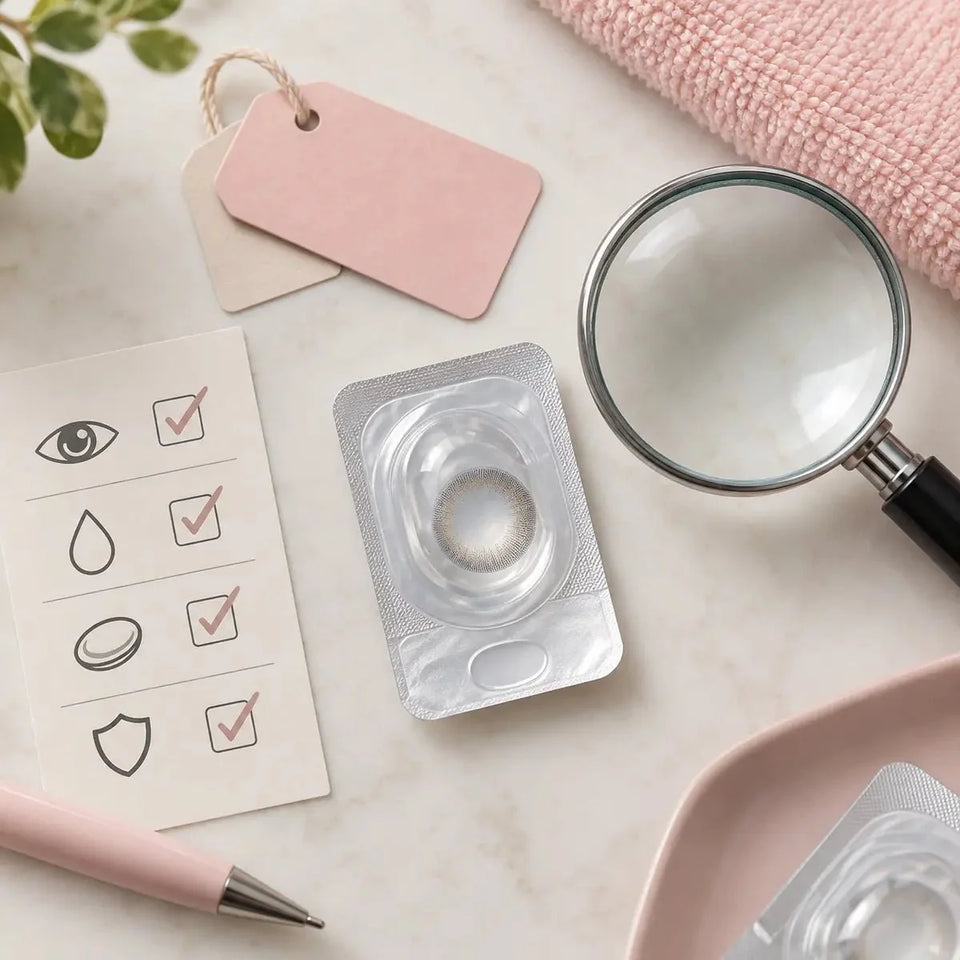
Care & authenticity
Gray Contact Lenses for Men: How to Choose Your Shade

Gray contact lenses for men can look understated, softly defined, or high contrast. Choose by the effect you want—not by a gender rule. Compare the exact shade, print opacity, edge, and your natural iris in more than one kind of light, then confirm the lens prescription and fit with an eye-care professional.
In this guide

Start with the look you want
Before browsing shades, describe the result you have in mind. You might want a subtle change that is noticeable only up close, a clear gray-brown blend for everyday wear, or a brighter steel tone that stands out in photos. Each goal points to different design details, so a short brief can make the search more focused.
There is no men’s-only rule for contact lens size, print, or color. Personal style, natural eye color, the exact lens design, and the setting are more useful than a gender label. If the word “natural” matters to you, decide what that means in your context: lower contrast, a softer edge, less visible print, or simply a shade that works with your usual clothes and grooming.
Think about viewing distance too. A subtle iris color may be visible in a mirror or portrait while reading as a small change in conversation. A defined ring or brighter print may be more noticeable from farther away. Decide whether you want the lens to blend or to act as a focal point.
Compare gray shade families
Gray is not a single color. Product names may describe cool, warm, silver, smoke, ash, or gray-brown variations, and brands do not necessarily use those words consistently. Compare the exact product photos and print rather than choosing by name alone.
- Warm gray or greige: Gray with a brown, beige, or golden impression may coordinate with warmer makeup or clothing palettes. Check the actual images to see whether the result leans more brown than gray.
- Neutral smoke: A balanced gray can be a middle ground between a warm blend and a cooler statement. The print and natural iris still affect the way it appears.
- Cool ash or steel: Blue-gray or silver-leaning shades may create a stronger contrast in some settings. Look closely at opacity and ring definition if you want to avoid an overly graphic look.
- Gray-brown or hazel-gray: Mixed tones can appear more layered than one flat shade. Compare how the center and outer areas transition in the exact design.
These are descriptive style directions, not guaranteed outcomes. A warm shade can still look bold if it has a dark ring; a cool shade can appear subdued if its print is soft and your natural iris blends with it. Evaluate hue and pattern together.
Check opacity, edge, and printed pattern
Color names do not show how a lens is designed. A gray lens may use a gradient, several printed tones, fine spokes, a defined outer ring, or a broad area of color. Those features can change the visual effect as much as the shade.
- Opacity: The printed color coverage can influence how much of the natural iris remains visible in the example. Do not assume a more opaque lens will create the exact same color on every eye.
- Outer edge: A dark or sharply defined ring can frame the iris and read more graphic. A feathered edge may create a softer transition in product images.
- Radial texture: Spokes, dots, or layered details add pattern. Their visibility depends on the lens, the image scale, and lighting.
- Center opening: Compare how the printed area transitions near the pupil. A more gradual boundary may look different from a clearly outlined center.
- Graphic diameter: This describes the printed colored area, not the overall physical diameter or suitability of the lens. Check specifications separately.
For a quiet effect, you may prefer to compare softer edges and blended tones. For stronger definition, look at ring contrast and color coverage. Those are ways to narrow a style search, not instructions for selecting a medically appropriate lens.
Coordinate gray lenses with your personal style
Consider the whole palette you tend to wear: clothing, glasses, hair, facial hair, and makeup if you use it. Charcoal, navy, black, denim, and cool white can echo a cooler gray palette. Camel, olive, cream, and brown can work with a warmer gray-brown direction. These are styling ideas, not rules; either palette can be worn with any gray lens if that is the look you prefer.
If you wear glasses, compare the lens color with your frames and consider whether you will use contact lenses with glasses or without them. Ask your eye-care professional whether the specific colored model is suitable for your prescription plan. Do not wear a plano lens over a clear contact to combine color and correction on your own.
For everyday wear, review examples in ordinary daylight and indoor light. For an evening look or photography, consider the actual lighting, but do not judge solely by flash. Lighting can make gray look cooler, brighter, or more blue than it appears in person.
Three gray style briefs
Soft everyday shift: Compare a gray-brown or muted smoke shade, lower contrast, and a soft edge. Look for a product photo that shows both a close-up and a face-distance view. This brief describes a styling goal; it does not promise that a specific lens will blend on every iris.
Defined but balanced: Compare neutral smoke with layered print and moderate edge definition. Check whether the outer ring is visible from normal viewing distance and how the color reads with your usual glasses, clothing, or grooming.
High-contrast statement: Compare cooler steel or silver-leaning designs with stronger coverage or a distinct ring. Review them under the kind of lighting where you expect to wear them, and decide whether the graphic effect is intentional.
Using the same brief for each product makes the comparison more objective. You can describe what the photo shows, then confirm product identity and fitting separately with the seller and eye-care professional.
Evaluate product photos realistically
Product photos help you compare design, but they cannot promise an individual result. Natural iris color, light direction, exposure, white balance, camera distance, editing, and screen settings can shift a shade. A tight macro image may make a ring or print look stronger than it does at face distance.
- Confirm that the photo shows the exact product, shade, and version you are considering.
- Look for both close-up and normal portrait views so you can inspect detail and overall proportion.
- Notice the model’s natural iris color, but treat it as context rather than a prediction.
- Compare images under similar lighting and crop when you are choosing between two products.
- Read the product specifications separately; styling photos do not confirm prescription, fit, or wear schedule.
If only one edited image is available, note that the real-life appearance is uncertain. Ask the seller for complete product details and more examples where possible. Do not assume a shade name or customer photograph guarantees what you will see.
A practical gray contact lens comparison checklist
Use the same questions for each candidate so the comparison stays useful:
- What is the exact brand, model, shade, and lens version?
- Does the gray lean warm, neutral, cool, silver, or mixed in the product images?
- Does the design have a soft edge, a defined ring, radial details, or several color layers?
- What is the listed graphic diameter, and is the overall DIA shown separately?
- Are there images at both close-up and face distance in different light?
- Is the product available in the prescribed power and required parameters?
- What replacement schedule and care instructions apply to this exact model?
Keep appearance notes separate from prescription and fitting questions. For example, “cool gray with a clear ring in the macro photo” is an observation. “Will suit my eye and fit comfortably” is not something a photograph or color chart can confirm.
Check the exact listing, not only the color name
Gray is a broad color family, and product names can be reused across different designs. Before comparing price or photos, verify the exact brand, series, shade, lens type, and package. Check whether the listing describes a daily disposable or reusable lens, and look for available prescription powers and product measurements.
If an item is described as a “natural gray” or “men’s gray,” read the specifications and images to understand what those labels mean for that product. Marketing words do not establish a lens’s fit, comfort, or suitability. If the page does not identify the exact model, ask the seller before ordering.
Confirm prescription and fit before wearing
Colored contact lenses are medical devices, including lenses worn only to change appearance. In the United States, decorative lenses require a prescription and professional fitting. The FDA explains the requirements for colored and decorative lenses. Requirements can differ in other countries, so check the rules where you live.
Ask an eye-care professional to assess the exact brand or model and confirm the prescription and parameters for each eye. A clear contact lens prescription does not automatically mean that a different colored model is fitted for you. If the gray lens is plano, that means it does not provide the listed spherical correction; it does not remove the fitting or prescription requirements where they apply.
Follow the manufacturer’s instructions and your clinician’s directions for insertion, removal, wear time, replacement, and care. The CDC contact lens hygiene guidance recommends washing and thoroughly drying hands before handling lenses and removing lenses if discomfort occurs. If you experience eye pain, unusual redness, light sensitivity, discharge, or blurred vision, remove the lens and contact an eye-care professional promptly.
Frequently asked questions
Which gray contacts look natural on dark eyes?
There is no universal shade. Compare the exact lens’s print, edge, and color coverage with examples on a similar natural iris, while remembering that photos cannot guarantee your result.
Will gray contact lenses look blue?
Some gray designs may appear cooler or more blue under certain light, but the effect varies by product and wearer. Check the exact lens in more than one lighting condition.
Do men need a different contact lens size?
There is no gender-based size rule. Lens selection and fit are specific to the person, the exact model, and professional assessment.
Does facial hair change which gray lens I should choose?
Facial hair can affect the overall style palette and perceived contrast, but it does not determine lens suitability or fit.
Should I avoid a limbal ring for a subtle look?
Not necessarily. A softer edge may read more blended in some images, while a ring can create definition. Compare the exact design and decide which effect you prefer.
Can I wear a plano gray lens over my regular contacts?
Do not stack lenses as a do-it-yourself styling method. Ask an eye-care professional whether a single fitted powered lens or a plano lens with glasses is suitable for you.
Where can I compare gray contact styles?
Browse the KPOP2 colored contacts collection and compare the exact product details before asking a professional about a lens.
Editorial note: Style suggestions are general and do not guarantee color appearance or lens fit. U.S. prescription and safety information is based on FDA guidance and CDC guidance. This article does not replace an eye examination, fitting, or current prescription.