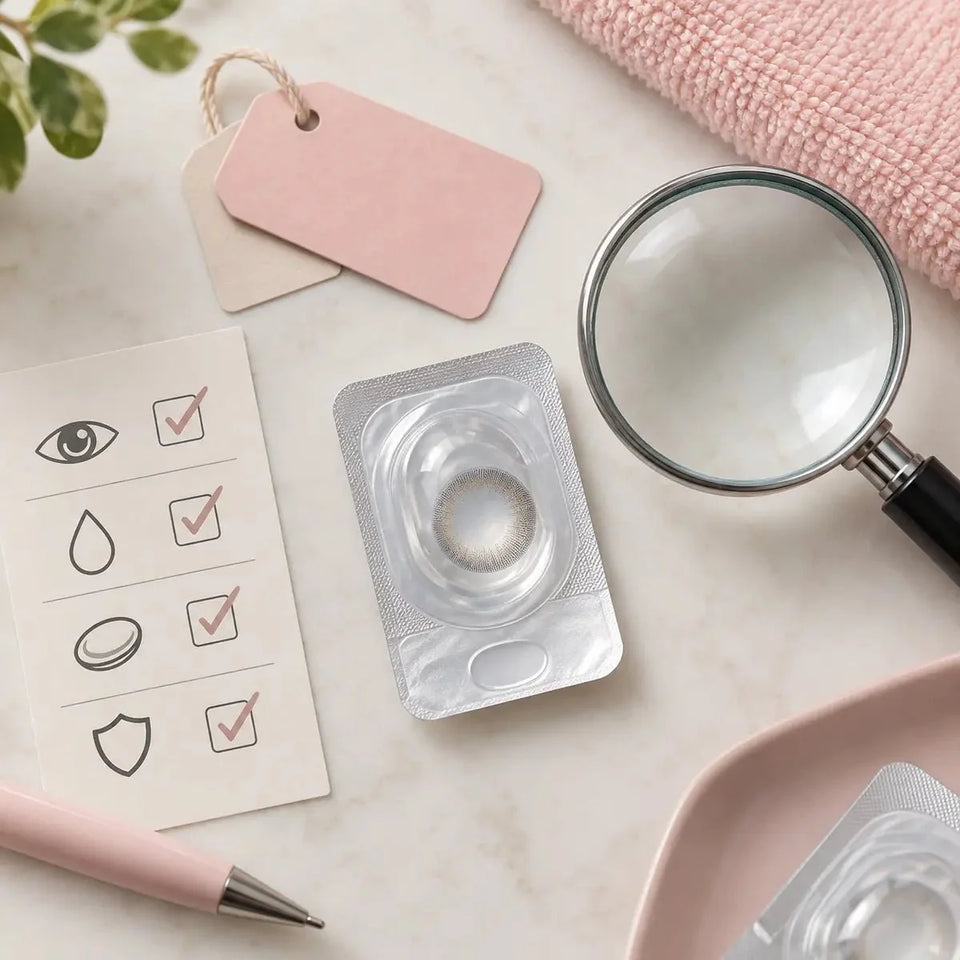
Care & authenticity
How to Get Plano Colored Contacts Safely in the U.S.

In the United States, “plano” or “0.00” means a colored contact lens has no spherical vision correction. It does not mean the lens is non-prescription. FDA guidance states that decorative and colored contacts require an eye examination, a contact-lens prescription, and proper fitting—even when you see clearly without corrective lenses. The safe route is to get fitted for the exact model, then purchase it from a seller that follows prescription requirements.

What “plano” means
Plano, 0.00, and sometimes “no power” describe the lens’s corrective power. They do not describe whether the lens fits your eye, which model you should use, or whether you may skip a prescription. A plano colored contact still sits on the eye and has a manufacturer, shape, material, replacement schedule, and care directions.
In the U.S., colored and decorative contact lenses are regulated medical devices, including lenses that only change appearance. The FDA says they are not cosmetics or over-the-counter merchandise. A lens must be prescribed and fitted; a search result or product selector using “non-prescription” may mean 0.00 power, not that a prescription is unnecessary.
How to get plano colored contacts in the U.S.
- Schedule a contact-lens exam. Tell the eye-care professional that your goal is cosmetic color and that you want a plano product.
- Discuss the exact model. Bring the product page or full manufacturer and model name. Similar colors or family names may refer to different designs.
- Complete the fitting. The professional evaluates the lens on your eye and decides whether the exact product is suitable.
- Get the contact-lens prescription. Review the brand and measurements for the fitted product; use 0.00 only where that is what the prescription specifies.
- Use a seller that follows prescription rules. The seller must obtain or verify the prescription under the applicable process before supplying the contacts.
- Compare the package before wearing. Check that the delivered model and specifications match what you ordered and were fitted for.
If the exact product cannot be fitted or prescribed, ask the professional about a suitable alternative. Do not use a friend’s lens or prescription, guess measurements, or select a similar product simply because it is available in your preferred shade.
Why fitting is required when your vision is clear
Clear unaided vision does not show how a contact lens will sit on your eye. A professional measures each eye and evaluates how the exact lens centers, moves, and responds during wear. A poor fit can irritate or injure the eye. Color, comfort during a brief first try, and a matching base curve on a webpage cannot establish proper fit.
The fitting also connects the prescription to the exact product. A different brand or version can have a different shape or material even when the color and some measurements look similar. Ask whether a change in manufacturer, model, or replacement format needs professional approval before ordering.
What to check on the prescription and product listing
After the fitting, use the contact-lens prescription—not a glasses prescription—to identify the lens. FDA consumer guidance says a contact-lens prescription includes information such as the brand, lens measurements, and expiration date. Keep the prescribed brand and specifications together when shopping.
| Check | What to confirm | Why it matters |
|---|---|---|
| Power | 0.00/plano for the prescribed eye or eyes | Confirms the selected correction value; not the fit. |
| Manufacturer and model | Exact brand and fitted version | Similar names can identify different lens designs. |
| Measurements | Use the values on the contact-lens prescription | Do not substitute another lens’s numbers. |
| Shade and replacement format | Exact color and daily/reusable version | These affect product identity and care instructions. |
| Package count | Number of individual lenses and unit of sale | A box may contain lenses for one eye, not a pair. |
| Expiry and seal | Intact sterile packaging and readable labeling | Do not wear a damaged or unidentified product. |
BC (base curve), DIA (overall diameter), and G.DIA (printed color diameter) describe product characteristics. They do not replace the professional fitting. Check live listing details and package contents because available variants and pack sizes can change.
How prescription verification works
The FDA says to buy decorative lenses only from a seller that requires a prescription. Under the FTC Contact Lens Rule, sellers generally either obtain a copy of the prescription or verify its information with the prescriber using the rule’s process. The FTC’s Contact Lens Rule guide explains these responsibilities for sellers and prescribers.
A seller that advertises “no prescription needed” for U.S. contact lenses is not offering a safe shortcut. Avoid sources that will not identify the manufacturer and exact product or invite you to bypass prescription verification. If the seller’s process is unclear, ask how it handles the prescription before placing an order. Do not provide altered values to force an order through.
Check the package before opening
When an order arrives, compare the sealed package with the prescription and order confirmation. Check manufacturer, model, shade, 0.00 power, measurements, replacement format, quantity, expiration, and seal. If any detail differs or the label is unclear, keep the package unopened and contact the seller and your eye-care professional. Do not wear a substitute brand or model unless your prescriber says it is appropriate.
Wear and care basics
Follow the instructions for the exact lens and your professional’s wearing schedule. Wash and dry your hands before handling contacts. Keep lenses away from tap, bottled, pool, shower, lake, and ocean water, and never use saliva. A daily disposable is used once and discarded as directed. Reusable lenses need compatible disinfecting solution, proper case care, and replacement on schedule. Do not share lenses or sleep in them unless the exact lens and wear plan specifically allow it.
Remove the lens immediately for eye pain, unusual redness, discharge, light sensitivity, swelling, burning or gritty irritation, or blurred vision. Do not reinsert it to test whether symptoms return. Contact an eye-care professional promptly; seek urgent care for severe or rapidly worsening symptoms. The CDC decorative-contact guidance and FDA risk information explain why proper fitting and care matter even for cosmetic lenses.
Frequently asked questions
Can I get colored contacts without vision correction?
You can ask an eye-care professional about plano colored lenses, but in the U.S. they still require a contact-lens prescription and fitting.
Does 0.00 mean the lens has no prescription?
It means no spherical corrective power. It does not remove the need for a contact-lens prescription, fitting, or proper care.
Can an online vision test replace a fitting?
No. A vision measurement alone does not evaluate the exact contact lens on your eye. Follow the professional fitting and prescription process.
Can I use a friend’s plano lenses?
No. Do not share contacts. The lens must be fitted and prescribed for you.
What if my preferred color is not available in the prescribed model?
Ask your eye-care professional about an appropriate alternative. Do not change brand or measurements yourself.
Where can I check U.S. requirements?
Read the FDA’s colored and decorative lens guidance and the FTC Contact Lens Rule guide, then consult your eye-care professional about your own fitting.
Sources: FDA: Colored and Decorative Contact Lenses: A Prescription Is A Must, CDC: About Decorative Contact Lenses, FTC: The Contact Lens Rule—A Guide for Prescribers and Sellers, and FDA: Contact Lens Risks. This article describes general U.S. requirements and does not provide legal advice or determine an individual fit.
Editorial method: “plano power” is distinguished from prescription status and fitting. Regulatory statements are limited to the U.S. context and linked to FDA, CDC, and FTC sources.