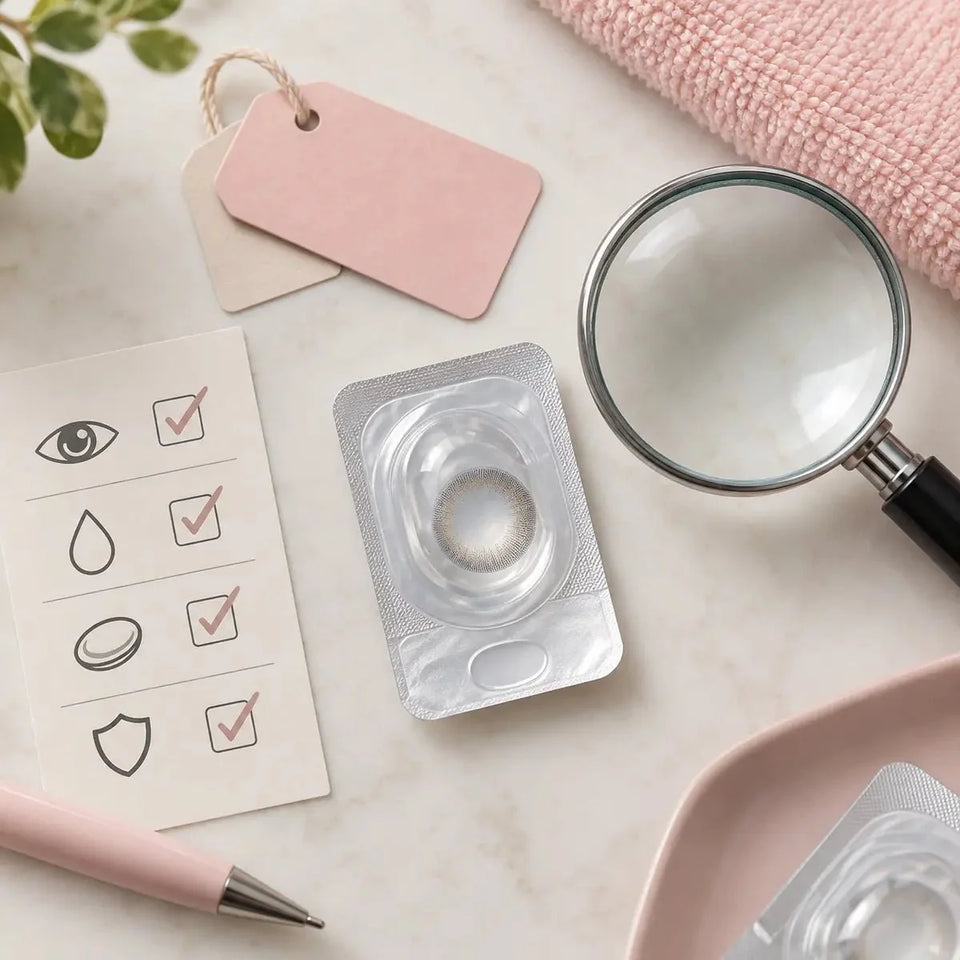
Care & authenticity
Colored Contacts for Astigmatism and Dry Eyes: Fitting Questions

If you have astigmatism and dry-eye symptoms, use a contact-lens fitting to answer two separate questions: whether the eye surface is ready for lens wear, and whether a specific toric design provides the prescribed correction and stable fit. Bring your current contact-lens prescription, symptom history, and the exact colored lens you want to discuss. A shade or product selector cannot answer either clinical question.

Prepare before the appointment
Bring a current contact-lens prescription, glasses if you use them, and the full name or product page of each colored toric model you want to discuss. Write down the brand, model, shade, replacement format, and any specifications shown on the listing. If you have worn contacts before, note the exact lens and how it went; do not assume a new colored version is the same design.
Make a short symptom record. Note which eye is affected, whether symptoms begin before or during wear, when they start, and whether vision changes after blinking. Describe sensations in plain terms such as burning, gritty, tired, or blurred. Include relevant circumstances—screen time, air conditioning, wind, allergies, sleep, and drops or solutions. This is a timeline for the professional, not a way to diagnose dry eye yourself.
Also bring the names of medications and eye drops you use. Do not stop prescribed medicine or start a new drop in order to prepare for the visit. Ask the professional whether any product is appropriate for your situation and compatible with the exact lens.
Questions about dry-eye symptoms
- What might be contributing to my symptoms, and does the eye surface need evaluation or care before lens wear?
- Do my symptoms suggest that I should pause contact-lens wear until they are assessed?
- What should I record about timing, environment, or vision changes?
- Which drops, if any, are appropriate for my eyes and compatible with the exact lens?
- What symptoms mean I should remove the lens and contact you?
Dry-eye symptoms can have different causes. The National Eye Institute explains that dry-eye treatment depends on the cause. A product’s material, water-content value, replacement schedule, or comfort claim cannot determine the cause or guarantee that it will suit you.
Questions about toric prescription and rotation
Toric contact lenses correct astigmatism with a coordinated prescription. Ask the professional to review the current contact-lens prescription for each eye, including sphere (SPH or PWR), cylinder (CYL), and axis (AXIS), and confirm the exact product design for the fitting. Keep OD/right and OS/left values separate. Do not transfer eyeglass values into an online contact-lens order or choose a nearby option if the exact value is unavailable.
- What are the complete prescribed values for OD and OS?
- Does the exact colored toric model offer each eye’s complete SPH/CYL/AXIS combination?
- How will you assess centering, movement, and orientation after blinking?
- What should I report if vision clears and blurs or changes after blinking?
- If the exact model is unavailable or unsuitable, what alternatives can be fitted?
Toric lenses have directional optics, and their orientation on the eye is part of the fitting. A product photo and an axis printed on a box cannot show how a lens settles on you. Fluctuating vision can have more than one cause, so ask the clinician to evaluate the exact lens and your eyes instead of adjusting axis, cylinder, or brand yourself.
Questions about the exact colored product
Ask whether the fitting is for the precise manufacturer, model, shade, and replacement version on the listing. Daily and reusable, spherical and toric versions may look similar while having different design details and care requirements. A shared family name does not prove that one version can replace another.
Use the product page to confirm seller-controlled facts such as current options, package contents, and unit of sale. BC (base curve), DIA (overall diameter), and G.DIA (printed color diameter) help describe the product; the numbers do not independently confirm fit or comfort. If the listing does not explain a required field, ask the seller to clarify the catalog information, and ask the eye-care professional whether that exact model is appropriate for you.
Color is a separate preference. Ask about the printed area and appearance only after the prescription and fitting questions have been addressed. Lighting, iris color, makeup, and camera processing affect photos, so a realistic image is a style reference rather than clinical evidence.
Agree on a trial and follow-up plan
If the professional recommends trying a lens, ask how to insert and remove it, how long to wear it, which replacement schedule applies, and when to return. Confirm the care routine for the exact product. For reusable lenses, clarify the compatible solution, cleaning steps, and case instructions. For a daily lens, confirm its single-use disposal directions. Do not extend wear to test endurance or change the schedule because the lens looks clean.
Agree on what to do if dryness, irritation, or vision fluctuation begins. Keep backup glasses available. Record insertion and removal times, which eye is affected, the product version, the environment, and when symptoms occur. Do not reinsert a lens to reproduce a symptom. Take your observations to follow-up so the professional can determine whether the lens, surface, care routine, or another factor needs review.
Daily and reusable formats have different routines; neither is universally best for dry-eye symptoms. The right approach depends on the exact lens, fitting, ocular surface, and the professional’s recommendation. A colored toric option may not be available for every prescription combination. If an option is missing, do not round or omit a value to reach checkout.
Check the order only after fitting
- Confirm that you have a current contact-lens prescription for the fitted product.
- Write OD and OS on separate lines and copy SPH, CYL, and AXIS exactly.
- Match the full manufacturer, model, shade, and replacement format.
- Verify that each complete prescribed combination is offered.
- Check the number of individual lenses per box and quantities needed for each eye.
- Compare your order confirmation and sealed package labels with the prescription before opening.
Ask the seller about availability, box count, and listing details. Ask your prescriber about prescription values, model substitutions, and fit. If the delivered product or parameters do not match, keep the package sealed and contact the seller before wearing it.
Know when to remove a lens
Remove contacts immediately for pain, unusual redness, burning or gritty irritation, excess tearing or discharge, light sensitivity, swelling, or blurred vision. Do not put the lenses back in while waiting to see whether symptoms return. Contact an eye-care professional promptly; seek urgent care for severe or rapidly worsening symptoms.
The CDC lists symptoms that require lens removal and immediate contact with an eye doctor. The FDA explains that a wearer cannot judge the seriousness of a contact-lens problem alone. It advises keeping removed lenses in their case and taking them to the professional, who may want to examine them. Follow the professional’s instructions.
For routine prevention, wash and dry hands before handling lenses, keep contacts away from water and saliva, follow the exact replacement schedule, and use only the care products recommended for reusable lenses. The CDC prevention guidance provides general hygiene advice; it does not replace your fitted wear plan.
Frequently asked questions
Can I choose the closest CYL or AXIS when my value is unavailable?
No. Ask your eye-care professional about an appropriate alternative. Do not round, omit, or substitute prescription values yourself.
Does daily replacement solve dry-eye symptoms?
No. Daily format changes the care routine, but it does not diagnose or treat dry eye or guarantee comfort.
Can I tell whether blur comes from toric rotation or dryness?
Not reliably from the symptom alone. Record when it happens and ask the professional to assess the lens and eye surface.
Can matching BC and DIA prove that another brand will fit?
No. Those listing values alone cannot establish an equivalent design or on-eye fit.
Should I pick the color before the fitting?
You can collect style preferences, but resolve the prescription, exact product, and fit questions before choosing among options.
What if no colored toric option is appropriate?
Ask the professional about clear toric lenses, glasses, a pause while symptoms are evaluated, or another plan.
Sources: National Eye Institute: Dry Eye, CDC: Contact Lens-Related Infection Symptoms, CDC: Prevention, and FDA: Contact Lens Risks. This guide supports appointment preparation; it does not provide a diagnosis, prescription, or individual fitting.
Editorial method: the appointment checklist separates dry-eye assessment, toric prescription and fit, live seller information, care, and cosmetic choice. No individual clinical outcome is claimed.