Care & authenticity
Daily Colored Contacts for Astigmatism: What to Verify
Finding daily colored contacts for astigmatism means confirming that one exact lens is colored, toric, and available in the prescribed parameters and replacement schedule for each eye. A daily clear toric lens, a colored monthly toric lens, or a colored daily spherical lens does not by itself confirm that the full combination is available.
In this guide
- Clarify daily wear and daily disposable schedules
- Check colored, toric, and replacement requirements
- Match the full prescription for each eye
- Work through a listing example
- Why a toric fitting matters
- Use a product verification checklist
- Ask the seller or prescriber
- What to do if you cannot confirm a match
- Frequently asked questions

Clarify what “daily” means
Product pages sometimes use “daily” to mean a lens intended for daily wear, while shoppers may use it to mean a daily disposable lens that is discarded after one day. Those are different details. Daily wear describes when the lens is worn; replacement schedule describes when that lens must be discarded. The FDA overview of contact-lens types distinguishes daily disposable and other replacement schedules.
If you specifically want a daily disposable, confirm that the exact colored toric model is single-use and available in the prescription parameters for each eye. Do not infer the replacement schedule from “wear daily,” “daily use,” or a collection heading. Check the manufacturer’s product information or ask the seller to clarify.
Also distinguish a cosmetic color design from a handling tint. A faint tint may help a wearer see a lens while handling it; it does not establish that the lens changes the apparent iris color. Confirm that the exact model has the cosmetic effect you want.
Check all three product requirements in the same lens
To answer the question “Can I get a daily colored contact for astigmatism?”, verify three characteristics on one exact product record:
- Toric correction: The lens must be offered as a toric product with the required cylinder and axis options, not only as a spherical lens.
- Cosmetic color: The exact lens version must be a colored design intended to change appearance, not a handling tint or clear lens.
- Daily replacement, if that is your requirement: The exact product must have the replacement schedule you are seeking, such as a single-use daily disposable schedule.
These features must intersect in the same product, and its prescription options must cover your needs. Separate catalog pages do not establish that intersection. A store could list daily spherical colors and reusable toric colors without offering a daily disposable colored toric model.
Some product listings may describe a colored monthly toric or a daily clear toric. Either may meet two of the shopper’s preferences but not all three. Read the full model name and specifications instead of combining details from different listings.
Match the full prescription for each eye
Contact lens prescriptions can include sphere (SPH), cylinder (CYL), and axis (AXIS), along with the prescribed brand or model and applicable fitting measurements. The right and left eyes may require different combinations. Compare each eye’s values as a complete set against the exact product options rather than looking for isolated menu values.
A product page that shows the right sphere somewhere and a possible axis elsewhere has not confirmed that your complete combination is available. Do not round a cylinder or axis, omit a prescribed value, or substitute a nearby option because it appears in a drop-down menu. Ask your eye-care professional or the seller to check the exact product against the written prescription.
The FDA’s contact lens buying guidance advises checking the exact brand and prescription details and warns consumers not to accept a different brand without the prescriber’s approval. Product availability does not determine which prescription is appropriate for you.
A practical example of checking a listing
Imagine a prescription with different cylinder and axis values for the right and left eyes. A product page shows several colors under a “daily” label and a separate page for toric lenses. That is not enough to conclude that a daily disposable colored toric is available. The shopper still needs one exact product record showing the cosmetic version, the single-use schedule, and the toric prescription options needed by both eyes.
Now imagine a colored toric product with a monthly replacement schedule and the required prescription values. That may meet the color and correction needs, but it does not meet a daily disposable preference. The next step is to ask the eye-care professional whether the exact lens is suitable and whether its replacement routine works for you—not to rename it “daily” because it is worn during the day.
These examples describe a verification method only. They do not indicate that a particular product is currently in stock or that any product can match an individual prescription.
Why a toric fitting matters
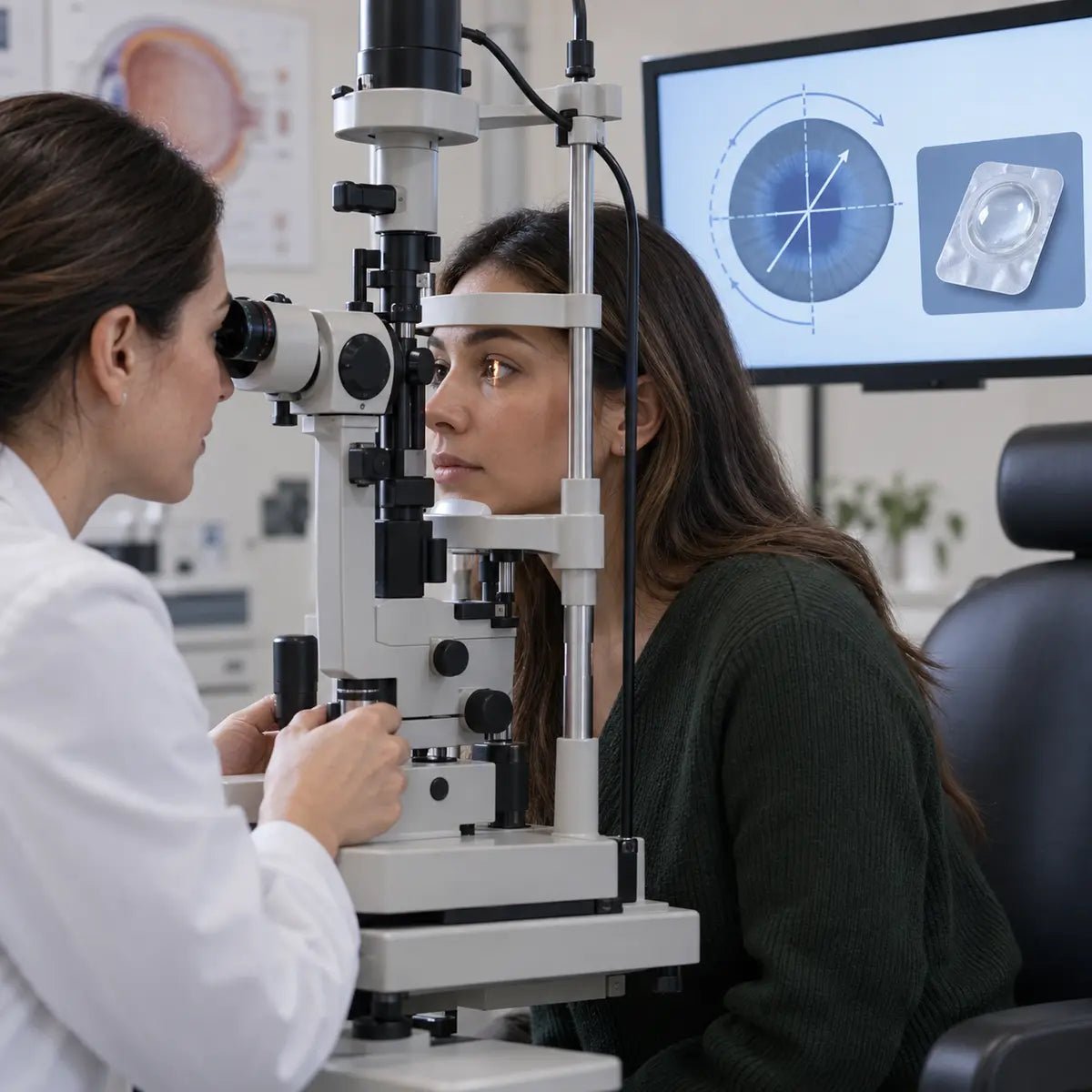
Toric lenses correct astigmatism with different optical powers in different meridians, so the lens’s orientation matters to vision. Manufacturers use stabilization designs, but the exact product still needs to be fitted and evaluated for the wearer. A product photo showing a stable colored pattern cannot confirm the lens’s optical orientation, fit, or visual performance.
Ask your eye-care professional whether the exact model is suitable, how the trial will be evaluated, and what to do if vision fluctuates or the lens feels uncomfortable. A colored lens may have its own design and parameters; a fitting for a different clear toric product does not automatically approve it. Bring the exact product page or packaging so the discussion is about the model you plan to use.
Do not place a colored spherical lens over a clear toric lens to combine color and correction. Do not rotate a lens or change its axis yourself. If no single suitable product meets the color, replacement, and prescription requirements, ask your clinician about alternatives.
A product verification checklist
Before ordering, collect the same facts for one lens model and confirm them for both eyes:
- Product identity: manufacturer, full model name, shade, and product version.
- Cosmetic status: colored iris design or handling tint; verify from manufacturer information.
- Replacement format: daily disposable, planned replacement, or another schedule; do not rely on ambiguous “daily” wording.
- Prescription range: available SPH, CYL, and AXIS values and any other product-specific options.
- Fitting parameters: exact base curve, diameter, and model details as prescribed or otherwise required.
- Availability: whether the exact lens and both eyes’ prescribed combinations are offered by this seller for your destination.
- Professional approval: whether the eye-care professional has fitted or approved this exact product.
- Instructions: wear time, removal, replacement, care, and follow-up for the exact lens.
Save the exact product link or package details with your prescription record. If the seller proposes a substitute, pause and ask your prescriber to approve that specific product. A similar shade or product name is not enough to show that a substitute is equivalent.
A short question for the seller or prescriber
“I am looking for a cosmetic colored toric lens with a [daily disposable or other specific] replacement schedule. Can you confirm the exact brand and model and whether it is available in my right-eye and left-eye sphere, cylinder, and axis values? Please include the model-specific measurements and tell me whether my eye-care professional has fitted or approved this exact lens.”
Keep the response with the product details and verify any clinical question directly with your prescriber. If the seller provides only a shade or broad collection link, ask for the exact product page or manufacturer specifications. If the answer remains incomplete, record the missing information and pause the purchase.
What to do if you cannot confirm a match
If the exact daily colored toric combination is not listed or the seller cannot confirm the required parameters, do not assume it exists or is appropriate. Ask your eye-care professional which part of the request can safely change, if any. Depending on individual circumstances, the discussion might include a fitted clear daily toric lens with glasses for color-free styling, or a professionally assessed colored toric product with a different replacement schedule. These are topics to discuss, not claims that a particular option is available or suitable.
Do not let a product shortage become a reason to omit cylinder or axis, combine two lenses, extend a replacement period, or wear a model fitted for another person. If the exact requirements cannot be met, use glasses or wait for professional advice rather than improvising.
In the United States, colored and decorative lenses require a prescription and professional fitting, even if they do not correct vision. The FDA’s colored lens guidance explains that these lenses are not one-size-fits-all. Check local requirements if you live elsewhere.
Before checking out, compare the final package or order summary with the lens the clinician approved. Verify the model and the right/left prescription values rather than relying on the color thumbnail. When the order arrives, compare its labeling with the order and keep the packaging until you have confirmed it is the correct lens. Contact the seller and prescriber if the product or parameters differ.
When the lens is reusable, verify how to clean, disinfect, and store it; when it is single use, confirm disposal instructions. A well-matched color and prescription still need a routine you can follow consistently.
Frequently asked questions
Are daily colored contacts for astigmatism available in every prescription?
Do not assume that. Verify the exact manufacturer, model, shade, replacement format, and full prescription range for each eye, then ask your eye-care professional whether it is suitable.
Is a handling tint the same as a colored contact lens?
No. A handling tint may make a lens easier to see, but it does not necessarily change the visible eye color. Confirm the exact design and purpose with the product information.
Can a daily clear toric lens and daily colored spherical lens be combined?
Do not stack lenses as a do-it-yourself solution. Ask about one fitted lens that meets your vision needs or another plan approved by your eye-care professional.
Can I leave out cylinder or choose the closest axis to find a colored option?
No. Do not change or round prescribed values yourself. Ask your prescriber to review the exact alternative and its parameters.
Does a toric collection prove daily colored torics are available?
No. A collection page groups products; it does not establish that one exact product meets all three requirements or matches your prescription.
What should I do if the product page omits a parameter?
Ask the seller or manufacturer for complete details and share the exact listing with your eye-care professional. Do not infer the missing value from a similar model.
What if my vision fluctuates during a toric lens trial?
Describe when it happens to the fitting practice and follow its instructions. If you have sudden blurry vision, pain, redness, or light sensitivity, remove the lens and seek professional advice promptly.
Editorial note: U.S. prescription and buying information is based on FDA buying guidance and FDA decorative lens guidance. Toric design principles are described by CooperVision. This article does not confirm stock or replace a professional fitting.