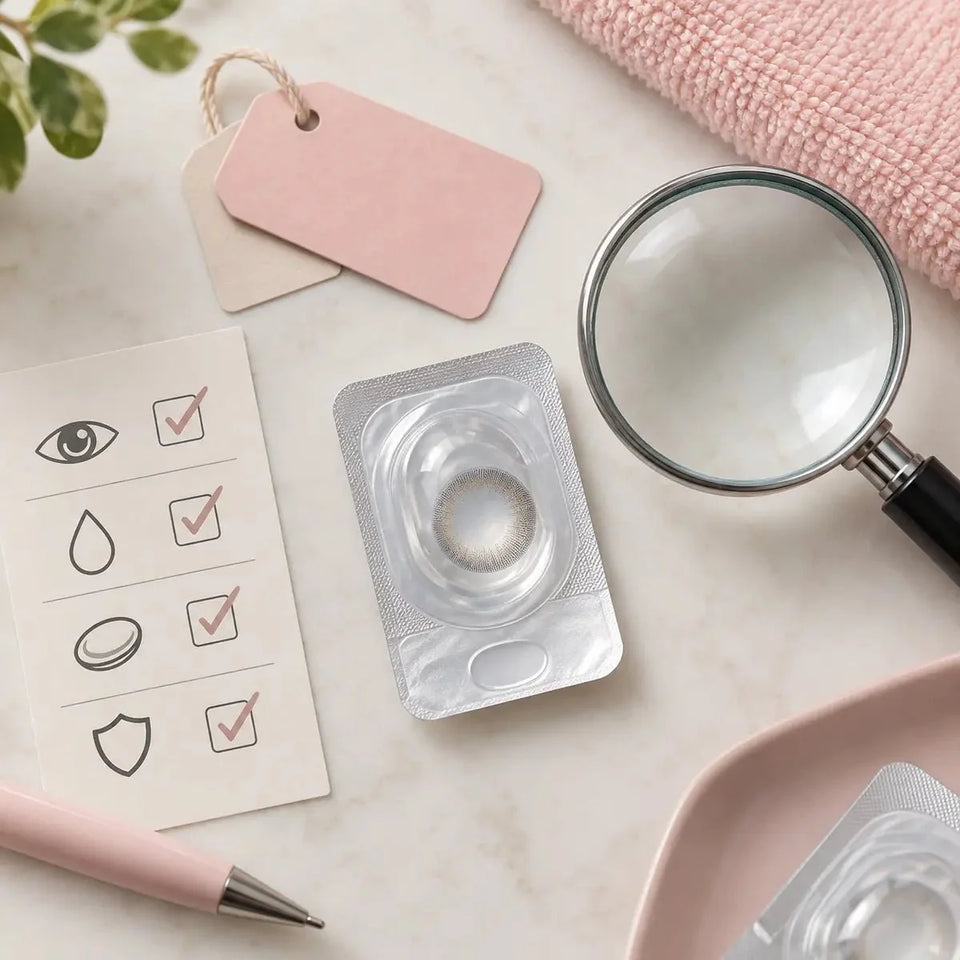
Care & authenticity
How to Wear Prescription Colored Contacts Safely

To wear prescription colored contacts safely, use the exact lens prescribed and fitted for you, verify the right- and left-eye details, follow the product’s insertion and care instructions, and observe the wearing schedule from your eye-care professional. Color does not change contact-lens safety. Remove a lens promptly for pain, unusual redness, discharge, light sensitivity, swelling, or blurred vision.

Before the first wear
Use a current contact-lens prescription and the exact brand, model, and replacement version that your eye-care professional fitted. A glasses prescription alone does not describe a contact lens. If you have astigmatism, verify the prescribed SPH/PWR, CYL, and AXIS for each eye. Keep OD (right) and OS (left) separate; do not assume they match.
Before opening a package, compare its label with your order and prescription. Confirm product identity, shade, power, replacement schedule, package count, expiration date, and intact seal. Daily, reusable, spherical, and toric lenses can look similar while having different instructions. If a label is unclear, the package is damaged, or the product differs from what was prescribed, do not wear it; ask the seller or your prescriber to clarify.
Choose a calm time for the first wear so you can follow the fitting demonstration without rushing. Keep backup glasses available. Make sure you know how to insert and remove that exact lens and what care solution, if any, it requires.
Insert lenses with clean hands
- Wash your hands with soap and water, rinse them thoroughly, and dry with a clean lint-free towel before touching a lens.
- Open one package at a time. If the eyes have different powers, keep right- and left-eye lenses clearly separated.
- Inspect the lens in good light. Do not insert one that appears torn, contaminated, or otherwise damaged.
- Use the insertion technique taught by your eye-care professional and the directions supplied with the lens. Do not force a lens onto the eye.
- After insertion, blink and allow the lens to settle as instructed. If it is painful, vision is unsafe, or the lens feels wrong, remove it and follow the advice you received during fitting.
If you are unsure whether the lens is inside out or cannot insert it comfortably, pause and ask your eye-care professional for a demonstration. Generic videos may show a different lens design or technique. Do not rinse a lens with tap water, bottled water, saliva, or homemade saline.
Follow the wearing plan
Use the wearing time and replacement schedule given for your exact lens. Do not extend wear because the lens still looks clear, the color remains attractive, or a special event is underway. Do not sleep or nap in contacts unless your professional has specifically approved the exact product and schedule.
- Keep lenses away from water, including showers, swimming pools, hot tubs, lakes, and oceans.
- Do not share lenses, including plano lenses or lenses with the same color.
- Do not stack a colored lens over another contact lens.
- Follow product-specific advice about eye makeup; keep cosmetics and remover away from the lens.
- Carry glasses so you can remove a lens if comfort or vision changes.
Dryness, illness, smoke, airflow, allergy, or long screen sessions can affect how your eyes feel. Do not treat a generic online hour limit as permission to wear lenses longer. Ask your professional what to do if discomfort or blur begins partway through the day.
Remove and care for the exact lens
Wash and dry your hands before removal. Use the removal method taught during fitting and follow the manufacturer’s instructions. Do not pull forcefully or use fingernails against the eye. If a lens is difficult to remove, follow the instructions you were given and contact an eye-care professional if you remain unsure.
A daily disposable is discarded after its single-use period. Do not save it for another day. Reusable lenses require the compatible cleaning and disinfection system specified for that product. Use fresh solution, follow its rub-and-rinse directions when applicable, and store the lens in a clean case. Never top off or reuse old solution. Replace the lens and case according to their instructions and your professional’s advice.
Water and saliva are not safe substitutes for contact-lens solution. The CDC prevention guidance covers hand hygiene, avoiding water exposure, proper cleaning, and carrying backup glasses. Follow those general habits alongside the exact lens and care-product directions.
Know when to stop and seek help
Remove the lens promptly for pain, unusual redness, burning or gritty irritation, excess tearing or discharge, light sensitivity, swelling, or blurred vision. Do not put it back in to test whether a warning symptom has gone away. Contact an eye-care professional promptly; seek urgent care for severe or rapidly worsening symptoms or sudden vision change.
The FDA explains that a wearer cannot determine the seriousness of a contact-lens problem alone. Its guidance advises removing lenses and contacting an eye-care professional; it also says not to throw away the removed lens because a professional may want to examine it. Follow the professional’s directions about keeping the lens and case.
Recurring dryness, blur, or lens movement should also be discussed with your fitter before you continue the same routine. Note which eye is affected, the product, how long it had been worn, and what happened. Do not change prescription values or switch brands to troubleshoot on your own.
A repeatable checklist
- Prescription: confirm exact product and OD/OS values, including toric fields when prescribed.
- Package: check the sealed label, product version, quantity, and expiry before opening.
- Hands: wash and dry them before insertion and removal.
- Lens: inspect for damage and use the insertion/removal technique taught at fitting.
- Schedule: follow the exact wear and replacement instructions.
- Care: for reusable lenses, use fresh compatible solution and a clean case; never use water.
- Backup: keep glasses available and remove lenses for warning symptoms.
- Follow-up: discuss recurring discomfort or unstable vision with an eye-care professional.
For product comparisons, review current options in colored contacts, daily contacts, or toric colored contacts only after confirming that the exact model is prescribed and fitted for you. See the KPOP2 wear and care guide for general handling information.
Frequently asked questions
Which eye should I insert first?
Use a consistent routine and keep each eye’s lens clearly identified, especially when the prescriptions differ. Follow the method taught by your eye-care professional.
Can I rinse a contact lens with water?
No. Do not use tap, bottled, pool, shower, lake, or ocean water to rinse or store contact lenses.
Can I reuse a daily colored lens?
No. Follow its single-use instructions and discard it after the prescribed use.
What if a lens is uncomfortable right after insertion?
Remove it and follow your fitting instructions. Do not push through pain or persistent irritation; contact a professional if symptoms continue or include warning signs.
Can I share colored lenses with someone who has the same prescription?
No. Never share contacts. Each lens wearer needs their own fitted product and hygienic handling.
Can I sleep in prescription colored contacts?
Only if the exact lens and schedule have been specifically approved by your eye-care professional.
What if vision changes after blinking?
Remove the lens if vision is unsafe and seek professional advice. Movement, rotation, tear-film changes, or another issue may be involved; do not change the prescription yourself.
Sources: FDA: Buying Contact Lenses, FDA: Contact Lens Risks, and CDC: Preventing Eye Infections When Wearing Contacts. Follow your exact product label and eye-care professional’s instructions.
This guide explains general wearing and care steps. It does not replace an eye examination, prescription, fitting, or individual medical advice.