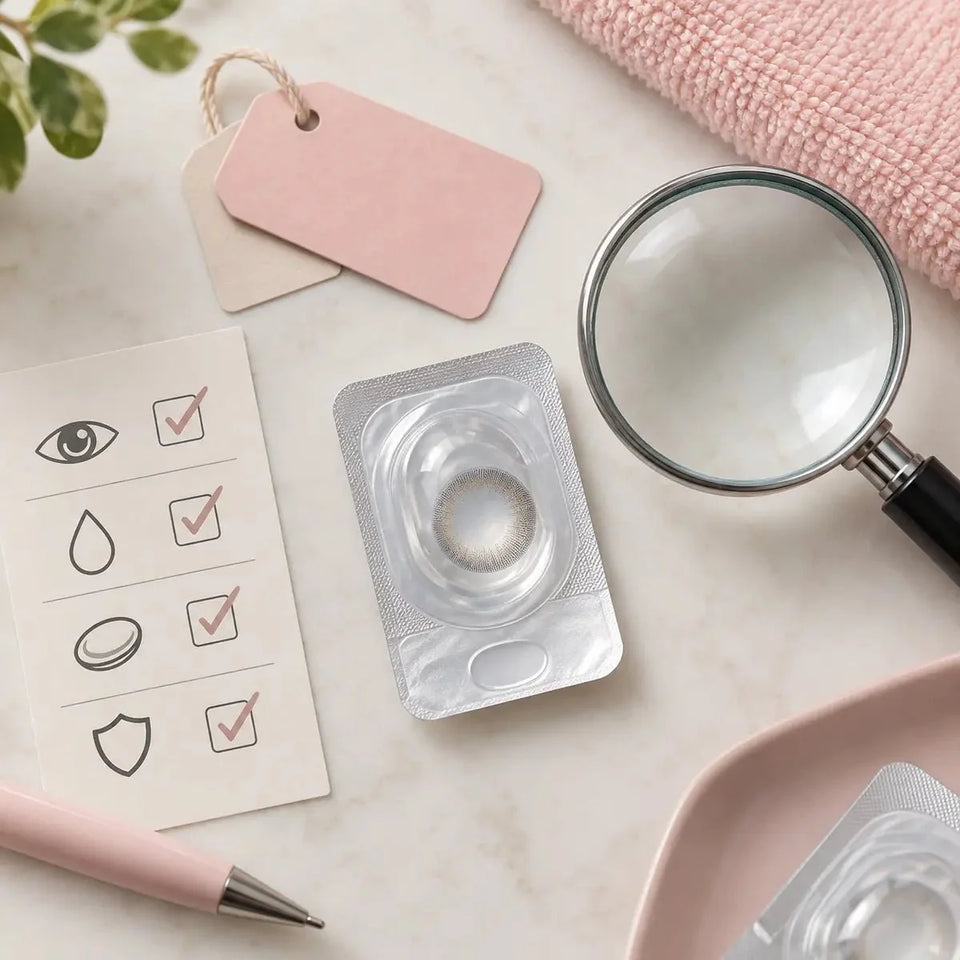
Care & authenticity
Korean Contacts for Bigger Eyes: G.DIA, Packaging & Safety

For colored contacts marketed for a bigger-eye look, start with G.DIA and the printed design—not just a word like “big” or the full lens diameter. Korean packaging may show DIA (overall lens diameter) and G.DIA or 착색직경 (graphic diameter) as different measurements. G.DIA helps compare the approximate width of the colored print; neither measurement predicts the exact visual effect or confirms fit.

Korean lens terms to recognize
Listings may combine Korean terms, English abbreviations, product names, power, replacement format, and package quantity. Keep the full model identity together when comparing products. A translated nickname or shade name may not identify which version you are looking at.
| Package or listing term | Common meaning | What to verify |
|---|---|---|
| DIA / 직경 | Overall lens diameter | Read it as a physical product specification, not the width of the colored print. |
| G.DIA / 착색직경 | Graphic or colored diameter | Compare the approximate span of the printed design; confirm the listing’s definition. |
| BC / 베이스커브 | Base curve | Use as product information for the exact model; it does not establish fit alone. |
| 도수 / PWR / SPH | Power | Match the current contact-lens prescription for each eye. |
| 난시용 | Toric / for astigmatism | Check the prescribed CYL and AXIS fields for the exact product. |
| 원데이 / 1day | Daily disposable | Follow the single-use instructions and verify individual lens count. |
| 한달용 / 1month | Monthly replacement | Follow the exact care and replacement directions. |
| 무도수 / 0.00 | No spherical corrective power | It does not mean fitting or prescription requirements can be skipped. |
Manufacturers and retailers may use different abbreviations. If a label is missing, translated inconsistently, or unclear, ask the seller to identify the exact model and its terms before ordering. Do not infer prescription meaning from a color name or package image.
What G.DIA can tell you
G.DIA is commonly used for the approximate diameter of the printed color area. It can help you compare how much of the visible iris a pattern may cover. A wider print may create more visible coverage, but G.DIA is not a universal “enlargement score.” The number cannot promise how large a lens will look on your eye.
DIA refers to the overall lens diameter, including areas beyond the colored print. It is not interchangeable with G.DIA. The overall diameter, base curve, material, and lens design belong to the exact product information and fitting discussion. Do not choose a larger DIA to make the eye appear larger or select BC based on a comfort claim.
If a listing gives one number without explaining whether it is DIA or G.DIA, do not assume. Confirm the term and exact model version with the retailer or manufacturer. Use current product details rather than carrying a measurement over from a similar shade or family name.
Why print design changes the bigger-eye effect
Two lenses with similar G.DIA can look different because of the printed pattern. A continuous dark limbal ring creates a sharper boundary. A broken or feathered edge may blend more softly. Opacity, dot density, inner-ring contrast, and the transition to the pupil all influence how much of the print stands out against your natural iris.
Your natural iris color, visible iris size, pupil size, eye shape, and lighting also affect the appearance. Warm indoor lights, daylight, flash, makeup, camera exposure, editing, and screen settings can change contrast. A close crop may make the design look more dramatic than it does at ordinary conversation distance.
When comparing photos, look for the exact model, shade, and replacement version. Prefer images taken in more than one lighting condition and at a normal viewing distance. Treat them as style references, not as a guarantee. Keep a simple preference list—such as soft edge, defined ring, warm brown, or visible contrast—rather than relying on a brand’s broad label like “natural” or “big eyes.”
Compare exact product versions
Before comparing a measurement or image, record the full manufacturer and product name, shade, daily or reusable format, lens count, power type, and listed DIA/G.DIA. Product families may reuse a color name across different versions. Similar numbers across brands do not mean the lenses are interchangeable or will look the same.
| Comparison field | Record for each exact listing | Why it matters |
|---|---|---|
| Identity | Manufacturer, complete model, shade, version | Prevents mixing daily, reusable, spherical, and toric products. |
| Graphic design | G.DIA definition, ring, opacity, edge, pupil transition | These features influence the visible effect. |
| Overall specifications | DIA, BC, material as listed | Useful product information for a professional fitting discussion. |
| Prescription | Power for OD and OS; CYL/AXIS if prescribed | Both eyes and all required fields must match the current contact-lens prescription. |
| Replacement and quantity | Daily/reusable directions and individual lens count | Determines care and how many lenses the package contains. |
Do not assume that a product with a larger G.DIA will feel different in a predictable way, or that a softer-looking print means a better fit. Compare cosmetic effect only among the exact models your eye-care professional says are appropriate.
Keep cosmetic size separate from fit
G.DIA describes appearance. DIA and BC are product specifications, but they do not create a do-it-yourself fitting formula. A professional fitting assesses how the exact lens centers and moves on your eye, along with vision and eye health. A familiar measurement, matching shade, or comfortable first impression alone cannot establish fit.
Colored and decorative contacts still require appropriate prescription and fitting, even when they have no corrective power. If you have astigmatism, use a toric lens only when it is prescribed or approved for you, and check the complete SPH, CYL, and AXIS values for both eyes. Do not change BC, DIA, power, or brand to get a preferred print size.
For U.S. shoppers, the FDA explains that colored and decorative contacts require a prescription and fitting. Requirements differ by location, so follow the rules where you live and the instructions from your eye-care professional.
Check packaging before opening
- Match manufacturer, complete product name, shade, and daily or reusable version to your order.
- Confirm power separately for OD/right and OS/left, including toric fields when prescribed.
- Check how the listing defines DIA and G.DIA for this exact version.
- Verify replacement schedule and number of individual lenses; do not assume the box is a pair.
- Check that the label is readable, the sterile seal is intact, and the product is within its expiry date.
- If anything differs from the order or is unclear, keep the package sealed and contact the seller before use.
Follow the exact product’s wear, cleaning, and replacement instructions. Wash and dry hands before handling contacts. Do not share lenses or expose them to water or saliva. Remove a lens and seek professional advice for pain, unusual redness, discharge, light sensitivity, swelling, or blurred vision.
When your prescription and product type are confirmed, browse current colored contacts and review prescription verification and wear and care. Use live product pages for current options and package details.
Frequently asked questions
Is G.DIA the same as DIA?
No. G.DIA commonly describes the printed color diameter; DIA describes the overall lens diameter. Confirm the exact listing’s terminology.
Does a larger G.DIA always make eyes look bigger?
No. Ring contrast, opacity, edge softness, print pattern, your natural iris, and lighting also affect the impression.
Can DIA tell me how large the colored design appears?
Not by itself. DIA includes the full lens, while G.DIA refers to the printed area when the product lists it.
Can I choose BC or DIA based on comfort reviews?
No. Reviews do not establish fit. Use the exact product and fitting guidance from an eye-care professional.
Does “1Day 10P” mean ten pairs?
Do not assume. Check the package description for the number of individual lenses and unit of sale.
Does a natural-looking print mean a lens is more comfortable?
No. Cosmetic appearance and fit are separate. A natural design still requires an appropriate prescription and fitting.
Why does a product look bigger in one photo than another?
Distance, crop, lighting, iris color, pupil size, makeup, and camera processing can all change the appearance.
What if the package and listing do not match?
Keep it sealed and ask the seller to confirm the exact product version before wearing it.
Sources: FDA: Colored and Decorative Contact Lenses: A Prescription Is A Must and CDC: About Decorative Contact Lenses. Product measurements and package quantities should be confirmed on the current exact-model listing and label.
Editorial method: translation of common catalog terms, cosmetic print effects, physical lens specifications, and professional fitting are treated as separate topics. No individual visual result or fit is guaranteed.