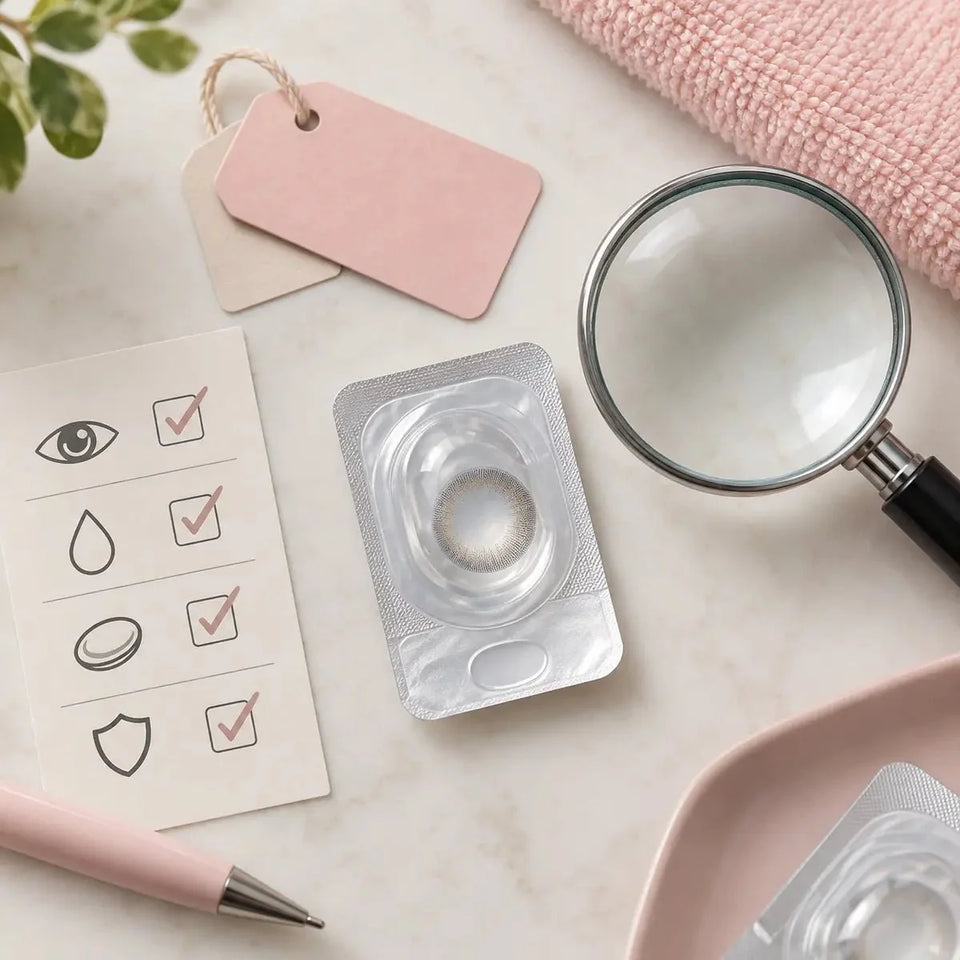
Care & authenticity
Korean Colored Contacts: Types, Specs & Buying Guide
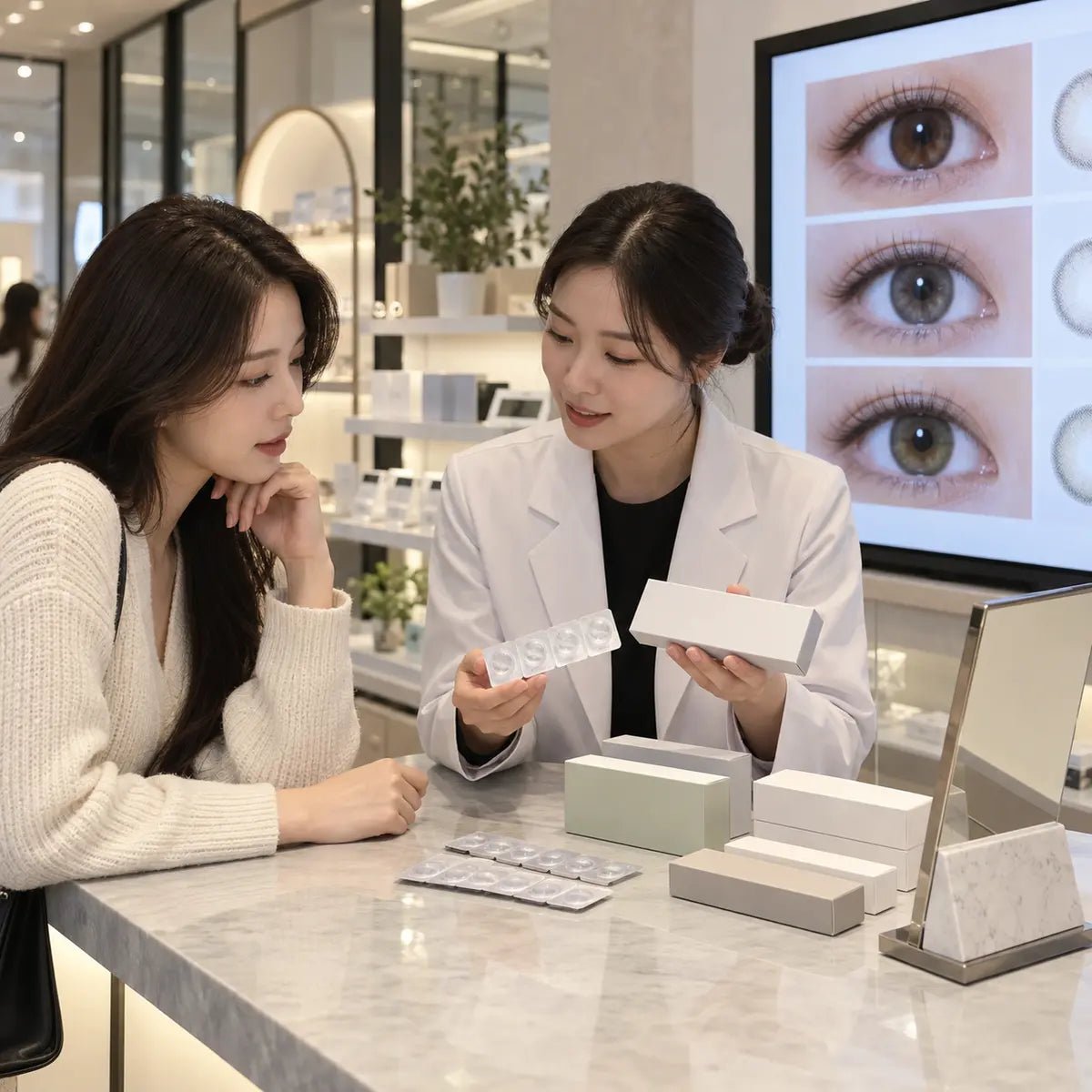
Korean colored contact lenses come in different shades, optical designs, materials, wearing schedules, and package formats. Compare the exact product rather than relying on “Korean,” a color name, or a single measurement. Confirm your current contact lens prescription, professional fitting, replacement schedule, lens parameters, and box contents before ordering.
In this guide
- Start with the exact product
- Compare lens formats and schedules
- Understand optical correction options
- Read the dimensions correctly
- Review material and care details
- Compare color and print design
- Check box contents and ordering
- Evaluate product and seller information
- Put prescription and fitting first
- Use a pre-purchase checklist
- Frequently asked questions

Start with the exact product
Korean colored contacts are not one uniform product category. A store may carry several manufacturers, color collections, optical designs, materials, and replacement schedules. Two lenses with similar names or photographs can have different specifications. Start with the full manufacturer and model name, then verify the exact version you are considering.
Make a product note with the shade, lens type, wearing and replacement schedule, available powers, base curve, diameter, graphic diameter if listed, material description, and package quantity. Not every listing will include every detail. Mark missing information as unknown and ask the seller or manufacturer instead of assuming it matches another color in the collection.
“Korean” identifies a brand or origin association, not whether the lens suits your eyes, corrects your vision, or is authorized for sale where you live. Product availability and local rules differ by market. Confirm the actual manufacturer, exact model, and seller rather than relying on country-of-origin shorthand.
Compare lens formats and schedules
Colored lenses are offered in different wearing and replacement formats. Read the exact label because the words are not interchangeable.
- Daily disposable: a fresh lens is used for its intended wearing period and then discarded. It should not be cleaned and reused.
- Reusable lens: it is cleaned, disinfected, stored, and replaced according to the product instructions and the prescriber’s advice.
- Daily wear: describes when the lens is worn—typically while awake and removed before sleep as directed. It does not necessarily mean the lens is disposable each day.
- Monthly or other planned replacement: describes a replacement interval. Follow the manufacturer’s schedule and your clinician’s instructions; never extend it because the lens looks clean.
A shorter replacement schedule does not automatically mean a lens is more comfortable or appropriate. The exact product still needs to be prescribed and fitted, and care routines matter. If you switch from a clear lens to a colored design, ask whether the exact model has been evaluated rather than assuming the schedule or fit carries over.
Understand optical correction options
Some colored lenses are spherical, some may be offered in toric designs for astigmatism, and some options may be plano. Product ranges vary by model. A listing that says “prescription available” does not guarantee that every power, cylinder, or axis is offered.
Check your current contact lens prescription for each eye. It may include sphere (SPH or PWR), cylinder (CYL), axis (AXIS), and product-specific fitting details. The right and left eyes may differ. Do not copy one eye’s values to the other, use an eyeglass prescription as a direct substitute, or choose a nearby power when the exact value is unavailable.
Plano or 0.00 generally refers to zero spherical correction in that field; it does not mean a lens has no fitting or legal requirements. In the United States, the FDA says decorative contacts require a prescription and professional fitting even when worn only to change appearance. Check the rules where you live and ask an eye-care professional about the exact product.
Read the dimensions correctly
Product listings may include base curve (BC), total diameter (DIA), and graphic diameter (G.DIA). Base curve and total diameter are product specifications that a professional may consider when fitting the exact lens. Graphic diameter usually describes the printed color area and is primarily an appearance detail.
Do not use BC or DIA as a do-it-yourself fit formula. Matching a measurement on your current lens does not prove that a different model fits the same way. Lenses can differ in material, shape, edge, and optical design. A clinician should assess the exact product and how it moves and centers on your eye.
Do not equate G.DIA with total DIA or treat a larger graphic area as proof of a larger-looking eye. Edge contrast, opacity, pattern, natural iris color, lighting, and camera distance all affect appearance. Use listed measurements to compare product versions, not to guarantee a result.
Review material and care details
A material name or water content is one product detail, not a complete comfort rating. Fit, surface, tear film, wear time, eye health, and environment also matter. Do not choose solely because a listing says “comfortable,” “high moisture,” or “breathable.” Ask your eye-care professional to assess the exact lens if comfort or dry eye is a concern.
Find the official care instructions for the exact model. Daily disposables are discarded after their intended use. Reusable lenses need the prescribed cleaning, disinfection, storage, and replacement routine. Do not use tap water, bottled water, saliva, or homemade saline on lenses or cases. Never top off old solution or share lenses.
Check whether the product instructions are available in a language you understand. If not, ask the seller for official manufacturer guidance before wearing the lens. Do not rely only on an automatically translated shade name to infer handling or care directions.
Compare color and print design
Color names such as gray, brown, blue, olive, or hazel are not standardized across brands. One “gray” may lean blue; another may look smoky or green. Compare the exact model’s print, edge definition, center transition, and images on different natural iris colors when available.
Product photos are visual references. Lighting, camera settings, editing, makeup, natural eye color, and distance all change the apparent result. A close crop can make a pattern look stronger than it appears from normal conversation distance. Compare images under similar conditions and consider the setting where you expect to wear the lens.
Separate the desired look from the medical selection. Decide whether you want a subtle tone shift, a defined iris ring, a higher-contrast pattern, or a costume effect. Then compare those features only among products your prescriber has confirmed can be considered. If the ideal color is unavailable in the appropriate prescription, adjust makeup or styling instead of changing the correction.
Check box contents and ordering
Package size can affect what you need to order. Some boxes contain several lenses with one prescription power, while other offers may have different quantities. Do not assume a pair or mixed prescriptions are included because a product image shows two eyes. If your eyes need different powers, confirm whether the right and left sides must be ordered separately.
Before checkout, compare the model, shade, powers, replacement schedule, and quantity in the cart with your product note and prescription. Save the product page and order confirmation. When the package arrives, inspect the manufacturer, exact model, power, shade, box quantity, expiration date, and seal before opening it.
If an item is damaged, unsealed, expired, or does not match the order or prescription, do not wear it. Contact the seller and your prescriber before accepting a substitute. Review the current shipping, return, and exchange terms before paying because packaged medical products may have specific restrictions.
Evaluate product and seller information
A reliable product listing should identify the manufacturer, model, lens type, replacement schedule, available prescription parameters, package quantity, and care instructions. The seller should explain how prescription information is submitted or verified where required. Be cautious if a listing claims that a lens fits everyone, describes a prescription product as universally safe, or leaves the exact model unclear.
Price, reviews, influencer posts, and professional-looking photographs cannot verify authenticity, fit, or prescription. Compare like with like: the same model, power, number of lenses, and replacement schedule. If a seller cannot identify the product or provide the label information, pause and contact the manufacturer or an authorized seller.
For U.S. orders, the FTC Contact Lens Rule guide explains the seller’s prescription presentation and verification process. Prescription verification checks order details; it does not replace an eye examination or confirm that a different lens is fitted for you.
Put prescription and fitting first
Colored lenses are still contact lenses. In the United States, the FDA says decorative lenses require a prescription and proper fitting, even when they do not correct vision. Requirements differ in other locations, so check local regulations and product authorization.
Use a current contact lens prescription and ask a licensed eye-care professional to evaluate the exact product. Do not assume that a clear version, a similar shade, or the same brand family is interchangeable. If the product is not available in your full correction or the professional does not recommend it, ask about another appropriate option.
Remove contacts and contact an eye-care professional promptly if you experience pain, unusual redness, discharge, light sensitivity, swelling, or blurred vision. Do not keep wearing a lens because its color or price is appealing. Keep glasses available as a backup and follow professional advice before resuming contact lens wear.
Use a pre-purchase checklist
- Manufacturer and full model identified.
- Exact shade and lens version selected.
- Daily disposable or reusable schedule confirmed.
- Full prescription checked separately for each eye.
- BC, DIA, G.DIA, and material understood as product details, not fit guarantees.
- Package quantity and powers per box confirmed.
- Local prescription, seller, and product requirements checked.
- Official care instructions available in a language you understand.
- Cart and order confirmation match the product and prescription.
Frequently asked questions
Are Korean colored contacts all daily lenses?
No. Products may have different wearing and replacement schedules. Check the exact model’s labeling rather than inferring the format from the brand or country.
Can I buy Korean colored contacts without a prescription?
Rules differ by location. In the United States, FDA guidance says decorative lenses require a prescription and professional fitting even if they do not correct vision. Verify local requirements.
Does G.DIA tell me whether a lens fits?
No. Graphic diameter describes the printed color area. It does not establish fit or predict the full visual result.
Does a matching base curve mean two products are interchangeable?
No. Lens design, material, and behavior can differ. Have the exact product evaluated.
How do I know if the box contains both prescriptions?
Check the package quantity and whether each box is supplied in one power. Confirm the right and left selections in your cart and order confirmation.
This article provides general product-shopping information and does not replace an eye examination, contact lens prescription, professional fitting, or product-specific instructions.