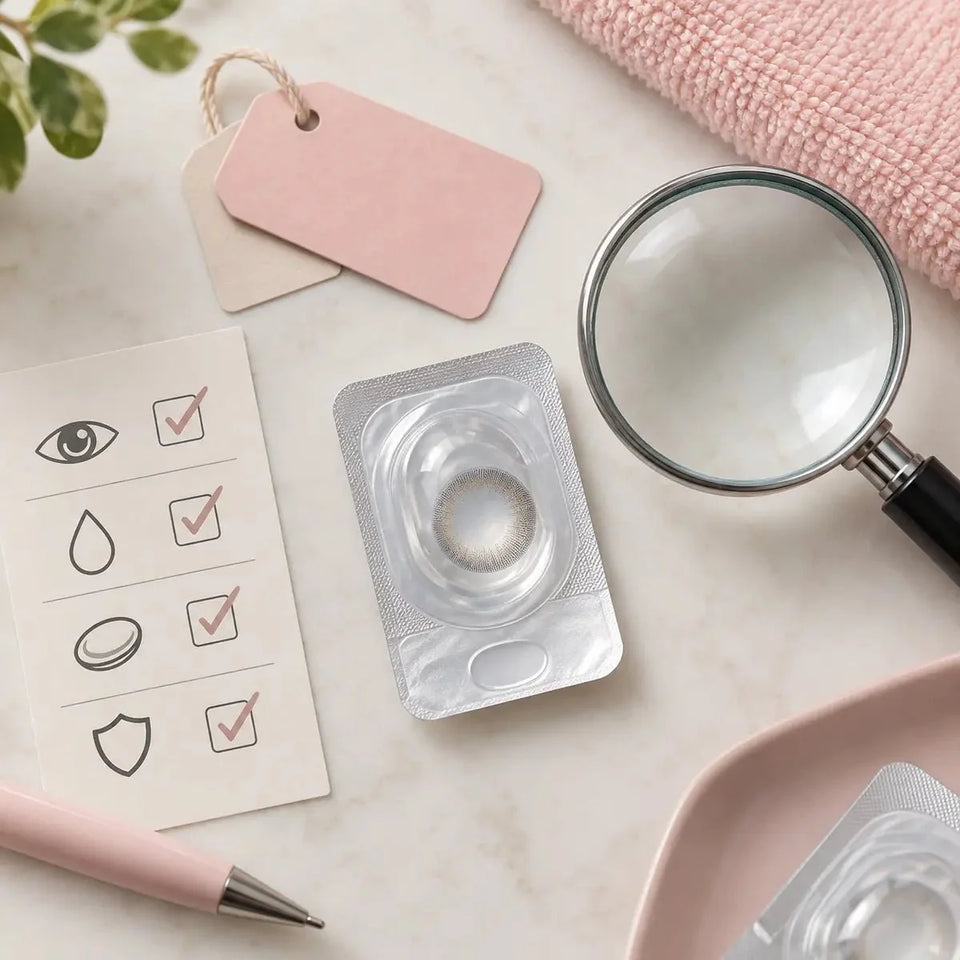
Care & authenticity
Korean Colored Contacts with Prescription Power: What to Know

“Korean colored contacts with power” usually means a product is offered with spherical prescription power. The power number is only one part of the decision. It does not confirm that the lens corrects astigmatism, matches both eyes, is available in the model you want, or has been fitted for you. Start with a current contact-lens prescription and compare the exact model and every prescribed field before choosing a color.

What “power” means on a colored contact lens listing
Power, often labeled PWR, SPH, or 도수, describes spherical correction. Some product pages offer a 0.00 option, which means no spherical correction in that field. A list of minus powers can describe options for nearsightedness, but the menu alone does not show whether a product is right for your eyes.
A product’s “power range” is the set of values a manufacturer or seller lists for that exact model. It is not a recommendation to choose the closest number, and it does not guarantee that every color or package version has the same choices. Check the exact live listing and the sealed box label. If your value is absent or the page is unclear, ask before purchasing.
A contact-lens prescription is more than one number
Use a current contact-lens prescription, not a glasses prescription or a number copied from a previous order. Contacts rest on the eye and need a product-specific evaluation. Your prescription may identify the brand or model and can include other information needed for the fitted lens.
| Field | What it describes | What to check |
|---|---|---|
| OD / OS | Right eye / left eye | Keep each eye’s values separate; they may differ. |
| SPH / PWR | Spherical power | Copy the exact sign and value. |
| CYL | Amount of astigmatism correction | Check whether the prescribed lens requires this field. |
| AXIS | Orientation of the cylinder correction | Confirm the exact value when prescribed; do not round it yourself. |
| Brand / model | The evaluated lens design | Ask before substituting a different line, material, or color version. |
| BC / DIA | Design dimensions shown for the lens | Matching numbers across brands alone do not establish interchangeability. |
Do not infer that both eyes use the same power because one field matches. Preserve plus or minus signs, decimals, and eye labels exactly. A retailer may need to verify the contact-lens prescription before fulfilling an order.
Spherical and toric colored contacts are different designs
A spherical lens has a spherical power. A toric lens includes cylinder and axis correction for astigmatism and needs to settle in a consistent orientation. If your prescription contains CYL and AXIS, a colored spherical lens with a similar SPH value is not automatically equivalent.
Some colored-contact lines are offered in spherical and toric versions, while others may not offer a toric option. Even within a toric line, the complete sphere, cylinder, and axis combinations can be limited. A product name or shade does not reveal all available parameters; open the exact listing and compare it with your prescription.
If a selector lacks your CYL or AXIS, do not choose a nearby value, remove the field, or use the other eye’s numbers. Ask your prescribing professional whether a specific alternative is suitable. Ask the seller only to confirm whether a model and combination are listed or available.
What a professional fitting tells you
A prescription number cannot show how a lens behaves on your eye. A fitting helps the professional evaluate the exact product, including how it centers and moves, whether the surface remains appropriate, and whether vision is stable. Toric lens orientation also needs to be assessed on the eye.
Color and fit are separate decisions. Once your professional has confirmed a suitable model, compare the shade, opacity, printed pattern, graphic diameter, and replacement format. Product photography can help with style, but lighting, the natural iris, pupil size, and camera settings affect appearance. A photo, review, or matching base-curve number cannot establish an individual fit.
A practical product verification sequence
- Confirm the prescription. Use a current contact-lens prescription and ask whether it identifies a required model.
- Identify the exact product. Record brand, model, shade, and version. Similar names can refer to different designs.
- Match both eyes independently. Check OD and OS and copy each prescribed field accurately.
- Check the available options. Compare the complete SPH value and, when needed, CYL and AXIS on that exact listing.
- Understand the package. Confirm individual lens count, replacement schedule, and manufacturer care instructions.
- Resolve differences before payment. Ask the seller about listing or stock details and your prescriber about clinical suitability.
- Inspect the sealed package. Compare model and parameters with the order before opening.
Use the live product page for current availability and package information. KPOP2’s prescription verification process explains the order review, and the wear and care guide covers handling. A listing can answer what is offered; it cannot decide whether a lens is appropriate for you.
U.S. prescription basics for colored contacts
In the United States, the FDA says decorative and colored contact lenses are medical devices that require a prescription, including lenses sold without vision correction. A “0.00” or plano option does not remove that requirement. The FTC Contact Lens Rule guide explains seller duties for prescription verification in the U.S.
Use a properly prescribed and fitted lens, and check the rules where you live if ordering from another country. Read the FDA guide to colored and decorative contact lenses and the FTC Contact Lens Rule guide. These sources explain U.S. requirements; they do not determine whether a particular model fits an individual wearer.
Follow the exact lens instructions
Check whether the exact product is daily disposable or reusable and follow its labeled replacement schedule. A monthly lens is not automatically approved for overnight wear. Wash and dry your hands before handling lenses, keep them away from tap water and saliva, and do not share or stack contacts. Use only the cleaning and disinfection routine specified for the exact reusable lens.
Remove a lens and seek prompt professional advice for pain, unusual redness, light sensitivity, discharge, swelling, or sudden or persistent blurry vision. Do not continue wearing a lens through a warning symptom. See the CDC prevention guidance and the FDA contact-lens risk information.
Frequently asked questions
Does a power range tell me which lens to order?
No. It shows listed options for a product, not your individual prescription or fit. Match your current contact-lens prescription and the exact model.
Can I order the closest power if mine is not shown?
No. Do not round or substitute a prescription value yourself. Ask your prescriber about a suitable alternative.
Does 0.00 mean the lens is non-prescription?
No. It means no spherical correction in that field. In the U.S., the FDA says colored and decorative contact lenses require a prescription, including non-corrective lenses.
Can a spherical color lens correct astigmatism?
A spherical design does not provide the cylinder-and-axis correction of a toric design. Ask your professional which exact product is appropriate.
Can I convert my glasses power to contact-lens power?
Do not convert the values yourself. Get a current contact-lens prescription and fitting.
Can the same product be used for both eyes?
Only if the exact product and each eye’s prescribed values match. Check OD and OS separately and verify package quantity.
Will two lenses with the same BC and DIA fit the same?
Not necessarily. Those values alone do not prove that designs from different brands or models are interchangeable.
What if the order page and package show different values?
Do not open the package. Contact the seller to resolve the order and ask your prescriber about any clinical concern.
Sources: U.S. FDA: Colored and Decorative Contact Lenses; U.S. FTC: Contact Lens Rule Guide; U.S. CDC: Contact Lens Prevention.
This article is general product education. It does not replace a current contact-lens prescription, a professional fitting, or advice from an eye-care professional.