Care & authenticity
Misty 48% vs. Eyeis 40% Water Content: What It Can Tell You
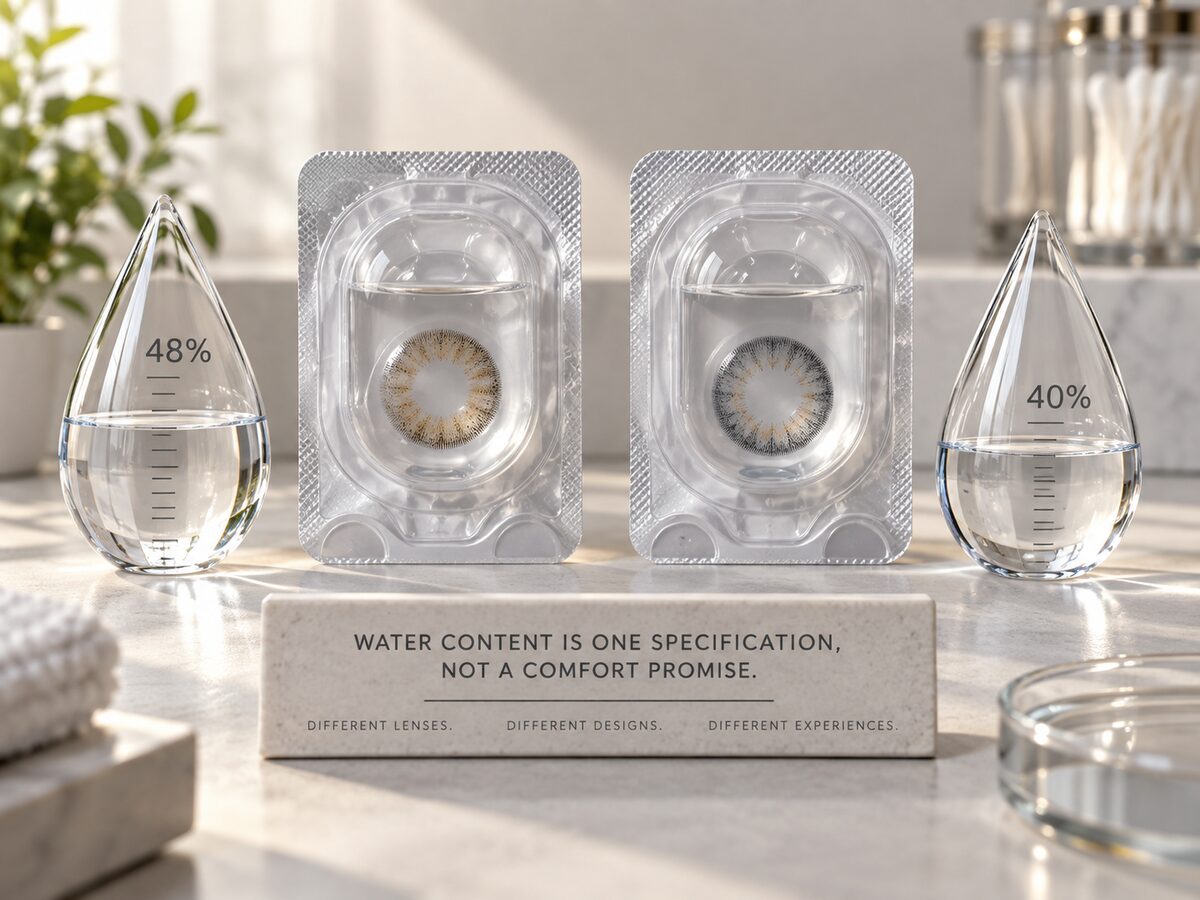
Misty Natural Choco’s listed 48% water content does not establish that it will feel better than Eyeis Melo Brown at 40%. The difference is eight percentage points, not a comfort score, extra wearing hours, or a measured reduction in dryness. These are different products with different materials, dimensions, replacement routines, and package counts. Compare the exact lenses with your eye care professional rather than choosing a higher percentage as a solution to discomfort.
In this guide
Quick answer: what 48% and 40% can tell you
Misty Natural Choco 20p lists 48% water content, while Eyeis Melo Brown lists 40%. This is a difference between two catalog values. It tells you neither which lens will feel better on your eyes nor why a current lens feels uncomfortable. These are distinct products with different materials, shapes, replacement instructions, and package quantities. A higher water-content figure is not a prescription, a clinical outcome, an oxygen-transmissibility value, or permission to extend wear.
Use the percentage as one field in an exact-product record. The practical comparison begins with the questions behind your search: Are you trying to address symptoms, simplify a care routine, compare a color design, or calculate supply? Each question needs different evidence. Symptoms call for prompt professional assessment. Routine calls for the instructions on the exact product. Appearance calls for relevant images of that design. Supply calls for individual-lens arithmetic. None can be answered by subtracting 40 from 48.
The exact KPOP2 product records used here
The current Shopify listing for OLENS Misty Natural Choco (20p) identifies a daily disposable with 20 individual lenses per box, 48% water content, Puscon in the material field, a 13.1 mm graphic diameter, a 14.2 mm overall diameter, and an 8.7 mm base curve. The I-DOL Eyeis Melo Brown listing identifies one individual lens per box, 40% water content, HEMA in the material field, a 13.0 mm graphic diameter, a 14.0 mm overall diameter, and an 8.6 mm base curve. Eyeis currently has a 3–6 month replacement range in the listing. The exact schedule should be checked on the supplied package and with the prescribed wear plan.
This matters because “Misty 48% versus Eyeis 40%” can hide the fact that one is a daily disposable and the other is reusable. It would be inaccurate to call Eyeis monthly based on these current records, or to call Misty's currently listed material Phosphorylcholine. A product comparison becomes less reliable when one of its supporting fields is out of date. Save the exact product URLs and review the selected options at checkout because catalog details can change.
Both listings state a 0.00 to −10.00 power range, but the range endpoints do not demonstrate that every intermediate option is available, currently in stock, or appropriate for an individual prescription. Check the actual option for each eye. If a needed value does not appear, do not round or substitute. Discuss a suitable exact lens with your eye care professional.
Why water content is not a comfort test
A material's water-content percentage is a specification of the lens, not a standardized score of a person's wearing experience. A wearer may care about how a lens feels at insertion, later in the day, or in a particular environment, but neither product record reports a matched comparison of those experiences. The two products also differ in material label, geometry, design, replacement format, and care routine. The table therefore cannot isolate one property and assign it the cause of a hypothetical result.
A number can invite false precision. The difference is eight percentage points, while the arithmetic ratio of 48 to 40 is 1.2. Neither permits a claim of “20% more comfortable,” “eight more hours,” or “less dry.” Such statements would require appropriate product-specific evidence measuring the outcome under defined conditions. This guide has no firsthand wear trial or clinical comparison of these exact products. The honest conclusion stays within the observed data: their water-content fields differ.
Comfort is also not a reason to self-test a different contact lens while your current lens is causing pain, redness, light sensitivity, discharge, or blurred vision. The FDA advises removing a lens immediately and contacting an eye care professional when irritation or infection symptoms occur. Keeping a note of the exact lens, when the symptoms began, and whether one or both eyes were involved can help the professional understand the situation. It cannot diagnose the cause at home.
What the material labels do and do not establish
KPOP2 currently lists Puscon for Misty and HEMA for Eyeis. These are catalog material fields that help identify the exact products. They do not, on their own, provide measured oxygen delivery, surface behavior, or a controlled comfort result for these two lenses. A broad statement about another lens made with a similar named material cannot automatically be transferred to these models. If a claim uses terms such as “breathable” or “moist,” ask whether the evidence names the exact product and measured property.
Similarly, water content is not oxygen transmissibility. The FDA's general explanation of lens types describes material categories, but the two KPOP2 records used here do not report product-specific oxygen-transmissibility values. Do not infer an oxygen ranking from 48% and 40%, or from a generic discussion of another material category. If this issue matters to your fitting, ask your practitioner to assess the approved lens choices using information relevant to your eyes.
Keep the distinction visible in your notes: a confirmed catalog field, a reported experience, and a clinical recommendation are three different kinds of information. The field can be copied from the product page. A review can describe one customer's experience under unstated conditions. A fitting recommendation belongs to your eye care professional. Treating all three as interchangeable is how an attractive but unsupported “higher water is better” rule spreads.
Fit, replacement, and daily routine are separate variables
Misty and Eyeis have different listed overall diameters and base curves. Those measurements describe parts of a lens design; they do not decide fit by themselves. Even if the values matched, the two lenses would not automatically be interchangeable. The FDA's buying guidance cautions against brand substitution without professional approval because brands can differ in water content and shape. A switch proposed to improve comfort still needs examination and confirmation of the exact lens.
The formats create a separate decision. Misty's daily disposable schedule means a new lens is used for the prescribed single-use wear and then discarded. Eyeis is reusable and currently carries a 3–6 month range; the supplied package and professional instructions determine the exact replacement and care plan. Do not convert that range into a universal six-month promise or start counting only the days you happened to wear it. Follow the exact replacement clock and care instructions applicable to the supplied product.
The different routines can matter to a shopper who wants fewer cleaning steps, but routine preference does not establish which product is comfortable or appropriate. If reusable lenses are prescribed, use the compatible solution and case routine as directed. Do not substitute water, top off old solution, or skip required disinfection because a lens has a particular water percentage. If daily disposables are prescribed, do not clean and reuse them to make the box last longer.
How to discuss discomfort with an eye care professional
Bring the exact name and version of the lens you currently wear, your current contact-lens prescription, and the care products and routine you actually use. Describe the symptoms without guessing the cause. Useful details include whether the experience starts immediately or develops later, whether one eye or both are affected, what the vision is like, and whether redness or sensitivity to light occurs. These details help frame a professional assessment, but they are not an at-home test of which water percentage you need.
If you are considering Misty or Eyeis, bring their product records as potential questions, not as self-prescribed substitutes. Ask whether either exact product is suitable for your eyes and prescription, what its wear schedule should be, and whether the proposed change addresses your actual concern. If an option is unavailable, ask for a professionally confirmed alternative. A store can clarify product identity, package count, and current selection menus; it cannot diagnose symptoms or determine an individual's fit from an online message.
Do not insert another colored lens to “see if the higher-water one fixes it” after a concerning reaction. Remove the symptomatic lens and follow professional advice. The FDA notes that problems can become serious quickly, and symptoms alone cannot establish how serious a condition is. Even when a discomfort episode seems minor, the appropriate response is based on the symptom and professional assessment rather than a comparison of two catalog percentages.
Calculate the correctly prescribed supply
When the clinical choice is settled, count individual lenses rather than comparing box prices alone. Misty's currently listed 20-piece daily box can provide ten two-eye wearing occasions only if both eyes use the same approved option and all twenty lenses can be allocated to that two-eye plan. If the right and left eyes need different powers, a separately configured supply for each eye may be needed. The exact number of boxes depends on the intended wear days and the pack configuration, not on the water percentage.
Eyeis currently lists one individual reusable lens per box. A two-eye plan typically needs two individually appropriate lenses, with separate selections if the eyes differ. That arithmetic still does not determine whether Eyeis is prescribed, or which point within its listed 3–6 month range applies to the supplied lens. Confirm the exact schedule from the packaging and professional instructions. Include the relevant care supplies when comparing the actual routine and cost, rather than treating one lens as a complete pair.
For a fair purchase comparison, write the same target use beside each candidate. For example, a shopper may want a planned number of two-eye wearing occasions during a month. Calculate the number of daily pieces required for that plan, then calculate the reusable pieces and care items under the confirmed replacement instructions. Do not force the result by reusing daily lenses or extending reusable wear beyond directions. The math can compare supply; it cannot award a comfort winner.
Keep the color question out of the comfort calculation
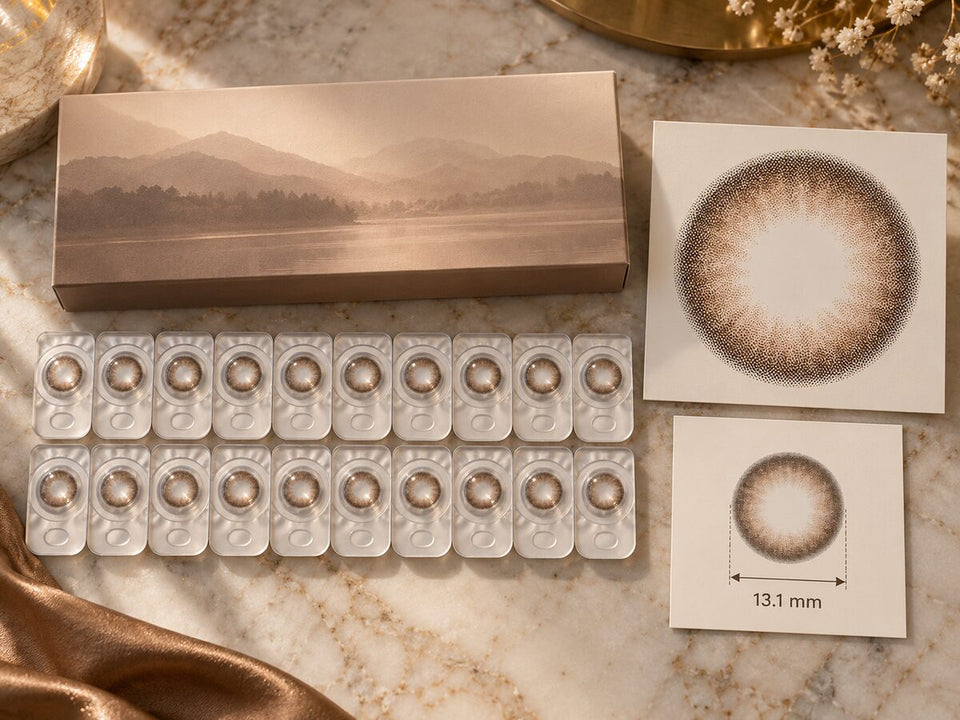
Misty Natural Choco and Eyeis Melo Brown are different color designs. If you prefer one image, identify what you actually prefer: apparent depth, warmth, outer ring, center transition, or graphic extent. A 13.1 mm versus 13.0 mm graphic-diameter field does not tell you which whole-face effect will look softer. Compare exact product artwork, identified on-eye images, and portraits under relevant lighting when available. Keep the starting iris color and photo conditions in mind.
A customer photograph may help describe appearance, yet it cannot establish that the wearer found the lens comfortable or that you will see the same color on your eye. A comfort review likewise cannot prove that the water percentage caused the experience. Separate a visual shortlist from a fitting decision. This lets you tell your practitioner what appearance you like while leaving clinical suitability to their assessment.
If only one product meets your desired look, that still does not make it suitable by default. If both appear acceptable, the percentage difference still does not replace professional fitting. The sensible path is to explain the desired visual effect and the actual comfort concern, then compare the exact products that remain appropriate after assessment. Product photography and specifications are useful inputs when kept within their limits.
A checklist for any “more comfortable” claim
Before repeating a comparison claim, identify the exact two lenses, who wore them, the conditions of fitting and care, what outcome was measured, and how long the observation lasted. Was the statement a controlled product study, a manufacturer's field, or one review? Did it measure comfort directly, or only describe a property such as water content? Was the claim made about the exact model and version you are considering? If those details are missing, treat the statement as unverified for this comparison.
The same questions apply to “more breathable,” “safer for dry eyes,” or “longer wear.” Each refers to a different outcome and may require a different measurement. The two KPOP2 product listings provide water-content values and other catalog fields; they do not provide a direct head-to-head clinical outcome. This article therefore does not offer a comfort ranking. Its role is to help you read the records accurately, avoid a numerical shortcut, and bring a precise question to the right professional.
Save a final decision note with three parts: confirmed product facts, your actual goal, and the next verification step. It might read, “Misty Natural Choco 20p: daily, Puscon, 48%, twenty lenses; Eyeis Melo Brown: reusable 3–6 month listing, HEMA, 40%, one lens. I want to discuss current discomfort and compare the exact approved options.” That note is more useful than “choose 48%,” because it records what is known and what still requires evaluation.
Before you switch lenses or place an order
Recheck both product pages on the day you make the decision. Confirm the complete name, shade, replacement format, material and water-content fields, overall and graphic diameters, base curve, package quantity, and actual selectable prescription options. The two products have a similar listed power-range endpoint, but that does not guarantee your exact option in each shade or current availability. Keep a note of the date and the details you relied on; product information and stock can change.
Then compare the product that your eye care professional approved with the cart, line by line. For daily lenses, make sure the quantity covers the number of individual lenses needed for each eye. For one-piece reusable packaging, confirm that the cart contains the right number of individually selected pieces. A correct shade and water percentage do not compensate for a wrong power, format, or count. If the order line is unclear, resolve it before payment.
When the order arrives, read the unopened package against the confirmed product record and prescription. Check the model, power and any other prescribed parameters, replacement instructions, piece count, expiration date, and seal. If anything is different, contact the seller and your eye care professional as appropriate before opening or wearing the lens. Keep the original box information for future reference. The final choice should be explainable from the whole record: clinical approval, exact product identity, usable supply, and care instructions. The 48% and 40% fields are only two entries in that record.
Four common comparison errors
Turning a specification into an outcome: The statement “48% water” is a product field. “More comfortable” is an outcome that needs its own evidence. Do not join them with an untested “therefore.”
Forgetting the version: A name shared by several shades or replacement formats is not a complete product identity. Confirm the exact daily or reusable version, its contents, and its currently listed material before comparing numbers.
Using one number to approve a switch: A familiar power, base curve, or water percentage does not establish that a new model fits your eyes. Have the exact choice confirmed by your eye care professional.
Comparing unlike purchase units: Twenty daily pieces and one reusable lens are not equivalent boxes. Count the two-eye supply and the required care routine under the applicable instructions. A calculation can guide the order quantity, but it should not change the prescribed replacement schedule.
Correcting these errors makes the article's answer deliberately limited. Misty and Eyeis can be compared as exact catalog entries, with an eight-percentage-point water-content difference and several other recorded differences. A comfort conclusion must come from an appropriate assessment and evidence about the exact wearer and lens. That boundary is the useful result of the comparison.
Related categories
For the next brown-lens comparison, browse Brown Contacts, Daily Contacts. Treat a collection as a discovery route, then verify the exact model, replacement schedule, package count, measurements and available prescription selections on the product page.
Questions and answers
Is 48% eight percent more comfortable than 40%?
No comfort improvement is established by those figures. The numerical difference is eight percentage points in the listed water-content field. It is not a measured comfort score, dryness reduction, or wearing-time allowance. This guide contains no matched clinical trial proving a comfort advantage between the two products.
Can I calculate oxygen performance from the water percentage?
The checked water fields do not supply product-specific oxygen-transmissibility measurements for this comparison. Do not turn the percentages into an oxygen ranking or borrow a claim from another lens material. Ask for evidence tied to the exact product and discuss suitability with your eye care professional.
Does the daily format mean Misty is automatically better for discomfort?
The daily replacement format is a routine difference, not a diagnosis or guaranteed treatment for symptoms. Misty and Eyeis also differ in material and dimensions. If discomfort prompted the comparison, remove symptomatic lenses and seek professional advice rather than selecting a different format yourself.
What information should I bring when discussing comfort?
Bring the current exact product, prescribed parameters, supplied routine, and a clear description of what happened, including relevant timing and whether one or both eyes were affected. Mention redness or vision changes. Do not continue or repeat symptomatic wear to gather a home comparison test.
Does Eyeis’s lower percentage mean it is worse?
The percentage alone cannot establish that. A lower or higher listed water value is not a universal quality or comfort ranking. The exact lens must be assessed for your eyes, and the appropriate choice should remain connected to the complete product and its instructions.
What can the comparison reliably help me decide?
It identifies the exact catalog differences, package units, and routine questions to confirm. It helps you ask about a specific daily or reusable product and calculate its correctly prescribed supply. It does not replace fitting, diagnose symptoms, or prove which lens will feel better for an individual wearer.
Named product records were checked in Shopify for this guide. KPOP2 editorial guidance using KPOP2 product fields and the linked sources. Catalog images and design discussions are not controlled wear tests.