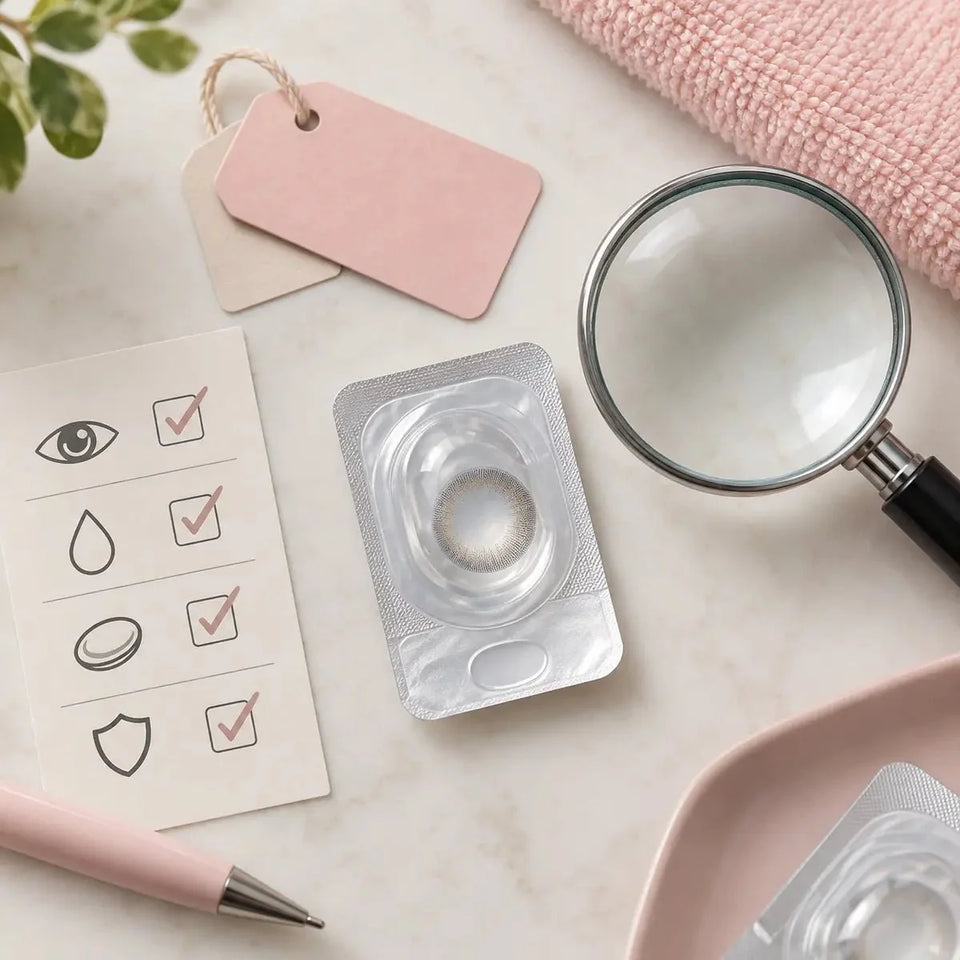
Care & authenticity
Colored Contacts for Astigmatism: Comfort & Fit Guide

No colored toric contact lens can be guaranteed to feel comfortable for everyone with astigmatism. Comfort depends on your eye health, tear film, prescription, exact lens design, fit, stabilization, care routine, and wearing time. Ask an eye-care professional to evaluate the specific product and your symptoms before choosing a lens from reviews or material claims.
In this guide

What comfort means for a toric lens
A toric lens corrects astigmatism with different optical powers in different directions. Its orientation on the eye affects how the correction is delivered, so a fitting needs to consider both vision and the way the lens sits and moves. A lens that is comfortable but does not provide clear, stable vision may still need professional review; clear vision does not by itself prove that the lens is a good fit.
People describe comfort differently. You may notice dryness, awareness of the lens, rubbing, intermittent blur, or difficulty keeping vision stable. These experiences can have several causes and cannot be diagnosed from a product review or a single measurement. A clinician can assess the exact lens, your eyes, and your prescription.
There is no universal list of the “most comfortable colored contacts for astigmatism.” A product that works for one wearer may feel different for someone else. Ask about the specific model and your own eye health rather than relying on a brand ranking.
Factors that can affect comfort
Comfort may be influenced by several factors working together:
- Fit and movement: the lens’s shape, dimensions, edge, and how it moves on your eye can affect sensation and vision.
- Toric stabilization: design features help orient the correction, but how the lens settles varies by product and wearer.
- Prescription: an outdated or incomplete correction may contribute to blur or visual strain. Sphere, cylinder, and axis need to be considered together.
- Eye surface and tear film: dryness, allergy, irritation, or another condition may affect tolerance. Symptoms should be assessed rather than attributed automatically to the material.
- Material and surface: lens materials and surface properties vary. A label alone cannot predict individual comfort.
- Care and handling: residue, incorrect solution, poor hygiene, or an extended replacement schedule can contribute to discomfort and risk.
- Environment and wear time: air conditioning, wind, screens, smoke, and long hours may coincide with symptoms for some wearers.
These factors are reasons to discuss symptoms and the exact lens with a professional, not a self-diagnosis checklist. Do not change your prescription, solution, or product repeatedly to discover the cause without guidance.
Start with the full astigmatism prescription
A contact lens prescription may include sphere (SPH or PWR), cylinder (CYL), and axis (AXIS), as well as a brand or model and fitting details. The right and left eyes can have different values. Record them separately and check that the exact colored toric product offers the complete correction prescribed for each eye.
Some colored contacts are available only in spherical powers or a limited toric range. A product page that says “prescription available” does not guarantee that it includes your cylinder and axis. Do not drop the astigmatism correction, choose a nearby axis, or select a matching sphere as a substitute without the prescriber’s direction.
Use a current contact lens prescription. An eyeglass prescription is not automatically interchangeable because contacts sit on the eye and may require product-specific fitting. If your vision, comfort, or prescription has changed, ask whether you need a new examination before ordering.
Why the exact fit matters
Toric lenses are designed to maintain an intended orientation. They can move or rotate slightly with blinking and then settle. The exact behavior depends on the design and your eye. A professional fitting can assess lens position, movement, and vision with the product, then decide whether it is appropriate.
Similar values do not make two toric products interchangeable. Lenses may differ in material, shape, stabilization, diameter, and edge design. A colored toric lens can also differ from a clear toric lens within the same brand family. Have the exact colored model evaluated instead of assuming the clear version’s fit carries over.
Base curve and diameter are product specifications, not a do-it-yourself fit test. A matching number alone does not confirm comfort, stability, or suitability. Ask your prescriber which details are relevant to the specific lens you are considering.
In the United States, colored and decorative contacts require a prescription and professional fitting even when used only to change appearance. The FDA advises an examination and fitting for decorative lenses. Check rules in your own location because requirements differ.
How to read comfort claims
Product pages and reviews may use phrases such as “all-day comfort,” “moisture-rich,” or “great for sensitive eyes.” Treat these as marketing or individual experiences, not a guarantee for your eyes. Water content, material family, and replacement schedule do not independently prove that a lens will feel comfortable or correct astigmatism adequately.
Look for product facts you can verify: exact manufacturer and model, whether the product is toric, available sphere/cylinder/axis values, base curve and diameter, replacement schedule, box quantity, and care instructions. Ask the seller or manufacturer to clarify missing details. Ask the eye-care professional whether that exact model is appropriate and how it should be fitted.
Reviews can help you understand packaging or color impressions, but they cannot verify another person’s prescription, eye shape, fit, hygiene, or clinical outcome. A comfortable review does not prove that the same model is suitable for you. Compare product documentation and professional advice before taking a rating as a buying decision.
Questions for your eye-care professional
- Is this exact colored toric model suitable for my eyes and full prescription?
- Does it offer the required sphere, cylinder, and axis for each eye?
- How should this design stabilize, and what should I do if vision fluctuates?
- Could my symptoms be related to dry eye, allergy, fit, care solution, or another issue?
- What wearing limit and replacement schedule apply to this product?
- Which care products, if any, can I use with this lens?
- Should I schedule a follow-up after the fitting or trial?
- Which signs mean I should remove the lens and seek care promptly?
Bring the product page or package, your current prescription, and a concise record of symptoms. Note which eye is affected, when symptoms start, how long you wore the lens, whether vision changes after blinking, and what happened after removal. Do not keep wearing an uncomfortable lens just to gather more information.
Match the schedule to your routine
Some toric colored lenses are daily disposables; others are reusable. “Daily wear” and “daily disposable” mean different things. Daily wear describes when the lens is worn, while a daily disposable is discarded after its intended use. A reusable lens has a replacement interval and needs the cleaning and storage routine specified for that model.
Ask how the schedule interacts with your comfort and care routine. A shorter replacement interval does not automatically make a lens more comfortable, and removing a reusable lens each night does not reset its replacement clock. Follow the product label and the clinician’s instructions rather than extending use because the lens still looks clear.
If you switch from a clear toric lens to a colored toric design, compare the exact model, schedule, and care system. Do not infer that one product will feel the same as another because the prescriptions or colors look similar.
What to notice during an approved trial
If the professional recommends a trial, follow the exact insertion, wearing, and follow-up instructions. Do not increase wear time to test whether the lens becomes more comfortable. Record both comfort and visual clarity separately. Mention whether vision is stable, whether it changes after blinking, and whether the lens feels different in one eye.
Do not rotate, reorient, or switch the lens based on a generic online tutorial. Follow the technique taught for the exact model. If vision is blurred or unstable, avoid driving or other tasks that require clear sight and contact the professional who fitted it.
A trial is not a reason to ignore symptoms. If discomfort recurs or worsens, stop and ask for advice. Do not mask irritation with drops to continue wearing the lens unless your professional has recommended a specific product and plan.
Care and stop signs
Wash and dry your hands before handling contacts. Follow the product’s cleaning and replacement instructions. Daily disposables are discarded after their intended use; reusable lenses need the specified cleaning, disinfection, and storage routine. Keep lenses and cases away from tap water, bottled water, swimming water, and saliva. Do not share lenses or top off used solution.
Remove the lens and contact an eye-care professional promptly if you experience pain, unusual redness, discharge, light sensitivity, swelling, or blurred vision. The CDC advises removing lenses and calling an eye doctor immediately for worsening pain, light sensitivity, sudden blurry vision, unusual tearing, or discharge. Do not reinsert the lens to see if symptoms return.
Frequently asked questions
Can a toric colored lens be comfortable for astigmatism?
It may be suitable for some wearers, but comfort and vision depend on the exact product, prescription, fit, and eye health. Have the model professionally evaluated.
Which colored contacts are most comfortable for astigmatism?
No product can be guaranteed most comfortable for everyone. Ask your clinician to compare exact toric models for your eyes and prescription.
Can I rely on material or water content to choose?
Those details do not predict individual comfort by themselves. Fit, eye surface, care, and wear time also matter.
What if the lens feels comfortable but vision is blurry?
Do not change the prescription yourself. Avoid tasks requiring clear vision and contact the professional who fitted the lens.
Can I switch to a similar toric lens with the same prescription numbers?
Matching numbers do not prove that products are interchangeable. Have the exact alternative evaluated.
This article is general educational information and does not replace an eye examination, contact lens prescription, fitting, or personalized advice.