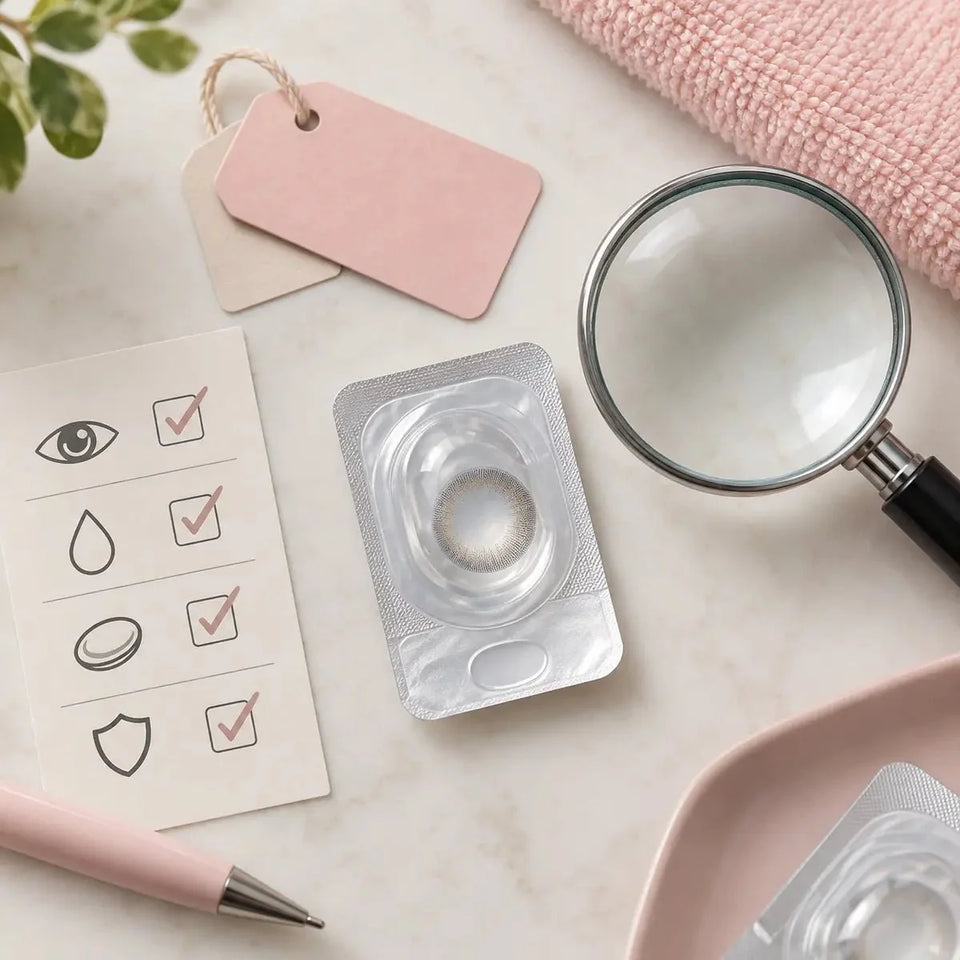
Care & authenticity
Plano Colored Contacts with Astigmatism: What to Know

If you have astigmatism, a plano colored contact lens adds cosmetic color but does not correct astigmatism. Plano or 0.00 describes no spherical power; a standard plano spherical lens does not include the CYL and AXIS correction used in a toric prescription. Ask an eye-care professional whether a fitted plano lens can be part of your plan, or whether you need a single colored toric lens, clear toric contacts, or glasses.

What plano means with astigmatism
Plano, 0.00, or “no power” describes the spherical corrective power shown for a lens option. It does not mean the lens corrects astigmatism. A standard spherical plano contact has no cylinder (CYL) and axis (AXIS) fields to match a toric correction. It changes appearance, but it does not replace the correction in a toric contact-lens prescription.
Astigmatism is not a reason to self-select or rule out a cosmetic lens. The useful question is how you see, what correction your eye-care professional prescribed, and how the exact lens fits. Some people may discuss a professionally fitted plano cosmetic lens with glasses; others may need a toric lens or another approach. The appropriate plan depends on an individual assessment and the visual tasks involved.
Do not use the word “mild” or an old glasses value to decide that correction is unnecessary. Ask your eye-care professional what is suitable for your intended wear, including work, school, driving, sports, and other activities.
Which prescription fields matter
Keep OD (right eye) and OS (left eye) separate. A current contact-lens prescription can include SPH or PWR, and a toric prescription can also include CYL and AXIS. The full model and lens design matter because contact lenses sit on the eye. Do not copy values from glasses or another wearer into an online selector.
| Field or product type | What it means | What it does not mean |
|---|---|---|
| Plano / 0.00 SPH | No spherical corrective power in that lens option | No astigmatism correction or automatic fitting exemption |
| CYL | Amount of cylinder correction when prescribed | A cosmetic color measurement |
| AXIS | Orientation of the toric correction when prescribed | An optional field to estimate yourself |
| OD / OS | Right eye / left eye | Proof that both eyes use identical values |
| BC / DIA | Product design specifications | A do-it-yourself fit test |
| G.DIA | Printed color diameter when listed | Optical correction or fit |
If a product selector has only a 0.00 option and does not show CYL or AXIS, it is not presenting a toric correction in those fields. If you need astigmatism correction, do not try to infer that the plano lens is sufficient from its color name, appearance, or a matching base curve.
Options to discuss with your eye-care professional
A single colored toric lens
Some colored products are made as toric lenses. The exact manufacturer, model, shade, replacement version, and complete parameter combination must be available and evaluated for you. A category page that says “toric” does not prove that your sphere, cylinder, and axis are offered together for both eyes.
A fitted plano lens with glasses
If your goal is cosmetic color and you ordinarily use glasses, ask whether a particular plano colored lens can be professionally fitted and used as part of a plan with your glasses. Do not assume this is appropriate for every activity or prescription. Have the exact lens assessed and ask when glasses should be worn.
Clear toric contacts
If a suitable colored toric model is unavailable, a clear toric contact may be an option to discuss. Your professional can advise on correction and wear. Do not layer a plano colored contact over a clear toric lens as a substitute for a single fitted design.
Non-contact styling
Makeup, lighting, or photography can provide a cosmetic change without adding a contact lens. This may be useful if no colored lens is suitable or if your professional advises against contact wear for now.
These options are discussion points, not interchangeable recommendations. The exact prescription and professional assessment determine what is appropriate for you.
Why stacking or guessing is unsafe
Do not stack a plano colored contact over a toric or other contact lens unless an eye-care professional has specifically directed that exact use. A layered setup is not the same as one designed and fitted contact lens. It can change movement and interaction with the eye, and it does not convert a plano spherical lens into a toric one.
Do not round CYL, choose the closest AXIS, swap OD and OS, or alter a power to fit an online dropdown. If an option is missing, stop and ask the seller about the exact product’s availability and ask the prescribing professional about an appropriate alternative. A preferred color, promotion, or event does not change the prescription.
Check the exact product and package
Before ordering, confirm the full manufacturer and model, shade, lens type (spherical or toric), replacement schedule, available powers, and number of individual lenses per box. Product families can use similar color names across different designs. A listing may show a product’s overall DIA or graphic diameter; those cosmetic or physical measurements do not replace CYL, AXIS, or a fitting.
- Use the current contact-lens prescription and keep right/left eye details separate.
- Confirm whether the exact product is plano or toric, and match the fields it offers.
- Ask whether every required sphere/cylinder/axis combination is available for each eye.
- Check box quantity; do not assume one box contains a pair or matching powers.
- Use a seller that follows applicable prescription requirements.
- Compare the delivered sealed label with the order before opening.
The seller can confirm current stock, package count, and listing details. The eye-care professional addresses prescription, whether a different model can be fitted, and how to handle vision correction with a cosmetic lens.
Prescription requirements and care
In the United States, colored and decorative contact lenses require a prescription and proper fitting even when they have no corrective power. The FDA explains that decorative contacts are medical devices, not over-the-counter cosmetics. The FTC Contact Lens Rule describes seller prescription-copy and verification procedures. Outside the U.S., check the current requirements where you live and ask a qualified professional.
Follow the exact lens’s wearing and replacement directions. Wash and dry your hands before handling contacts; keep them away from water and saliva; use compatible sterile solution and a clean case for reusable lenses. Do not share lenses or sleep in them unless the exact product and schedule have been approved.
Remove a lens for pain, unusual redness, discharge, light sensitivity, swelling, or blurred vision. Do not reinsert it to test whether symptoms return. Contact an eye-care professional promptly. See the FDA decorative lens guidance, CDC information, and FTC Contact Lens Rule guide.
Frequently asked questions
Do plano colored contacts correct astigmatism?
No. A standard plano spherical lens has no CYL or AXIS correction. Ask your professional what correction plan is suitable.
Can I wear plano colored contacts with glasses?
Discuss the exact lens and intended activities with your eye-care professional. Have the lens fitted; do not assume glasses make any contact lens safe.
Can I use a plano lens over my clear toric lens?
Do not stack contacts as a workaround. Ask about a single fitted lens or another styling option.
Can I choose 0.00 if my prescription has astigmatism?
Do not decide from the number alone. Ask your professional whether the exact plano lens is appropriate with your correction needs.
Can a colored toric lens correct astigmatism?
Some exact products are toric. Confirm the complete SPH, CYL, and AXIS options for both eyes and have the model evaluated.
What if no colored toric model matches my prescription?
Ask your prescriber about clear toric lenses, glasses, a different fitted model, or another styling plan. Do not alter your prescription to match stock.
Does plano mean a prescription is not required in the U.S.?
No. FDA guidance says colored and decorative contacts require a prescription and proper fitting, even when they do not correct vision.
Sources: FDA: Colored and Decorative Contact Lenses, CDC: About Decorative Contact Lenses, and FTC: Contact Lens Rule Guide. This article explains product terminology; it does not determine an individual prescription or fitting.
Editorial method: zero spherical power, toric correction, cosmetic intent, seller inventory, and professional fitting are distinguished. No correction plan is recommended for an individual reader.