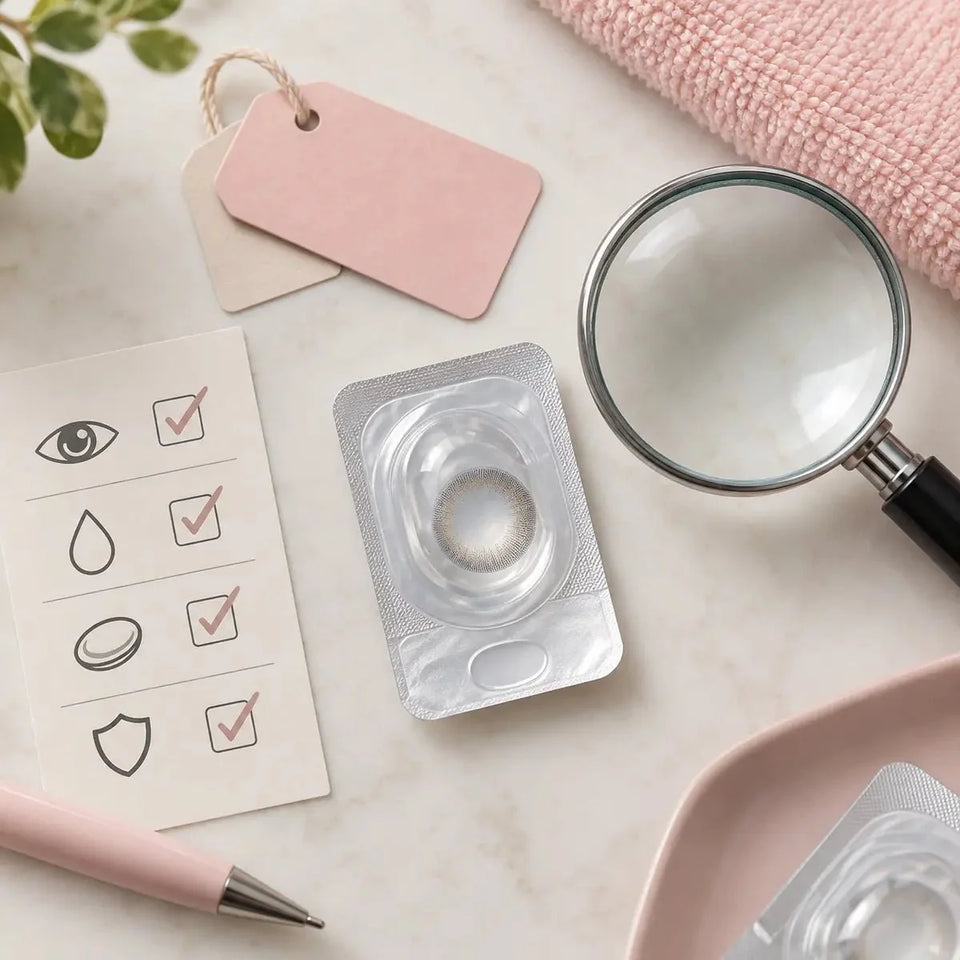
Care & authenticity
Plano Colored Contacts for Brown Eyes: Fit, Color and Care
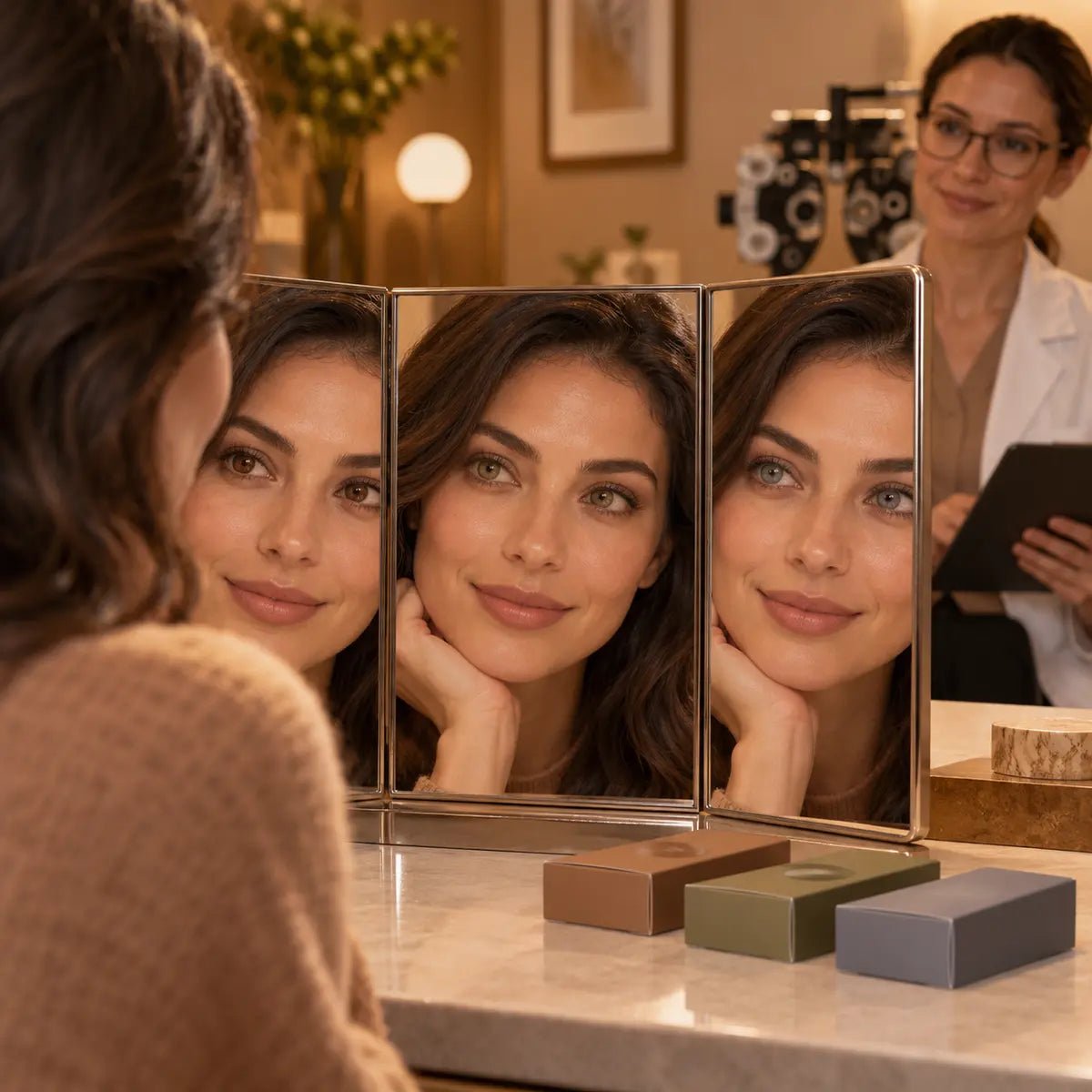
“Non-prescription” colored contacts usually means a zero-power, or plano, lens—not a lens that needs no fitting or care. If you want color on brown eyes without vision correction, begin with the exact plano contact lens your eye care professional has fitted or approved. Then compare that lens's print on a starting iris similar to yours. In the United States, decorative contacts still require a prescription; a cosmetic purpose does not remove contact lens risks.
In this guide

Plano describes optical power, not permission to skip a prescription
Retailers may use “non-prescription,” “plano,” or “0.00” to describe a lens that does not add distance-vision correction. That language can be confusing because contact lenses are also prescribed as specific medical devices. A 0.00 option does not mean the lens will fit every eye, and it does not make the product equivalent to eye makeup.
The CDC explains that decorative lenses alter eye color or appearance, some also correct vision, and all contact lenses require a prescription and proper fitting in the United States. The purpose of wearing them does not erase the risks of an ill-fitting lens or poor hygiene. If your eyes see clearly without correction, ask about a properly fitted plano decorative lens. If you need vision correction, a 0.00 lens will not provide it.
Do not order a zero-power colored lens to place over a clear corrective contact. Two lenses on one eye are not a workaround for an unavailable color or power. Discuss your visual goal and prescription needs with an eye care professional so the selected approach is appropriate for you.
What an eye care professional checks
A contact lens sits on the eye and moves with blinking. Fitting considers the exact lens design, centration, movement, the eye's surface, tear film, vision, and the individual's response. Base curve and overall diameter may be part of the lens information, but matching those two numbers to a different brand does not establish that the products are interchangeable. The FDA advises buyers to check the exact brand and lens name and not accept an unapproved substitution.
Ask for the full contact lens prescription and note the product or manufacturer information, any eye-specific values, and the expiration date. An eyeglass prescription is not the same document. Even if your chosen power is 0.00, the exact lens still needs to be appropriate. If your preferred shade is only available in another model, ask whether that model can be evaluated instead of assuming the color family makes it equivalent.
Comfort is not a stand-in for fitting. A lens that feels acceptable at first may still require professional assessment, and a photo that shows a centered printed ring cannot reveal the complete on-eye response. Another reviewer's experience is useful as a question to ask, not as proof of your own safe wearing time.
How a plano colored lens may look on brown eyes
Brown eyes are not one uniform background. Warm medium brown, deep chocolate, and nearly black irises can interact differently with the same print. A sheer pattern lets much of the natural iris influence the final shade. A denser or layered design may produce a more visible change. A brown lens can enhance definition rather than change hue; a hazel lens may add a warmer center; a gray lens can appear more muted indoors than under bright light.
Before choosing a shade, decide whether your aim is a near-natural enhancement, a visible but wearable change, or a high-contrast look. For a subtle result, compare diffused edges, a soft center transition, and tones close to the starting iris. For a stronger change, look for greater pigment coverage and clear contrast in ordinary indoor photos. These are visual directions, not promises that any one color will behave the same way on every eye.
Look for before-and-after photos of the exact product on a bare iris similar to yours. Favor comparable daylight and indoor views, plus a normal-distance portrait. Bright ring lights and image processing can make color appear stronger. A product name alone cannot tell you the visible outcome. Photos also cannot establish whether the lens is appropriate to wear.
Read the print before comparing a numeric size
Colored lens design has a center, a middle color field, and an outer edge. The center transition can make a lens look blended or deliberately graphic. The middle field carries the main undertone. The edge can make the iris appear more sharply outlined. Two plano lenses labeled “brown” can look very different because their print zones differ.
Graphic diameter, sometimes shown as G.DIA, describes the size of the printed area when listed for the exact model. Overall lens diameter, DIA, is a separate physical measurement involved in fitting. Do not treat graphic diameter as a fit measurement. Nor does a larger graphic automatically make an eye appear larger: a smaller, dark ring can look more pronounced than a wider soft print.
Selfies are unreliable for estimating either number. Crop, camera distance, gaze, lashes, and editing affect apparent scale. Use verified specifications from the current exact product listing, and use ordinary-distance photos to judge the visual effect. If an exact specification is missing, ask the seller rather than borrowing it from a similarly named version.
Daily and reusable are different care commitments
A daily disposable follows its single-use schedule and is discarded after wear. A reusable lens follows the manufacturer's replacement schedule and needs appropriate cleaning, disinfection, and storage. The format can affect your routine and total cost, but neither schedule guarantees comfort or fit. Choose within the exact lenses appropriate for your eyes and your ability to follow the care instructions.
Do not save a daily lens for another day because it still looks clear. Do not stretch a reusable lens beyond its instructed replacement date. If you wear colored contacts only occasionally, ask what the specific product's storage and replacement instructions require between wears. Avoid making your own care schedule from a social media comment.
Package counts matter. “10 pieces” does not mean ten pairs, and some products are sold as single lenses or pairs. If the two eyes require different versions or values, determine whether separate selections are needed. Compare value only after the exact product, quantity, schedule, and care supplies are clear.
Match the package to the care plan
Before opening a box, confirm the exact brand, model, shade, optical power, replacement schedule, and package count against the fitted product. Check whether the selected version is daily or reusable, because the care instructions and supplies differ. If the listing or delivered label is unclear or mismatched, contact the seller before use.
Care and warning signs apply even to occasional wear
The CDC's decorative lens guidance warns against sharing lenses, storing them in water, and cleaning them with water or saliva. It advises fresh contact lens disinfecting solution for reusable lenses and following the eye doctor's replacement instructions. The broader CDC prevention guidance also recommends washing and drying hands before handling lenses and removing lenses and contacting an eye care provider when discomfort occurs.
Do not wear lenses through a shower, swim, hot tub, or other water exposure. Follow your prescribed wear schedule and the instructions for the exact lens. Keep appropriate backup vision correction available when needed. A special event is not a reason to extend wear after a problem starts.
Remove the lens and seek prompt professional advice for pain, unusual redness, swelling, discharge, light sensitivity, a persistent gritty sensation, or a change in vision. Do not reinsert it to see whether the symptom has passed. The fact that the lens has no optical power does not make these signs less important.
Sources: CDC decorative contact lens guidance, CDC prevention guidance, and FDA buying guidance. Verify current rules and exact product details at the time of purchase.