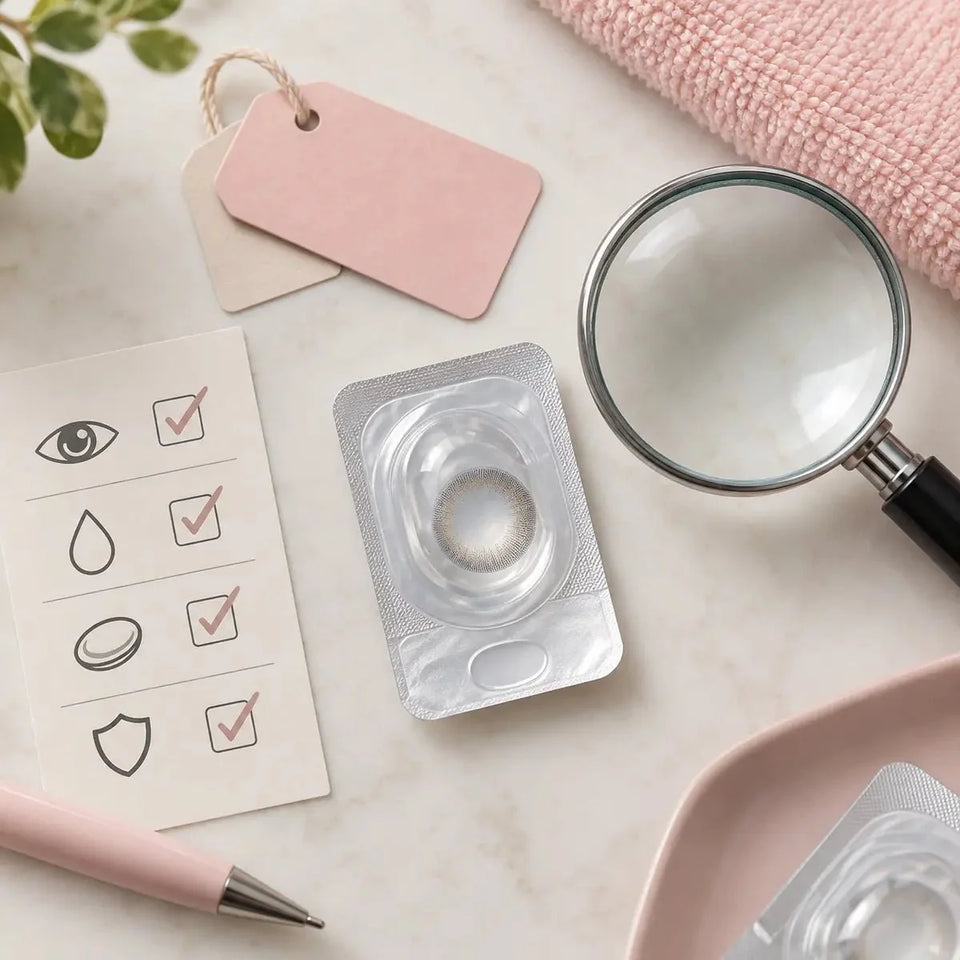
Care & authenticity
Plano Colored Contacts for Men: Rules & Style Guide

Plano colored contacts can change eye color without spherical vision correction, but “no power” does not mean “no prescription” or “no fitting.” If you are looking for colored contacts for men, compare shade, contrast, and edge design according to your own style. Confirm local rules and have the exact lens prescribed and fitted by an eye-care professional.
In this guide

What plano colored contacts mean
Plano, or 0.00 spherical power, generally means a lens does not provide spherical vision correction in that field. It does not mean the lens is not a contact lens, that it cannot affect your eyes, or that it is appropriate for every wearer. The lens still sits on the eye and has product-specific fit, care, and replacement requirements.
Listings may use phrases such as “non-prescription colored contacts,” “zero power,” or “no correction.” Those words can be confusing. A seller may mean that the lens does not correct vision, while local rules may still require a prescription and professional fitting. Ask what the product designation means and check the requirements where you live.
If you already wear clear contact lenses for vision correction, do not stack a plano colored lens on top. Ask an eye-care professional whether a single colored lens can meet your needs, or use glasses and styling choices instead. Do not borrow or share a plano lens with another person.
Prescription rules and fitting
In the United States, colored and decorative contact lenses are prescription medical devices, even when worn only to change appearance. The FDA advises getting an eye exam and a prescription that identifies the brand and lens measurements. An eye-care professional should measure each eye, fit the exact lens, and evaluate how the eye responds.
Requirements differ outside the U.S. Check your local regulator’s current guidance and ask a licensed eye-care professional in your region. Do not assume that a website’s “no prescription required” statement overrides local rules or proves the product is suitable. A seller’s ability to ship a lens does not replace professional fitting.
Ask whether the prescription needs to identify the brand or exact model, how the seller will obtain or verify it, and whether the product is authorized for your market. For U.S. sellers, the FTC Contact Lens Rule guide explains prescription presentation and verification. Verification checks order information; it does not replace an exam or fitting.
Choose a look by style, not gender
There is no single “men’s” eye color or lens design. Choose by your own preferred effect and the setting where you plan to wear the lens. You might want a subtle warm shift for everyday styling, a cool gray for a sharper contrast, or a vivid shade for a costume or photo. These are options for any wearer, regardless of gender.
Think about the impression you want: blended or defined, muted or bright, natural-looking or intentionally graphic. A soft print may look understated in one light; a dark edge may appear more noticeable in a portrait. The same color can read differently with brows, makeup, hair, clothing, and camera exposure.
If the lens is for a special event, describe the intended setting to your eye-care professional and plan around the approved wear schedule. A striking reference image can help explain style, but it cannot show whether the exact product fits or whether you can wear it comfortably.
Compare shade, contrast, and pattern
Shade names such as gray, brown, blue, hazel, or green are not standardized across brands. Compare the exact product’s color and print rather than assuming that two lenses with the same name look alike.
- Undertone: brown can lean golden, red, olive, or ash; gray may read blue-gray or charcoal.
- Edge definition: a pronounced outer ring can create a more outlined appearance; a soft edge can blend more gently.
- Print density: a higher-contrast or denser pattern may be more graphic, while a gradual pattern can appear more blended.
- Graphic area: graphic diameter describes the printed color region, not whether the lens fits or how large the eye will look.
- Lighting: warm indoor light, daylight, camera settings, and distance can all shift how a shade appears.
Use product photos as style references, not guarantees. Check whether the image shows the exact shade and version and whether the natural eye color is identified. A close-up can exaggerate a ring or fleck; a full-face photo can show how the color relates to the rest of the look. If photos are not comparable, rely on the documented product details and keep expectations flexible.
Verify the exact product
Before ordering, record the manufacturer, model name, shade, lens type, replacement schedule, base curve, total diameter, graphic diameter if listed, and package quantity. Different versions in the same collection may use different materials, designs, or schedules. Do not infer missing specifications from another color or product family.
Base curve and diameter are product information, not a self-fitting formula. A matching number on another contact lens does not prove that two products are interchangeable. Have the exact plano colored lens evaluated and fitted by an eye-care professional.
Check the official instructions and seller details. A useful listing should identify the manufacturer and exact model, provide available parameters, explain the replacement schedule, and state how prescription information is handled where required. Be cautious of claims that a lens is “one size fits all,” universally safe, or requires no professional involvement.
Check the package and order
Review the cart before payment. Confirm that the selected item is truly the plano version if that is what you need, and check the exact shade, lens schedule, box quantity, and return terms. Some packages contain several lenses of one power; a photo showing both eyes does not prove that a pair or mixed package is included.
When the order arrives, inspect the manufacturer, model, shade, package count, expiration date, and seal before opening. If the package is damaged, unsealed, expired, or different from what you ordered, do not wear the lens. Contact the seller and your eye-care professional before accepting a substitute.
Keep the order confirmation and package details until you have verified the product. If the instructions are in a language you cannot read, ask for official manufacturer directions in a language you understand. Do not guess care steps from a translated color name or a social media post.
Build a personal style brief
When comparing colored contacts, a short style brief can make the choice easier. Write down the desired shade family, how visible you want the print to be, whether you prefer a soft or defined edge, and where you plan to wear the lens. You might describe the goal as “a muted gray for daylight,” “warm brown with a soft blend,” or “a bold blue for a costume.” These descriptions communicate the effect without relying on gendered product labels.
Compare product images in similar lighting and at similar distances. A studio close-up may make the print appear stronger than a casual portrait. Note which images show the exact model and which are general campaign photos. If the product page does not identify the exact shade or version, ask the seller before ordering.
Use the brief as a visual reference for your appointment, not as a substitute for clinical evaluation. The eye-care professional can help you identify which exact lenses can be considered. If the approved product does not create the exact effect, change styling through makeup, lighting, or clothing rather than choosing an unsuitable lens.
Questions to ask before purchase
- Is this exact plano model appropriate for my eyes?
- Does it require a prescription and fitting where I live?
- Who will measure and fit the lens?
- What is the precise replacement schedule and care routine?
- How many lenses are in each box, and does each box contain one version?
- Which symptoms mean I should remove the lens and contact a professional?
Keep the answers with the product page and package label. That makes it easier to confirm you received the version that was discussed and to follow its instructions correctly.
Care and warning signs
Wash and dry your hands before handling lenses. Follow the exact instructions for wearing, cleaning, and replacement. Daily disposable lenses should be discarded after their intended use; reusable lenses need the prescribed cleaning and storage routine. Keep contacts and cases away from tap water, bottled water, swimming water, and saliva. Never share lenses or top off used solution.
Remove the lens and contact an eye-care professional promptly if you have pain, unusual redness, discharge, light sensitivity, swelling, or blurred vision. The FDA lists these as possible signs of irritation or infection. Do not keep wearing a lens for photos or to finish an activity. Keep glasses available as a backup and follow professional advice before wearing contacts again.
Remember that retailer terms such as “costume,” “fashion,” or “plano” can describe appearance or correction, but they do not answer whether the product is authorized, fitted, or suitable for you. Read the local rules and exact manufacturer instructions before purchase.
When in doubt, ask the eye-care professional to identify the exact lens by manufacturer and model code, not by a broad color category.
That small detail helps avoid confusion when model names are similar.
Frequently asked questions
Are plano colored contacts the same as non-prescription contacts?
Plano generally refers to no spherical correction. It does not determine whether a prescription or fitting is required. Rules depend on your location.
Can men wear any colored contact lens?
Color and design are personal choices, not gender-specific. The exact product still needs to meet your prescription, fitting, and local requirements.
Can I buy plano colored contacts online without an exam?
In the United States, FDA guidance says decorative lenses require a prescription and professional fitting. Elsewhere, check local rules and consult an eye-care professional.
Can I wear plano colored contacts over my regular contacts?
Do not stack lenses. Ask a professional about a single lens that meets your needs or use glasses.
Does a matching base curve mean a plano lens will fit?
No. Matching one measurement does not establish fit or interchangeability. The exact model should be evaluated.
This article provides general shopping and styling information. It does not replace an eye examination, prescription, professional fitting, or product-specific care instructions.