Care & authenticity
Buying Plano Colored Contacts In Store: Prescription & Safety Checks
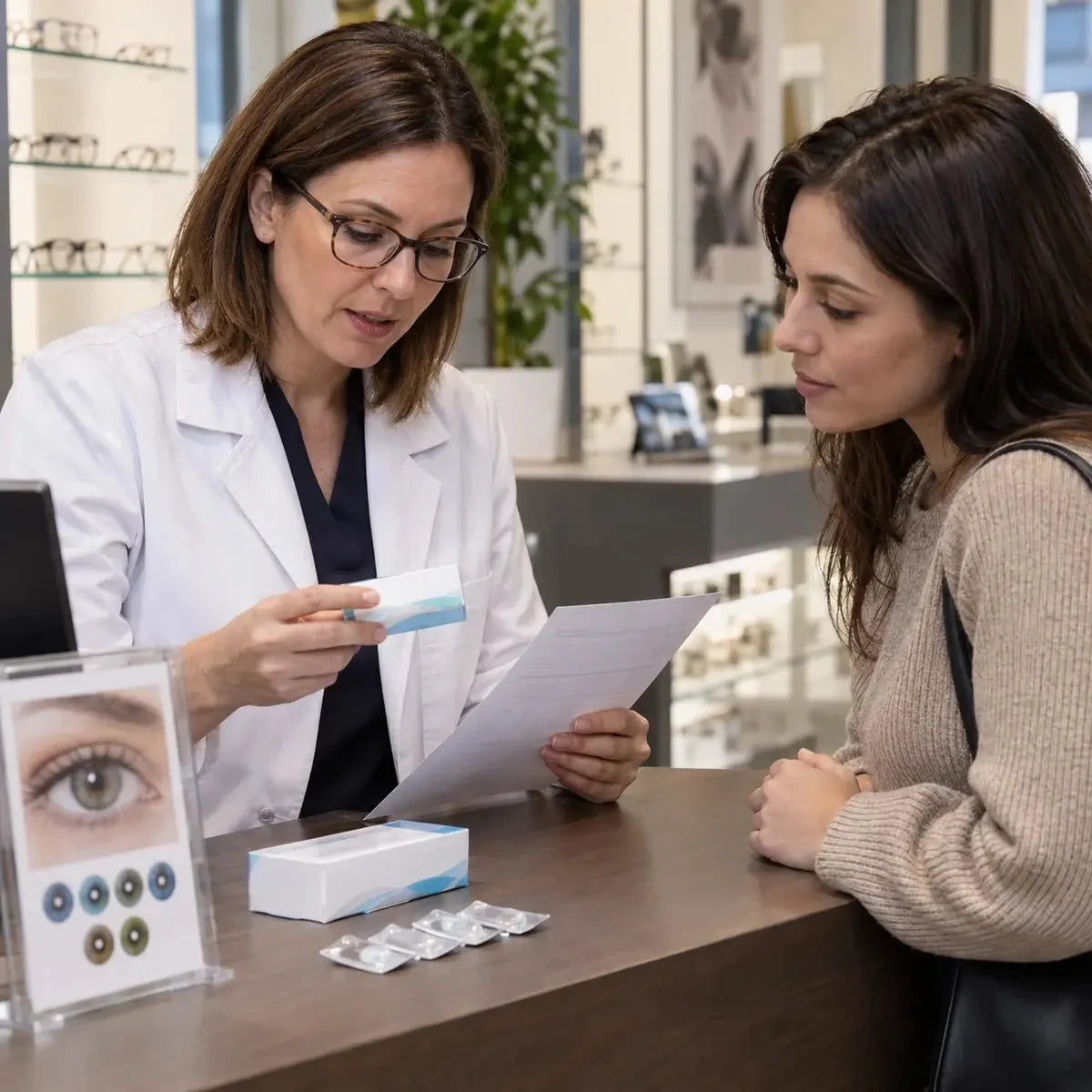
Buying plano colored contacts in a physical store does not make them prescription-free in the United States. “Plano” generally means 0.00 corrective power; the lens still needs an appropriate prescription and professional fitting. Before paying, verify the exact product, seller’s prescription process, packaging, and instructions.
In this guide
- What plano means for colored contacts
- Prescription rules and in-store sales
- Why fitting comes before color choice
- What to check before purchasing
- What to inspect on the package
- How prescription verification may work
- Questions to ask the store and your eye-care professional
- After you bring lenses home
- Frequently asked questions

What plano means for colored contacts
Plano usually indicates 0.00 spherical power, meaning the lens does not provide that kind of vision correction. It describes corrective power, not the lens’s fit, safety, or regulatory status. A plano lens can still cover the cornea and requires correct product information, fitting, and care.
In the United States, decorative lenses that change eye appearance are regulated as medical devices. The FDA says colored and decorative contact lenses require a prescription, including lenses that do not correct vision. The eye-care professional must evaluate and fit the lens; it is not an over-the-counter cosmetic simply because the power is 0.00 or it is sold in a retail shop.
Rules differ outside the United States. If you are shopping in another country, check the current requirements from the relevant health authority and ask the retailer which rules apply. Do not use a U.S. rule as a substitute for local information.
What an in-store prescription process should involve
A physical shop can offer a convenient way to ask questions and see packaging, but the location of the sale does not replace prescription and fitting requirements. In the United States, the FTC Contact Lens Rule applies to sellers of contact lenses. Under the FTC’s Contact Lens Rule guide, sellers generally must obtain a copy of the prescription or verify prescription information with the prescriber before providing lenses.
Ask how the store handles the prescription requirement before you choose a lens. A responsible process should identify the exact contact lens and connect the sale with the required prescription process. A sign saying “non-prescription,” “fashion,” “costume,” or “plano” does not by itself show that a lens may be sold without a prescription.
Prescription compliance and suitability are separate checks. Even if a retailer follows the required process, the specific lens still must match the prescription and professional fitting for your eyes. A store clerk cannot determine fit from eye color, a previous brand, or the printed diameter alone.
Why fitting comes before the color choice
If you have never worn contacts, start with an eye-care professional rather than the display shelf. A contact lens fitting evaluates more than whether a lens has the color or power you want. The practitioner needs to identify and assess a specific lens for your eyes, provide instructions, and explain any follow-up. A shop assistant can help you locate a labeled product, but a retail conversation is not a clinical evaluation.
If you already wear contacts, bring the written prescription and the exact product information for the colored lens you want. Ask your practitioner whether the prescription covers that specific brand and model. Some prescriptions identify a particular lens; another color or line may be treated as a different product. Do not rely only on matching power values or a past box because product parameters and prescriptions can change.
Before you leave a fitting, confirm how to insert and remove the lens, how long to wear it, when to replace it, and which solution to use if it is reusable. Ask what symptoms mean you should remove the lens and call for help. A first-time wearer should practice the handling method shown by the professional rather than learning from a shop package alone.
What to check before purchasing in person
- Exact product identity: Write down the brand, model or series, color, and product version. Similar shade names may describe different lenses.
- Prescription for each eye: Bring your current contact lens prescription and confirm whether the product is available in the exact prescribed details. Do not substitute glasses power or assume 0.00 is correct.
- Fit approval: Confirm that an eye-care professional has evaluated the exact lens or model. A previous contact lens fitting for another brand does not automatically approve a new product.
- Product specifications: Check the power and applicable lens measurements shown on the prescription and package. FDA buying guidance advises checking the exact brand, power, and relevant measurements.
- Replacement schedule: Identify whether the lens is daily disposable or reusable and confirm its labeled replacement and wearing directions.
- Care system: For reusable lenses, ask which cleaning and disinfecting solution is compatible. Do not rely on a generic instruction or use water.
- Package quantity and terms: Confirm how many lenses are included and review the store’s current exchange or return terms before opening a package.
- Receipt and records: Keep the receipt and packaging so you can identify the lot, product, and purchase if you need to contact the retailer or clinician.
If you have not been fitted for contact lenses or are trying a new brand, arrange an examination and fitting before wearing them. Contact lenses are placed directly on the eye, so choosing a color and confirming product suitability are different parts of the process.
A store may carry a product but not stock the shade or prescription you need. Ask whether the item is available in your exact prescribed details or whether the store would be ordering it. If it suggests a different version, request the full product name and have the prescriber review that specific option. Do not let an immediate color match substitute for an approved lens.
What to inspect on the product package
Before leaving the store, look for clear labeling that matches the product you selected and the details on your prescription. Check the brand and model, color, lens type, corrective power, and applicable measurements. Read the replacement schedule and manufacturer’s patient instructions. The box and sealed lens container should be intact, and the date information should be legible.
Do not buy a lens if its manufacturer or exact product identity cannot be confirmed, if the package appears opened or damaged, or if the label conflicts with what you ordered. A generic unmarked vial or loose lens without traceable packaging does not give you the information needed to verify the product or follow its instructions. Ask the shop to explain any discrepancy before paying.
Be cautious when a seller offers a substitute because the shade or package looks similar. A different model can have different specifications and instructions. The FDA advises consumers to avoid unapproved substitutions and to check the exact product with an eye-care professional. Do not accept a different lens just because it is available immediately.
How prescription verification may work
In the United States, the FTC Contact Lens Rule allows a seller to obtain the prescription from the customer or use the rule’s verification process with the prescriber. A shop may ask to see the written prescription, contact the prescriber, or explain another compliant process. The precise steps depend on the transaction and the rule; asking about the process is more useful than assuming that a store counter makes verification unnecessary.
Keep your prescription accessible and make sure the seller has the correct provider contact details if it needs to verify the order. Check that the request concerns the exact lens you intend to buy, including brand and parameters where applicable. If the shop says the product is “non-prescription” solely because it has 0.00 power, ask it to clarify how that statement fits the rules for decorative lenses in your location.
The FTC’s seller guide is a U.S. source. For shopping elsewhere, consult the relevant local authority or a licensed eye-care professional. Do not infer that the same seller process applies in every country.
Questions to ask the store and your eye-care professional
Use direct questions so the answers are about the exact item rather than colored contacts in general:
- What is the exact brand, model, and color of this lens?
- How does the store obtain or verify the contact lens prescription?
- Has my eye-care professional approved this exact lens and its parameters?
- Is this product 0.00 in both eyes, or are different powers available?
- What is the replacement schedule, and what care system does the manufacturer recommend?
- Is the package sealed, traceable, and labeled with the product and date information?
- If this exact product is unavailable, will you contact my prescriber before offering another model?
- What should I do if the package or lens I receive differs from the item on the receipt?
If the answer to a prescription or fitting question is unclear, pause the purchase and confirm with the prescriber. Getting that clarification before opening the package is simpler than trying to resolve a mismatch after you have worn a lens.
After you bring the lenses home
Keep each pair in its original package until you are ready to use it according to the approved instructions. Do not transfer a lens to a different case before first use unless the professional or manufacturer directs you to do so. Keep the package details available so you can answer questions about the model or lot if you need advice.
Before opening the package, compare its labels with the product you intended to buy and the details your eye-care professional approved. Keep the receipt and original packaging. If anything is different, do not wear the lens; contact the retailer and ask your prescriber if the product’s suitability is uncertain.
Wash and dry your hands before handling lenses. Follow the exact manufacturer and eye-care professional instructions for insertion, removal, cleaning, disinfection, replacement, and follow-up. The CDC contact lens hygiene guidance recommends thoroughly washing and drying hands, avoiding water exposure, and removing lenses if discomfort occurs. Never share lenses or use another person’s prescription.
If you experience eye pain, unusual redness, light sensitivity, discharge, or blurry vision, remove the lens and contact an eye-care professional promptly. Do not put it back in to “test” whether symptoms have passed.
Frequently asked questions
Does plano mean I can buy colored contacts without a prescription?
No, not in the United States. Plano usually refers to 0.00 corrective power. FDA guidance says decorative colored contact lenses still require a prescription and professional fitting.
Can a beauty or costume shop sell plano contacts without a prescription?
In the United States, decorative contact lenses require a prescription regardless of whether they are sold in person or online. Check the rules that apply in your location.
Can I buy the lens now and get fitted later?
Arrange the required professional examination, prescription, and fitting before wearing the lens. Do not treat a store purchase as a fitting.
Can the store substitute a similar color or brand?
Do not assume a different lens is equivalent. Ask your eye-care professional to approve the exact alternative and its parameters before use.
What if a seller says prescription checks are unnecessary?
Pause and verify current local requirements with an official source or eye-care professional. In the United States, the FDA and FTC describe prescription requirements for decorative contact lenses.
Does buying in person make the product safer?
Not by itself. Check the prescription process, exact identity, labeling, sealed packaging, and care instructions, and obtain a professional fitting.
What should I do if the box is damaged or does not match my order?
Do not wear the lens. Keep the packaging and receipt, contact the retailer, and check with your prescriber if the product identity or parameters differ.
Editorial note: U.S. prescription information is based on current FDA guidance and the FTC Contact Lens Rule. Requirements differ by location. This article is general information and does not replace an eye examination, prescription, or fitting.