Care & authenticity
Prescription Colored Contacts for Cosplay: Fit & Safety Guide
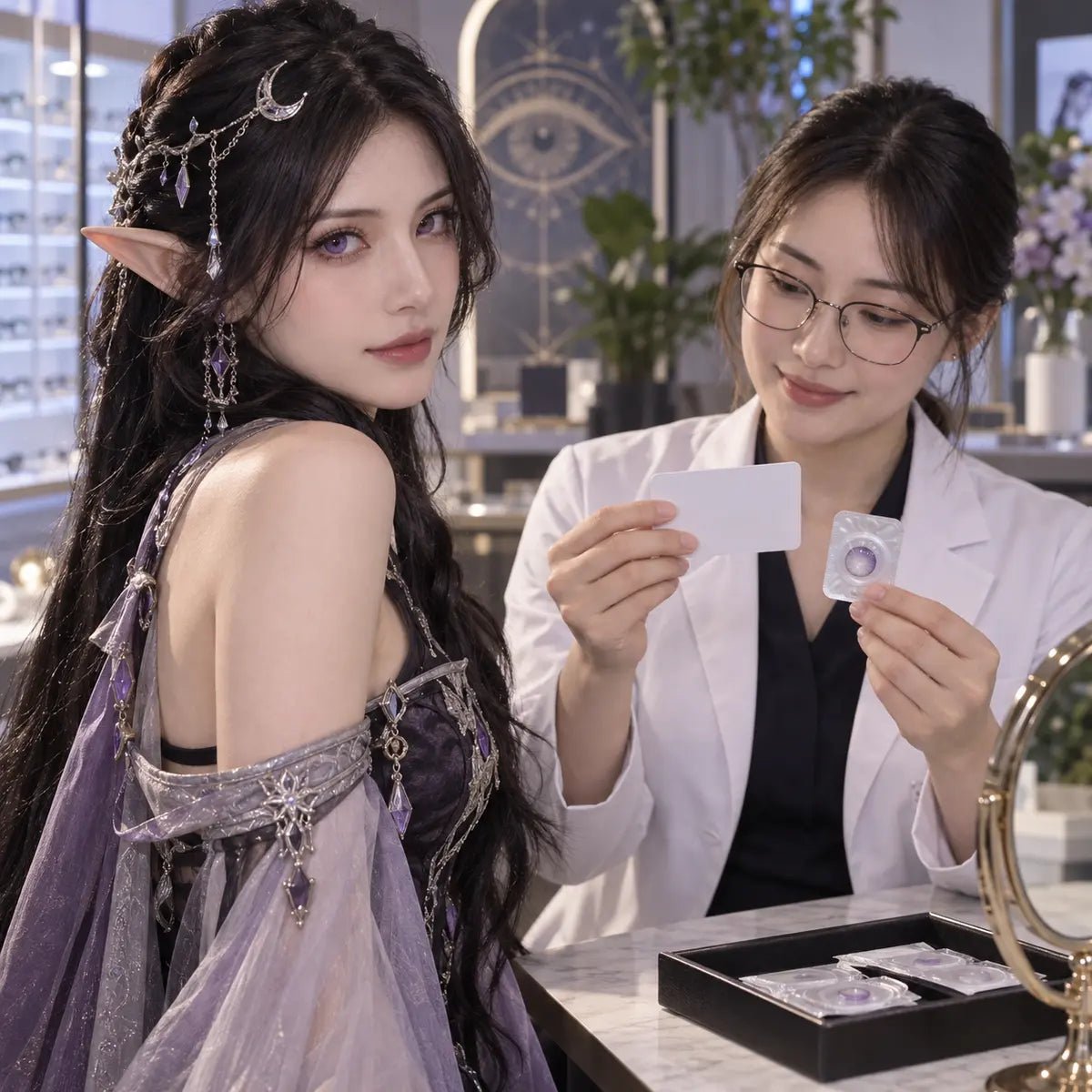
Cosplay contact lenses should be chosen in this order: prescription and professional fit first, exact product identity second, costume effect third. A dramatic pattern or character reference cannot confirm that a lens fits, corrects your vision, or is suitable for a long event. Plan the look around one approved lens per eye and a clear backup option.
In this guide
- Turn the character reference into a visual brief
- Confirm the full prescription for each eye
- Verify exact product identity and pack format
- Why base curve and DIA are not fit shortcuts
- Plan for convention or performance day
- Handling and care during an event
- Know when to remove the lens
- If the exact costume lens does not fit your needs
- Frequently asked questions

Turn the character reference into a visual brief
Bring a clear reference image to your eye-care professional and describe the effect you want in visible terms. Instead of relying only on a character name, note the dominant color, print intensity, edge definition, and whether the design covers the iris or creates a stylized pattern. Identify which details matter most and which you could change.
A drawing, digital illustration, or edited cosplay photo is a style reference, not evidence that a contact lens with the same appearance exists or will provide clear vision. Camera effects, lighting, makeup, and retouching can change an eye’s appearance. A character illustration may also show a pupil or iris design that is not appropriate for everyday vision.
Separate your plan into two lists:
- Vision and fit requirements: current contact lens prescription, exact correction for each eye, approved lens type, wearing schedule, and care instructions.
- Visual preferences: color, opacity, graphic diameter if listed, edge pattern, costume lighting, and how visible the effect should be at conversation distance.
Let the professional help identify which lens options can meet the first list. Then compare the costume effect among those suitable products. If a dramatic design is unavailable in your prescribed correction, adapt the makeup, lighting, or costume accessory rather than changing the prescription yourself.
Confirm the full prescription for each eye
A contact lens prescription may include sphere (SPH), cylinder (CYL), and axis (AXIS), plus brand or model details and fitting measurements. Your right and left eyes may have different values. Copy each eye’s prescription onto its own line and compare the complete combination with the exact product’s available options.
Do not choose a nearby power, omit cylinder, round an axis, or assume that a menu showing some prescription numbers can provide your full prescription. If you have astigmatism, confirm that the exact colored lens has the toric correction you need. A listing with “prescription” in its title may offer only a limited set of powers.
In the United States, decorative or colored contact lenses require a prescription and professional fitting, even when they do not correct vision. The FDA’s decorative lens guidance says a prescription should identify the brand and correct lens measurements. Requirements can differ outside the U.S.; check the rules for your location.
The FTC Contact Lens Rule guide explains the U.S. process for sellers to obtain or verify a prescription. Prescription verification addresses the order details; it does not replace the fitting or confirm that a dramatic lens is suitable for your eyes.
Verify exact product identity and pack format
Before ordering, confirm the manufacturer, full product name, color or design, lens type, replacement schedule, and available prescription parameters. Similar product names, fan-made references, or pictures from another version can lead to the wrong selection. If the listing does not identify the exact model, ask the seller for the manufacturer’s product information.
Check what the package includes. Some boxes contain lenses in one power, while other packs or offers have a different quantity. Calculate the order for the right and left eyes separately if the powers differ. Do not assume that a “pair” or a photograph showing two eyes means the box contains the exact right-left combination you need.
Compare the order confirmation with your prescription before opening the lenses. When the package arrives, check the brand, model, shade, power, and relevant measurements against the order and the lens your professional approved. Keep the receipt and packaging until you have confirmed the product. Do not wear an item that differs from what you ordered; contact the seller and prescriber.
Why base curve and diameter are not fit shortcuts
Base curve and overall diameter describe product dimensions, but they do not show whether a lens fits your eye. Graphic diameter describes the colored printed area and is a styling detail, not a fitting measurement. Matching one number from your everyday contact lens does not prove that a different cosplay design is interchangeable.
Contact lenses vary in material, shape, optical design, and stabilization. The eye-care professional evaluates the exact lens and how it behaves on your eye. The FDA cautions consumers against accepting an unapproved substitution because different products may have different properties. Ask your prescriber to review the exact model rather than using a base-curve match or costume photo as a fitting test.
Do not put a decorative lens over a clear contact lens to combine costume color with vision correction. Use one lens per eye as prescribed. If the exact design is not available in your powers, discuss a different single lens or a glasses-based plan with your professional.
Plan for convention or performance day
Do not make a long event the first time you handle an unfamiliar contact lens. Schedule the examination and fitting in advance, learn the insertion and removal method from the professional, and follow any trial instructions they give you. This gives you time to ask questions about the product and the costume before you are in a crowded venue. If a professional recommends a trial or follow-up, arrange it early enough to address questions before the event and record symptoms as instructed.
Plan the lens around the event rather than extending wear to match it. Ask the prescriber what wearing limit applies to the exact lens and whether it should be removed for any part of the day. Build in a way to stop wearing it early. If the costume includes gloves, long nails, face paint, or prosthetics, decide in advance how you will access clean hands and remove the lens without touching unclean materials.
Pack the correct glasses, lens supplies, a clean case if the lens is reusable, and the manufacturer instructions. Keep products in their original packaging until needed and separate right and left lenses if their prescriptions differ. Do not transfer solutions into unmarked containers or improvise a cleaning method at a convention.
Try the complete visual look in similar lighting before the event, but judge lens suitability separately. A photo can help you assess costume color and visibility; it cannot tell you whether the lens fits or whether your vision is dependable.
Handling and care during an event
Wash hands with soap and dry them completely before handling contacts. Follow the care system and wearing schedule for the exact product. Daily disposable lenses are discarded after their intended use; reusable lenses require the prescribed cleaning, disinfection, and storage routine. Do not reuse a daily lens because the event was short.
Keep contact lenses away from water, including tap, bottled, pool, and costume-related water effects. Do not wet a lens with saliva or use makeup remover, setting spray, or other cosmetic product as lens solution. Apply makeup and handle lenses only in the order recommended by your eye-care professional and the product instructions.
Never share contact lenses, even if the other person has a similar prescription or wants the same character look. Each wearer needs an individual prescription and fit. Avoid touching a lens after handling costume materials, props, or makeup unless you have washed and dried your hands again.
Know when to remove the lens
Remove the lens and seek professional advice promptly if you experience redness, ongoing eye pain, discharge, light sensitivity, or decreased vision. The FDA advises prompt medical attention for these possible infection signs. Do not keep the lens in for photographs, finish a performance, or reinsert it to see whether symptoms return.
If vision becomes unstable, stop tasks that require clear sight, including driving or navigating stairs in a crowded venue. Use your glasses and contact an eye-care professional. If removing the lens is difficult or painful, do not scrape at the eye or use tools; seek prompt help.
Tell the professional which lens you wore, how long it was in, and what symptoms occurred. Keep the packaging if available, but do not delay care to retrieve it. Follow the individualized advice you receive before wearing contact lenses again.
If the exact costume lens does not fit your needs
Separate essential requirements from optional costume details. If clear vision or a particular prescription is essential and the dramatic design is unavailable, ask about another fitted colored lens, glasses, or a lens-free styling approach. These are discussion options, not a claim that a particular product is in stock or suitable for you.
A character’s appearance can be created with makeup, lighting, glasses frames, or other accessories. A successful costume does not require an unverified lens. Do not use a lens that lacks the right correction, skip a fitting, or combine two lenses because the effect is important to a photo.
Browse product collections to identify designs to discuss with your eye-care professional, then return to the exact item page to verify brand, version, pack contents, and prescription choices. A collection page is a discovery route, not confirmation that one item meets your medical and costume requirements.
Plan for common convention situations
Think through the practical details of the venue before deciding whether lenses suit the day. A long queue, warm stage lighting, air conditioning, outdoor walking, smoke effects, elaborate makeup, or a late evening can make the day different from a brief trial at home. These conditions do not predict that a problem will occur, but they are useful reasons to plan conservatively and follow the wear schedule rather than treating the event as an exception.
- Before makeup: Follow the lens maker’s and clinician’s directions about when to insert lenses. Wash and dry your hands thoroughly. Keep cosmetics, glitter, adhesive, and setting spray away from the lens and eye surface.
- During the event: Do not rub your eyes or handle a lens with unwashed hands. If discomfort or vision changes begin, move to a clean, well-lit place and follow the removal and care directions for your lens. Do not keep wearing it for photographs or a performance.
- For breaks and removal: Bring only care products approved for the exact lens type, in their original labeled containers where practical. A daily disposable is discarded after removal; it should not be cleaned and reused. Reusable lenses require the prescribed cleaning and storage routine.
- As a backup: Carry your glasses and the relevant product instructions. If you cannot handle lenses with clean hands or cannot follow the required care routine at the venue, glasses may be the more practical choice for that part of the day.
Never use tap water, bottled water, saliva, or homemade saline on lenses or cases. Water exposure can introduce organisms that cause serious eye infections. Do not share lenses, even briefly, and do not place a lens in a costume prop, makeup container, or an unclean case. If you have no clean place to remove or care for a reusable lens, ask your eye-care professional how to plan for that situation before the event.
Questions to bring to an eye-care professional
A focused appointment can make the decision clearer. Bring your current prescription information, the product label or a reliable product link, and your expected event schedule. Ask whether the lens is available in the exact power needed for each eye, whether it requires a separate fitting, what wear and replacement schedule applies, how to clean or discard it, and what symptoms mean you should remove it and seek care. Ask what to do if the lens feels uncomfortable during the event and whether glasses should be your backup.
These questions are especially useful when one eye has a different prescription, when you have astigmatism, or when the desired cosmetic design is offered in limited powers. Do not assume that a plano version, a spherical version, or another design can safely substitute for the lens prescribed for you. Your clinician can explain the appropriate options based on your eyes and the specific product.
Frequently asked questions
Can I put a costume lens over my regular contact?
No. Do not layer lenses. Ask your prescriber about one fitted lens per eye or a glasses-based alternative.
What if the costume lens does not offer my cylinder or axis?
Do not omit prescribed values or choose a nearby option. Ask your prescriber about a suitable alternative or adapt the costume design.
Does a matching base curve mean I can skip a fitting?
No. A matching number does not show that another lens design fits or behaves the same way on your eye.
Should I wear a cosplay lens for the first time at a convention?
Do not make a long event your first lens trial. Arrange the fitting and learn the handling instructions in advance.
What if the lens looks right but my vision is blurry?
Vision takes priority over the costume. Remove the lens and contact an eye-care professional, especially if the blur is sudden or persistent.
Editorial note: U.S. prescription and seller information is based on FDA guidance and the FTC Contact Lens Rule. Follow the instructions for your exact product and your eye-care professional’s advice. This article does not replace an examination, prescription, or fitting.