Care & authenticity
Prescription Colored Contacts for Light Eyes: Order & Fit Guide
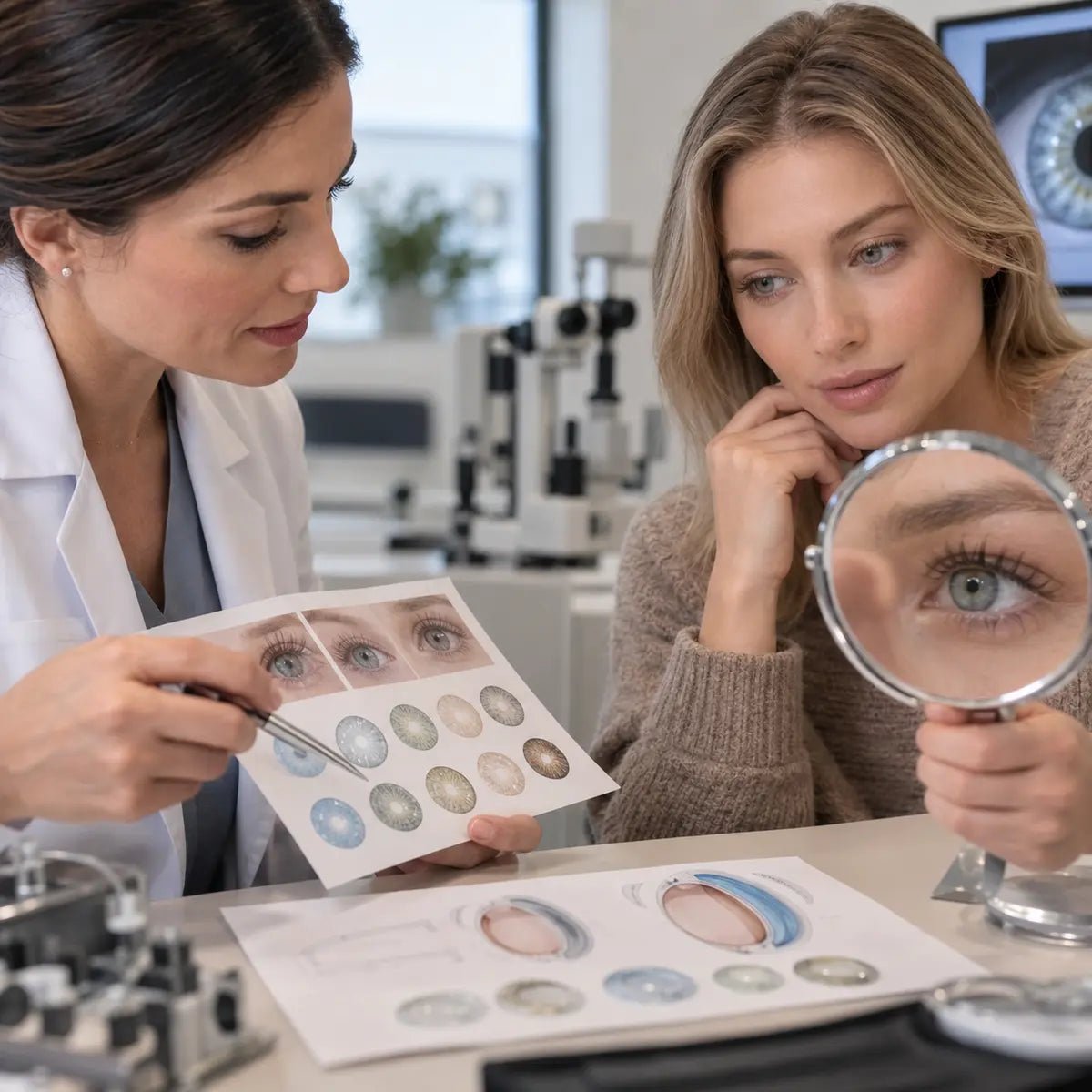
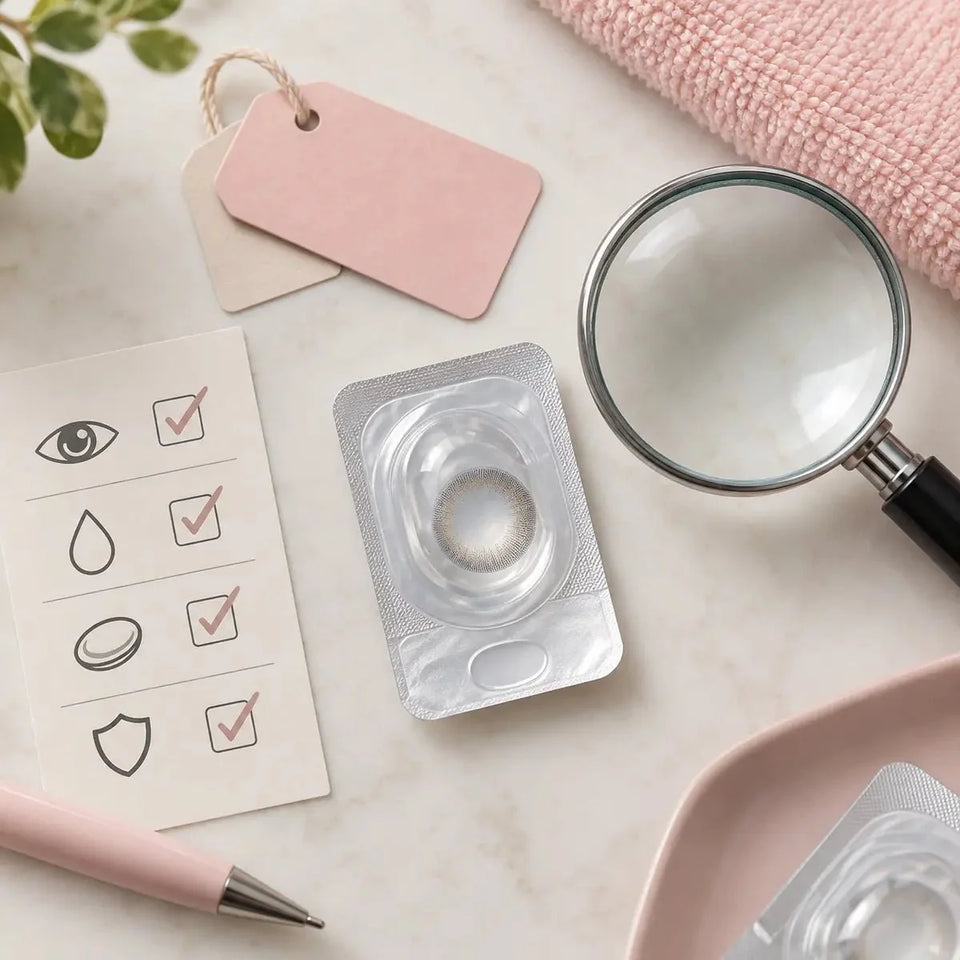
To order prescription colored contacts for light eyes, match the exact lens model and version to your current contact lens prescription for each eye. Then have that lens prescribed and fitted by an eye-care professional. A lighter iris may show more of a lens’s printed pattern or blend with a translucent tint, but photos cannot guarantee the result. Verify the product, powers, package, and care instructions before wearing it.
In this guide
- Start with the two decisions
- How light eyes interact with color designs
- Read each eye’s prescription
- Match the exact lens to the order
- Understand lens parameters
- Compare appearance without overpromising
- Review the cart and package
- Follow fitting and care guidance
- Questions to ask
- Frequently asked questions

Start with the two decisions
There are two separate questions when shopping for colored contacts for light eyes. First, is the exact lens appropriate for your eyes and prescription? Second, does its design create the visual effect you want? Answer the prescription and fit question with an eye-care professional, then compare colors among the exact products that can be considered.
Do not select a lens solely because a product photo looks subtle on a person with light eyes. A photo does not show whether the lens corrects your vision, how it fits, or whether its care schedule works for you. Likewise, a product selector can show available powers but cannot decide what prescription is appropriate.
Before placing an order, keep the product page or manufacturer label nearby and compare every required field with your prescription. If the exact model is unavailable in your correction, pause and ask your prescriber about another appropriate option. Do not select a nearby value or switch to a similar looking lens on your own.
How light eyes interact with color designs
Light irises can have visible variations in tone, spokes, and rings. A colored contact may blend with those details, add a new tint, or create more contrast depending on the print. A translucent or softly blended design may allow more natural variation to show through; a denser print or defined ring may look more graphic. These are general design observations, not a promise about a specific wearer’s outcome.
Read the exact product description and look for images showing the exact shade and version. Product names such as “enhancement,” “natural,” “gray,” or “hazel” are not standardized across brands. Compare the printed area, edge pattern, and color transition rather than assuming two lenses with similar names will look alike.
On a light iris, a subtle lens can sometimes appear more visible than expected because its border contrasts with the natural eye. A shade that seems close to your own color may still create a noticeable change in bright light or close photographs. A bolder printed design may look softer at a distance. Natural eye pattern, pupil size, lighting, makeup, and camera settings all affect the impression.
Use photos to compare broad visual qualities: warm versus cool tone, soft versus defined edge, and blended versus high contrast. Check whether the model’s natural eye color is stated and whether the image is a close crop or a full-face view. Treat each image as a reference, not a guaranteed preview.
Read each eye’s prescription
A contact lens prescription may include sphere power (SPH or PWR), cylinder (CYL), and axis (AXIS) for astigmatism, as well as fitting information such as base curve and diameter and a specified brand or model. The fields depend on the lens. The right and left eyes can have different corrections, so keep them on separate lines when preparing an order.
A glasses prescription is not automatically a contact lens prescription. Contact lenses sit directly on the eye, and the prescription may include product or fitting information that glasses do not. Do not convert a glasses value yourself, round a number, copy one eye’s power to the other, or omit cylinder and axis when they are required.
“Plano” or “0.00” typically means no spherical vision correction in that field. It does not mean that a lens is non-prescription in every legal sense or that it needs no fit. Decorative contacts still require appropriate prescription and fitting under U.S. rules, even when they do not change vision.
In the United States, the FDA recommends an eye exam and a prescription identifying the brand and lens measurements for colored and decorative lenses. Requirements can differ outside the U.S.; check the rules and product authorization for your location with the relevant regulator and a qualified eye-care professional.
Match the exact lens to the order
Before entering powers, confirm the manufacturer, full model name, shade, lens type, replacement schedule, and version. One brand may sell similar shades in daily and reusable formats, different diameters, or different prescription designs. A clear lens and its colored counterpart may not have identical product details. Use the exact model that your professional evaluated.
Look for the available power range and any cylinder or axis choices. Some cosmetic designs are offered only in selected powers or only as a spherical lens. If the exact product does not include the parameters you need, do not choose the closest option. Ask the prescriber whether another model could meet your vision and fitting needs.
Base curve and diameter are product specifications; they are not a self-fitting formula. Matching a number printed on your current lens does not prove that a different model fits the same way. Materials, shape, edge design, and lens movement can vary. Ask the professional to evaluate the exact lens rather than relying on a numerical match alone.
Check the box contents. Some packages contain multiple lenses of a single prescription power, while other offers may have different quantities. If the right and left eyes need different powers, you may need to select or order each side separately. Do not assume a pair or mixed-power set is included because the product image shows two eyes.
Understand lens parameters and style terms
Product listings may show total diameter (DIA), base curve (BC), and graphic diameter (G.DIA). DIA is the overall lens diameter. BC describes a curve parameter of the lens. G.DIA usually refers to the printed color area. These fields describe product design; none alone tells you whether the lens fits or guarantees how large, bright, or natural the effect will look.
When the product page does not explain a term or measurement, ask the seller or manufacturer for exact specifications. Do not infer missing values from another color in the same collection. Different shades or lens versions may have separate specifications or availability.
Appearance descriptions also vary. “Enhancement tint” may signal an intended subtle effect, while “opaque” may suggest a more visible printed area, but terms are not universal. Review the actual images and product documentation. On light eyes, even a subtle print may create a defined boundary, and an opaque print does not necessarily guarantee a particular final color.
Compare appearance without overpromising
When comparing colored lenses for light eyes, use a consistent method. First compare the exact shade and printed pattern. Next look at photos in similar lighting and from similar distances. Finally view a full-face image to see how the color relates to makeup, brows, hair, and clothing. A close-up reveals fine print; a portrait shows the overall balance.
Warm indoor lighting can make a shade seem more golden; daylight may reveal cooler gray or green nuances. Camera exposure, filters, editing, and screen settings can also shift color. A lens that looks almost identical to the natural iris in one photo may look more defined in another. If the seller provides examples on different light eye colors, use them to understand the range of possibilities, not to predict an exact result.
For a natural look, you might prefer a low-contrast print or a soft edge, but naturalness is subjective. A defined ring can be an intentional style choice. Decide whether the goal is a small tonal adjustment, a clearer ring, a cooler shade, or a noticeable change. Then compare those features among products your professional has approved.
If the ideal shade is not available in a suitable prescription, consider adjusting makeup, lighting, or styling rather than changing the prescription. A visual reference can be adapted. A contact lens order should match the individual correction and the exact product.
Review the cart and package
Before checkout, compare your cart with a written note of the prescription for each eye. Confirm the chosen shade, manufacturer, exact model, power, box quantity, and replacement schedule. Check that the selected product is the version reviewed by your clinician. Save the order confirmation so you can compare it with the package label later.
When the order arrives, inspect the packaging before opening it. Check for a damaged seal, incorrect model, shade, power, quantity, or expiration date. If the package differs from the order or prescription, do not wear the lens. Contact the seller to resolve the discrepancy and ask your prescriber before accepting a substitute.
Keep the original packaging and care instructions until you have confirmed what arrived. If instructions are in a language you do not understand, ask the seller for official manufacturer guidance in a language you can read. Do not use an automated translation alone to infer wear or disinfection instructions.
For U.S. purchases, the FTC Contact Lens Rule guide describes how sellers obtain or verify prescriptions. Prescription verification checks order information; it does not replace an examination or fitting.
Follow fitting and care guidance
Wash and dry your hands completely before handling lenses. Follow the wearing and replacement schedule for the exact product. A daily disposable is discarded after its intended use; reusable lenses need the cleaning, disinfection, and storage method specified by the manufacturer and your professional. Do not extend a schedule because the lens still looks clean.
Keep contact lenses and cases away from tap water, bottled water, swimming water, and saliva. Do not top off used solution or share lenses. Do not sleep, shower, or swim in contacts unless the exact product instructions and your eye-care professional explicitly say that use is appropriate.
Remove the lens and contact an eye-care professional promptly if you experience pain, unusual redness, discharge, light sensitivity, swelling, or blurred vision. Do not continue wearing a lens to see whether the symptoms improve. Keep glasses available as a backup and follow professional advice before wearing contacts again.
Questions to ask before placing an order
- Is this exact colored lens appropriate for my eyes and prescription?
- Does it provide the complete correction needed for my right and left eye?
- Is the model available in the cylinder and axis I need, if applicable?
- Have you evaluated this specific lens rather than only a similar clear or colored version?
- What wear limit and replacement schedule apply?
- What are the package quantity and care instructions?
- What symptoms mean I should remove the lens and seek care?
Frequently asked questions
Can I wear prescription colored contacts if my eyes are light?
Light eye color does not determine whether a lens is suitable. The exact product, prescription, fitting, and eye health should be reviewed by an eye-care professional.
Will colored lenses look more natural on light eyes?
Not necessarily. A light iris can show natural variation through some designs, while a subtle print or edge may still create visible contrast. Results differ by product and wearer.
Can I order the closest available prescription power?
No. Do not round or select a nearby value. Ask your prescriber about a product that offers the correction and fit you need.
Can I use my glasses prescription to buy colored contacts?
Do not assume it is interchangeable. Use a current contact lens prescription and follow your clinician’s fitting advice.
Does a matching base curve mean the lens is a fit?
No. A single matching parameter does not make different lenses interchangeable. The exact product needs professional evaluation.
This article offers general shopping information and is not a substitute for an eye examination, contact lens prescription, fitting, or product-specific care instructions.