Toric & prescription
Toric Colored Contacts for Dark Eyes: Fit and Color Questions
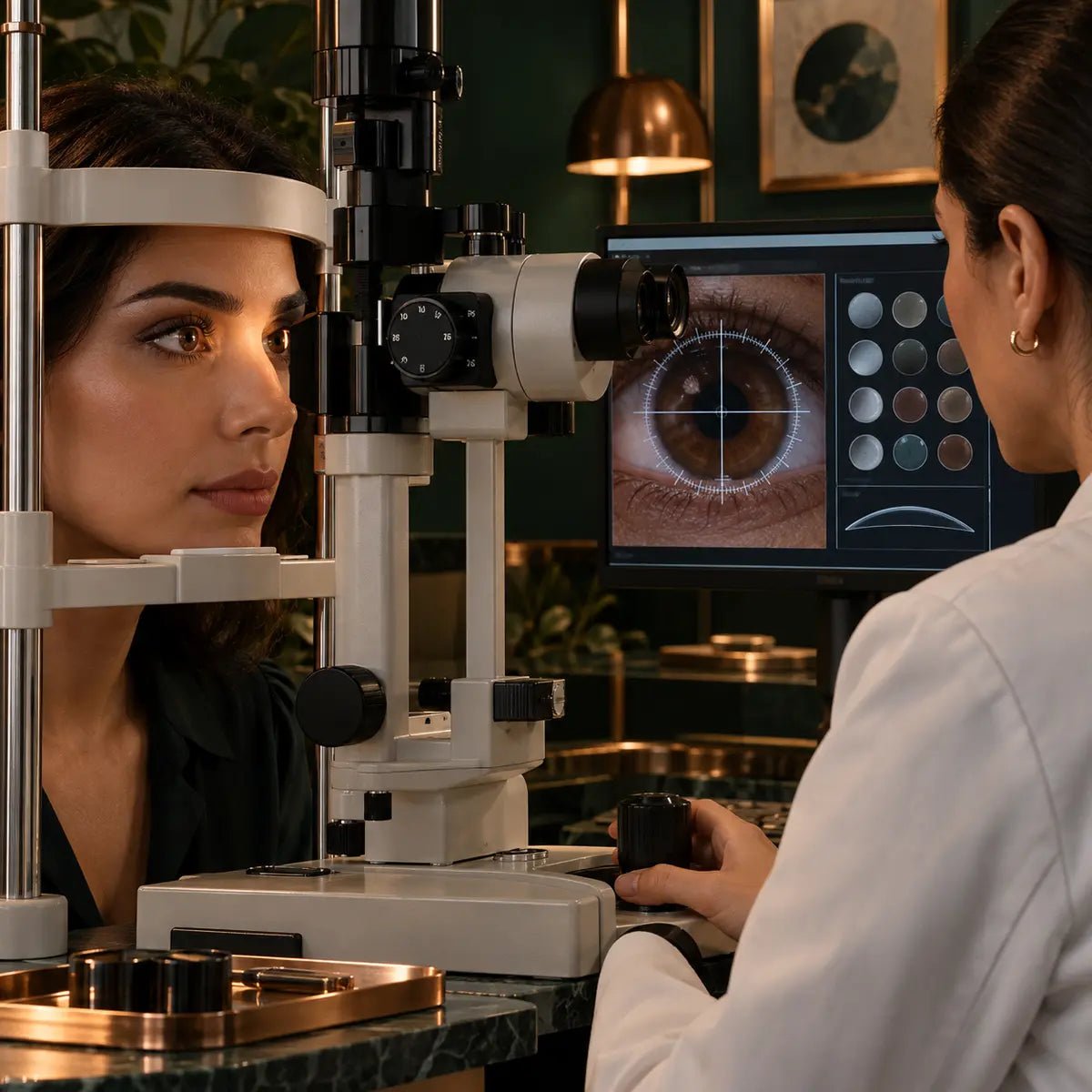
Toric colored contacts for dark eyes have two filters: the exact lens must meet your astigmatism prescription and fit requirements, and its print must create the visual effect you want on a dark iris. Ask your eye care professional which specific toric models are suitable before comparing shades. Check every available sphere, cylinder, and axis combination for each eye. Then judge opacity, center transition, and outer edge using photos of the exact version on similarly dark eyes. A color cannot compensate for unstable vision or a missing prescription option.
In this guide

Build a clinical shortlist before a color shortlist
Begin with the current contact lens prescription and the exact model your eye care professional has fitted or approved. Toric contacts are intended to correct astigmatism, and the lens must provide the right optical values and behave appropriately on your eye. The FDA advises using a current valid prescription, verifying the exact brand and lens name, and avoiding an unapproved substitution. A similarly colored toric lens from another brand is a different product.
Once your professional has identified appropriate exact lens choices, compare their printed designs. Dark eyes may make a sheer print look subtle and a denser layered print more visible. This second stage is about preference, not prescription. A product can pass the fitting stage and still fail to deliver the color change you want. It can also look perfect in a photo while failing the first stage. Both outcomes are useful information.
Do not reverse the sequence by picking the strongest campaign image and trying to force your prescription into that lens's menus. A colored toric range may offer only selected combinations of sphere, cylinder, axis, shade, and replacement format. An unavailable value is a reason to ask the prescriber about options, not to round or omit a field.
Bring specific questions to the fitting appointment
The most useful appointment begins with a concrete visual goal: “I want a subtle brown definition on very dark eyes,” or “I would like a noticeable gray effect while retaining stable vision.” Bring the full name of any lens that interests you. Ask whether that exact toric model exists in your prescribed values and whether it can be evaluated for fit. A clinician may have to consider other suitable designs or explain that a particular aesthetic option is not available.
| Question | Why it matters | What a product page cannot answer |
|---|---|---|
| Does this exact model cover both eyes' required values? | A shade may exist without the needed combination | Whether a missing value can be changed safely |
| How does it center and move? | The lens must behave appropriately on the eye | Your individual on-eye fit |
| Does toric orientation remain stable? | Axis performance depends on consistent orientation | Whether a static photo predicts your vision |
| Which wearing and care plan applies? | Schedules differ by exact model and wearer | Your personal safe wearing time |
| What if the color version is unavailable? | An alternative model may need assessment | Approval for substitution |
Record the answers alongside the exact lens name. If the fitted model is a clear contact and the colored version has different specifications, ask explicitly whether the colored product is a separate fitting decision. Do not assume a shared family name transfers approval. If your prescription changes later, revisit the product match before reordering from an old cart.
Ask also what a follow-up visit should confirm after the lens has been worn according to professional instructions. A lens can appear acceptable immediately after insertion but behave differently after settling or during blinking. Record any persistent blur, uneven print position, unusual sensation, or difficulty with the care routine and bring that information back. Avoid extending wear simply to finish a trial. The goal is an informed decision about the exact lens on your own eyes, including both visual clarity and how the eye responds, before a color preference becomes a recurring order.
Product limits: a color swatch is not a complete prescription range
A toric order can require sphere or power (SPH/PWR), cylinder (CYL), and axis (AXIS). OD is the right eye; OS is the left. The two eyes may need different values. A website might display a color and a power range in a family overview while the exact combination is unavailable for a selected version. Open the actual variant selectors for each eye and compare them with your written prescription.
If a selector is missing, do not assume the value has been built into the lens or that the seller will choose one. Ask how that specific product is ordered and verified. If your cylinder or axis is not offered, leave the order incomplete. A professional may evaluate another lens, adjust a prescription after an examination, or recommend a different approach. The seller's nearest dropdown value is not a clinical answer.
Overall lens diameter and base curve can be part of the prescription details, but matching those two numbers across brands does not establish equivalence. Lens materials, designs, edges, and on-eye behavior can differ. Graphic diameter, if listed, describes the printed color area and is not a fit parameter. Keep these meanings separate when comparing products.
Package quantity is another limit. A one-lens box covers one lens, not automatically both eyes. A price comparison between a one-lens toric box and a multi-lens spherical box is incomplete until you account for the prescribed eyes, the exact piece count, and the replacement schedule. Verify the live listing; quantities and available variants can change.
Why rotation matters to the wearer
A toric lens uses an optical orientation for its cylinder correction. Stabilization features are intended to support that orientation on the eye. An eye care professional can assess how the lens settles, its movement, and whether vision remains stable after blinking. A shopper cannot infer these properties from base curve numbers or a promotional photograph.
If vision repeatedly clears after a blink and blurs again, or if one eye has variable ghosting, describe that pattern during a fitting review. Persistent visual instability may have several possible explanations, so do not diagnose it from an article. Do not change the axis, increase sphere, or manually reposition the lens as a substitute for professional assessment.
The printed color can make decentration or changing position more noticeable. If the ring appears uneven and vision or comfort is affected, remove the lens and ask for a fit check. A lens that looks centered in one frame is not proven stable. A short period of initial comfort does not establish safe use.
Avoid driving or continuing visually demanding tasks through unstable vision. Follow the exact wearing plan given for you. The CDC advises removing lenses and contacting an eye care provider when discomfort occurs.
What may show over very dark eyes
Brown-on-brown designs can deepen or sharpen the iris edge without substantially lightening it. A layered gray can add visible cool contrast, yet may appear more muted in ordinary indoor light than under flash. Olive or hazel may add warmth or a different undertone rather than a complete transformation. The exact print and the starting iris matter more than the color family.
Look at the pupil transition, middle color field, and outer edge separately. A soft inner gradient can blend with the natural dark iris; an abrupt boundary may create a bolder appearance. The middle field determines much of the new shade, while a defined outer ring affects apparent size and definition. A toric version may not share the identical print of a similarly named spherical version, so verify the exact one shown.
| Visual goal | Evidence to seek | Possible limitation |
|---|---|---|
| Subtle definition | Dark-eye before and after, normal-distance portrait | Little color change indoors |
| Clear cool shift | Exact gray toric version in daylight and indoor light | Camera may exaggerate brightness |
| Warm, lighter appearance | Layered hazel or olive print on a similar iris | Starting brown may remain visible at the center |
| Apparent enlargement | Outer-ring comparison at normal distance | Graphic width alone is not a fit or effect guarantee |
Choose the result you want before narrowing by shade. If you need a quiet everyday look, inspect the normal-distance indoor image. If you want a stronger photographic look, check whether the effect remains appealing outside direct studio light. Do not let an aesthetic preference override the approved lens shortlist.
Create a useful photo evidence set
Seek the same wearer's bare-eye reference, the exact toric lens name and shade, an unfiltered daylight frame, an ordinary indoor view, and a normal-distance portrait. A macro shot is valuable for printed detail but can make small dots and edge contrasts appear larger than they do in daily life. Ring light, flash, white balance, makeup, and retouching can change perceived color.
When two images disagree, identify the changed variable before judging the lens. A darker starting iris, different replacement version, cool camera setting, or bright light may explain the difference. A photo set with fewer images but clear conditions is more useful than a large collection of unlabeled selfies.
Keep a small note for each suitable candidate: “Exact toric model verified; deep brown starting iris; soft edge; gray visible in daylight; indoor image missing.” The missing information tells you what to request next. A caption that merely says “comfortable gray torics” offers no evidence about your own fit or prescription.
Compare exact versions, not family names
Read the current product listing for brand, full model, toric designation, shade, material when provided, replacement schedule, available parameter combinations, overall diameter, base curve, graphic diameter if listed, and package count. Do not copy any figure from a spherical sibling, another color, or an older screenshot. If the seller cannot clarify a required field, remove the candidate from the ready-to-order list until the exact information is available.
Some shoppers compare a brown toric and a gray toric within one family. Shared measurements may make a visual comparison easier, but they do not guarantee the same print or on-eye outcome. Others compare a gray toric with a choco toric from another brand. Those are different lenses requiring separate suitability assessment. A new color is not always merely a new shade selection.
Make a two-column decision sheet. The clinical column records prescribed model, SPH/CYL/AXIS for each eye, fitting status, and care plan. The style column records starting iris, print zones, opacity, and lighting evidence. Do not mark a lens “ready” when either column has a blank that matters to the decision.
Order and inspect the exact toric lens
- Place the current written contact lens prescription beside the exact product page.
- Confirm the brand, model, toric version, shade, and replacement schedule.
- Enter OD and OS separately, checking the sign and every SPH, CYL, and AXIS value.
- Confirm the full required combination exists; do not round or omit a value.
- Check whether the package contains one lens, a pair, or more, and order the correct quantity for both eyes.
- Review the cart and order confirmation after any change to quantity or destination.
- Inspect the sealed boxes for product identity, eye-specific values, expiry, lot information, and package integrity before wear.
If the shipped lens differs from the prescribed order or the seal is compromised, contact the seller and your eye care professional as appropriate before using it. Keep the order record and packaging. Do not test a mismatched lens to see whether vision seems close enough.
For current options, explore KPOP2's toric colored contacts and use the prescription verification and wear and care pages. These pages support the purchase process; they do not replace a fitting for the exact lens.
Three common situations
Your favorite shade does not offer the required axis
Keep the shade as a style reference, but do not choose a nearby axis or omit it. Ask your eye care professional whether another appropriate toric model provides a similar visual effect. The missing combination is a limit of that product range, not a value you can approximate yourself.
The product family has a spherical photo but no toric example
Do not assume the toric print is identical. Ask for imagery of the exact toric version, and prioritize a photo on a dark starting iris under ordinary lighting. Until then, the family image can communicate a rough aesthetic direction but cannot support a precise expectation.
Vision changes after blinking
Record when the fluctuation occurs and whether it affects one or both eyes. Stop if vision is unsafe or discomfort develops. Arrange a fit assessment rather than changing power or axis in your next online order. Color satisfaction does not resolve visual instability.
Keep backup glasses available when you need corrected vision and may have to remove the lenses. If an event, trip, or photo session is approaching, complete the fitting and ordering checks beforehand. A deadline should not turn an unverified variant into an acceptable substitute or encourage wearing a symptomatic lens.
Sources: FDA buying guidance and CDC prevention guidance. Follow professional advice and the instructions for the exact prescribed product.