Lens reviews & comparisons
LensVery Vellica Brown vs Silhouette1 Gray: Color and Graphic Size
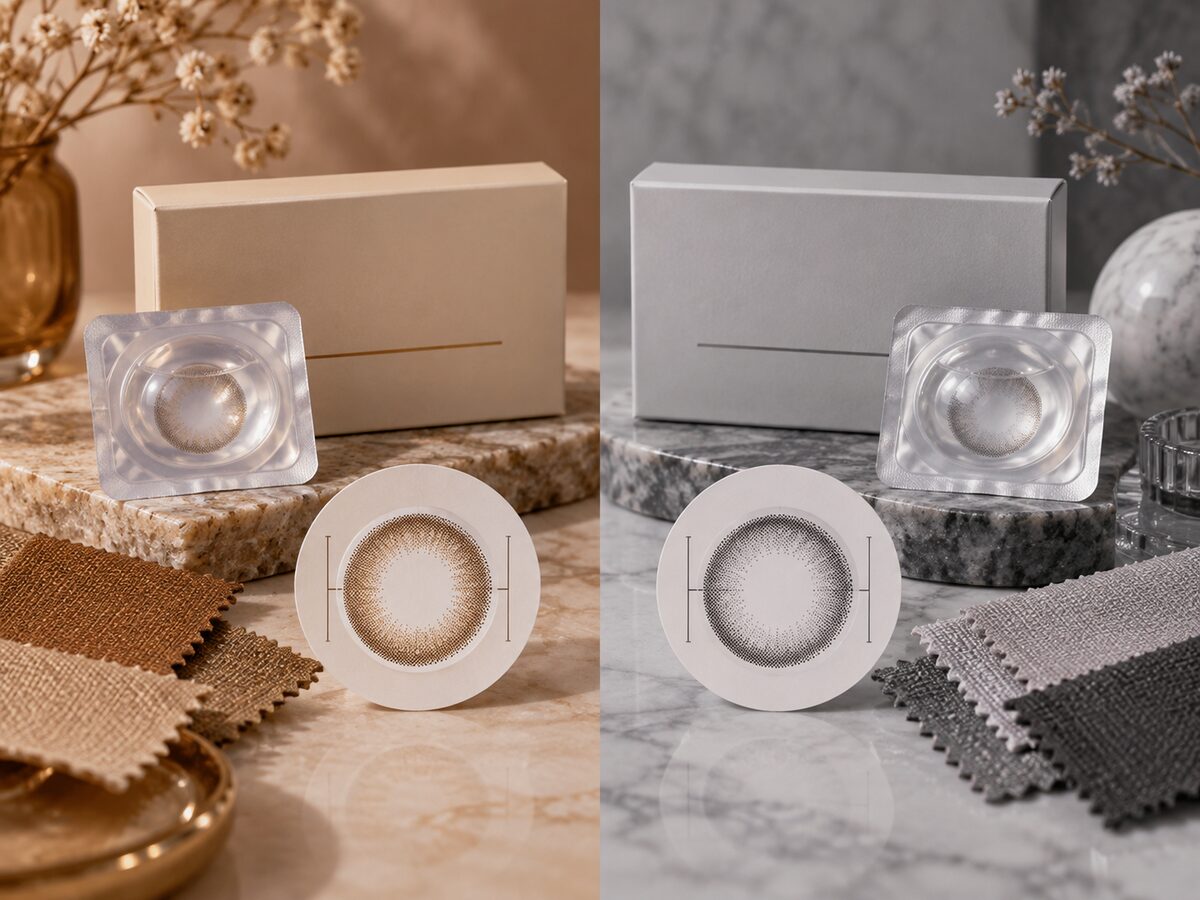
LensVery Vellica Brown (2p) and LensVery Silhouette1 Gray (2p) offer different visual directions: warm brown and cool gray. Their current KPOP2 listings also show different graphic diameters and materials, even though both are monthly two-lens boxes with the same listed base curve and overall diameter. A 0.3 mm difference in printed size does not by itself predict which will look larger or more natural on your eyes. Compare the print, natural iris, lighting, and full-face result, then confirm the exact fitted product and correct power for each eye before ordering.
In this guide
Begin with two different design goals
Vellica Brown and Silhouette1 Gray should first be compared as visual concepts. A warm brown lens may add depth, warmth, or a familiar-looking definition. A gray lens may add a cool shadow or a more noticeable color change. Those descriptions are only starting hypotheses. The actual pattern, its opacity, your natural iris, and the viewing light determine the finished look.
Write a one-sentence brief for each option. “I want a warm brown eye with a gentle outer edge” is specific enough to test against Vellica images. “I want a cool gray accent visible in portraits but not a heavy ring” gives Silhouette1 a clear job. Without a brief, the comparison can collapse into a vague decision about which product photo you like more.
Choose a viewing distance. A close-up may show every printed stroke, while a full-face portrait shows whether the lens changes the overall expression. If you are shopping for everyday wear, normal conversation distance should carry weight. If you are planning a makeup shoot, close detail may matter more. A lens can perform differently at those two scales.
Separate style from fit. The color that looks better in a photograph is not automatically the lens your eye-care professional has fitted for you. The two products differ in material and printed area, and their matching base curve and overall diameter do not establish interchangeability. Confirm the exact product before treating it as an order candidate.
Compare the current product records
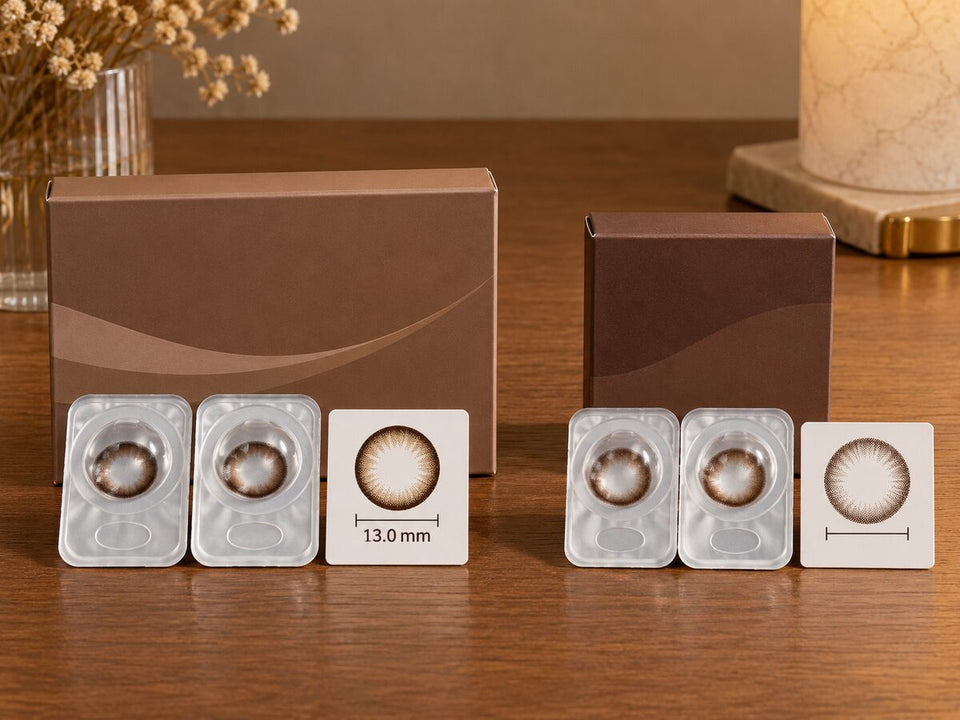
The current LensVery Vellica Brown (2p) page lists a 13.0 mm graphic diameter, 14.2 mm overall diameter, 8.6 mm base curve, silicone hydrogel material, 43% water content, and two lenses per box. It is described as a monthly brown contact lens with a general 0.00 to -8.00 power range.
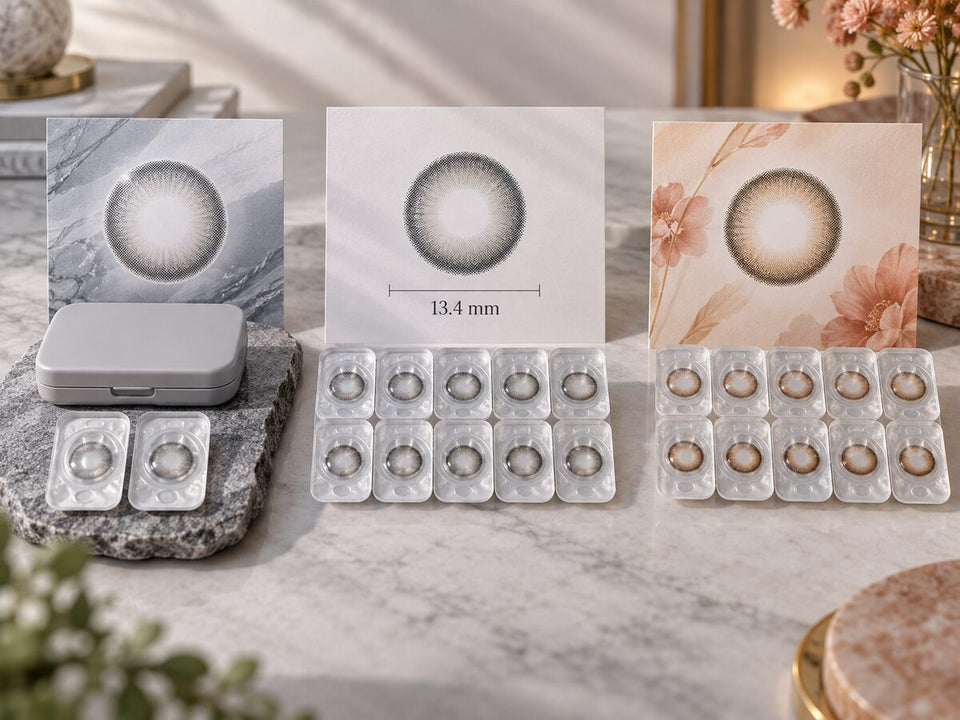
The current LensVery Silhouette1 Gray (2p) page lists a 13.3 mm graphic diameter, 14.2 mm overall diameter, 8.6 mm base curve, HEMA material, 38.5% water content, and two lenses per box. It is described as a monthly gray contact lens with a general 0.00 to -8.00 power range.
These values are useful for identifying the exact listings, not for declaring a universal winner in comfort or appearance. Material and water content cannot be reduced to “more is better” from a product table alone. The fit and wearing experience depend on the exact lens and the individual eye. Ask an eye-care professional about suitability rather than selecting based on one material field.
Availability can change. A listed power range does not prove that your exact prescribed option is in stock. Recheck the live variant and package before ordering. If you have astigmatism or another optical requirement, a standard spherical colored lens may not meet it. The color choice should stay within an appropriate contact lens prescription.
Interpret the 0.3 mm graphic difference
Graphic diameter is the size of the visible printed area, not the physical lens diameter. The current listings give 13.0 mm for Vellica Brown and 13.3 mm for Silhouette1 Gray. That is a 0.3 mm difference in the published print measurement. It may be one factor in how much iris is visually covered, but it cannot predict how large your own eyes will appear in a photograph.
Outer-edge darkness, pattern opacity, and your natural iris can matter as much as the printed measurement. A smaller graphic with a crisp dark ring may create stronger definition than a slightly larger graphic with a feathered perimeter. A gray pigment can produce more color contrast than brown even when the print is only modestly wider. Compare the actual artwork and wearer images rather than treating 13.3 as automatically bolder.
Both products list a 14.2 mm overall physical diameter. That matching number does not establish identical fit or comfort because the materials and designs differ. The base curve is also listed as 8.6 mm for both, but a fitting decision involves more than two headline measurements. The correct lens should be assessed by an eye-care professional for your eyes.
Use the graphic number as a controlled comparison field. Note it in a table beside color, center transition, outer edge, and wearer photo context. If a product image does not show the print clearly, ask for better evidence rather than inferring the visual outcome from 0.3 mm. A numerical difference is precise; the personal visual effect remains uncertain.
Do not confuse print coverage with prescription selection. A lens that appears to enlarge the iris is not automatically available in the power you need, and a graphic diameter does not correct vision. The order must match the exact product and contact lens prescription for each eye.
Compare brown and gray on your natural iris
Vellica Brown may add warmth to a dark brown eye or create a deeper brown effect on a lighter eye. Silhouette1 Gray may introduce a cool note, but on very dark eyes a sheer gray can look darker than a studio image suggests. On light eyes, either print may show a more obvious inner transition. These are possible interactions, not promises for either exact lens.
Describe your starting iris in indirect daylight. Note its center, mid-zone, and outer ring. A warm center may remain visible under a gray print and create a two-tone result. A deep brown center may blend more easily with a brown print. If the center opening is large, the natural iris can have a strong role in both products.
Look at hue and depth separately. A brown lens can be more noticeable than a gray lens if it has a stronger dark ring or a brighter warm field. A gray lens can feel soft if its print is muted and its edge is broken. Color family alone cannot rank the final impact. Decide whether the goal is warmth, cool contrast, more definition, or a larger-looking printed iris.
Lighting can shift the impression. Warm indoor light may enrich brown and mute gray. Cool daylight may reveal gray or blue undertones. A ring light can brighten both and flatten their texture. Ask which conditions matter for your intended use. A single model image should not decide a daily-wear choice.
Keep any product comparison anchored to the exact wearer context. A photograph of Vellica on a deep brown eye and Silhouette1 on a light hazel eye is not a fair shade test. Note the differences and make only the conclusions the evidence supports. You can still have a style preference while acknowledging uncertainty.
Read wearer photographs fairly
Use a flat lens photograph to understand the print, an eye close-up to inspect the center and outer edge, and a full-face portrait to judge normal-distance impact. Each view answers a different question. A close-up can exaggerate fine pattern detail, while a portrait may hide an abrupt center boundary.
Look for wearers with a natural iris close to yours. Brown eyes span light amber to near-black; gray prints can behave differently on each. Check whether the image is filtered or shot in bright studio light. Heavy editing can change saturation, skin tone, and the apparent sharpness of the iris. Treat it as inspiration, then seek ordinary-light evidence for a buying decision.
If you already have a properly fitted lens, photograph it in consistent daylight and indoor light with the same camera and distance. Include a close-up and full portrait. The record helps you understand how your own iris interacts with that lens. It does not prove that a different material or design will fit you the same way.
Build a look around the lens, not only the lens color
A color comparison becomes more useful when you imagine the lens with the rest of your styling. Vellica Brown is the warmer starting point. With soft taupe, beige, peach, or warm brown makeup, it can support a cohesive, low-contrast look. Silhouette1 Gray creates a cooler direction. It can sit beside charcoal liner, muted rose, cool brown, or silver-toned styling without requiring an especially dramatic eye look. These are styling suggestions, not promises about how either lens will look on every iris.
Start with the occasion. For an everyday portrait, ask whether you want the eye color to blend with your complexion and hair or become a visible feature. A warm brown lens may feel more familiar if your usual makeup is neutral and warm. A gray lens may suit the brief if you want a cooler, more noticeable color shift. Neither choice has a fixed level of boldness: iris color, lighting, and your overall makeup change the final impression.
For a soft daytime look
Use a light hand with eyeliner and keep the visible makeup around the eye simple. Photograph each candidate, if already appropriately fitted, in indirect daylight rather than relying on a strongly edited product image. In the close-up, inspect the outer edge and the way the color transitions toward the pupil. In a full-face photo, inspect whether the eye still feels balanced with your brows, lips, and hair. The full portrait often reveals more about everyday wearability than an isolated lens crop.
For evening and event photography
Artificial light can shift the appearance of gray and brown in different ways. A warm indoor bulb may make brown appear deeper and may reduce the cool impression of gray. Flash or bright ring lighting may increase contrast and bring out printed details. If the lenses are for a specific event, use a test image under similar light and at the distance at which photos will actually be taken. Keep the same camera exposure and avoid changing filters between comparisons.
For minimal makeup
When the rest of the face is understated, eye color may be more apparent. Brown can serve as a gentle tonal change, while gray can provide a cooler accent. Yet the lens pattern and your own iris can override a simple warm-versus-cool expectation. Evaluate the visible result rather than choosing solely from a category label such as “natural” or “bold.”
If you compare social-media examples, look for unedited images with the wearer's original eye color identified. An image shot on light eyes may be a poor prediction for dark eyes, and vice versa. A heavily cropped photograph can also hide how large a 13.0 or 13.3 mm graphic feels in a full-face view. Treat creator images as inspiration; use the verified listing for specifications.
What the two-lens box count means for planning
Both current KPOP2 listings identify these products as 2p monthly lenses. “2p” means two physical lenses in the box. It does not mean two pairs, two months of use for both eyes, or two different prescriptions automatically. Confirm the selectable power for each lens and the quantity needed for your own eyes before checkout. If the left and right eye need different powers, review the store's available selection and cart contents carefully so that the pair you receive matches your prescription.
A monthly replacement schedule refers to the labeled replacement period for an opened lens, subject to its instructions and your eye-care professional's direction. It is not permission to wear a lens continuously for a month. Remove and care for reusable lenses as instructed. Never extend a replacement schedule to make a box last longer. The time since opening, the remaining quantity, and your actual wear plan matter more than an assumption based on the word “monthly.”
For occasional styling, calculate the number of usable wearing days you expect within a monthly cycle. A reusable lens still requires the recommended cleaning, storage, and replacement routine even if you wear it only a few times. If you want a fresh lens for a later event, check the product's replacement timing and plan the purchase around the event rather than assuming an earlier opened lens will still be suitable.
The two products share a 14.2 mm overall diameter and an 8.6 mm listed base curve, but those numbers alone do not establish identical fit. Material, edge, thickness, design, and the way a lens behaves on the eye also matter. The listings identify Vellica Brown as silicone hydrogel with 43% water and Silhouette1 Gray as HEMA with 38.5% water. Those descriptions are product facts to discuss during fitting, not a ranking of comfort, breathability, or suitability for a specific person. A licensed eye-care professional should determine whether either lens is appropriate for your eyes.
Fit and lens care belong in the comparison
Colored contact lenses are contact lenses, even when selected mainly for appearance. Before ordering, use a current contact lens prescription and ask your eye-care professional to confirm the exact lens choice and fitting requirements. The FDA explains that a contact lens prescription contains information beyond a general eyeglass power. It may identify the lens brand or material and measurements needed for a suitable fit. A visually appealing color does not replace that process.
Start a new reusable pair with clean, dry hands and follow the manufacturer's directions and your eye-care professional's advice. Use fresh recommended contact lens solution for cleaning and storage, and do not top off old solution. Keep the case clean and replace it as directed. Water is not a substitute for solution; avoid exposing lenses to tap water, shower water, or swimming water. These practices are explained in the CDC contact lens guidance and related FDA lens-care information.
If a lens feels painful, produces unusual redness, causes discharge, or changes your vision, remove it and contact an eye-care professional promptly. Do not continue wearing it to finish a photo session or to “get used to” discomfort. A successful fit is more important than the intended color effect. Also follow the prescribed wear schedule; do not sleep in lenses unless your eye-care professional specifically prescribes that use for the exact product.
Keep the right and left lenses organized, especially if powers differ. Before each use, inspect for tears, deposits, or other visible damage. Do not use a damaged lens. Check the box and individual blister labels against your order when they arrive: product name, color, power, and expiration information should all make sense before opening. If anything differs, resolve it before use.
Why the material figures need context
Silicone hydrogel and HEMA describe different lens materials. Water content is a listed specification, but a larger percentage does not automatically mean a lens will be more comfortable or healthier for a given wearer. Surface treatments, lens geometry, tear film, environment, wear time, and fit all affect the experience. Use the material and water-content difference as a reason to confirm suitability with your fitter, not as a shortcut to a medical conclusion.
The same principle applies to graphic size. The 13.3 mm graphic on Silhouette1 Gray is 0.3 mm larger than the 13.0 mm graphic on Vellica Brown. This is a printed-design measurement. It is not the diameter of the whole lens and cannot predict fit by itself. Even when two lenses share a base curve and overall diameter, the fit may differ. The professional fitting process remains necessary if you change from one design to the other.
A practical way to choose between them
Use a two-stage decision. First, determine whether the exact lens is appropriate for your eyes and prescription. Then compare the aesthetic outcome. Reversing those steps may encourage a choice based on a photograph before you know whether the lens is suitable. If either product is unavailable in the power or specification required by your prescription, choose another professionally appropriate option rather than compromising the prescription for a preferred color.
- Confirm the lens: Match the product name, power options, replacement schedule, and material to your prescription and professional advice.
- Compare the mood: Choose warm brown for a warmer direction or gray for a cooler direction, while recognizing that your iris changes the result.
- Compare scale: Note the listed 13.0 mm versus 13.3 mm graphic. Evaluate it in a full-face photo when possible, not only a close-up.
- Compare conditions: Use the same daylight, indoor light, camera distance, and makeup for each photo.
- Check the box: Confirm the two-lens count, each eye's power, and the timing of your intended wear.
If you already like a fitted warm brown lens and want a similarly warm wardrobe accent, Vellica Brown is the more relevant visual reference. If your goal is a cool gray change and a slightly larger listed graphic, Silhouette1 Gray is the more relevant reference. These are shopping and styling comparisons, not a recommendation to substitute one lens for another without professional confirmation.
When choosing for photographs, create a small comparison sheet. Use one daylight close-up, one indoor close-up, and one full-face view for each lens you have been fitted to wear. Record the date, lighting, original iris color, camera, and makeup. Rate color visibility, edge definition, and how balanced the eye looks in a portrait. A repeatable record helps you interpret your own results more reliably than a single promotional image.
Frequently asked questions
Is the 13.3 mm graphic much larger than 13.0 mm?
The listed difference is 0.3 mm in graphic diameter. It can contribute to a different visual impression, but it does not isolate the effect of the print pattern, outer ring, iris color, or lighting. Compare photographs at the same scale and distance. Do not interpret the graphic figure as the whole-lens diameter or as proof of an identical fit.
Do both lenses have the same overall diameter and base curve?
The current KPOP2 product listings show 14.2 mm overall diameter and 8.6 mm base curve for both products. These are useful facts to check against a contact lens prescription. They do not mean the lenses are interchangeable. The materials differ, and a professional should assess the specific lens on your eyes.
Will gray look lighter than brown on dark eyes?
Gray may create a cooler color direction and brown a warmer one, but the visible result depends on the print, your underlying iris, and light. “Lighter” is not a reliable prediction from the color name alone. Look for realistic examples on an iris similar to yours and review unedited images in more than one lighting condition.
Can I order either lens using my glasses prescription?
Do not assume eyeglass and contact lens prescriptions are interchangeable. Contact lenses require fitting and a contact lens prescription for the appropriate lens. Follow your eye-care professional's direction. The FDA buying guide explains why purchasing should be based on a valid contact lens prescription.
Does “monthly” mean I can sleep in the lenses?
No. Monthly describes the listed replacement schedule, not overnight wear permission. Follow the exact product instructions and your eye-care professional's recommended wearing schedule. Remove, clean, and store reusable lenses as directed. Never extend wear because the lenses are labeled monthly.
Which one is better for a natural-looking portrait?
Natural-looking is subjective. On some people, a warm brown lens will look more integrated with their existing color palette; on others, a cool gray lens with a carefully chosen makeup look can feel balanced. Compare full-face images as well as close-ups. The lens that reads as “natural” in one photo may read differently under evening light.
Can I switch between the two for different outfits?
Only if both exact products are professionally suitable for you, correctly prescribed, within their replacement periods, and cared for properly. The shared overall diameter and base curve do not independently authorize switching. If you plan to rotate reusable lenses, label your cases and track each pair's opening date so you do not confuse their replacement schedules.
What should I check when my box arrives?
Verify the product, color, quantity, power for each eye, unopened packaging, and expiration information before use. Keep the order record and packaging until you have confirmed everything. If the box is different from what you expected, contact the seller before opening it or placing a lens on your eye.
Final comparison
Vellica Brown and Silhouette1 Gray answer different style briefs. Vellica Brown offers a warm brown direction with a 13.0 mm listed graphic, while Silhouette1 Gray offers a cool gray direction with a 13.3 mm listed graphic. Both current listings show a two-lens monthly box, 14.2 mm overall diameter, and 8.6 mm base curve; their listed materials and water content differ. Begin with prescription and fit, then choose the color effect that works with your iris, lighting, and wardrobe. Recheck the live product pages before purchasing, because assortment and selectable specifications can change.
Compare the current LensVery Vellica Brown (2p) and LensVery Silhouette1 Gray (2p) listings for the exact selections currently available. For general safety information, see the FDA decorative contact lens guidance and CDC contact lens guidance.