Care & authenticity
Yurial Royal vs Serum vs Water Brown: 12-Month Shade Guide
Yurial Royal Brown, Serum Brown, and Water Brown share the same checked 12-month specifications: a 12.8 mm graphic, 14.0 mm overall diameter, 8.6 mm base curve, HEMA material, 38% water, and one lens per box. Their names identify different color designs, not different hydration or treatment benefits. To choose a shade, compare the exact 12-month versions in relevant images, then confirm your prescription and the correct two-eye quantity.
In this guide
First decide what “brown” should do for your look
Royal Brown, Serum Brown, and Water Brown are three different names inside the Yurial family. A name can suggest a mood, but it does not measure brightness, opacity, or comfort. Before choosing from the images, define the effect you want. Are you seeking a slight shift that leaves your natural iris prominent, a clear warm-brown impression in portraits, or more visible definition around the outer edge? The answer turns a broad shade search into a specific comparison.
Write that goal in a sentence and keep it beside the three product tabs. If you want a subtle everyday result, look at normal-distance portraits in ordinary light. If you want an eye-color accent for photography, examine whether the printed brown remains visible at the camera distance you plan to use. If you want an outer ring, zoom into the edge, then zoom back out to see whether it still matters in a full face.
Do not infer from “Water” that the Water Brown lens contains more water or provides hydration. The current KPOP2 records show 38% water for all three products. “Serum” similarly identifies a shade, not a treatment. A shopping decision based on those names would confuse branding with a measured lens property.
What the matching specifications do and do not tell you
The three current listings show a 12.8 mm graphic diameter, 14.0 mm overall diameter, 8.6 mm base curve, HEMA material, 38% water content, 12-month replacement schedule, and one lens per box. Those shared values help you avoid comparing a daily Water Brown to a regular 12-month product by mistake. They also make clear that the names are not shorthand for different water percentages or package quantities.
However, graphic diameter is only the listed extent of the printed design. Two designs can share 12.8 mm while using different color placement, border darkness, and transitions toward the pupil. The 14.0 mm overall diameter is the physical lens diameter, a different measurement. Neither number by itself predicts how “large” an eye will look in a photograph, and neither determines whether a lens fits you.
Base curve is another descriptive measurement, not a universal fit code. Matching 8.6 mm values do not establish that all three lenses will sit and move the same way on your eyes. A professional contact lens fitting considers the exact product and its behavior on the eye. If your prescription is for one shade or model, confirm any change with your eye-care professional instead of relying on a shared number.
The listed 0.00 to -10.00 power range gives endpoints for the product family, not a guarantee that every intermediate value is currently selectable. Check the exact power menu for each shade and the separate prescription for each eye. A different shade may be visually appealing, but it cannot solve a missing prescription option by using an approximate power.
Build a fair three-shade photo comparison
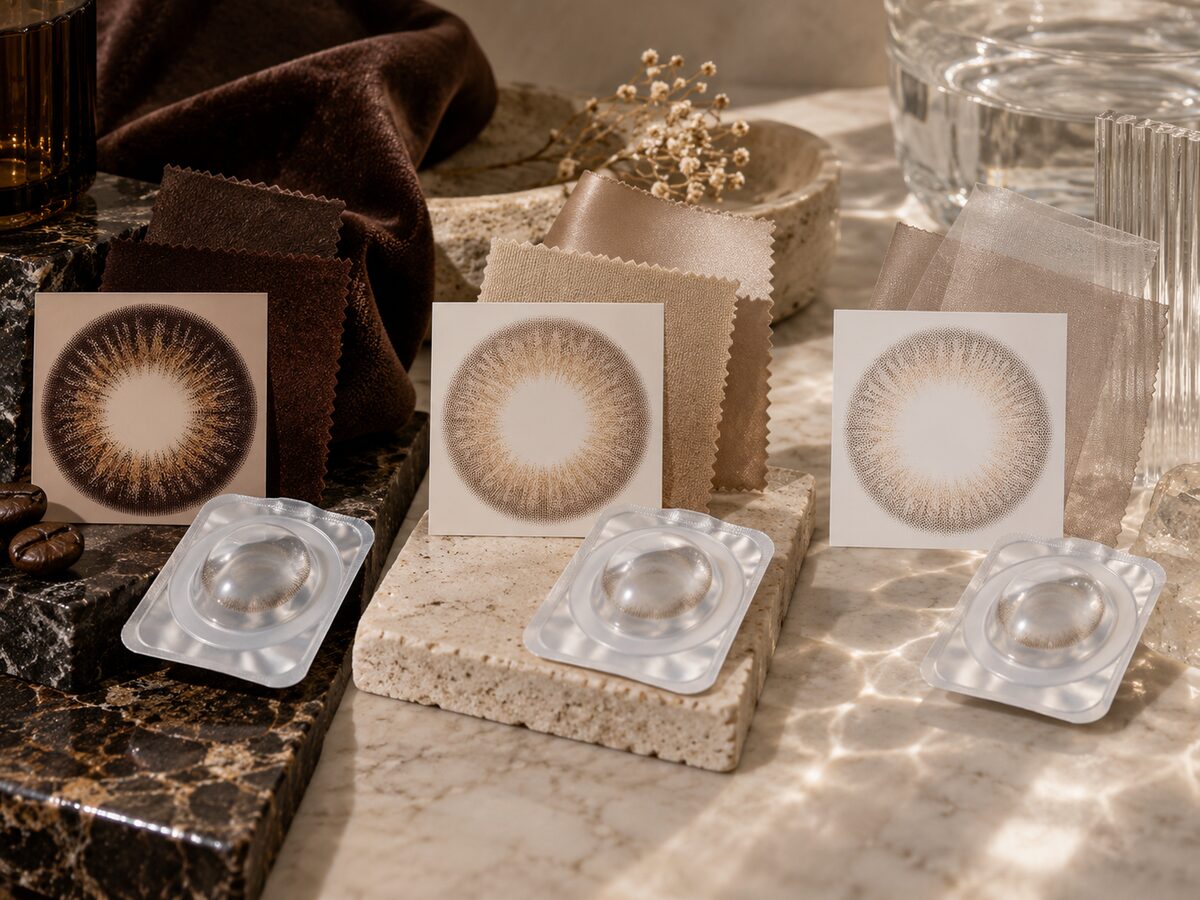
Start with the exact 12-month product pages. Keep a labeled image for Royal, Serum, and Water Brown. If a search result says only “Yurial Water Brown,” check its replacement schedule and box contents before including it. A daily or Max product may have a similar name but a different design and specification. Mixing them makes any shade conclusion unreliable.
Gather one close-up and one full-face image for each exact version when possible. The close-up shows the print; the portrait shows its effect at a more realistic viewing distance. Note the wearer's original iris color, since the lens overlays a different background on light and dark eyes. A dark iris can change the apparent brightness and undertone of a printed brown. Do not treat a photograph on one starting iris as a promise for another.
Control the camera conditions as much as the available images allow. Daylight and warm indoor light can emphasize different tones. Ring lights can create bright reflections, while filters can alter brown toward gold, red, or gray. A full-face portrait captured with a phone's automatic exposure is not directly comparable to a studio macro image. When the conditions differ, write down the mismatch rather than announcing a winner.
Use a simple observation sheet
- Outer edge: Does it look crisp, soft, dark, or hard to judge in this image?
- Middle color: Is the brown visually warm, neutral, or mixed with another apparent tone under this light?
- Center transition: How much of the original iris appears visible near the pupil?
- Portrait effect: Is the design visible at normal distance, or mainly in a close-up?
- Evidence gap: What image or lighting condition would you need to judge it better?
These are observations about available images, not lab measures. You may find that one shade has better photographic evidence than the others. That is a reason for more caution, not proof that the best-photographed product is the best choice. If you already own an appropriately fitted pair, take your own photos under consistent conditions and save them with the exact product label for future comparison.
Style the shades without forcing a fixed ranking
For a restrained look, try evaluating the lens with the makeup you actually wear most days. Brown lenses can look very different beside a bare eye, a thin brown liner, or a strong dark wing. A heavily lined promotional photo may make the lens boundary appear softer in context than it would with minimal makeup. If natural-looking wear is your priority, compare full-face examples with little editing and familiar makeup.
For an event or portrait, pay attention to the color harmony with hair, brows, and clothing. Warm blush, caramel, chocolate, and neutral taupe palettes may each support a different brown impression. These are ideas for styling photographs, not rules about who can wear a shade. The same design may feel quiet in a high-contrast makeup look and prominent in a minimalist one.
Do not label Royal, Serum, or Water Brown as universally lightest, darkest, or most natural from their names. If you want such a ranking for your own decision, define the conditions first: your iris, light, makeup, and camera distance. Then compare images gathered under those conditions. If the evidence is too uneven, say the ranking is uncertain and choose only after you have the information you need.
One lens per box changes the order math
Each current KPOP2 listing says one lens per box. For both eyes, you generally need two appropriate single-lens units, selected with the correct prescribed power for each eye. If the powers are the same, that means two boxes of the same selection. If they differ, it means a correct box for the right eye and a correct box for the left eye. Quantity two at one power does not create a mixed-power pair.
Check the cart as a set of individual lenses rather than assuming one product line means one pair. The same logic applies if you buy two approved shades: each shade needs a complete two-eye set if you intend to wear it in both eyes. Compare package prices using the number of physical lenses, and account for the approved care supplies that reusable lenses require. Prices, promotions, and availability can change, so rely on the live checkout for current totals.
If you are ordering for the first time, verify the exact product and prescription before focusing on bulk savings. Buying more boxes of a visually appealing shade does not make an unconfirmed lens appropriate. At delivery, inspect the sealed packaging against the order and prescription: product, shade, power, quantity, and expiration date. Resolve any mismatch before opening.
What a 12-month replacement label requires
A 12-month replacement period is not continuous-wear permission. It does not mean you can sleep in the lenses, ignore the cleaning routine, or use them after the indicated replacement point. Follow the instructions for the exact product and the schedule given by your eye-care professional. If you rotate between multiple pairs, track the opening date and replacement date for each pair separately.
Reusable colored lenses require proper handling and storage. Wash and dry your hands before touching them. Use fresh solution recommended for your lenses and care system; do not top off a case of old solution or substitute water. Clean the case and replace it as directed. Keep each lens assigned to the correct eye if your powers differ. The CDC contact lens guidance and FDA care guidance explain these fundamentals.
Inspect the lens before insertion. Do not wear a torn or visibly damaged lens. If you experience pain, unusual redness, discharge, sensitivity to light, or a vision change, remove it and seek advice from an eye-care professional promptly. Avoid swimming or showering while wearing lenses. An appealing shade or an upcoming event is not a reason to ignore an eye-health warning sign.
Do not derive a comfort promise from 38% water content, HEMA material, or the shade name. Comfort depends on fit, the lens surface, your tear film, environment, care routine, and other individual factors. This article is a product and style comparison, not a test of oxygen transmission, moisture retention, or clinical outcomes.
Choose in a clear decision order
- Confirm the exact version: Royal, Serum, or Water Brown in the regular 12-month listing.
- Confirm professional suitability: Match the exact product and each eye's prescription with your eye-care professional's advice.
- Confirm the current option: Check both powers and the one-lens box quantity on the live product pages.
- Compare the design: Use labeled close-ups and portraits on a relevant starting iris, with lighting differences noted.
- Plan care and reorder: Record opening dates, instructions, shade, powers, and packaging details.
This sequence separates an aesthetic preference from prescription and care requirements. If a preferred shade is unavailable in the correct specification, pause the order rather than approximating. If all three are appropriate options, the final color preference can remain personal. You do not need an invented technical ranking to select a brown design you enjoy.
More questions to resolve before checkout
Does the word “Water” mean a higher water percentage?
No. The current KPOP2 records list 38% water content for Royal Brown, Serum Brown, and Water Brown. The shade name does not describe a different hydration treatment or prove better comfort. Use the specifications and professional fit advice rather than the name when evaluating lens suitability.
Can I mix different Yurial shades between my two eyes?
A deliberately mismatched color look is a styling choice, but each lens still needs to be appropriate for its assigned eye and prescription. If you are considering it, confirm the exact products with your eye-care professional and check the one-lens box count and each eye's power. Do not assume a photograph of mismatched colors predicts your own result.
Do the three designs need three different care routines?
The current listings share a 12-month reusable format, but always follow the instructions supplied with the exact lens and care system. Do not assume that a shared replacement label gives permission to use any solution or to skip cleaning. If you rotate shades, use clear labels and separate opening-date records so each pair is replaced on time.
Can I use a daily Water Brown photo to judge this product?
It may offer general color inspiration, but it is not reliable evidence for the regular 12-month design. Check the full product name, graphic size, replacement format, and package size before making a direct comparison. The different versions should be treated as separate products.
Related categories
For the next brown-lens comparison, browse Brown Contacts, Daily Contacts, 12 Months Contacts. Treat a collection as a discovery route, then verify the exact model, replacement schedule, package count, measurements and available prescription selections on the product page.
Questions and answers
Which of these three shades is the most natural?
There is no controlled comparison here that establishes a universal winner. Define whether you want a quieter border, a less visible color change, or a particular photographic effect, then compare the exact 12-month designs on similar starting eye colors and in similar light.
Does Water Brown have higher water content?
No. The checked regular 12-month records for Water Brown, Royal Brown, and Serum Brown all list 38% water. The shade name is not a hydration claim and does not predict individual comfort or a longer permitted wearing time.
Is Serum Brown a treatment lens?
Nothing in the verified product fields establishes a treatment benefit associated with “Serum.” Treat it as the color design’s name. If you have dryness, irritation, or a medical concern, discuss the lens choice with your eye care professional rather than selecting by that word.
Does one box complete both eyes?
No. These three checked 12-month listings contain one lens each. A two-eye supply requires two individual lenses, with the appropriate power selection for each eye. Read the cart’s options as well as its quantity before placing the order.
Can I replace the 12-month Water Brown with a daily version?
Do not assume that a shared shade name makes the versions interchangeable. Their dimensions, materials, and packaging may differ. Confirm the exact prescribed product, then use the separate version comparison to identify the right listing and order quantity.
Why might a shade look different from its product photograph?
The wearer’s original eye color, lighting, camera processing, and viewing distance can all affect the comparison. A catalog photograph is a reference for the depicted image, not a guarantee of your result. Seek relevant, clearly identified images before making a visual judgment.
Product records checked September 17, 2026. KPOP2 editorial guidance using KPOP2 product fields and the linked sources. Catalog images and design discussions are not controlled wear tests.