Care & authenticity
Colored Contacts With Long Nails: Safe Handling and Removal Planning
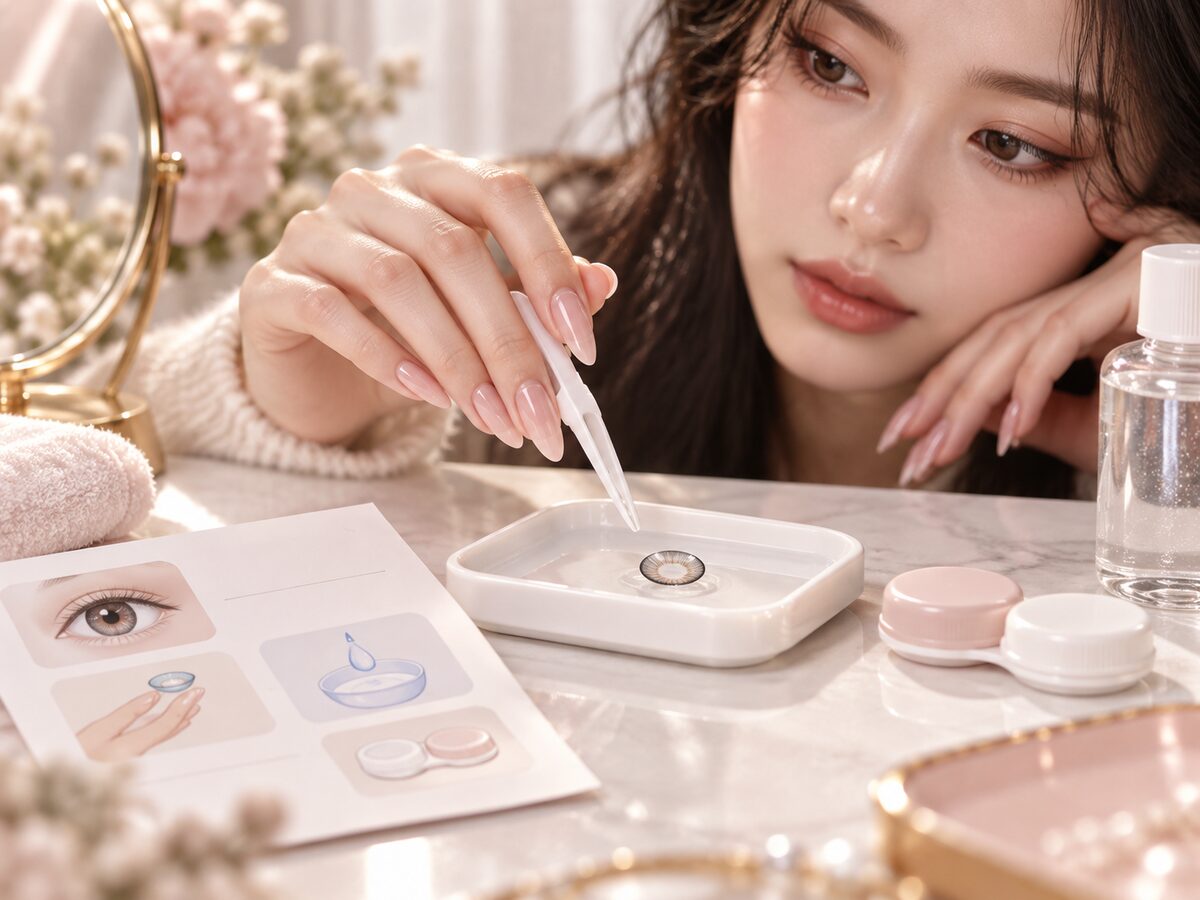
If long nails make lens insertion or removal difficult, have your eye care professional review your handling before the next independent wear. Use the method taught for your prescribed lenses and keep nail edges away from the eye. Do not compensate for an uncontrolled grip with improvised tools, repeated force or a plan to leave the lenses in longer.
In this guide
- Long nails and contacts: begin with a workable plan
- Prepare hands, supplies and a calm workspace
- Nail shape changes the movement, not the fitting rule
- Practice insertion and removal as one routine
- Coordinate nails, lenses and makeup without rushing
- When removal is difficult
- Do not buy a lens on a “nail-friendly” promise
- Questions to bring to your eye care professional
- Practical scenarios for planning
- Related categories
- Questions and answers
- Editorial source check

Long nails and contacts: begin with a workable plan
Long nails can change how you position your fingers, hold an eyelid and control a small soft lens. The question is not whether a manicure looks compatible in a photograph; it is whether you can insert and remove your prescribed lens without a nail edge approaching the eye or the lens in an uncontrolled way. If your usual technique changed after a manicure, arrange a handling review with your eye care professional before independent wear. Do not discover the difficulty at the end of a long event when you are tired and need to remove the lens.
Be specific when asking for help. Tell the practitioner which step has become unreliable: taking the lens from its package, placing it on the finger, holding lids open, positioning the lens or removing it. Ask them to demonstrate and then watch you repeat the movement with your current nail length and shape. A written tip that works for short nails may not describe a motion you can carry out safely. The professional can judge whether a different taught technique, a shorter nail, a different plan or glasses is appropriate.
Practice removal as well as insertion under supervision. Insertion that succeeds once does not prove you can remove the lens later, especially after a full day, makeup, fatigue or a different environment. Before leaving the appointment, ask whom to call if removal becomes difficult and what to do if a lens feels stuck or causes symptoms. The goal is a repeatable routine and a clear help pathway, not a one-time successful demonstration.
Prepare hands, supplies and a calm workspace
Follow the handwashing and drying method taught by your professional and the manufacturer’s instructions. The FDA advises washing hands before lens handling and following lens and care-product labels. Keep the work surface clear, lighting adequate and the correct lens and case or blister identified. Do not begin by opening several different lenses and then sorting them with long nails. Identify right and left and check the exact prescribed product first.
Move nail glue, remover, polish, filing dust, skincare oils and unrelated cosmetics away from the lens-handling area. This is a practical way to avoid confusing supplies and touching the lens after handling another product. If you touch a phone, door handle or cosmetic container, repeat the hand preparation appropriate to the lens before continuing. Do not use a lens as a way to brush a nail product off your finger, and do not let decorative accessories make contact with the eye.
Keep water and saliva out of the process. The FDA warns against exposing contacts to water and against using saliva to wet them. A difficult grip does not justify improvising with a sink rinse or wetting a fingertip with saliva. Prepare the exact products your lens’s care routine calls for before starting. If you lack a needed supply or cannot identify a bottle, wear glasses and resolve the question rather than creating a new step under pressure.
Place backup glasses within reach, especially if you need vision correction to see what you are doing. Glasses are also the reasonable alternative when the handling routine is not yet manageable. The FDA everyday care page recommends keeping a current pair available. Choosing glasses for one event is a practical decision, not a failure of style planning.
Nail shape changes the movement, not the fitting rule
A longer or pointed nail can alter the angle at which a fingertip approaches the eye. Decorative gems or textured art can create additional edges. These observations can guide what to demonstrate to the practitioner, but they do not create a universal maximum nail length or guarantee that a particular shape is safe. People’s hand control and fitted lenses vary. Ask the professional to watch your actual movements rather than relying on a generic internet claim that one manicure style is “contact-friendly.”
Keep nail tips and edges away from the eye and the lens according to the technique you are taught. Do not use a fingernail as a hook to catch a lens or pinch the lens against the eye. If the movement repeatedly fails, stop rather than increasing force. A soft lens can be damaged, and an eye can be injured by uncontrolled contact. The solution is to review the technique or change the plan with a professional, not to repeat a risky motion until it happens to work once.
Do not rely on tweezers, cotton swabs, suction devices or other improvised tools simply because a video shows someone else using them. A clinician can tell you whether a specific tool is appropriate for your lens and teach its use if it is. Many online demonstrations leave out product context, hygiene and the ability to recover when a step goes wrong. A product sold near contact lenses is not automatically an approved handling method for every wearer.
Practice insertion and removal as one routine
At a supervised review, ask to perform the full sequence: prepare hands, identify the correct lens, handle it, insert it, confirm comfort and vision, then remove it and follow the correct after-use routine. The practitioner can observe where nail length creates a problem. Ask them to explain what successful control looks like and what should trigger a pause. A short verbal instruction is less useful than feedback on your real movement.
Repeat the sequence enough to know whether you can perform it without the practitioner moving your hand for you. If you cannot, ask what to change before independent wear. The next step could be more teaching, nail adjustment, a different schedule or glasses for now. This is not a prescription for any one person; it is a way to make the decision based on demonstrated ability rather than a guess.
Discuss what happens after removal. A daily disposable is discarded after its intended use, while a reusable lens follows its labeled cleaning and storage routine. The FDA lens type overview distinguishes these formats. Long nails do not change replacement rules. Do not save a daily disposable because removal was difficult, and do not prolong wear of a reusable lens to avoid repeating the handling step.
Coordinate nails, lenses and makeup without rushing
If you have an event, arrange your handling review before the manicure or in enough time to test the final nail shape under supervision. Schedule insertion before cosmetics and removal before makeup removal in line with the FDA’s everyday care advice. This sequence reduces the need to work around a full makeup look while handling a lens. Keep aerosol products away from the insertion process as directed by the FDA.
Plan where you will remove the lenses and what supplies you need at the end of the event. A crowded restroom with poor lighting may not support the method you practiced. Bring backup glasses and the correct case or disposal plan. Do not assume that you can sleep in the lenses because removal feels inconvenient. If your lens is for daily wear, follow its prescribed wear schedule, and ask your professional about any uncertainty before the event.
For a photoshoot, performance or travel day, build enough time for careful handling. If the technique is unreliable, choose the glasses plan rather than starting a new experiment moments before leaving. A color look can be recreated at another time; an eye injury or a lens that cannot be removed is a more consequential outcome. Tell any makeup or nail professional about the order of steps you have been taught, but keep clinical decisions with your eye care professional.
When removal is difficult
If you cannot remove the lens with the method you were taught, avoid forceful repeated pinching, scraping or searching with a nail. Contact your eye care professional or an appropriate eye care service and explain that a contact lens may still be in your eye. Ask for direct guidance or assistance. A person watching a generic video cannot see your eye or determine where the lens is. Do not substitute household tools to make the process faster.
If pain, unusual redness, discharge, light sensitivity or a change in vision develops, seek prompt professional advice. The FDA advises removing lenses, leaving them out and contacting an eye care professional when symptoms occur. If removal itself is the problem, tell the service that first so it can direct you. Do not keep wearing the lens while waiting for a retailer to answer an order question.
If a lens is removed after symptoms, keep it available for assessment as directed. Do not reinsert it to check whether it feels better. Tell the clinician the full product name, how long it was worn, what handling difficulty occurred and whether you believe a nail contacted the eye or lens. These details help assessment without requiring you to diagnose a scratch or infection yourself.
Do not buy a lens on a “nail-friendly” promise
Some product attributes can be compared on a page: replacement format, package count, lens diameter and prescribed options. They do not establish how easily a particular person can handle the lens with a particular manicure. A smaller graphic diameter concerns the colored print, not the ease of pinching or positioning the lens. A thicker-looking product photo is not a measurement of handling performance. A daily disposable can simplify after-use care, but it still requires insertion and removal.
If you want a different colored product, discuss it with your prescriber as a product and fitting question. Similar base curve, power or overall diameter do not prove equal fit or handling. Do not let a perceived handling advantage justify changing a prescribed lens without evaluation. The safer comparison is among products that the professional considers suitable, followed by supervised practice with the actual candidate lens.
Keep a record of the full product name and what happened during practice. “Could insert with supervision but could not remove independently with current nails” is a useful note. It is more informative than “lens A is hard” because it identifies the unresolved step. If you later shorten or reshape your nails, repeat the relevant handling check rather than assuming the old problem is solved or that all lenses will now be easy.
Questions to bring to your eye care professional
- Can you watch me insert and remove the exact lens with my current nails?
- Which part of my hand should contact the lens in the method you recommend?
- What should I do if my nail edge approaches the lens or eye during the movement?
- Is my current nail length or shape preventing safe independent handling?
- Do I need to change anything before wearing the lens away from the clinic?
- Who should I contact if removal becomes difficult outside office hours?
- What is the correct after-use routine for this exact daily or reusable lens?
- What symptoms mean I should leave lenses out and seek assessment?
Write the demonstrated method in your own words after the appointment and keep it with the lens instructions. Include the help contact and the specific step that was difficult. If the clinician advises a change in nail length, product or routine, note exactly what must be reviewed before the next independent wear. Do not replace a professional demonstration with a list of online hacks that were never tested with your actual lens.
Practical scenarios for planning
Fresh manicure before a wedding. The nails are longer than those used in your fitting. Arrange a supervised handling check before the event. If that cannot happen or removal remains unreliable, choose glasses. Do not insert lenses first and hope you can solve removal later.
Insertion works, removal does not. Treat the routine as incomplete. Ask the professional to observe the removal motion with your current nails. Do not extend wear or sleep in the lens to avoid the step. If a lens is already in and cannot be removed, seek help directly.
Makeup is complete and the lens feels wrong. Prioritize the eye. Remove the lens if you can do so safely, leave it out and contact an eye care professional if symptoms occur. A finished look does not make further lens experiments appropriate. The next makeup plan can be adjusted after the issue is addressed.
A product review recommends a tool. Do not adopt it without professional review. The reviewer’s lens, hands and training may differ. Ask whether that exact method or device is appropriate for your prescribed lens and have it demonstrated before using it independently.
Related categories
Browse Colored Contacts for product options, but decide whether a handling routine works for your nails with an eye care professional before ordering. No lens should be selected on a claim that it is “nail friendly.”
Questions and answers
Editorial scope: This page helps plan handling with longer nails. It does not promise a nail-safe lens; use professional guidance for the exact handling method and product.
Editorial source check
Safety and prescription boundaries for “Colored Contacts With Long Nails: Safe Handling and Removal Planning” were checked against CDC contact-lens guidance, FDA contact-lens safety information, and National Eye Institute guidance. Current stock, specifications, selectable combinations, prices and promotion terms must be confirmed on the live product and cart.