Lens reviews & comparisons
Colored Contacts for Light Eyes: How Color Blending Works
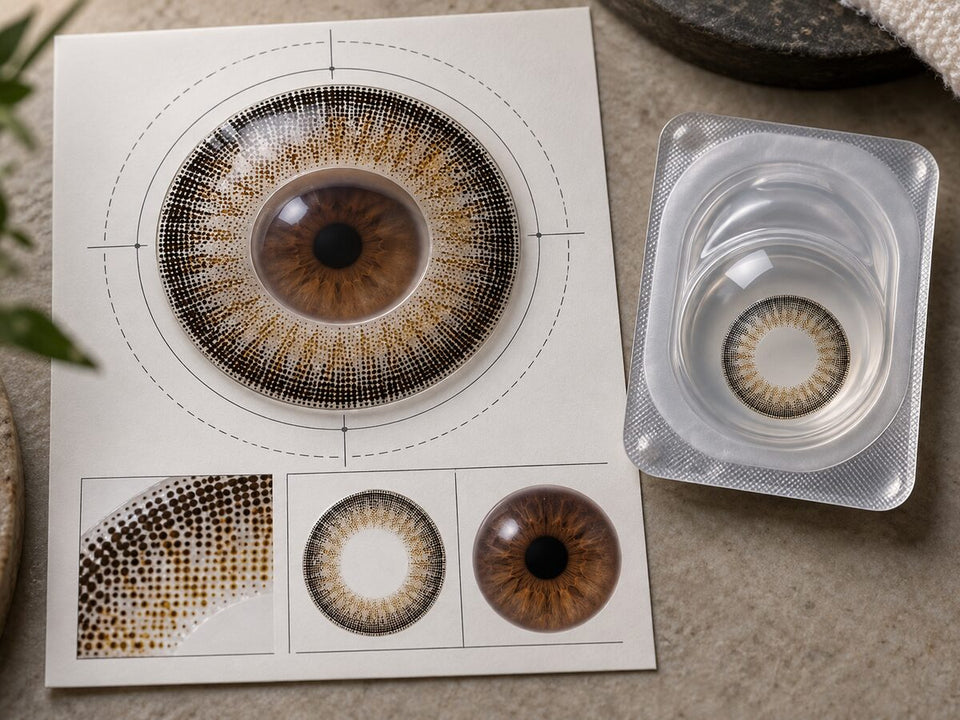
Colored contacts can behave differently on blue, gray, green, hazel, and other lighter irises because the natural color remains visible through or beside parts of the print. A lens that looks softly blended on one model may show a distinct inner boundary on another. To choose with more confidence, identify your starting eye color, decide whether you want continuity or an obvious change, compare the print’s center and outer edge, and review ordinary-light photos from people with similar eyes. Verify the exact prescribed lens before purchasing; appearance alone cannot establish fit or comfort.
In this guide
- Describe your starting eye color
- Choose continuity, contrast, or a new hue
- Read the inner and outer transitions
- Understand opacity and texture
- Compare shade families on light eyes
- Evaluate wearer photographs
- Build a complete style
- Check the exact fitted product
- Make an evidence-based shortlist
- Common questions

Describe your starting eye color
“Light eyes” is a broad description. A blue eye may have a gray outer zone, a green eye may contain golden flecks, and a hazel eye can look different in sunlight and indoor lighting. Start with what you can observe rather than forcing your eyes into one label. Take a neutral photograph in indirect daylight and look at the center, middle, and perimeter separately. Avoid a beauty filter that changes iris saturation.
Write a short starting description such as “gray-blue with a warm center” or “light green with a dark outer ring.” This helps you predict where a printed color may blend or stand apart. It is a visual note, not a medical assessment. The goal is to compare products on a starting iris closer to yours, because the same lens print can create different impressions on different eyes.
Check whether your natural outer edge is already strong. A lens with another dark ring may make the overall eye more defined than you expect. If your iris fades softly toward the white of the eye, a sharply printed border may introduce a new outline. If your center contains amber or brown, a translucent cool print may leave that warmth visible and create a mixed effect rather than a uniformly cool iris.
Notice how much of your iris changes with light. Color does not literally switch, but the balance you perceive can shift as the pupil changes size and illumination reveals different details. A product photo taken with a bright ring light may show a center blend that looks less visible in dimmer conditions. Evaluate the lens in the settings you actually plan to use.
Do not assume that a lens worn by a model with light blue eyes will give the same result on every “light” eye. If the model’s center and edge differ from yours, the transition may differ too. Use multiple wearer examples when available, and keep a note of which parts of the outcome remain unknown.
Choose continuity, contrast, or a new hue
Before comparing shades, choose the effect. Continuity means you want the lens to extend or deepen a color already present in your iris. Contrast means you want a clearer edge, added depth, or a different tone that remains visibly distinct. A new hue means the lens should read as a different color at ordinary distance. These goals can lead to different print designs even within the same color family.
For continuity, look for a soft inner transition and a related shade. A blue-gray print may feel integrated on gray-blue eyes; a green-brown mix may echo parts of a hazel iris. Related color does not guarantee seamless blending. The center geometry, print opacity, and natural iris details still matter. A related hue with a hard inner circle can be more conspicuous than a different hue with a feathered transition.
For more definition without a full color change, focus on the perimeter. A thin darker ring may frame the eye while leaving much of the original color visible. A broad, opaque ring can create a stronger “doll eye” or editorial effect. Whether that appeals to you depends on the rest of your face and the distance at which the eye is viewed. Compare both a close-up and a portrait.
For a clearly new hue, examine how much of the printed area is dense enough to cover or redirect the natural color. A sheer brown over blue may not read as a uniform brown. A deeper graphic may change the impression more strongly, but it may also create a visible center or outer border. Decide whether a blended multicolor result is welcome or whether you need the new hue to be obvious.
Write your goal as one sentence. “Keep my gray-blue center but add a soft outer definition” leads to a different shortlist from “Make my light eyes look warm brown in portraits.” A precise brief makes product images more useful and reduces the temptation to judge every lens by a vague “natural” label.
Read the inner and outer transitions
The center is often the first place to inspect on light eyes. A printed lens may leave a central opening through which the natural iris is visible. If your center is golden and the lens print is cool gray, the result may look like a warm ring surrounded by gray rather than a solid gray eye. That can be beautiful if you want dimension, but noticeable if you expected a uniform result.
Look for a gradual transition between the clear center and the colored print. Fine radial strokes, scattered dots, or overlapping shades can soften the boundary. A sudden opaque circle can make the printed area easier to see, especially when your natural iris is much lighter or warmer than the lens. Review actual wearer photos for this inner transition, because the flat lens image cannot fully show it.
The outer edge matters too. A soft, broken perimeter may let a related shade feel like an extension of your own iris. A dark continuous ring can give strong definition even if the middle color is subtle. On naturally light eyes, that ring may be the most obvious part of the design. If the goal is continuity, do not evaluate only the center; examine the whole circle.
Some prints have a middle zone that is more saturated than either edge. In close-up, the strokes may look intricate. From normal distance, they may blend into a new overall hue. Compare both views. The lens could be visually soft in a portrait yet detailed in a beauty photograph, or the reverse if an outer ring dominates the wider view.
A practical pattern note has four parts: natural center visible, inner boundary softness, middle-zone texture, and outer-edge definition. Add a sentence about the result at conversation distance. This gives you a reasoned comparison between designs labeled with broad terms such as gray, green, honey, or brown. Color names are starting points, not a complete description of blending.
Understand opacity, texture, and the limits of photos
Translucent prints allow more of your natural color to influence the final look. A blue iris may cool a sheer gray print; golden flecks may remain visible under a green-brown pattern. A denser print may create a stronger new color, but even that does not guarantee the exact shade shown on a model. The open center, pattern gaps, lighting, and camera processing still affect what you see.
“Natural-looking” and “opaque” are not opposites. A lens may use enough pigment to shift the apparent hue while retaining a finely textured, irregular graphic. Another may be sheer but have a conspicuous outer ring. Judge the finished pattern and full-face effect rather than using one marketing descriptor to predict the look.
Check for mixed-color designs when you want blending. A green lens with brown and gray details may connect to several tones in a hazel iris. A blue-gray design may harmonize with gray-blue eyes while adding subtle contrast. But more printed colors do not automatically produce a better result. If the mixture conflicts with your center color or has a hard perimeter, it may still read as a separate lens.
Print density can also change the eye’s apparent depth. A pale gray graphic might brighten the iris in strong daylight, while a darker gray rim can make it appear more defined indoors. A warm honey design might pick up natural amber details but look quite brown in dim light. Ask which impression matters for your intended setting. A single swatch does not capture that range.
Do not infer the lens material, breathability, physical size, or safe wear time from how fine or dense the printed pattern looks. Those are product and fitting questions. Visual opacity and medical suitability are different. Always verify the exact lens details and follow your eye-care professional’s advice before wearing any color style.
Compare shade families on light eyes
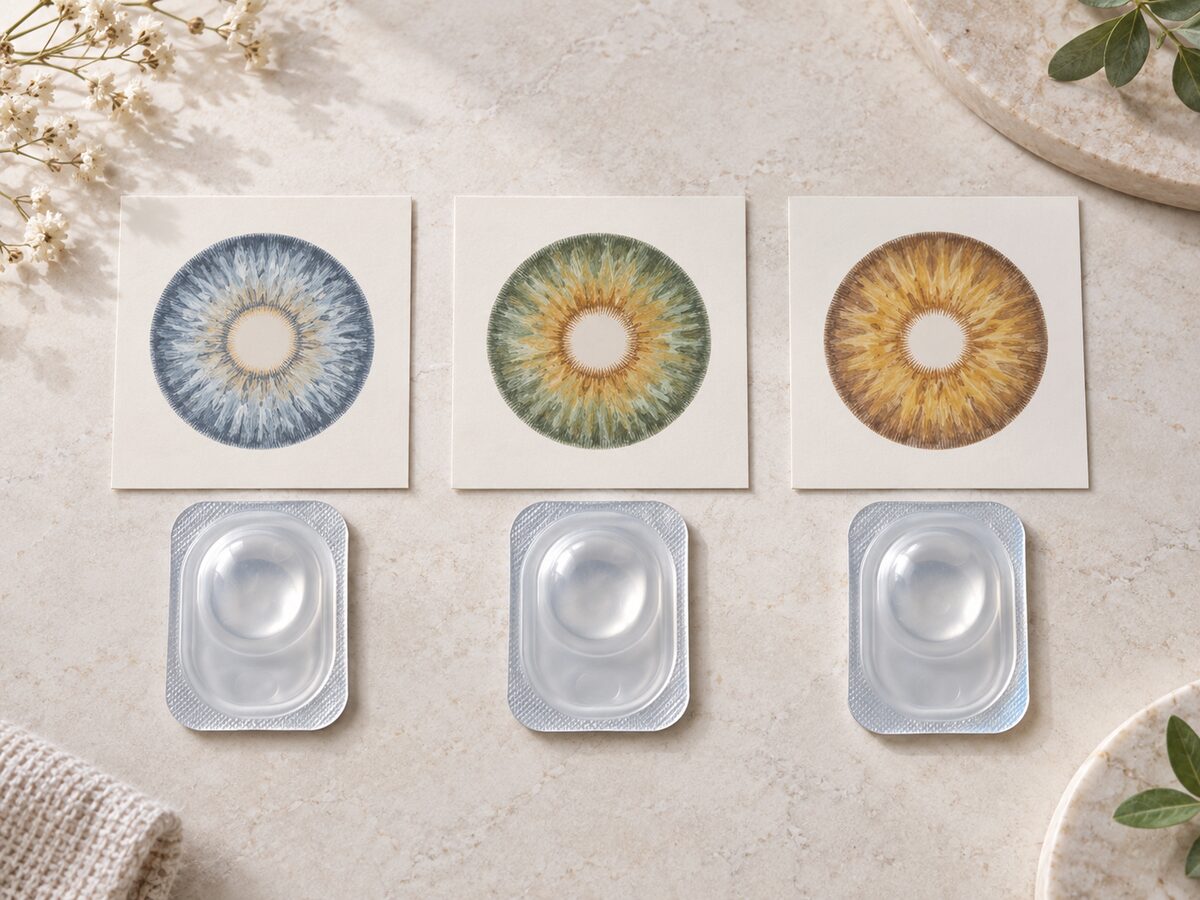
Blue and gray: These can extend a cool eye color or create a clearer cool direction. A blue print over gray-green eyes may produce a mixed result, while a gray print over blue eyes may mute saturation. Look at the center transition and whether any warm flecks remain visible. A pale print with a dark edge may feel more dramatic than a deeper print without one.
Green: A green design may enhance an existing green zone or shift blue or gray eyes in a new direction. Olive, emerald, and muted sage are very different visual goals. On a hazel eye, natural brown near the pupil can remain visible and create an appealing two-tone look. If you want a uniform green iris, check whether the print is dense enough and whether the center remains distinct.
Hazel and brown: These can warm light eyes, but a sheer warm print over blue may create an unexpected mix. A layered honey or choco design may appear softer in one lighting condition and stronger in another. Compare model eyes that share your starting color. If your goal is a convincingly deeper eye, examine both opacity and perimeter rather than trusting the brown name alone.
Pink and violet: These are often chosen as an accent or statement. On light eyes, a translucent pastel may show more of the natural iris, creating a blended color rather than a pure pink or violet. A denser print can read more clearly, especially in photos. Decide whether the desired effect is a subtle tint, a visible new hue, or a costume look.
Each family includes many print structures. Avoid ranking broad shades as universally subtle or strong. A crisp ring can make a muted color prominent; a feathered design can soften a vivid tone. Compare actual products using the same checklist, and keep unknown details explicit.
Evaluate wearer photographs with context
Search for photographs taken on a starting iris as close to yours as possible. A caption that says “light eyes” is not enough: pale blue, gray-green, and amber-hazel can each interact differently with the same print. If the listing offers several eye-color examples, place them side by side. Note which part of the result stays similar and which changes with the natural iris.
Use three views when available. The flat lens image shows the intended print. A close-up on an eye shows inner and outer transitions. A full-face portrait shows whether the color reads as subtle, defined, or obviously changed at a normal distance. An extreme close-up may make pattern details seem prominent even when they vanish in a portrait. Conversely, a portrait can hide a sharp inner ring that bothers you up close.
Compare lighting before comparing color. Cool daylight may make a gray or blue lens look brighter. Warm indoor light may emphasize yellow or brown in the iris. A ring light can flatten texture and increase perceived saturation. Ask whether the images are filtered or heavily edited. A beautiful styled photo can inspire a look, but it is weak evidence for an exact color outcome.
Pay attention to pupil size and angle. A larger pupil can change how much of the natural center appears visible, while oblique angles can hide parts of the perimeter. Do not try to diagnose lens fit or safety from a promotional photograph. Use the image only for the visual clues it can show, then verify specifications and fitting through appropriate sources.
If you already own a lens that is properly fitted for you, take a neutral reference photograph before putting it on, then a comparison image while wearing it within the prescribed schedule. Keep camera distance, light, and white balance consistent. A close-up and a full portrait are useful. Do not apply color filters if you want the record to guide a future purchase.
When one listing lacks comparable photos, note that gap. A missing light-eye example does not prove the lens will look bad or good; it means the prediction is less certain. You can ask the seller for clearer wearer images or choose a product with more useful evidence. Avoid filling the gap with a guaranteed claim based on a shade label.
Build a complete look around the result
For a blended everyday look, let the lens extend one feature you already have: a blue-gray outer edge, a green middle zone, or a warm hazel center. Keep eye makeup simple enough that the lens’s transition remains visible. Neutral liner and restrained lashes can help you judge the color itself. Once you understand the lens in ordinary light, add other accents deliberately.
For a clearly changed eye color, give the lens a role in the whole face. A warm brown lens can connect to a bronze makeup palette; a cool gray lens can support a minimal, monochrome look. These are options rather than rules for skin tone. A contrasting makeup direction can also be effective if it is intentional. Judge the complete portrait instead of isolated swatches.
Do not treat all light eyes alike when planning an “easy” color. A gray-blue eye with a dark rim may already carry strong definition. Adding another dark ring can shift the impression substantially. A light hazel eye with a warm center may show that warmth under a cool print. If the finished effect differs from your inspiration image, identify the specific difference rather than assuming the lens was described incorrectly.
For editorial or costume styling, determine whether close-up accuracy or full-face impact matters more. A detailed multicolor iris can reward a close beauty photograph; a denser, clearer hue may be needed to read from farther away. Venue lighting and camera editing can alter both. Plan a professionally approved trial in comparable light if the look depends on a particular result.
Keep color preference separate from wear tolerance. If a lens feels uncomfortable, makes vision blurry, or causes redness, remove it and contact an eye-care professional. Do not attempt to “get used to” a painful lens for a shoot or event. A visually successful blend is not evidence of safe fit.
Check the exact fitted product
After choosing a visual direction, verify the actual lens. Read the current listing for the full brand and product name, available prescription powers, base curve and physical diameter where supplied, material, replacement schedule, package quantity, and specific care instructions. These details may vary between designs and over time. A general style article cannot substitute for the current product page.
Contact lenses, including decorative color lenses, need proper fitting. In the United States, the FDA states that even lenses without vision-correcting power require a prescription. An eye-care professional can assess whether the exact product is appropriate for your eyes and advise on wearing and care. Do not assume that a lens with similar artwork or numbers fits like a different brand you have used.
If you have astigmatism or another vision-correction need, confirm that the chosen product meets your prescription rather than selecting a standard spherical color style by appearance. Do not use another person’s lens or prescription. The final buying choice is where product details, professional advice, and visual preference meet.
When a package arrives, verify the product name, prescribed power, and other relevant details before opening it. Check the seal and expiration date. Follow the exact lens’s instructions and your professional’s care guidance. Never use tap water to rinse or store contacts, and do not sleep in them unless that specific product and schedule are prescribed for overnight wear.
Make an evidence-based shortlist
Start with no more than three designs that address your visual goal. For each, record the starting eye color shown in wearer photos, the inner transition, middle-zone texture, outer edge, apparent opacity, and result at normal distance. Add a note about lighting and whether the image appears filtered. A compact comparison is more useful than opening many product pages and remembering only their shade names.
Separate confirmed facts from predictions. Product specifications and current availability can be checked on the exact listing. A photo can show what happened on one model in one setting. How the lens will blend with your iris remains a prediction until you see it on your own eye after an appropriate fitting. Use terms such as “likely softer based on the feathered center” rather than “will look seamless.”
Compare only meaningful differences. If two lenses share a similar print size and edge structure, you can focus more on hue and opacity. If one has a broad dark ring and the other a soft perimeter, recognize that you are comparing two design concepts, not just two colors. This prevents a misleading conclusion such as “green is more natural than gray” based on unrelated prints.
Make the final choice for a reason you can explain. “This gray-green design keeps the warm center visible and has a soft edge” identifies the feature that matters. “This brown design is denser and may create a stronger color change in portraits” identifies a different priority. If the two goals conflict, decide which matters more for the occasion. Do not let a broad product label make that choice for you.
Revisit the shortlist if a current listing does not supply essential details or the prescribed option is unavailable. Do not substitute an unverified color or power simply because the inspiration photo looks right. An alternative must meet both the visual brief and your eye-care requirements. Keep a link and date for each candidate so you can check updated information before ordering.
Three light-eye blending scenarios
Gray-blue eyes and a blue-gray lens. This sounds like a close color match, but inspect the actual center and edge. If the lens has a cool opaque band surrounding a warm natural center, the result can be noticeably two-toned. A feathered inner transition may soften that effect. A dark outer ring may still make the eye more defined than the original. Choose based on whether the extra definition supports the goal, not merely on the matching shade names.
Green-hazel eyes and a warm brown lens. Natural amber flecks may connect visually with the printed brown, producing depth. But a very dark, continuous perimeter can dominate the overall look and hide the subtle color relationship at conversation distance. If the goal is warmth without a sharp outline, seek ordinary-light portraits that show the edge clearly. A flat swatch cannot reveal how the natural green and printed brown will combine.
Light blue eyes and a green lens. A translucent green print may allow blue to show through and create a cooler teal impression. A denser olive print might push the eye toward a warmer green while leaving a blue or gold center visible. Neither outcome is inherently better. Ask whether you want a mixed hue or a clearer green from normal distance, then compare prints that can plausibly deliver that particular effect.
These scenarios are examples of reasoning, not predictions for specific products. The final appearance depends on the exact lens, the iris beneath it, and the light. If a product listing does not show wear on a similar starting eye, state the uncertainty. You can still make a style choice, but you should know which part is supported by evidence and which part is an informed guess.
When trying an approved lens, photograph it first with minimal makeup and again with the planned finished look. The first view reveals the lens-and-iris interaction; the second shows whether the whole face reaches the intended mood. Keep the camera settings and light consistent so the comparison answers a real question. If you experience discomfort, stop the trial and contact your eye-care professional.
Colored contacts for light eyes: common questions
Will a blue lens look more natural on blue eyes?
It may blend with your existing color, but that is not guaranteed. A hard inner circle or thick outer ring can make a related blue design obvious. A carefully feathered print in a different shade might feel softer. Compare the full pattern and wearer photos on a similar starting eye.
Can brown contacts cover light blue eyes completely?
Some denser designs can create a much stronger brown impression than sheer designs, but the center opening, texture gaps, lighting, and your natural iris may remain visible. Do not promise a uniform result from a color name or flat product photo. Look for comparable light-eye examples and note the limits of the evidence.
Why can a lens look two-toned on light eyes?
The natural iris can show through a clear center or translucent print while the printed zone adds another color. An inner boundary can make the difference more noticeable. A two-tone result can be intentional and attractive, but if you want a smoother transition, inspect center blending closely before choosing another design.
Does a larger printed area mean a better blend?
No. More visible print can change a greater portion of the iris, but it may also create a stronger outline or color difference. The physical lens diameter and fit are separate from apparent printed coverage. Compare the center and edge transitions and follow professional fitting advice.
Can I use plano color contacts without an eye exam?
In the United States, the FDA says decorative lenses need a prescription and proper fitting even when they do not correct vision. Requirements may differ elsewhere. Follow the rules in your location and the advice of your eye-care professional for the exact lens.
What if my eye becomes red or painful?
Remove the lens and seek prompt advice from an eye-care professional, especially with pain, discharge, light sensitivity, or blurred vision. Do not keep wearing a lens to complete a look or try another cosmetic shade as a workaround. Eye health comes first.
For further safety information, see the FDA guidance on decorative lenses and the CDC contact lens prevention guidance. Follow the instructions supplied with your exact lens and the advice of your eye-care professional.
Keep the names of shortlisted colors attached to their exact brands and designs in your notes. Two products with the same shade name may use different printing methods, edge widths, and inner transitions. A note that says only “green worked” will not help you identify why. Record the actual product, the lighting, and the natural eye color shown so your next decision is based on a more repeatable, useful, and careful comparison.