Buying guides
First Colored Contacts: Prescription, Product and Cart Checklist
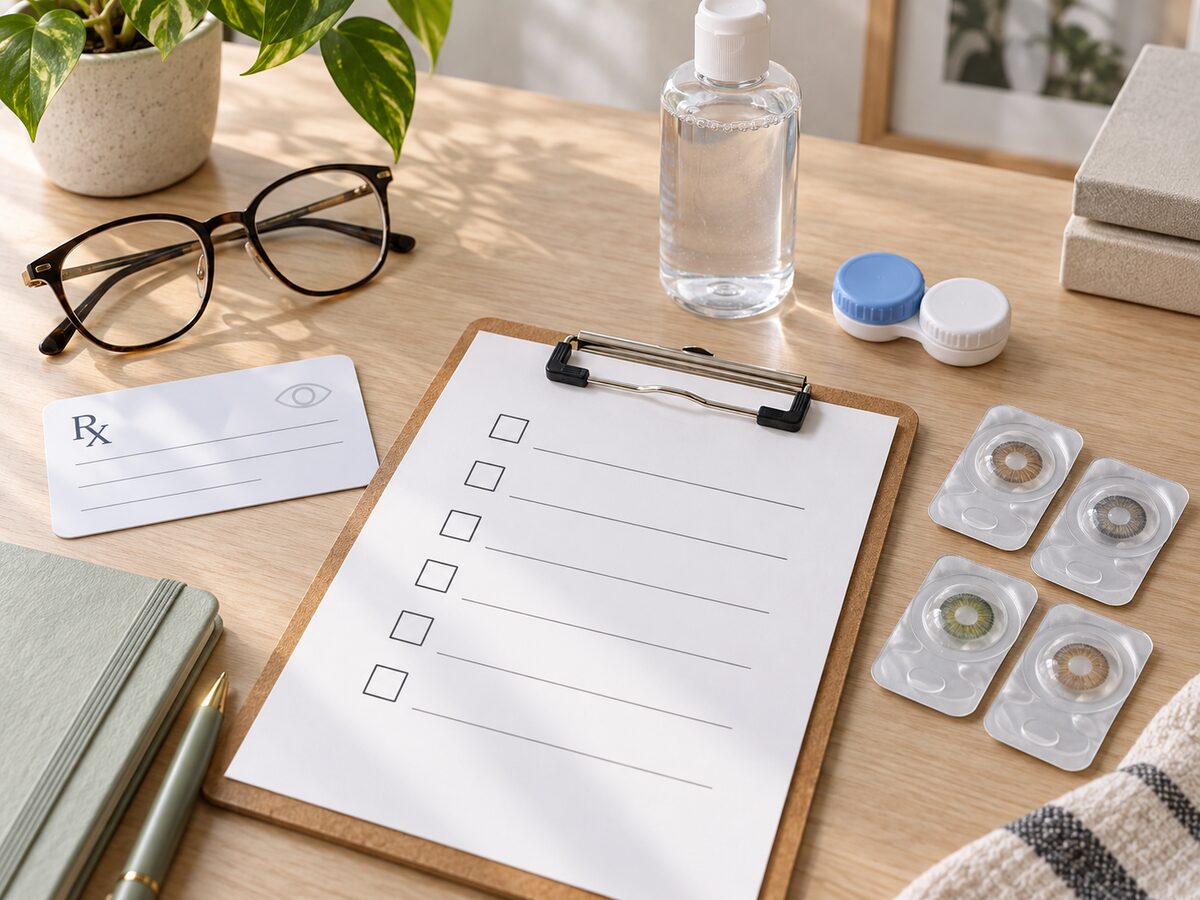
Your first colored-contact order should connect a professionally confirmed lens to the exact version, prescribed options, and quantity in the cart. Start with your eye-care requirements, then define the visual change you want and compare a small, clearly identified shortlist. Before paying, confirm the replacement instructions and count individual lenses for each eye. A promising color is only one part of a complete purchase.
In this guide

Prescription and toric order decisions
A contact-lens order must be built from the exact contact-lens prescription and fitted model, not from an eyeglass prescription or a remembered sphere number. Clear and colored lenses with the same sphere power are not automatically interchangeable: material, base curve, diameter and design can differ. Do not round a missing power, substitute the nearest option or treat a blank CYL field as permission to ignore astigmatism. Ask the prescriber to confirm an appropriate alternative when the exact model, color or parameter is unavailable.
| Situation | Decision |
|---|---|
| Right and left eyes differ | Build and verify each eye separately; different models require professional confirmation. |
| A shade stops before your power | Do not round or self-convert. Choose only from professionally confirmed options. |
| CYL or AXIS appears | Use the complete toric prescription and the exact available parameter combination. |
| The prescription names a model | Do not assume another clear or colored lens with the same sphere is equivalent. |
| Toric production or dispatch is longer | Separate product availability, made-to-order processing and carrier transit; confirm the current listing before a deadline. |
Power ranges can differ between colors, replacement schedules and series because each is a separate product configuration. The stopping point of one range does not prove that a nearby selection is appropriate. U.S. shoppers can review the FDA guidance on decorative contact lenses and the FTC Contact Lens Rule guidance, then follow the prescriber’s instructions for the individual order.
The first-order roadmap in one view
For a first colored-contact purchase, put the steps in an order that prevents a style preference from becoming an unsupported prescription choice. First, establish the current contact-lens prescription and the model or product parameters confirmed by your eye care professional. Second, state the appearance you want in words that can be checked in photographs. Third, identify the complete product version, including color, replacement schedule, and package count. Fourth, confirm each selectable prescription option and count the lenses needed for each eye. Fifth, compare the finished cart with that written record. After delivery, inspect the unopened packaging and learn the exact wear and care routine before use.
Each checkpoint answers a different question. “This looks like the right brown” is a design observation. “This model is appropriate for my eyes” is a professional fitting decision. “This cart has enough lenses in the correct options” is an order calculation. A confident first purchase needs all three, and a good photograph can answer only part of the first. If one checkpoint remains unresolved, write down the specific missing fact. This makes it easier to ask KPOP2 about a listing or to ask your prescriber about suitability without mixing the two conversations.
Prepare a usable prescription and fitting record
Before browsing, find the current contact-lens prescription or the exact model and parameters your eye care professional confirmed. Record the expiration or validity information that applies where you live. A glasses prescription can differ from a contact-lens prescription; the lens is placed on the eye and has product-specific fit considerations. A previous box can help identify what you wore, but it does not establish that a different colored lens is appropriate. If you are uncertain whether your prescription includes the intended product, ask the prescriber before selecting a substitute.
Make one line for the right eye and one for the left eye. Copy every applicable field exactly: sphere power, and cylinder and axis for a toric prescription when required. Do not assume the two eyes match because one value happens to be the same. If a product menu does not offer your exact combination, stop at the missing option. A nearby power or a blank field is not an alternative prescription. Ask for professional guidance on a suitable product instead of editing the numbers to fit a store menu.
Write the confirmed lens model beside the numbers. This small step prevents a common mix-up: moving the values from a familiar clear lens into a different colored design merely because the power is offered. Published base curve and diameter can inform a comparison, but matching values do not establish equivalent fit or approve a switch. A first-time wearer also needs practical handling instruction, not just a set of values. Ask how to insert and remove the lens, what wear schedule is appropriate, and which symptoms should end wear.
Turn the style goal into observable features
Begin with your own starting iris color and the setting where you expect the lenses to be seen. “Natural” may mean a color close to your iris, a soft outer edge, a small amount of enlargement, or simply an eye that does not dominate a full-face photograph. Decide which meaning is yours. Write a one-sentence target such as “a warmer brown with little brightness change” or “a visible gray shift but a gentle boundary.” Add one feature you want to avoid. That creates a useful brief for screening product images.
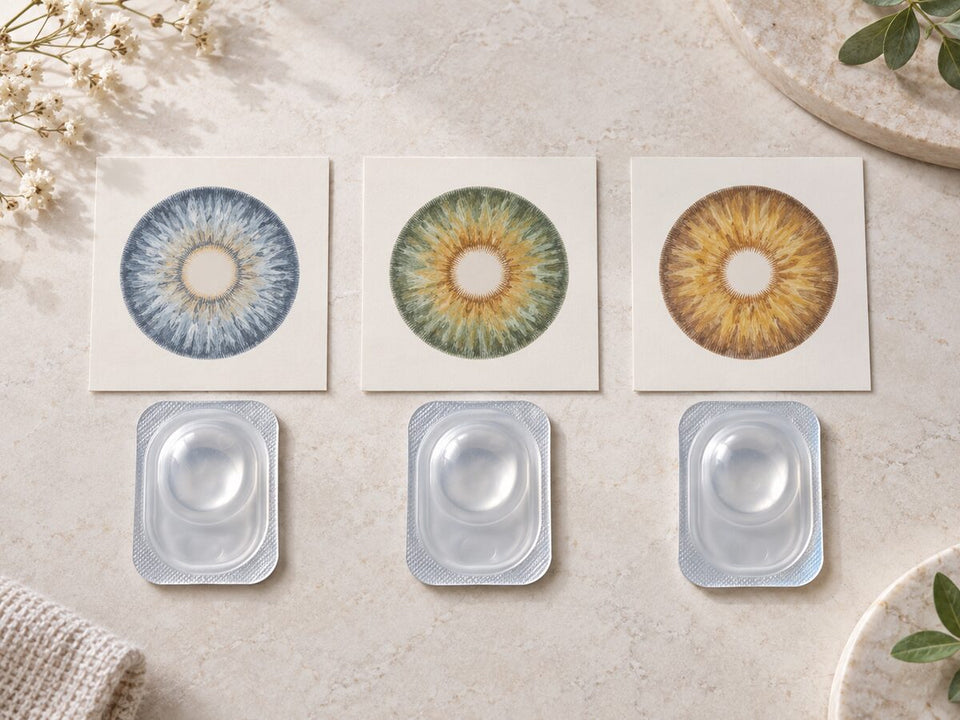
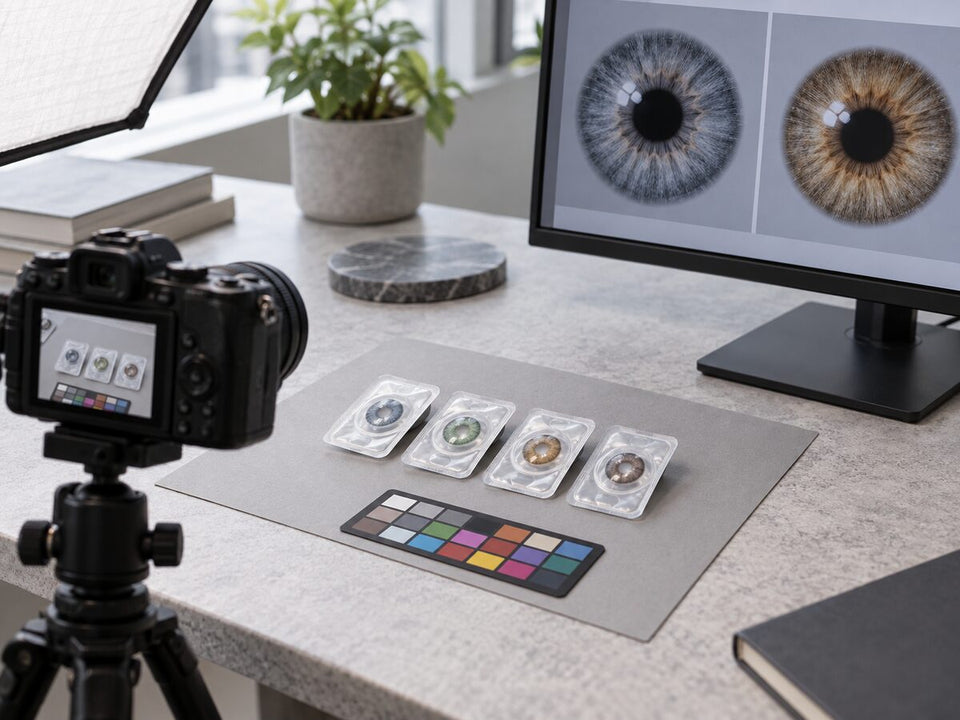
Compare the exact named product in more than one view when available: product artwork for the print layout, an identified on-eye close-up for center blending, and a portrait for whole-face impact. Check whether the model's starting eye color is disclosed. Lighting, camera distance, editing, and makeup can affect the apparent result. An image can show how a lens looked under its photographed conditions; it cannot promise the same result on you. If the relevant view is missing, keep the conclusion narrow and record the gap.
Limit the first shortlist to two or three exact products. Give each a line for apparent depth, color direction, outer ring, and center transition. Keep visual notes separate from verified product facts such as replacement schedule and package count. A shortlist of identified models makes the comparison manageable and lets you return to the same product after checking prescription eligibility. An album of unlabeled eye photographs often loses the information that matters most: which exact lens, which version, and which starting eye produced the image.
Read a product page in a fixed order
Start with the full title rather than the main picture. Record brand, series, shade, daily or reusable format, and any pack-size label. Then read the product specifications and the current selectable options. Graphic diameter describes the printed portion when the seller provides that measurement; overall diameter describes the lens. Base curve is another specification, but none of these values alone predicts a natural appearance or suitable fit. If a product has daily and monthly versions with similar names, treat them as separate items until their exact records are compared.
Next identify the unit sold. “1 piece” means one individual lens. “2 pieces” means two individual lenses, which may share the power selected for that package. A 10p, 20p, or 30p daily box counts individual lenses, not automatically wearing days for two eyes. Check whether the selection is made per box, per lens, or per eye in the actual listing. If the page does not make this clear, use the product link and the exact unclear field when asking KPOP2. Do not infer package contents from a photograph that happens to show a pair of eyes.
Read replacement and care information after you identify the version. A daily disposable and a monthly reusable lens create different purchase counts and routines. “Monthly” is a replacement category, not a promise that one lens supplies thirty separate wear occasions or permission to wear it overnight. A longer replacement label also does not remove cleaning duties. The instructions for the exact product and your eye care professional's wear plan determine the routine. Store a screenshot or note of the version and directions you used to make the decision so that a later reorder does not rely on a shortened nickname.
Count supply by eye, then by purchase unit
Build the quantity calculation from individual lenses. For a daily disposable worn in both eyes on one day, the usual count is one new lens for the right eye and one new lens for the left eye. If the powers differ, verify how many lenses of each power are in the selected boxes. A box of twenty individual lenses at one power does not automatically contain ten complete right-left pairs. For a one-piece reusable product, a two-eye order may require two separately configured pieces. For a two-piece product, confirm whether both lenses in the box carry the same selected option before deciding how many boxes to buy.
As an illustration, suppose a person with two different professionally prescribed powers plans ten days of daily wear. They need ten lenses in the right-eye option and ten in the left-eye option. The number of boxes depends on the exact pack size and how the seller configures each selection. The illustration is arithmetic, not a recommendation for a particular product or wear frequency. It shows why “20p” alone cannot answer the order quantity. If the two eyes use different models under a confirmed plan, count each model separately as well.
For reusable lenses, separate purchase quantity from replacement timing. Confirm the number of individual lenses supplied, the instructions for opening and replacement, and whether a spare is part of your plan. Do not stretch a replacement schedule to make a box seem cheaper. Include any required solution and case in a realistic routine comparison. The product with the lowest displayed box price may not be the lowest cost for your actual two-eye supply, and the price comparison is incomplete until the correct quantity and care needs are known.
Audit the final cart line by line
The cart is the last place to catch a correct product configured incorrectly. For each line, compare the displayed brand, series, color, replacement format, selected prescription values, package count, and quantity with the record you made before shopping. Do not use the thumbnail as the only confirmation: a picture may be shared across options, and the written selection is what needs to match. Check the right and left configurations independently. If the order process stores the two eyes in separate lines, make sure both lines are present.
Consider a simple example. You intended a monthly brown lens, one box in each of two powers. The cart shows the right shade and two boxes, but both lines display the right-eye power. The total piece count may look correct while the usable order is wrong. In another case, a daily version may share the family name of a reusable version you researched. Its package count, care routine, and perhaps specifications are different. Read the entire line before checkout, and resolve any mismatch on the product page or with the store before paying.
Review the current shipping and policy information at checkout for the destination and product in the cart. Availability, processing, delivery estimates, taxes, and return rules can change or vary by order. If the lenses are for a date-specific event, do not build the plan on an unverified arrival day. Leave time for a professional fitting, potential prescription clarification, and inspection after delivery. Keep suitable glasses available as an alternative if the order or first wear cannot proceed as expected.
What to check when the package arrives
Before opening a lens package, compare the label to the saved order. Look for the exact brand, series, shade, prescribed parameters, quantity, replacement format, expiration date, and intact seal. Keep the outer box and product information until the comparison is complete. If the wrong option arrived or the seal appears compromised, stop and contact the seller with the order details. Do not wear a lens while a mismatch is being investigated. A photographed package label can help identify the exact problem, provided you share only information needed for support.
For a new wearer, set aside time for insertion and removal instruction from the eye care professional. A product page cannot replace hands-on guidance about handling, wear duration, and care. Follow the instructions for the prescribed lens and the care system that is appropriate for it. For a reusable lens, use compatible fresh solution as directed and keep the case according to the relevant guidance. Do not use water as a shortcut for lens care. For a daily disposable, discard the lens after its prescribed single-use period rather than saving it for another day.
If a lens is painful, causes redness, or changes vision, remove it and seek professional advice promptly. Do not try to solve an eye symptom by choosing a different shade or forcing more wear time. Keep style disappointment separate from comfort or safety concerns: the first may call for a different visual shortlist later, while the second requires professional assessment. Record the product and symptoms accurately so the clinician can review what was worn.
Save a compact first-order decision sheet
A one-page record makes ordering and reordering more reliable. Include the date, the exact product link and full name, the professionally confirmed prescription details for each eye, the selected replacement format, pieces per purchase unit, number of units in the cart, and the care instructions you were given. Add the visual reason you chose the shade in one sentence and cite the specific reference image or description you used. This separates the reasons for liking a design from the evidence that the order is correct.
Mark every line as confirmed, unclear, or awaiting professional advice. “Confirmed” should mean that you checked the exact product record or were told the fit information by the appropriate professional; it should not mean merely that a similar lens looked suitable online. If one eye's axis, package count, or replacement instruction remains unclear, pause that selection and resolve the missing fact. A short, precise question is easier for the seller or prescriber to answer than a broad request for the “best” lens.
Keep the record after the first order. When you reorder, compare the current listing and cart with it rather than assuming that product options, stock, or packaging have stayed the same. If the exact product changes, revisit the fit decision with your eye care professional. If only a visual preference changes, rebuild the shortlist while keeping the prescription boundary intact. The practical goal is an order you can explain: why this exact lens, which options each eye needs, how many individual lenses are supplied, and how they will be used.
Questions worth asking before you pay
If a listing is unclear, ask a question that names the exact product and the missing detail. For the store, useful questions include: “Does this two-piece box contain two lenses in the single power I select?” “Is this shade the daily or monthly version shown in this link?” and “Is my exact selected parameter combination available for this item?” Include the product URL and the option you are viewing. Store support can clarify catalog fields, stock, and the order process; it should not be asked to prescribe a replacement power or judge whether a lens fits your eye.
For the prescriber, bring the full product name and specifications rather than only a picture or shade word. Ask whether that exact product is appropriate for your eyes, which parameters should be ordered, what to do if an option is unavailable, and which wear and care routine applies. If you have never handled contacts, ask for insertion and removal instruction and how to recognize a problem. These are practical first-order questions, not details to infer from a product review.
Keep answers attached to the relevant version and date. A statement about one shade or format may not cover another, and a stock answer can change. If the store confirms a package count but the prescription remains uncertain, the order is still not ready. If the prescriber confirms the model but the cart has the wrong quantity, the order is also not ready. The checklist works because each answer closes its own gap before checkout.
Related categories
Browse Colored Contacts, Daily Contacts, Monthly Contacts as discovery routes. Verify the exact model, replacement schedule, package quantity, measurements and prescribed selections on the product page before ordering.
Questions and answers
Check current product records and available options before ordering. KPOP2 editorial guidance using KPOP2 product fields and the linked sources. Catalog images and design discussions are not controlled wear tests.
Editorial source check
Safety and prescription boundaries for “First Colored Contacts: Prescription, Product and Cart Checklist” were checked against FTC Contact Lens Rule, FDA contact-lens safety information, and National Eye Institute guidance. Current stock, specifications, selectable combinations, prices and promotion terms must be confirmed on the live product and cart.