Style & occasions
Colored Contacts With Neutral, Denim and Black Outfits: Styling Guide
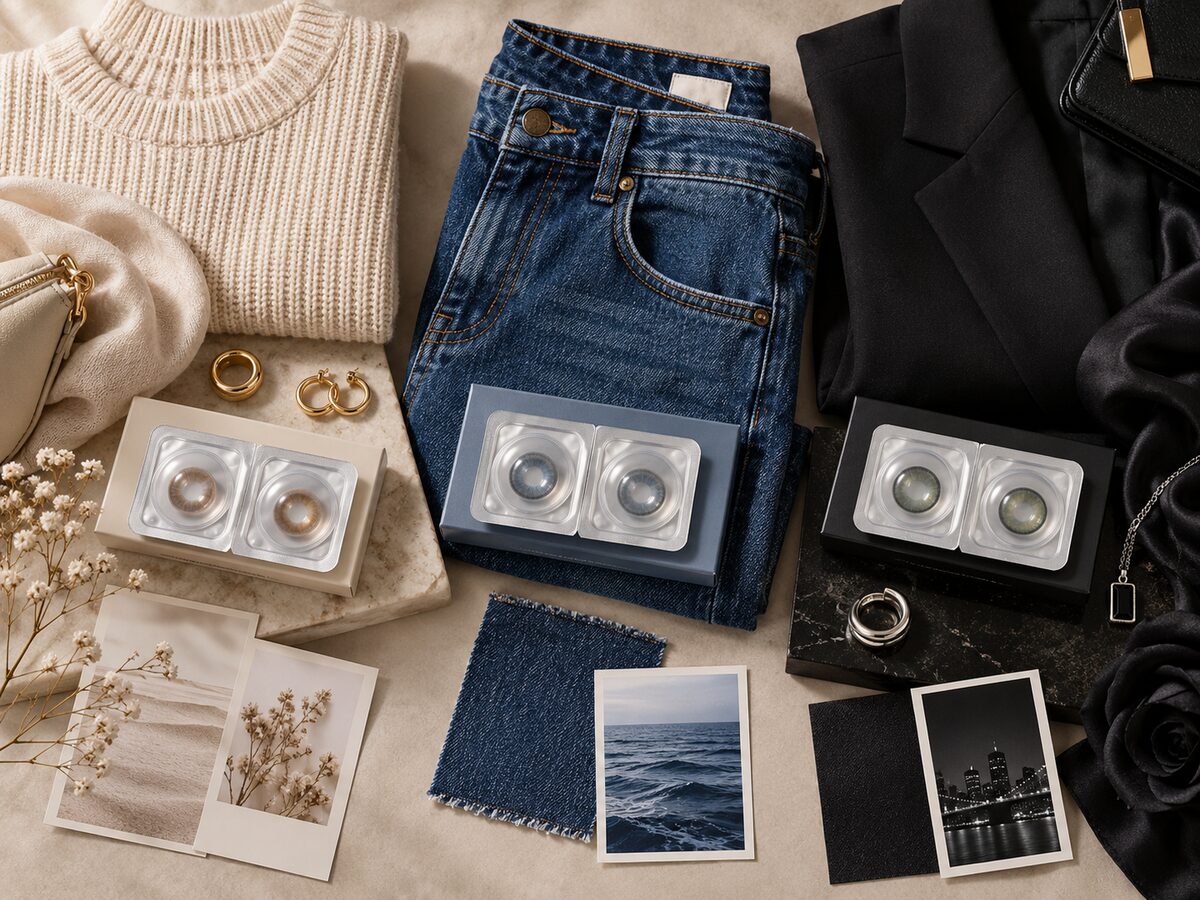
Match colored contacts to the part of an outfit nearest your face, then decide whether the eyes should blend into the palette or provide an accent. A cream collar, blue denim jacket and black top create different frames even with the same makeup. Exact color matching is optional. Start with one fitted lens and the clothes you already own; changing the neckline, jewelry or lip may solve the styling problem without requiring another pair.
In this guide
- Style the frame around your face first
- Colored contacts with cream, camel, gray and taupe
- Colored contacts with light, indigo and black denim
- Colored contacts with an all-black look
- A practical one-lens, three-outfit test
- Keep your outfit comparison photographically honest
- Keep product facts separate from outfit opinions
- Three outfit decisions in plain language
- The outfit cannot decide lens suitability
- A final outfit-and-lens checklist
- Related categories
- Questions and answers
- Editorial source check

Style the frame around your face first
The clothing closest to your face changes how colored contacts read in a portrait. A cream collar reflects a different mood from a dark denim jacket or black turtleneck, even if the trousers, shoes and bag stay the same. Start with the neckline, scarf, earrings, hair and makeup. These are the elements a viewer sees beside your eyes. Photograph that face frame before deciding that the lens needs to change.
Describe the outfit in two ways: temperature and depth. “Warm and light” can describe cream or camel; “cool and medium” can describe washed denim; “dark and high contrast” can describe a black top against pale skin or bright jewelry. This is a styling vocabulary, not a diagnosis of the wearer’s undertone. The same garment can shift in different light, so use the actual clothing and environment rather than relying on a retailer’s shade name.
Then decide what job the lens should do. It can echo a nearby color, contrast with it, or stay quiet while another feature leads. If you choose the job first, a shortlist becomes easier: you can compare the relevant color families and pattern strengths rather than browsing every lens in the catalog. Exact matching is optional. A coherent look can use controlled contrast as effectively as repetition.
Colored contacts with cream, camel, gray and taupe
Neutral outfits are a flexible background, but they are not visually identical. With a light cream top, a warm brown lens can repeat the softness of the fabric, while a cool gray lens can become the main accent. With camel, hazel or brown directions may feel connected, while a cooler eye color can make the face more graphic. These are possible compositions, not universal rules or predictions of how a lens will appear on every iris.
With gray or taupe clothing, test the actual fabric in ordinary light. Taupe can lean warmer or cooler depending on what sits beside it. A lens that looked cool in a product image may appear warmer on your natural eye color. Keep hair and makeup similar for the first comparison and change only the lens candidate or the clothing layer. This helps you see which relationship you prefer without losing track of what caused the difference.
A neutral outfit can also make a strongly ringed lens feel more prominent. If the face looks busier than intended, soften an eyeliner edge, change the collar or use a subtler accessory before deciding that the lens color is wrong. You may find that the product you already wear works across several outfits with small styling changes. A useful guide should help reduce unnecessary product switches, especially when every lens change still requires exact prescription and fit considerations.
Colored contacts with light, indigo and black denim
Blue denim does not require blue contacts. A faded wash can support a cool gray echo, a warm brown contrast or a green accent. Dark indigo can frame the face more strongly, making a subtle iris color feel quieter by comparison. Black denim behaves differently from a bright blue jacket even though both are called denim. Compare the fabric actually near your face, not a generic “denim outfit” idea.
Try one fitted lens with a light denim shirt and a darker denim jacket while keeping makeup and camera setup steady. Ask whether the lens changed in perceived warmth, definition or prominence. If the change comes mostly from the collar shape or wash, record that. You have learned a styling adjustment that does not require another lens. If the eye color still feels disconnected, experiment with a small accessory or lip color that links the palette.
For a portrait, denim texture adds detail around the face. A heavily patterned or strongly ringed lens can compete with that texture, or it can reinforce an intentional editorial look. Decide whether the outfit should feel relaxed or graphic. This is a more useful question than “Which color goes with denim?” because it lets two people with different goals make different, coherent choices.
Colored contacts with an all-black look
Black clothing can make eye contrast more noticeable, but the direction depends on hair, skin, makeup and the lens design. A dark brown lens may continue the deep palette. A light gray or hazel eye may become an accent. A black lens with a defined outer edge can make the eye area particularly graphic. None of these outcomes is inherently better. Choose what should lead the face rather than assuming an all-black outfit requires a matching dark iris.
Watch how many dark boundaries accumulate: black collar, dark hair, dense liner, strong lashes and a thick limbal ring. If every edge is equally strong, the face may feel busier than you expected. Soften one element at a time. You might keep the lens and reduce liner, or keep the liner and choose a lighter collar or earring. A black outfit often provides room for one bold eye detail; the decision is which detail you want that to be.
In a low-light restaurant or evening event, product photographs taken in bright studio light may overstate how visible a subtle pattern will be. Take an ordinary portrait in the setting where you plan to wear the look. Do not infer that a lens becomes unsuitable because its color is less obvious in dim lighting. Decide whether the overall expression still works, and keep photography limits separate from clinical fit.
A practical one-lens, three-outfit test
- Choose a lens you are already prescribed and can wear according to its instructions.
- Prepare one light neutral neckline, one denim layer and one black top.
- Keep hair, makeup, camera distance and lighting similar for the first set.
- Take a head-and-shoulders image in each outfit and label it.
- Review the portraits at normal viewing size, then inspect a close-up only if a specific eye detail needs explanation.
- Write what changes: eye prominence, color relationship, outer-edge strength or makeup balance.
If the same lens works in all three looks, you have a flexible option. If one outfit feels off, change one surrounding element and repeat only that portrait. The goal is to identify the smallest useful styling change rather than purchasing a new lens for every garment. If you are comparing two lenses, repeat the setup with the second only if it is also an appropriate fitted choice; keep product identity and replacement version clear.
Keep your outfit comparison photographically honest
Use consistent light when comparing. A warm lamp can make cream look yellow and brown contacts look richer, while cool window light can shift the same outfit. Automatic camera white balance can also change the image. Adobe’s white-balance guide explains why light color and camera adjustments affect photographs. Record the setting instead of assuming a shade change came from the lens alone.
Take a full-face image before a tight eye crop. An enlarged crop makes pattern and ring details dominate, while the outfit relationship is mainly visible in a portrait. If the final use is a profile photo or video call, check that format too. A lens can be beautifully detailed in a close-up and still read as a soft neutral accent at normal size. Choose based on the context in which you want the look to succeed.
Do not use a heavily filtered image as the only evidence of product color. Creative images are useful for a mood board, but label them separately from the ordinary comparison. A neutral reference helps you repeat the outfit later and makes it easier to describe what you liked to someone else.
Keep product facts separate from outfit opinions
Graphic diameter, replacement format, package count and available prescription options are product facts. “Looks soft with my gray blazer” is a personal observation. Both can inform a purchase, but they should not be mixed into a single unsupported claim. A smaller graphic diameter does not guarantee subtlety if the printed ring is dark, and a larger design does not guarantee a bold result on every iris. Compare the exact product’s documented pattern and identified wearer images.
The original table shows Scandi Hazel, Scandi Gray and ViVi Ring Brown as examples. Their listed dimensions can help you plan what design difference to inspect. Do not use their size alone to rank fit, comfort or how well they match a neutral outfit. The exact prescribed lens and a wearer’s natural eye color still matter. If a product page does not offer your full required configuration, ask the seller about availability and the prescriber about alternatives; do not choose a nearby option for styling reasons.
Keep the full model name and version in your notes. A family name or color label may identify several daily and monthly products. Package contents affect quantity planning but not the lens’s wear schedule. The prescription and manufacturer instructions govern the lens, while the outfit experiment governs only your aesthetic preference.
Three outfit decisions in plain language
Cream knit and warm jewelry: Try a brown or hazel direction if you want an echo. If you prefer the eyes as a cooler accent, compare a gray candidate among fitted options. Photograph both at normal portrait size; a close-up may exaggerate the difference.
Dark indigo jacket and simple makeup: Ask whether the lens should add warmth or reinforce the cool frame. A warm brown can contrast with the denim, while a cool gray may feel connected. Check the actual jacket and hair together, since the wash and neckline can change the result.
Black top with strong eyeliner: Decide whether the lens’s outer ring or the liner should lead. If both feel too sharp, soften one rather than changing every element. A quieter eye color can still look intentional, and a more defined lens can work when the rest of the face is balanced.
The outfit cannot decide lens suitability
A lens that looks ideal with a blazer or costume still requires the correct prescription, fit and care plan. In the United States, the FDA’s decorative-lens guidance explains that cosmetic contacts are medical devices requiring a prescription. Do not borrow a friend’s colored lenses for a one-night look or switch to another product only because the color matches your clothes.
Follow the exact lens’s wear and replacement instructions. If pain, unusual redness, light sensitivity, discharge or changed vision occurs, remove the lens and contact an eye care professional. The styling test can be repeated another day. A good outfit plan includes a lens-free version and accessible glasses where needed.
A final outfit-and-lens checklist
Which clothing color actually frames the face? Do you want the eyes to echo, contrast or remain quiet? Have you compared portraits in the intended light and size? Is the exact lens professionally suitable, available in the required configuration and correctly identified by model and replacement format? Can you complete its wear and care routine for the occasion? Answering those questions in order gives you a reusable style decision without treating a fabric label as proof of how a lens will look or fit.
Related categories
Use Colored Contacts to browse styles that might work with different outfits, and Daily Contacts to see one routine category. Treat these as starting points; compare your outfit reference with the exact lens image and confirm fit and product details separately.
Questions and answers
Editorial scope: Outfit pairings here are styling suggestions based on catalog records and linked sources. They do not establish an individual fit or guarantee how a lens will appear in a particular photograph.
Editorial source check
Safety and prescription boundaries for “Colored Contacts with Neutral, Denim and Black Outfits” were checked against FDA contact-lens safety information, CDC contact-lens guidance, and National Eye Institute guidance. Current stock, specifications, selectable combinations, prices and promotion terms must be confirmed on the live product and cart.