Style & occasions
Red Contacts for Halloween: Costume Palette and Styling Guide
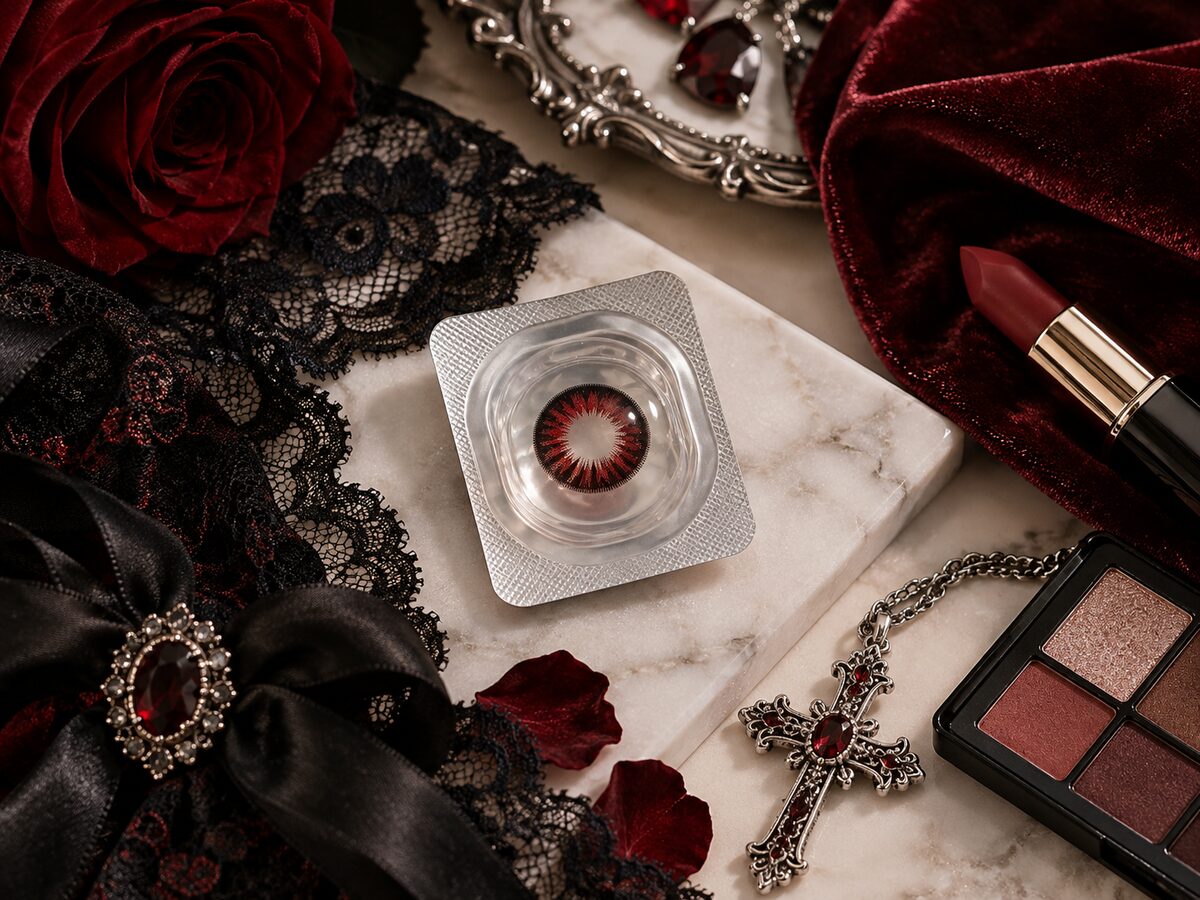
Red contacts can make a Halloween character instantly recognizable, add one striking detail to a quiet costume, or bring a fantasy palette together. The best choice starts with the exact prescribed and fitted lens, then asks what role the red color should play in the whole look. Compare print, edge, center opening, and realistic wearer photos rather than treating every red lens as the same effect. Rehearse the makeup and costume with a glasses alternative ready, because a successful Halloween look should still work if the contacts need to come out.
In this guide
- Define the character mood
- Build a palette around red eyes
- Compare lens design details
- Consider your natural iris
- Coordinate wig, makeup, and clothing
- Test in useful lighting and photos
- Check the exact product before buying
- Rehearse the full event plan
- Make the costume work without lenses
- A quick decision sequence
- Questions and answers

Define the character mood
“Red eyes” describes a color, not a complete costume. A gothic portrait may use them as the only bright accent. A fantasy character may repeat muted red across hair, embroidery, and makeup. A graphic black-and-red costume may use a sharp iris outline to echo its bold shapes. Decide what the eyes should communicate before browsing: eerie, elegant, playful, supernatural, or faithful to a specific character.
Write a one-sentence creative brief. For example, “a polished vampire portrait with one red focal point” leads to different styling from “a warm-toned fantasy warrior with several earthy red details.” The brief helps you reject references that are visually exciting but incompatible with the costume you are actually building. It also keeps you from choosing the most saturated lens automatically.
Identify the strongest non-lens cue. A recognizable wig, collar, accessory, silhouette, or makeup shape may carry the character more than the exact iris shade. If the only available lens that matches a reference has not been fitted for you, build that cue elsewhere rather than substituting an unfamiliar contact. Creative interpretation is often stronger than a literal detail that makes the wear plan impractical.
Build a palette around red eyes
Choose whether the red lens is the main accent or an echo. If it is the focal point, use calmer colors near the face so the eyes remain legible. Black, cream, charcoal, or muted brown can frame the red without competing. If the red is an echo, repeat a related tone in a lip, accessory, or textile, then let the rest of the palette support it.
| Direction | Supporting colors | Role of the eyes | What to simplify |
|---|---|---|---|
| Gothic portrait | Black, deep brown, ivory, antique metal | Single vivid focal point | Competing neon accessories |
| Warm fantasy | Copper, wine, mahogany, muted gold | Echo of the costume palette | Several unrelated bright reds |
| Graphic character | Red and black with clear shapes | Repeat of a deliberate motif | Small patterns around the face |
| Playful Halloween | One saturated color plus neutrals | Optional surprise detail | Props that obscure expression |
These are styling prompts, not claims that a particular lens will look a certain way on every wearer. Test the palette with your actual wig and clothing. A red lip and red iris do not need to be identical. You can use a deeper lip with a brighter eye, or a muted eye design with a bold costume red. What matters is a relationship that reads intentionally at normal viewing distance.
If the face looks crowded, remove one bright element before replacing the lens shortlist. A busy scarf, patterned collar, heavy glitter, and vivid lip can all compete with red eyes. Simplifying the neckline or makeup may reveal that a subtler printed lens already does the job. The eye color is one part of an image, not a paint swatch that must carry all the drama.
Compare lens design details
Look beyond the word “red.” A lens may have a solid-looking print, a translucent radial pattern, a dark outer ring, a blended center, or a theatrical shape. These details change how the eye reads. A bold ring can emphasize definition; a softer edge can make the color feel less graphic. A center opening lets the natural iris remain part of the result. Two products with similar product thumbnails can feel quite different in a full-face portrait.
Compare three image types when available: a product close-up to inspect print, a wearer image on an iris similar to yours, and a normal-distance face photograph. A close-up can exaggerate tiny details that disappear in conversation. A studio image may use dramatic lighting that alters apparent redness. If only one image exists, keep expectations modest rather than filling gaps with assumptions.
Consider your natural iris
A red print sits over a real iris. On dark brown eyes, a translucent pattern may read deeper or more burgundy than it appears on a light-eyed model. A more opaque design may show a stronger color shift but can appear less blended in close photos. The size of the clear pupil opening and the transition to the print also affect whether a brown center is visible. None of these features can be predicted perfectly from a color name.
Search for wearer examples with a similar base eye color and ordinary lighting. Compare the center, outer edge, and overall intensity. If the seller does not show a base-eye comparison, treat the outcome as uncertain. Do not assume a lens is defective because it looks less saturated on your own eyes than in a campaign photograph. Ask about the exact product if its printed pattern or specifications are unclear.
Think about visual scale. A large graphic area or dark outer rim can make the eye appear more prominent. That may serve a fantasy design but look overpowering with minimal makeup. A smaller or softer print can be more versatile across a long event. Overall lens diameter and graphic diameter are separate specifications when both are provided; read the exact listing rather than guessing from a photo.
The color also changes with lighting. Warm lamps may push red toward amber or wine, while cool light can make it appear sharper. Colored stage lighting can transform the entire face. Take test photos in daylight and normal indoor light, then include any special lighting as an extra styling reference. This helps you understand the range without expecting one fixed appearance in every room.
Coordinate wig, makeup, and clothing
Put on the real wig before deciding whether a lens matches. A “white” wig can be cool silver, cream, or warm ivory. Each version changes the color relationship around the face. A black wig creates strong contrast, while a red wig may make red eyes either coherent or visually crowded. Look at the wig, brows, iris, and neckline together rather than comparing separate shopping screenshots.
Makeup can direct attention without copying the iris. A sharp liner can echo a graphic lens edge; a soft smoky eye can support a blended wine-red design; a pale complexion effect can make the iris the focus. Avoid the assumption that a red contact always needs red shadow and red lipstick. If every nearby feature is bright, the eye may stop being the special detail you intended.
Choose one color near the face to lead and one to support. For a gothic look, the iris can lead while the lip stays muted. For a theatrical villain, a bold lip may lead while a darker red iris acts as an echo. For a playful costume, a recognizable hat or prop may lead and the contact can be optional. This hierarchy gives the look a clear story in both close and wide photographs.
Check practical access. Long sleeves, gloves, face paint, and elaborate lashes can make clean lens handling harder. The FDA advises inserting contacts before cosmetics and removing them before makeup removal. Rehearse that order with the complete costume. If you cannot remove a lens without disturbing a prop or touching your eye with an unclean glove, adjust the styling sequence.
Test in useful lighting and photos
Take one eye-detail image to see the print, one full-face portrait, and one wider costume photo. Use a similar distance and light when comparing two approved lens looks. Turn off strong beauty filters and color presets if you want to judge the actual shade. Phone white balance can shift red, so compare several views rather than treating one image as a controlled test.
Ask what the image needs to communicate. A character close-up may benefit from a visible red iris, while a group photo may rely more on wig shape and costume silhouette. If the eye detail disappears at distance, consider whether that is actually a problem. Many costumes are recognized without an exact iris color. Do not change to a more extreme or unfitted lens only to improve a tight crop.
Check the expression and sightline too. A lens that looks striking in a still eye crop may feel different when you smile or turn your head. The finished portrait is the whole face and body. If you dislike the balance, adjust makeup or accessories before treating the lens as the only variable. Keep fit, comfort, and safety decisions with the eye care professional.
Check the exact product before buying
Once you like the visual direction, verify the actual lens. Check manufacturer, full name, power options, base curve or other prescribed parameters, overall diameter when listed, replacement format, and number of individual lenses per package. The FDA says decorative contacts require a prescription and fitting in the U.S. The lens you order should match the product and parameters your eye care professional has approved.
Do not assume “red contacts” refers to one standardized lens type. A theatrical red print can be sold in more than one brand or replacement format. A series may have daily and reusable versions with different specifications. A package image showing both eyes does not tell you whether a box holds one lens, a pair, or several individual lenses. Read the current listing and review each eye separately in the cart.
If you need a lens for a rehearsal and an event, calculate the supply from the exact replacement instructions. Daily disposables are counted by individual wearing occasions and eye. Reusable lenses follow their prescribed replacement schedule and care process. Do not store a used daily lens to save it for Halloween night. If the required product is unavailable in time, use your lens-free costume plan.
Keep a copy of the prescription and product name with your order notes. An unapproved substitution is not made safe by a similar color, diameter, or photograph. If a product page does not show the parameter you need, ask the seller and eye care professional. Clarifying before checkout is easier than discovering after delivery that the lens cannot be used for your event.
Rehearse the full event plan
Plan the first complete rehearsal before Halloween day. Practice insertion and removal with the exact fitted lens as your professional instructed. Wear the wig, makeup, and costume long enough to discover whether gloves, accessories, or face paint interfere with the routine. Keep current glasses and the correct care supplies accessible. Do not turn a crowded venue into the first handling lesson.
Map the full day: preparation, travel, photos, meals, queues, the party, and the way home. The event length is not a wear-time recommendation. Follow your professional's schedule and identify a practical time to remove lenses. If water, a shower, or swimming is part of the day, remove contacts beforehand as the CDC advises. Bring backup vision for after removal.
Check the venue's current bag and liquid rules rather than relying on a previous party or convention. Keep solution in appropriate original packaging; the FDA advises against transferring it into unmarked small bottles. A compact kit is useful only if it contains the correct items and remains accessible under your costume. If the care routine cannot be followed in the venue, adjust the lens plan rather than improvising.
Agree with a friend that you may step away from photos if your eyes become uncomfortable. They do not need to make medical decisions for you. They can help locate your glasses or a quiet space, and they can keep the group moving while you follow the plan. A costume should be fun to wear; it should not trap you in a lens because people expect a certain image.
Make the costume work without lenses
Take one rehearsal photo with your natural eyes or glasses. Identify the strongest character cue that remains: wig silhouette, collar, prop, makeup shape, or color blocking. If the character becomes hard to recognize, strengthen that cue now. A deliberate alternate look is easier to accept than an improvised version after discomfort begins.
You can also use a quieter eye design or no lens at all while preserving the red theme through clothing and makeup. A red accessory close to the face may create more visible color in a group photo than a tiny iris detail. This is a creative opportunity, not a compromise in costume quality. The point is to keep the look recognizable while respecting the fitted-lens plan.
If the proper product has not arrived or the fitting is incomplete, do not let a deadline push you toward a novelty lens from an unverified seller. The FDA warns that decorative lenses sold without prescription controls can harm the eye. Halloween happens every year; a costume can be photographed without an eye product. Save the lens concept for a later, properly arranged event.
A quick red-lens decision sequence
- Confirm the exact lens. Check the fitted model, parameters, replacement format, and package quantity.
- Choose the visual role. Decide whether red is the focal point or one part of the costume; compare identified images in relevant light.
- Rehearse the complete look. Test the approved lens, makeup, wig, and clothing in full-face and event-distance photos.
- Prepare the practical plan. Follow the professional care instructions, plan removal, and keep a lens-free version of the costume ready.
This checklist summarizes the detailed guidance above. Appearance references cannot establish fit or guarantee a color result.
Questions and answers
Do red contacts always create a vampire look?
No. The surrounding wig, clothing, makeup, and expression shape the interpretation. Red eyes can read gothic, graphic, fantasy, or playful. Define the role of the eyes in the whole costume before choosing a print.
Will a red lens cover dark brown eyes completely?
That depends on the exact print, opacity, center opening, lighting, and natural iris. Seek wearer images on similar eyes when available and keep expectations flexible. A campaign image alone cannot guarantee your result.
Should the lens match red lipstick exactly?
Exact matching is optional. A darker lip can support a bright iris, or a muted lens can echo vivid clothing. Test the real costume pieces together under the same light rather than comparing color names on separate screens.
Are strongly edited costume photos useful?
They can inspire a mood. They are weaker evidence for the ordinary color of a product. Compare an unfiltered close-up and a full-face image in neutral light when possible.
Does a bigger graphic make a better Halloween lens?
No. A large graphic may create a more theatrical effect, while a smaller one can support a subtle character cue. The right scale depends on the costume brief and the exact lens fitted for you.
Can a friend try my red contacts for a picture?
No. Contact lenses are individually fitted and should not be shared. Use makeup, accessories, or photo composition for a shared costume theme without trading eye products.
What if my eyes hurt during the event?
Remove the lenses if you can do so safely, keep them out, and contact an eye care professional promptly. The FDA warns that contact lens problems can become serious. Put on current glasses and do not wear another lens to finish a photo session.
What if I cannot get fitted before Halloween?
Use the lens-free version of the costume. Build recognition through wig, clothing, makeup, or props. Do not treat a deadline as a reason to wear an unfitted decorative lens.
Choose the complete costume for enjoyment, and use only the exact contact lens and care plan approved by your eye care professional.