Toric & prescription
Clear Toric Contacts: ULTRA Monthly 6p vs O2 Balance Daily 30p
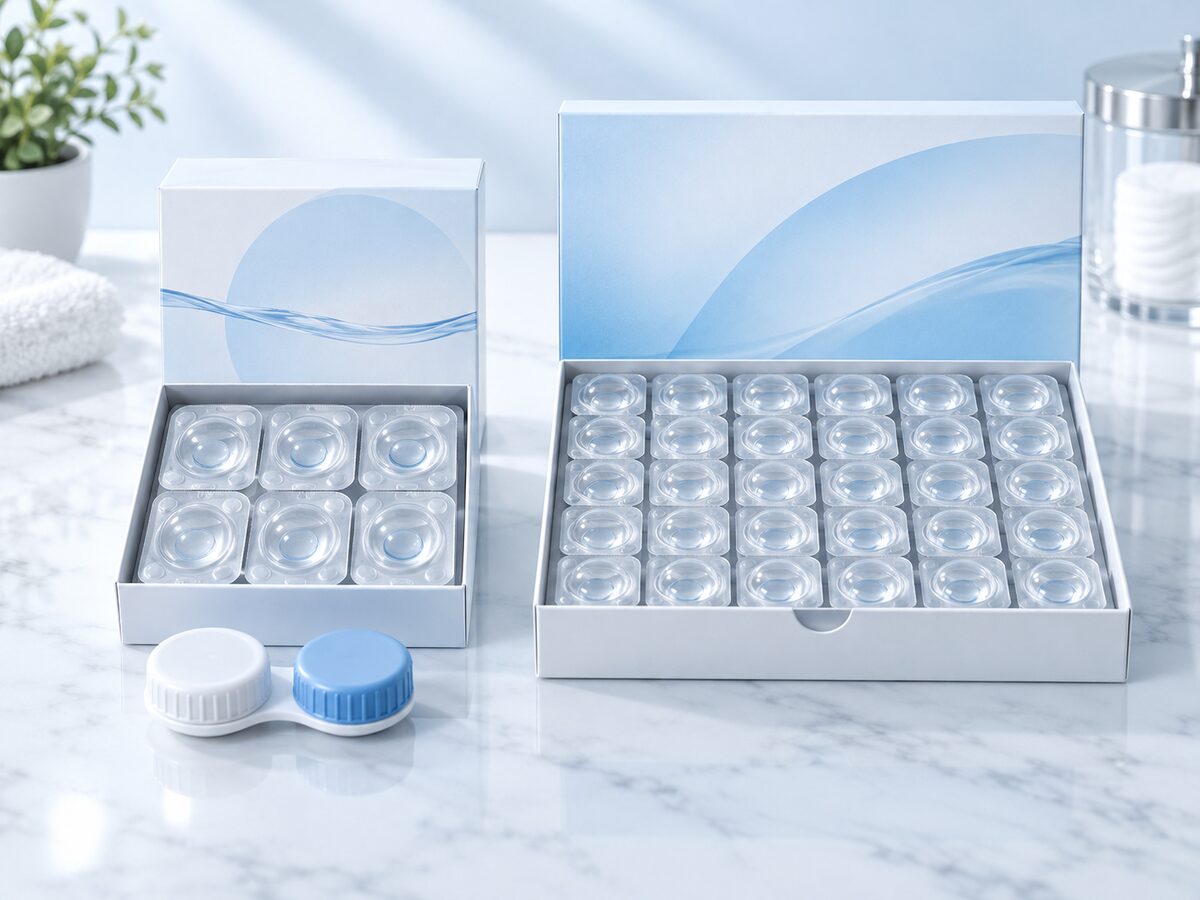
A 6-piece monthly toric box and a 30-piece daily toric box are not directly comparable by lens count alone. The current KPOP2 listings identify Bausch + Lomb ULTRA for Astigmatism Monthly (6p) as a reusable clear toric lens and OLENS O2 Balance 1Day Clear Toric (30p) as a daily disposable clear toric lens. They differ in brand, material, fit measurements, listed parameter options, replacement routine, and package quantity. Start with the exact contact lens prescribed for each eye, then calculate supply from that product’s wear schedule and box contents. Do not substitute one model based on price or count.
In this guide
Identify the two exact clear toric models
Bausch + Lomb ULTRA for Astigmatism Monthly (6p) is currently listed as a monthly reusable clear toric contact lens with six lenses per box. The page lists an 8.5 mm base curve, 14.5 mm overall diameter, silicone hydrogel material, and 46% water content. Those are product-listing details, not a personal fitting recommendation.
OLENS O2 Balance 1Day Clear Toric (30p) is currently listed as a daily disposable clear toric lens with thirty lenses per box. Its page lists an 8.7 mm base curve, 14.2 mm overall diameter, Puscon material, and 60% water content. The listing also mentions UV protection, but a contact lens does not cover the entire eye or replace UV-blocking sunglasses.
Both are clear toric products, yet they are distinct lens designs. A matching sphere number does not make their fit or optical behavior interchangeable. If your eye-care professional prescribed one model, do not select the other merely because its box appears to offer more lenses or a different upfront price. Any product change should be assessed and prescribed by the professional.
Read the full product title when you reorder. “ULTRA” alone is not enough; the monthly toric version matters. “O2 Balance” alone may not distinguish a clear toric daily from another product in a wider line. Keep the box label or current prescription beside the cart. An exact name prevents a count comparison from drifting into the wrong listing.
Product specifications and available options can change. Check the live listing before purchasing and compare the delivered package with the current prescription. The numbers in this guide summarize the listings reviewed now; they cannot guarantee future stock or your individual suitability.
Check sphere, cylinder, and axis as a combination
A toric contact lens prescription includes eye-specific optical parameters such as sphere (SPH), cylinder (CYL), and axis. These values are not independent styling choices. Write the complete prescription line for the right eye and a separate line for the left. Do not use an eyeglass prescription as a direct replacement for a contact lens prescription.
The current ULTRA page lists SPH options from -9.00 to 0.00, CYL values of -0.75, -1.25, -1.75, -2.25, and -2.75, and axis values at ten-degree steps from 10 through 180. The O2 Balance page lists SPH from -8.00 to -1.00, CYL values of -0.75, -1.25, and -1.75, and axis 180. These are public lists, not proof that every possible combination is orderable or in stock.
If your prescription’s axis is not 180, the current O2 Balance listing does not show a matching axis option. Do not choose 180 anyway. Ask the seller to verify the exact option and ask your eye-care professional about suitable alternatives. The same caution applies when your CYL or SPH falls outside a displayed list. A near value is not a customer-selected compromise.
Even when a parameter appears on both pages, the two products may have different fit and wear characteristics. The FDA contact lens prescription guidance explains that a prescription needs enough information for accurate fulfillment, including manufacturer or material and base curve or appropriate designation. Confirm the prescribed brand and model, not just three numbers.
Count a 6-piece monthly box correctly
Six lenses in a monthly box are six individual physical lenses, not six pairs and not six days of wear. If both eyes use the same exact prescribed ULTRA configuration and both lenses are opened together, two lenses form an active pair and the box can supply three such pairs. Each opened lens follows the monthly replacement and care instructions for that product, not a daily-disposable discard rule.
If the right and left eyes have different SPH, CYL, or AXIS values, they generally need separate correctly configured boxes. A six-lens box selected for the right eye does not provide six right-left pairs. You might have six lenses for one eye and a different box of six for the other. The actual number of months covered depends on the prescribed schedule, how many lenses are used per eye, and any damaged or lost units.
Replacement timing is tied to the exact monthly lens and the instructions after opening. Do not assume that wearing a monthly lens only on weekends lets you keep it for more months. Clean, disinfect, and store it as directed between wears. Record the opening and discard date for each eye, especially if replacements are opened on different days.
A spare monthly lens is an unopened lens with its own package expiration date. Once opened, it begins the relevant replacement period. Do not confuse an unopened spare with an active lens sitting in a case. Keep the box label and power information available so the correct eye receives the correct replacement.
For travel, a monthly format requires the recommended solution, clean case, and a plan for storage after removal. If a flight or hotel routine makes that difficult, discuss appropriate options with your eye-care professional before switching to another product. The 30-piece daily box is not automatically an approved travel substitute.
Count a 30-piece daily box correctly
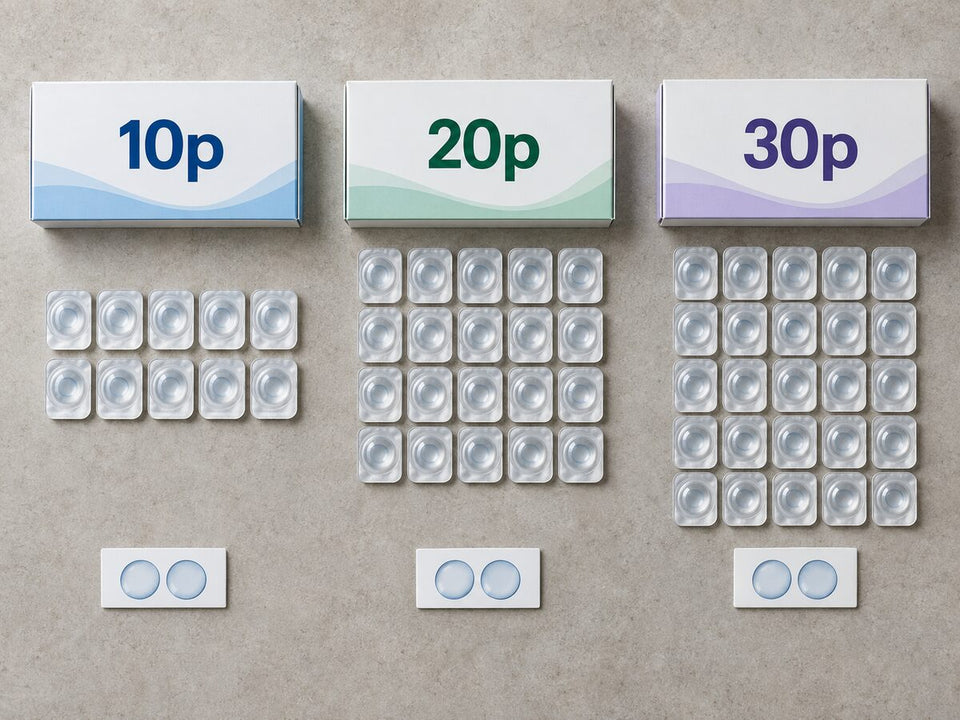
Thirty lenses in the current O2 Balance 1Day box are thirty individual single-use lenses. For a two-eye wearer with the same prescribed product and configuration in both eyes, one wearing occasion uses two lenses, so a full box could supply fifteen two-eye occasions before spares. That calculation assumes every blister is correctly prescribed, unopened, unexpired, and available for both eyes.
When the eyes have different prescriptions, count each eye separately. A box of thirty selected for the right-eye parameters does not also supply thirty left-eye lenses if the left differs. You may need one box for each eye. For fifteen planned two-eye days, the base need is fifteen right-eye lenses and fifteen left-eye lenses, before a reserve for damaged blisters or itinerary changes.
Daily disposable means a fresh lens for each wear according to the exact product instructions. The current listing says to discard after removal and not clean or reuse a daily lens. Do not place it in solution overnight to stretch a box. If an event requires another insertion later, account for another fresh lens for each eye if the routine is appropriate under your professional’s advice.
A 30-piece pack can be convenient for frequent wear or travel, but the package count says nothing about fit or whether your axis is available. Verify the complete SPH, CYL, and AXIS combination before using the box arithmetic. An incorrect parameter cannot be made useful by a larger quantity.
The daily format removes cleaning and storage for reuse of the lens itself, but it does not remove hygiene. Wash and dry hands before handling lenses, avoid water exposure, follow the wearing schedule, and carry backup glasses. If discomfort or vision changes occur, remove the lens and seek eye-care advice rather than trying another daily blister repeatedly.
Calculate right and left eyes separately
Make a two-row worksheet. On the right-eye row, record exact model, SPH, CYL, AXIS, package size, planned wearing periods, and reserve. Repeat for the left eye. If the configurations match, note that explicitly. If they differ, keep the physical boxes and blister supplies separate. “Thirty lenses” is an incomplete packing answer without the eye assignment.
Example for the monthly product: if both eyes are prescribed the same exact configuration, one six-piece box could contain three two-lens sets. If they differ, two boxes may be required, one selected for each eye. Each box then contains six lenses for that eye, not six complete pairs. The replacement and care plan still comes from the exact lens instructions.
Example for the daily product: ten two-eye wearing occasions require twenty individual fresh lenses, ten for each eye. If the powers differ, you need at least ten of the right-eye variant and ten of the left-eye variant. A single 30-piece box of one configuration is not a complete two-eye supply unless the exact prescription allows it for both eyes.
Keep the calculation separate from price and availability until the prescription match is confirmed. A cheaper box or larger pack is irrelevant if it cannot be ordered in the prescribed combination. Ask the seller about exact options; ask the eye-care professional about a suitable alternative if the prescribed product is unavailable.
Compare care and travel routines
The monthly ULTRA product requires a reusable-lens routine. Follow the prescribed cleaning and disinfection method, use the recommended solution and case, and replace the lens on schedule after opening. The CDC contact lens prevention guidance advises hand hygiene, keeping water away from lenses, using fresh solution, and caring for the case. A long replacement interval does not permit careless storage.
The daily O2 Balance product uses a fresh lens for each wear and is discarded after removal according to the current listing. That can simplify a trip because you do not clean and store the lens for reuse. It also means you must pack enough correctly prescribed blisters for the planned occasions and delays. A daily lens is not a spare monthly lens unless the exact product is approved and prescribed for you.
Consider your real schedule. A traveler who wears contacts on only a few days may value daily packaging, but cannot choose the model from convenience alone. A person who wears contacts regularly may be familiar with a monthly care routine, but still needs a safe plan for flights and water activities. Discuss format changes with an eye-care professional and check the actual product options.
Both formats require attention to symptoms. Remove lenses and contact an eye-care professional if you experience pain, persistent redness, discharge, unusual light sensitivity, or blurred vision. Do not switch from monthly to daily lenses as an improvised treatment for discomfort. Backup glasses can help you function while you obtain advice.
Do not sleep in either lens unless the exact product and schedule are prescribed for overnight wear. Remove lenses before swimming or showering. If you need to remove a monthly lens, use its prescribed cleaning and storage routine. If you remove a daily disposable, follow its disposal instruction. The format determines what happens after removal.
Compare practical cost without a false per-lens answer
Box price divided by lens count is an incomplete comparison. The six monthly lenses can be reused during their prescribed replacement periods with solution and case care. The thirty daily lenses are single-use. Their cost per wearing occasion depends on how many eyes are fitted, how often you wear the product, the correct parameter boxes needed, and any supplies. Do not compare the two by sticker price or number of pieces alone.
Start only after professional suitability is established. Then map a realistic calendar: how many days or occasions will you wear contacts during the chosen period? For monthly lenses, include solution, case replacement, and the possibility of early loss or damage. For daily lenses, count one fresh lens per eye per occasion and any reserve. Use current prices at the time of purchase; prices can change.
Keep upfront spending and allocated-use cost separate. A six-piece monthly box may require a larger or smaller purchase than a thirty-piece daily box, depending on the store and selected variants. But a low upfront price does not establish a lower cost for your actual routine. A useful comparison shows both what you pay now and how many correctly prescribed wearing occasions that purchase supports.
If the two eyes have different configurations, include the cost of separate boxes. A person with one shared configuration may use a box differently from a person who needs one for each eye. Do not borrow the other eye’s remaining blisters to make a calculation look better. Optical correctness comes before accounting convenience.
Do not let cost analysis encourage overuse. A monthly lens is replaced on its prescribed schedule even if it was worn only occasionally. A daily lens is not cleaned and reused to lower the cost per occasion. Safe product use is part of the real cost model.
Verify the reorder and delivery
Before checkout, compare the full model name, replacement format, SPH, CYL, AXIS, eye side, package count, and current prescription. Do not assume a selected dropdown represents every listed combination until the order summary shows the exact values or the seller confirms them. If the needed O2 Balance axis is not among the currently displayed options, ask for an appropriate alternative through your eye-care professional.
When the boxes arrive, inspect the seals, expiration dates, full names, and printed parameters before opening. Separate right-eye and left-eye supplies if configurations differ. A correct total count with one incorrect axis is still an incorrect order. Contact the seller and professional to resolve a mismatch rather than trying to use the lens.
Create an opening record for a monthly box when you begin using a lens. For daily boxes, maintain a remaining-blister count if you rely on it for travel or a routine supply. Keep the original carton or a private photograph of its label so you can identify the exact product on a future reorder.
Questions to settle before comparing boxes
Is the exact model prescribed? A comparison between monthly ULTRA and daily O2 Balance is useful only if both have been professionally assessed as options for you. If only one is on your current prescription, the other is an idea to discuss with your eye-care professional, not a product to put directly in the cart. Clear lenses still have distinct designs and fit requirements.
Does each eye have an available combination? Write SPH, CYL, and AXIS for right and left in separate rows. Compare each full row with the options for the intended product. A listed cylinder or axis value by itself does not establish a valid combination. The O2 Balance page’s single displayed axis of 180 is especially important when the current prescription calls for another orientation.
How many wearing occasions are realistic? A monthly wearer may use the lens frequently within its replacement period or only occasionally, but the opening schedule still applies. A daily wearer consumes a new lens per eye per occasion. Count actual planned use over a defined time window. Without that window, “six versus thirty” is only a package comparison, not a supply comparison.
What supplies and backup plan are needed? Monthly lenses require the approved solution and case routine between wears. Daily disposables do not need cleaning for reuse but require enough sealed replacements. Both need hand hygiene, water avoidance, and backup glasses when contacts cannot be worn. A travel plan should include the exact product names and prescription details.
What are the current prices and stock? Prices and availability are changeable. Recheck them on the live listings at purchase time after confirming the prescription match. Compare cost over the same realistic wear period, including separate boxes for different eye parameters and care supplies for monthly wear. Do not use an old price or a simple price-per-piece figure as a final answer.
Keep the answer to each question in a compact worksheet. If a field is unknown, resolve it with the seller or eye-care professional before checkout. The point is to make the comparison precise: one prescribed model, one complete parameter combination per eye, one replacement routine, and one supply calculation. When those facts are clear, the box counts become easy to interpret.
Monthly 6p versus daily 30p toric: common questions
Does a six-piece monthly box mean six months?
Not automatically for a two-eye wearer. Six pieces are six individual lenses. If both eyes use the same configuration and two lenses are opened per set, the box contains three sets. Each opened lens follows its monthly replacement schedule and care instructions. If right and left configurations differ, separate boxes may be needed.
Does a thirty-piece daily box mean thirty days?
Only for a one-eye use of one fresh lens per occasion, under the correct prescription. A two-eye wearer with one shared configuration uses two lenses per occasion, so thirty pieces could cover fifteen two-eye uses before reserves. Different eye configurations may require separate boxes.
Can I switch from ULTRA monthly to O2 Balance daily for travel?
Do not switch on your own. The two products differ in model, material, base curve, diameter, replacement format, and listed toric options. Ask your eye-care professional to fit and prescribe the exact daily lens if you want it as a travel option.
Are all combinations of listed SPH, CYL, and AXIS available?
Do not assume so. A product description may list possible values independently without proving every combination is orderable or in stock. Verify the precise combination for each eye on the live listing or with the seller. Do not choose a near value when the prescribed one is absent.
Why does the O2 Balance page show only axis 180?
That is the axis listed on the current KPOP2 product description reviewed for this article. If your prescription calls for another axis, the page does not establish an orderable match. Ask the seller about the exact product options and your eye-care professional about appropriate alternatives.
What if I have the same sphere power in both eyes?
Sphere alone does not establish that the full toric prescriptions match. Compare cylinder and axis too, as well as the prescribed model. Separate boxes may still be required when the complete combinations differ.
What if a lens causes pain or blurred vision?
Remove it and contact an eye-care professional promptly, especially with redness, discharge, or light sensitivity. Do not alter toric parameters yourself or try the other product as a workaround. A clear lens can still be inappropriate despite appearing correct in the package.
For prescription and buying guidance, see the FDA contact lens prescription page, the FDA buying guide, and the CDC prevention guidance. Follow your professional’s advice and the exact product instructions.
Two planning examples
Regular two-eye wear: If an eye-care professional has prescribed ULTRA in the same configuration for both eyes, a six-piece box can be understood as three pairs of monthly lenses. If right and left parameters differ, each eye may need its own selected box. The replacement dates depend on when physical lenses are opened and the exact instructions.
Occasional daily wear: If O2 Balance is prescribed in the same configuration for both eyes and you plan eight two-eye wearing occasions, the base count is sixteen daily lenses. Add an appropriate reserve, then check whether a thirty-piece box covers the actual plan. If the eyes differ, count each configuration independently before deciding how many boxes to buy.
These examples explain package arithmetic; they are not individualized prescriptions or purchasing recommendations. The exact product and parameters must be confirmed first.
When a prescription changes, start the comparison again. Do not assume an older box in the cabinet still matches either eye’s new parameters, even if it is unexpired. The correct product may remain the same while sphere, cylinder, or axis changes. Keep unopened boxes in their original cartons, and ask your eye-care professional whether any old stock remains appropriate.
At delivery, the package label is the final identity check. Read the full brand and model, replacement format, eye-specific parameter combination, box count, seal, and expiration date. If a single field does not match, contact the seller before opening. A 30-piece box with the wrong axis is not a better value than a six-piece box with the correct prescription.
Each format has different handling needs. Choose only after reviewing the full prescription, replacement routine, fit, and travel needs. Box count alone cannot determine which lens is suitable.