Care & authenticity
Is Your Contact Lens Inside Out? Shape and Orientation Guide
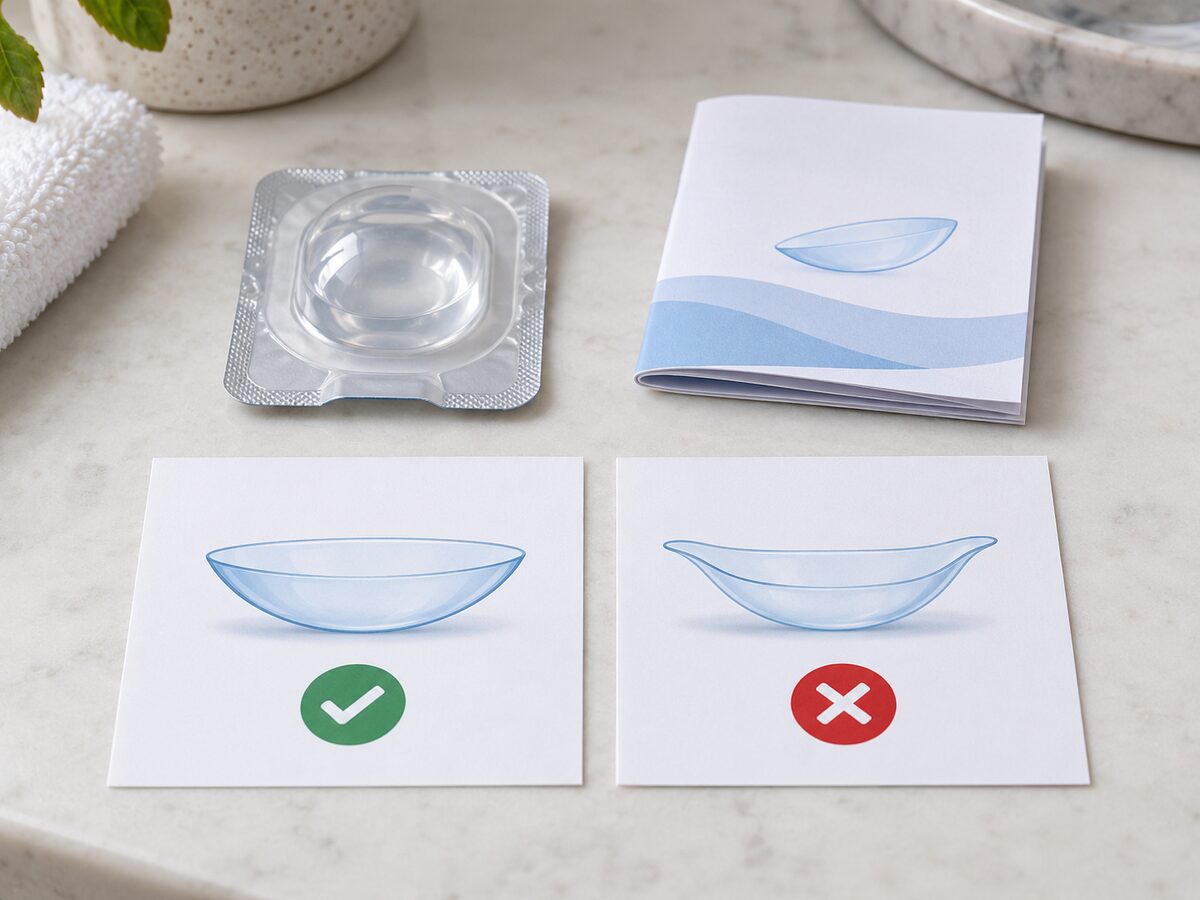
A soft colored contact lens may look like a small bowl when its edge is in the intended position, while a reversed lens may show an outward flare. That visual clue is useful only alongside the instructions for your exact product and the method demonstrated by your eye care professional. Color print, a single online diagram, or discomfort after insertion cannot reliably answer every orientation question. Check product identity, clean hands, lens condition, and orientation as separate steps; if you are unsure, leave the lens out and ask for help.
In this guide
- Start with the correct lens
- Prepare clean hands and good light
- Understand the bowl-and-edge comparison
- Use printed marks only when instructed
- Why colored print can confuse the check
- Keep damage and orientation separate
- Do not use discomfort as a test
- Build a repeatable pre-insertion routine
- Apply the check in common situations
- Questions for a professional demonstration
- Questions and answers

Start with the correct lens
Before judging orientation, read the product name and the selection for the eye you intend to wear it in. A correctly shaped lens can still be the wrong power, the wrong eye's lens, or a different version of a familiar design. The FDA's buying guidance emphasizes checking the exact lens name and parameters against the prescription. Keep the package or case labeling accessible while handling the lens.
Soft colored contacts may be sold in daily and reusable formats under related names. The print can appear similar while the instructions and specifications differ. Do not use a diagram from one version as proof about another. The manufacturer's patient information for your prescribed lens and the eye care professional's demonstration are the appropriate references for orientation.
If right and left eyes need different powers or parameters, set up a consistent order: for example, always begin with the same eye and keep the packages separated. A visual shape check cannot tell you which eye a lens belongs to. Organizing identity first prevents a confident orientation check from hiding a selection mistake.
A 0.00-power colored lens is not exempt from this preparation. It still has a specific product identity and must be fitted appropriately. A friend wearing the same shade may have a different lens or fit. Never share contacts to compare which direction the print faces.
Prepare clean hands and good light
Wash hands with soap and water and dry them completely with a clean cloth before touching a lens. The CDC recommends this every time lenses are handled. Use a well-lit, uncluttered space where you can view the edge without reaching over a sink full of water. Read the relevant instruction before picking up the lens so you are not handling a phone and lens in quick succession.
Have the supplies required for your exact lens ready. A reusable lens may need its recommended solution and case; a daily disposable follows its own single-use instructions. Do not use tap water, bottled water, or saliva to moisten a lens while you inspect it. The FDA warns against water and saliva exposure and says sterile saline alone does not disinfect lenses.
Keep fingernails and rough surfaces away from the lens. If long nails or limited dexterity make a shape check difficult, ask your eye care professional to teach a hand position you can control. Do not pinch or stretch the lens aggressively in an attempt to make the edge obvious. The purpose is a gentle inspection, not a stress test of the material.
If you need to pause to read another instruction, put the lens down according to the taught method and clean hands again before resuming if you touched another surface. Working slowly can be more efficient than repeatedly dropping or turning the lens through rushed attempts. The check should fit into a clean handling routine.
Understand the bowl-and-edge comparison
For some soft lenses, a practitioner may show an upright bowl with edges pointing up in the intended orientation and a wider, outward-flaring edge when reversed. Ask them to show you both views using the exact product you wear. The angle of the lens on a fingertip, the lighting, and the material can affect how obvious the difference looks. A generic “taco test” or diagram may be less clear than a demonstration with your actual lens.
Look at the side profile without touching the edge more than necessary. Ask the fitter where to place the lens on the fingertip and which part of the rim to compare. A lens that has partially collapsed or carries excess liquid can look different from the picture you memorized. If the edge will not hold a clear shape, ask for help instead of deciding that the less familiar shape must be correct.
The bowl clue answers only one question: which side is facing outward. It does not establish that the lens has the correct power, is undamaged, has completed its care cycle, or fits your eye. Keep those checks in separate mental boxes. A beautiful bowl shape cannot make a torn lens safe to insert, and a correct product label cannot prove the lens is oriented properly.
Use the comparison before insertion rather than inserting repeatedly to see what feels better. If your professional taught a different validated method for that specific lens, follow it. The goal is a repeatable check that you understand, not loyalty to one popular internet phrase. If you remain uncertain after a few calm attempts, leave the lens out and ask for another demonstration.
Use printed marks only when instructed
Some lenses have orientation marks, but their appearance and reading direction are product-specific. A number or tiny line seen in a photo should not be assumed to be an orientation indicator for the lens in your hand. Read the manufacturer's instructions: what mark should appear, from which side should it be viewed, and what orientation does that view confirm?
Colored designs can add lines, dots, and rings that look like intentional indicators. A decorative mark may be part of the iris print rather than a handling cue. If your instructions do not identify it, do not invent a rule based on which side looks darker or which number appears upright from one angle. Ask the eye care professional to show you the actual indicator if the product has one.
A related product family can still contain multiple versions. A monthly and daily lens with the same color name may have different materials or specifications and may not share the same markings. Keep the full product name with your note about orientation. “My brown lens has a tiny mark” is less useful than the exact manufacturer and model.
If no marking method is provided, rely on the shape or other method taught for that lens. “No mark described in the product listing” is not proof that the packaged lens has no indicator; listings often omit handling details. Obtain the patient instructions or ask your eye care professional. Do not make the product page do a job it was not designed to do.
Why colored print can confuse the check
The print is designed to change the visible iris when the lens is worn. It may look more saturated on one side under a lamp, and the edge of a limbal ring may appear darker from one viewing angle. Neither observation is a universal orientation test. The printed pattern also may not be centered visually on a lens resting on a fingertip. Use the physical cues and product instructions that apply to that lens.
A photograph can be misleading here. Camera focus, reflection from solution, and a tilted lens can make an edge appear to flare when it does not. A photo of a different brand cannot confirm your product's orientation. If you want a visual reminder, ask the fitter whether you may take a photo of both orientations of your own training lens under their supervision, and label the images clearly.
Do not treat appearance after insertion as a final check. A lens may look visually centered but still be uncomfortable for reasons unrelated to orientation. Conversely, a red or blue printed pattern may hide a small edge difference in a close-up. Handle orientation before wear, then assess comfort and vision separately as instructed.
Keep damage and orientation separate
A lens with a nick, tear, rough edge, or other visible problem should not be inserted simply because its bowl shape looks right. Inspect the lens according to the instructions supplied for the product. If you are uncertain whether a feature is damage or part of the printed design, ask the eye care professional or follow the product's support directions. Do not try to repair a soft lens by trimming, smoothing, or stretching it.
The package and solution matter too. Check that a daily blister is intact and the product is the correct one before opening it. For a reusable lens, ensure the prescribed cleaning or disinfection process has been completed. A shape check cannot tell you whether the lens was stored in fresh solution, exposed to water, or placed in the wrong case. Those are separate reasons to pause.
Make a short order of operations: identity, hand hygiene, lens condition, orientation, then insertion as taught. If any earlier step fails, stop rather than letting a later step “pass” the lens. This is more reliable than focusing on the dramatic moment when the lens reaches the eye. A beginner may want to practice the orientation view repeatedly, but practice should still respect the clean handling process.
After removal, keep the right and left lenses separated when a reusable format requires storage. The next morning's orientation check cannot repair a mix-up in product or power. Store and replace lenses exactly as directed. A daily disposable should not be saved in a case merely because its shape remains intact.
Do not use discomfort as a test
Some people assume an inside-out lens will always be obviously painful and a comfortable lens must be correct. Neither is a safe universal rule. Discomfort can have several causes, and the seriousness of a problem cannot be judged from a quick feeling test. If a lens causes pain, unusual redness, tearing, light sensitivity, or blurred vision, remove it if you can do so safely, keep it out, and contact an eye care professional promptly.
The FDA advises prompt professional assessment for contact-lens irritation or infection symptoms and cautions that problems can become serious quickly. Do not flip and reinsert the same lens repeatedly to see if the feeling changes. Do not use a new lens as a diagnostic experiment. Tell the clinician what product you wore, when symptoms began, and whether the lens may have been damaged or exposed to water.
If the lens will not come out, seek appropriate professional help instead of increasing force. If it tears during removal, report whether a piece may remain. The FDA suggests retaining involved lenses for possible assessment, so ask how to handle the lens and case. Your priority is professional advice, not photographing the print or proving that orientation caused the problem.
For a handling difficulty without symptoms, a supervised technique review may be appropriate. Explain whether the bowl shape is hard to read, the lens collapses on your fingertip, or a possible mark is unclear. These are questions about a skill. Pain or changed vision is a question about the eye and deserves a different, prompt response.
Build a repeatable pre-insertion routine
- Identify: confirm the exact lens and the eye it belongs to.
- Prepare: wash and dry hands, gather the proper supplies, and read the relevant instructions.
- Inspect: check package and lens condition without overhandling the lens.
- Orient: use the product's taught bowl, edge, or marking method.
- Insert: follow the movement demonstrated by the eye care professional.
- Assess: check comfort and vision as instructed; stop for concerning symptoms.
This sequence is a memory aid, not a universal fitting procedure. Your own practitioner may add steps or use a different orientation method. Write their instructions beside the exact product name. When a lens or care system changes, review the routine again. A familiar print does not guarantee that the new product has the same handling details.
Give yourself enough time. A rushed morning can turn an uncertain orientation check into a sequence of repeated insertions. Prepare the night before by confirming that the correct lenses, solution if needed, and current glasses are available. If you cannot confirm the lens's orientation confidently, use glasses and seek instruction later. Skipping the contact for one day is a workable outcome.
Apply the check in common situations
A new sealed daily lens
Read the package for the exact product and eye, then follow its instructions for opening and inspection. A daily lens can be turned during handling even if it came from a sealed blister, so confirm orientation with the taught method before insertion. If it falls onto an unclean surface or looks damaged, do not simply rinse it with water and continue. Ask how to handle that specific situation, or use another prescribed lens if directed.
A reusable lens after storage
Confirm that the correct lens is in the correct side of the case and that the prescribed disinfection process is complete. Orientation may change while the soft lens is removed from solution and placed on a fingertip. Check the edge as taught, but do not let the shape distract you from care-system requirements. A lens from a peroxide system must complete the full labeled neutralization cycle before insertion regardless of how perfect its bowl looks.
A colored lens with a bold limbal ring
A dark outer ring may draw the eye away from the physical edge. View the profile in good light, not only from the printed front. Ask the professional which part of the contour should be visible on your product. If the graphic makes the check difficult, a manufacturer mark may help only when its instructions specifically explain it.
Two eyes with different powers
Keep right and left products in separate, clearly identified positions. Check the package label before the shape. A lens may have the correct orientation and the wrong power for the eye. Do not rely on the red, brown, or gray print to tell the powers apart. Maintain the same order when removing and storing reusable lenses.
An uncertain lens just before an event
Do not rush the check because photographs or friends are waiting. Keep the lens out if you cannot verify it by the method you were taught. Use current backup glasses and ask for another demonstration later. A planned look can change; inserting an uncertain lens to preserve a costume is not a necessary step.
These examples make the same distinction in different settings: the orientation clue is useful, but it does not replace identity, cleanliness, care, fit, or symptom checks. When the situation is unclear, describe the exact product and step to the eye care professional so the answer is tied to your lens rather than a generic color-contact image.
Questions for a professional demonstration
Bring the exact package, the manufacturer's patient instructions, and a description of the step that confuses you. Ask your eye care professional to show the correct side and reversed side of that product under the same light. Have them watch you identify each orientation without inserting the lens. This can reveal whether the problem is the viewing angle, an edge that collapses, a mark you misread, or the way you hold the lens.
Useful questions are precise: “Does this lens have a manufacturer orientation mark?”, “Which direction should the bowl edge point from this viewing angle?”, “How should I handle a lens that folds on my finger?”, and “What should I do when I cannot tell at home?” Ask whether you can keep a written or photographed reminder for your own lens. Do not rely on a generic picture copied from a different product family.
Also ask about the boundary between handling and symptoms. If a lens feels uncomfortable after insertion, when should you remove it, and whom should you call? If you cannot remove it, what service should you contact? Knowing the answer before independent wear reduces pressure to continue trying a lens that feels wrong. Keep current glasses accessible as the FDA recommends.
If a new prescription or product version is issued, revisit the orientation lesson. Small differences in material or edge profile can change how easy the visual check is for you. The fact that a lens shares a color or series name with your old one is not a reason to transfer the old method without confirmation. A two-minute review can prevent repeated uncertain attempts at home.
For your own reminder, record the full lens name, the method your professional demonstrated, and the help contact in one place. If they approve photographs, label one image “correct side” and another “reversed side,” taken in the same light from the same angle. This avoids a confusing gallery of unrelated internet images. Review the note before touching the lens; do not use it as a reason to handle a phone mid-procedure with unwashed hands. If a future package or prescription changes, ask whether the reminder still applies. The written card should serve the current lens, not every colored lens you may try later.
Keep the final decision simple: if the lens identity, condition, orientation, or required care step cannot be confirmed, leave it out. Current glasses are a practical alternative. You can ask a more precise question when you have the package and instructions in front of you, and you can practice again in a calm setting after professional guidance.
Questions and answers
Do all lenses in a product family use the same orientation mark?
Do not assume so. Check the patient instructions for the exact model and version; ask your eye care professional to demonstrate its method if unclear.
What should I do if I cannot tell which side is correct?
Leave the lens out and request a demonstration with that product. Do not insert it to test the orientation.
What if the lens is damaged or causes symptoms?
Do not insert a visibly damaged lens. If you have pain, redness, light sensitivity, discharge, or blurred vision, remove it if safe and seek prompt professional advice.
What if I cannot remove the lens?
Stop and contact an eye care service; do not use force or household tools. Report pain, redness, or vision changes.
Use the exact lens prescribed for you and ask your eye care professional to confirm the orientation method before independent wear.